Culture & Power #147
Postcolonialism
original term: postcolonialism (Eng.) · teoria postkolonialna, studia postkolonialne, kolonialność władzy
Central European lineage: 3 threads (historical experience, counterpoint) · 1978–2001 · jump to documentation ↓
Working Definition
Postcolonialism is a family of critical tools for examining how imperial rule shapes knowledge, identity, and institutions, and how that hierarchy endures long after formal empires dissolve. Its core working thesis is that political independence does not end structural subordination, because empire leaves behind its language, literary canon, division of labor, and categories for classifying human beings—above all race. In popular commentary the word often serves as a catch-all label for anti-Western critique or “studies of the Other”; in its technical sense it analyzes specific mechanisms linking power and representation (Edward Said), speaking and institutional silencing (Gayatri Spivak), and modernity and the “coloniality of power” (Aníbal Quijano). Keeping the two apart matters: the popular version trades in moral indictment, whereas the technical version dissects how hierarchies reproduce themselves.
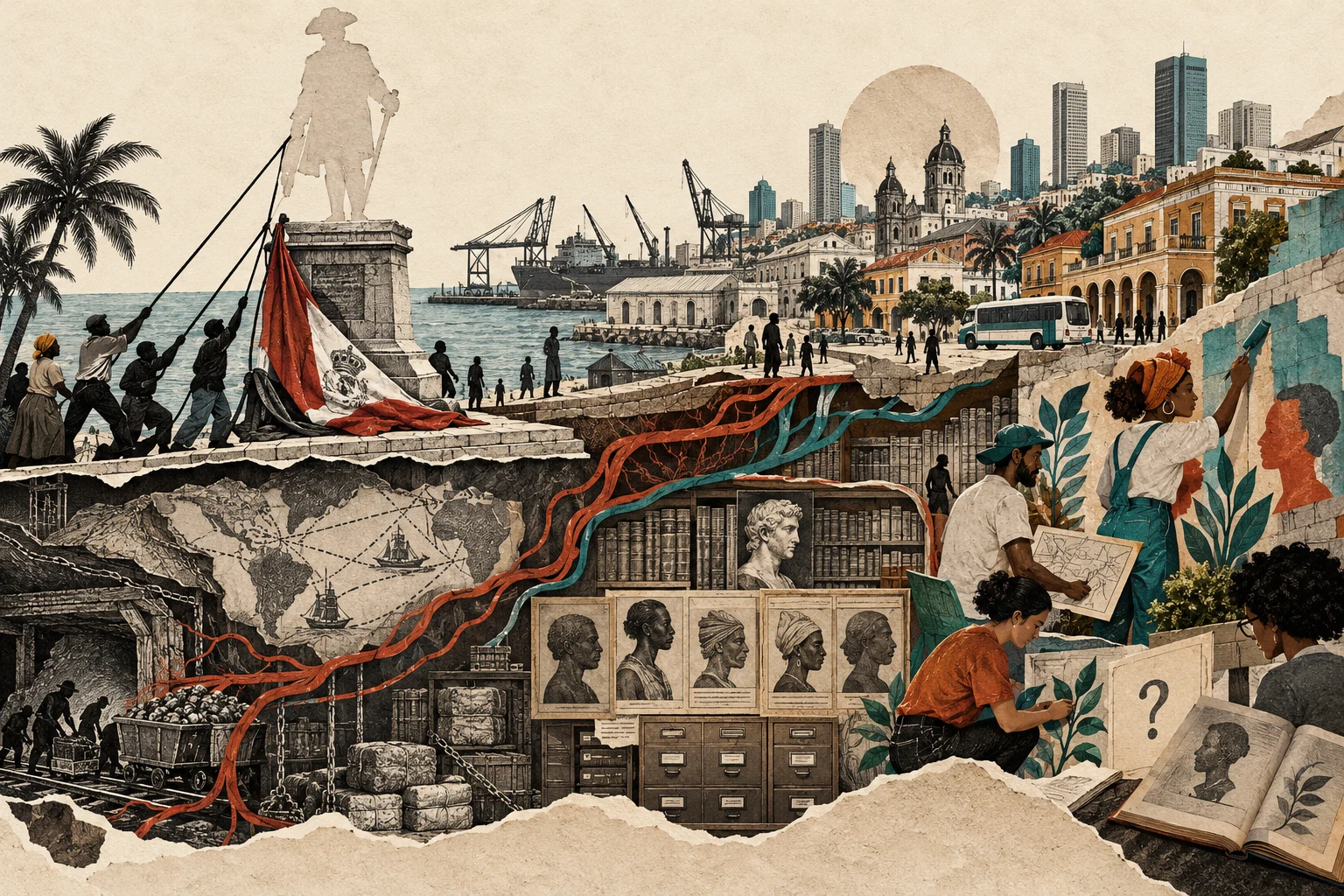
The formal end of colonial rule leaves lasting imprints on resource flows, language, and knowledge, which local actors also work to contest and reshape.
AI-assisted illustration · conceptual metaphor View in visual quiz →Genesis and Global Lineage
The field has two distinct taproots. The first is anticolonial liberation thought: writing from inside the Algerian War in Les Damnés de la terre (The Wretched of the Earth, 1961), Frantz Fanon diagnosed the psychological internalization of inferiority among the colonized and warned that the post-independence national bourgeoisie would simply step into the administrative apparatus of the departed empire without altering its extractive logic. The second is the academic turn inaugurated by Edward W. Said’s Orientalism (1978), which drew on Michel Foucault and Antonio Gramsci to show that Western scholarship on “the East” functioned as an institution of imperial domination rather than neutral description. In the 1980s and 1990s poststructuralist and historical extensions multiplied: Gayatri Chakravorty Spivak asked Can the Subaltern Speak? (1988), Homi Bhabha theorized colonial mimicry and hybridity (1994), and the Indian Subaltern Studies collective rewrote South Asian history from below. Simultaneously in Latin America, the Peruvian sociologist Aníbal Quijano developed the concept of the “coloniality of power” (colonialidad del poder, synthesized in 2000), arguing that race was invented during the conquest of the Americas to organize a global division of labor that outlived formal Spanish and Portuguese rule. From Quijano’s line grew the “decolonial option” (Walter Mignolo, María Lugones), which faulted Anglo-American postcolonial studies for being overly literary and tied to the British and French empires.
Central European Lineage
Central and Eastern Europe enters postcolonial scholarship not as the birthplace of the theory, but as a contested borderland case that tests its conceptual limits. In a landmark 2001 PMLA essay (Is the Post- in Postcolonial the Post- in Post-Soviet?), David Chioni Moore pointed out that Western postcolonial studies almost completely ignored the post-Soviet sphere, even though Imperial Russia and the USSR had ruled the Caucasus, Central Asia, the Baltic states, Ukraine, and Central Europe for anywhere from fifty to two hundred years; he called for a genuinely global postcolonial critique that does not treat overseas maritime colonization as the sole model. A year earlier, Ewa M. Thompson—educated at the University of Warsaw (1963) before becoming a professor of Slavic studies at Rice University—published Imperial Knowledge: Russian Literature and Colonialism (2000; published the same year in Kraków by Universitas as Trubadurzy imperium), reading the nineteenth- and twentieth-century Russian literary canon through Said’s lens as an instrument of imperial self-justification. A sharp counterpoint came from Sofia University historian Maria Todorova: in Imagining the Balkans (1997) and a 2007 methodological essay, she distinguished “Balkanism” from Said’s Orientalism, arguing that because the Balkans and Eastern Europe are treated as an incomplete semi-periphery inside Europe rather than an exotic racial Other across an ocean, neither the Ottoman Empire nor the USSR fits the strict colonial paradigm.
Documented regional lineage · Links: 3. Compiled: October 2026.
-
historical experience 10 years
Central European Source: Rządy imperium rosyjskiego i Związku Sowieckiego nad krajami bałtyckimi, Polską, Ukrainą i resztą regionu, zakończone w latach 1989–1991 — Panowanie Rosji i ZSRR nad Europą Środkowo-Wschodnią; Warsaw, Poland; Vilnius, Lithuania; Riga, Latvia; Kyiv, Ukraine, 1991
Global Circulation: global postcolonial critique encompassing the post-Soviet space — David Chioni Moore, 2001
-
counterpoint 19 years — regional source later than global formulation
Central European Source: Maria Todorova, “Imagining the Balkans”; Sofia, Bulgaria, 1997
Global Circulation: Orientalism — Edward W. Said, 1978
-
historical experience 0 years — same text on both sides
Central European Source: Ewa M. Thompson, “Imperial Knowledge: Russian Literature and Colonialism”; Warsaw, Poland (formation; the book was written in Houston, Texas), 2000
Global Circulation: postcolonial reading of the Russian Empire — Ewa M. Thompson, 2000
historical experience
10 yearsRządy imperium rosyjskiego i Związku Sowieckiego nad krajami bałtyckimi, Polską, Ukrainą i resztą regionu, zakończone w latach 1989–1991 — Panowanie Rosji i ZSRR nad Europą Środkowo-Wschodnią
1991 · Warsaw, Poland; Vilnius, Lithuania; Riga, Latvia; Kyiv, Ukraine
global postcolonial critique encompassing the post-Soviet space
2001 · David Chioni Moore
- Claim & Connection
- In a 2001 PMLA article, David Chioni Moore observes that postcolonial studies almost entirely overlook the post-Soviet sphere—even though Russia and the USSR ruled the Caucasus, Central Asia, the Baltic states, and Central and Eastern Europe for anywhere from fifty to two hundred years—and calls for a “truly global postcolonial critique” that does not treat Western European overseas colonization as the sole template. The region’s historical experience thus serves as a test case for the boundaries of the concept.
- Source Documentation
-
- reception / translation David Chioni Moore, „Is the Post- in Postcolonial the Post- in Post-Soviet? Toward a Global Postcolonial Critique”, PMLA, Vol. 116, No. 1, 2001, s. 111–128; abstract and main thesis of the article (DOI 10.1632/pmla.2001.116.1.111). cambridge.org ↗
- Historical Context
- The year 1991 marks the dissolution of the USSR, i.e., the end of the historical experience described; Moore speaks of a period ranging from fifty to two hundred years without a single start date. Russia and the USSR belong to the region’s neighborhood; the link concerns the core countries of Central and Eastern Europe as the subordinated side.
historical experience
0 years — same text on both sidesEwa M. Thompson, “Imperial Knowledge: Russian Literature and Colonialism”
2000 · Warsaw, Poland (formation; the book was written in Houston, Texas)
postcolonial reading of the Russian Empire
2000 · Ewa M. Thompson
- Claim & Connection
- Ewa M. Thompson, a graduate in Russian and English philology from the University of Warsaw (1963), applied the apparatus of postcolonial critique in her 2000 monograph to Russian literature as an imperial literature. The book appeared in Polish in the same year as “Trubadurzy imperium” (Troubadours of Empire).
- Source Documentation
-
- biographical record Ewa Thompson, hasło w polskiej Wikipedii; biographical section: studies at the University of Warsaw (1963), PhD at Vanderbilt (1967); bibliography: “Trubadurzy imperium. Literatura rosyjska i kolonializm”, trans. Anna Sierszulska, Universitas, Kraków 2000. pl.wikipedia.org ↗
- bibliographic record Rice University, profil Ewy M. Thompson, Professor Emerita of Slavic Studies; book list: Imperial Knowledge (2000). profiles.rice.edu ↗
- bibliographic record Biblioteka Narodowa, rekordy: Ewa M. Thompson, „Imperial Knowledge: Russian Literature and Colonialism”, London; Westport, Conn.: Greenwood Press, 2000; „Trubadurzy imperium. Literatura rosyjska i kolonializm”, przekł. Anna Sierszulska, Kraków: Universitas, cop. 2000 (tyt. oryg.: Imperial knowledge, 2000); MARC fields 245, 246, 260 of both records. data.bn.org.pl ↗
- Historical Context
- Verification 2026-10: postcolonial readings of Ukrainian culture had been published earlier by Marko Pavlyshyn (1992, Australian Slavonic and East European Studies 6, no. 2), so priority is not claimed. Regional formation: studies at the University of Warsaw (1963); the book was written in the US.
counterpoint
19 years — regional source later than global formulationMaria Todorova, “Imagining the Balkans”
1997 · Sofia, Bulgaria
Orientalism
1978 · Edward W. Said
- Claim & Connection
- Maria Todorova, educated at Sofia University (PhD 1977), took Said as her point of departure to describe “Balkanism” as a distinct discourse about a region that is geographically and historically part of Europe rather than its exotic external Other, showing why the colony–metropole schema does not map directly onto Europe’s semi-peripheries.
- Source Documentation
-
- biographical record Maria Todorova, hasło w angielskiej Wikipedii; education: history and English studies at Sofia University, PhD 1977; Imagining the Balkans, Oxford University Press, New York 1997; relation to Said and “nesting orientalisms”. en.wikipedia.org ↗
- bibliographic record Maria Todorova, hasło w polskiej Wikipedii; Polish edition: “Bałkany wyobrażone”, trans. Piotr Szymor, Magdalena Budzińska, Czarne, Wołowiec 2008. pl.wikipedia.org ↗
- primary source Maria Todorova, „Balkanizem in postkolonializem: O lepoti pogleda z letala” (Balkanism and postcolonialism, or On the Beauty of the Airplane View), Zgodovinski časopis 61, 2007, nr 1–2 (135), s. 141–155; English abstract, p. 141: methodological parallels and differences between Balkanism and Orientalism; reservations about applying postcolonialism because the author considers neither the Ottoman Empire nor the USSR in relation to Eastern Europe to be colonial empires. ojs.inz.si ↗
- Historical Context
- Bulgaria belongs to the region’s neighborhood (the Balkans); the link is included because the debate over whether Orientalism and postcolonialism apply to Central and Eastern Europe uses her terms. Verification 2026-10: Todorova’s 2007 article explicitly confirms her objection to transferring the postcolonial paradigm to the Balkans and Eastern Europe.
Why Now
Three sequences of events between 2018 and 2026 thrust postcolonial categories into the center of public politics. First, museum restitution moved from seminar rooms to state treaties: Felwine Sarr and Bénédicte Savoy’s November 2018 report to the French president recommended the permanent return of African cultural heritage, and in 2021–2022 Germany and Nigeria signed agreements transferring ownership of the Benin Bronzes. Second, in the summer of 2020 following the murder of George Floyd, protesters in Bristol toppled the statue of slave trader Edward Colston, sparking fierce disputes across Europe and North America over monuments, street names, and university curricula. Third, Russia’s full-scale invasion of Ukraine in February 2022 triggered an international wave of calls to “decolonize” Slavic and Russian studies: Moore’s and Thompson’s questions from two decades earlier suddenly became urgent decisions about university chairs, museum labels, and literary canons from Kyiv and Vilnius to Warsaw, London, and New York. Meanwhile, intense debates over whether postcolonial frameworks clarify or distort the Middle East conflict after October 7, 2023 brought the field’s foundational assumptions under fresh scrutiny.
Explanatory Power
The concept makes visible forms of structural dependence that never appear on a political map of sovereign states. First, in post-independence statehood: borders drawn by European powers in Africa and the Middle East still determine fault lines of civil war, while the language of the former metropole remains the gatekeeper of higher education, law, and administration. Second, in global supply chains: the pattern in which raw critical minerals or coffee beans come from the Global South while patents, branding, and high-margin value capture stay in the Global North reproduces the exact division of labor that Quijano termed the coloniality of power. Third, in Central and Eastern Europe’s layered history: Polish debates over whether the country was a victim of imperial colonization (during the Partitions of 1772–1918 and later under Soviet domination in the PRL) or itself a colonizing hegemon in its eastern borderlands (Kresy—vis-à-vis Ukrainian, Belarusian, and Lithuanian peasants) become legible through postcolonial theory as a classic case of a subordinated elite that simultaneously ruled over its own subalterns. Without this framework, such disputes collapse into competing national martyrologies.
Axes of Debate
Is the post-Soviet and Central European space genuinely postcolonial?
Scholars such as Ewa Thompson, David Chioni Moore, and in Poland Dariusz Skórczewski and Dorota Kołodziejczyk argue that Russian and Soviet domination meets the core criteria of colonialism (forced linguistic assimilation, economic subordination, erasure of local history), and that Western theory ignored the region out of maritime bias and Cold War blind spots toward the Second World. On the other side, historians such as Maria Todorova warn that applying postcolonialism to white, Christian European societies erases the constitutive role of racial hierarchy and easily degenerates into nationalist self-victimization. Strongest counterargument: Aníbal Quijano anchors coloniality explicitly in racial classification forged during the conquest of the Americas; if race is constitutive of the concept rather than optional, then Central Europe was an imperial province or semi-periphery (in Immanuel Wallerstein’s sense) rather than a colony, and needs its own analytical terms. Nature of the dispute: substantive — it concerns the defining core of the concept (whether racialized overseas rule is necessary, or whether contiguous continental empire with cultural erasure suffices).
Marxist materialism versus cultural discourse (Ahmad, Chibber versus Said, Chakrabarty)
Marxist critics from Aijaz Ahmad (In Theory, 1992) to Vivek Chibber (Postcolonial Theory and the Specter of Capital, 2013) charge that postcolonial studies replaced the political economy of capitalism with textual analysis and rejected universal categories (class, material interest, Enlightenment rationality) in the name of cultural “difference,” thereby depriving the Global South of a shared language of emancipation. Strongest counterargument: Dipesh Chakrabarty replies in Provincializing Europe (2000) that European Enlightenment categories are simultaneously “indispensable and inadequate” for non-Western histories: one cannot think modern politics without them, yet treating them as neutral universals automatically turns every non-European society into a story of historical lag and incompleteness. Nature of the dispute: mixed — the methodological disagreement over political economy versus discourse analysis is substantive, though polemics on both sides often target caricatures.
Analytical method versus institutional orthodoxy
Liberal and conservative critics (such as political scientist Bruce Gilley, whose controversial 2017 article “The Case for Colonialism” was withdrawn after intense protests) argue that postcolonialism has become an unfalsifiable campus orthodoxy that forbids empirical cost–benefit comparisons of imperial rule and reduces all Western institutions to original sin. Strongest counterargument: Defenders of the field reply that Said’s and Spivak’s foundational texts were exercises in rigorous archival and philological criticism rather than moralistic slogan-shouting, and that vulgarized checklist uses of “decolonization” in university administration are regularly criticized by postcolonial scholars themselves. Nature of the dispute: rhetorical — public clashes over museum labels and reading lists are driven largely by domestic culture-war positioning rather than empirical historiography.
Underappreciated Angle
The least theorized figure in global postcolonial studies is the subordinated actor who simultaneously rules over others. Central and Eastern Europe supplies historical material that the classic Anglo-French maritime canon lacks: the nobility of the Polish-Lithuanian Commonwealth was at once a colonized elite under Russian Partition and a landlord class ruling over Ukrainian and Belarusian peasantry; nineteenth-century Hungarian elites were simultaneously resistors against Habsburg Vienna and assimilators of Slovaks and Romanians; Baltic cities experienced layered German and Russian imperial hierarchies. This tiered structure—which Milica Bakić-Hayden called “nesting orientalisms” and Todorova analyzed as Balkanism—breaks the binary of metropole versus colony and suggests that coloniality operates as a continuous gradient rather than a binary border. Seen this way, global postcolonial theory needs the Central European case more than Central Europe needs an imported label: without intermediate, semi-peripheral cases, the field remains trapped in a two-color map that describes fewer and fewer power relations in the twenty-first century.
One-Sentence Takeaway
An empire can collapse overnight while coloniality endures in grammar, canons, and the global division of labor—and Central Europe is the borderland case that tests where this concept stops working.
Related Concepts Network
How this concept reinforces, constrains, or complements other analytical frameworks in the corpus. View on graph →
-
Epistemic violence reinforces
Spivak’s concept names the epistemic dimension of coloniality: empire decided what counted as knowledge in the colonies, and that division persists after political decolonization.
-
Cultural hegemony complements
Said drew directly on Gramsci: Orientalism is a form of hegemony that produces consent to domination through scholarship and representation rather than force alone.
-
Epistemic injustice complements
The credibility deficit assigned to speakers from former colonies is the interpersonal face of the hierarchy that postcolonialism analyzes at the level of global structures.
-
Biopolitics complements
Mbembe’s necropolitics grows out of reading Foucault through colonial experience: sovereignty in the colonies consisted in deciding who may be left to die.
-
Intersectionality complements
According to Quijano, race as an axis of social classification was invented during the colonial conquest of the Americas, giving intersectionality its deep historical genealogy.
-
Path dependence reinforces
The thesis that “coloniality endures” is at bottom a claim about path dependence: institutions, languages, and borders established under imperial rule reproduce themselves long after empire ends.
-
Climate justice reinforces
Because the distribution of historical emissions and current climate damages tracks the map of former empires, debates over climate responsibility rely heavily on postcolonial categories.
Reading Canon & Translation Bridge
Foundational texts, introductions, and critical perspectives—with availability of English and Polish editions.
-
foundational text 1978 · English
Edward W. Said, Orientalism
The foundational text: demonstrates how Western scholarship on “the Orient” functioned as an institution of power, giving the entire field its method for reading the imperial archive.
In English: original text written in English
In Polish: “Orientalizm”, Państwowy Instytut Wydawniczy 1991, trans. Witold Kalinowski
-
foundational text 1961 · French
Frantz Fanon, Les Damnés de la terre
The anticolonial taproot of the field, written from inside the Algerian War: on violence, the psychology of the colonized, and the pitfalls of the national bourgeoisie after independence.
In English: English edition not verified
In Polish: “Wyklęty lud ziemi”, Państwowy Instytut Wydawniczy 1985, trans. Hanna Tygielska
-
foundational text 1988 · English
Gayatri Chakravorty Spivak, Can the Subaltern Speak?
The essay that placed representation at the center of the field: who speaks on behalf of the subaltern, and what is erased when Western theory speaks for them.
In English: original text written in English
In Polish: “Czy podporządkowani inni mogą przemówić?”, Krytyka Polityczna (nr 24/25, s. 196–239) 2010, trans. Ewa Majewska
-
foundational text 2000 · Spanish
Aníbal Quijano, Colonialidad del poder, eurocentrismo y América Latina
The fullest exposition of the “coloniality of power,” developed by Quijano since the early 1990s: race as a colonial classification invention that outlived formal empires and still organizes the global division of labor.
In English: “Coloniality of Power, Eurocentrism, and Latin America”, Duke University Press („Nepantla: Views from South” 1, nr 3, s. 533–580) 2000, trans. Michael Ennis
In Polish: Polish edition not verified
-
introduction & synthesis 1998 · English
Leela Gandhi, Postcolonial Theory: A Critical Introduction
A concise introduction that maps the tension between the Marxist and poststructuralist wings of the field without flattening either.
In English: original text written in English
In Polish: Polish edition not verified
-
critical perspective 2000 · English
Dipesh Chakrabarty, Provincializing Europe: Postcolonial Thought and Historical Difference
A critique from within: European categories of political modernity are simultaneously “indispensable and inadequate,” a dilemma solved neither by simple rejection nor by uncritical adoption.
In English: original text written in English
In Polish: Polish edition not verified
-
critical perspective 2000 · English
Ewa M. Thompson, Imperial Knowledge: Russian Literature and Colonialism
Transfers Said’s method to the Russian Empire while faulting Western postcolonial studies for seeing only overseas colonialism; a major point of departure for Polish postcolonial debates.
In English: original text written in English
In Polish: “Trubadurzy imperium. Literatura rosyjska i kolonializm”, Universitas 2000, trans. Anna Sierszulska
-
cross-disciplinary 1997 · English
Maria Todorova, Imagining the Balkans
A historian demonstrates how discourse about the Balkans differs from Orientalism and why Europe’s semi-peripheries require their own analytical categories.
In English: original text written in English
In Polish: “Bałkany wyobrażone”, Czarne 2008, trans. Piotr Szymor, Magdalena Budzińska