Culture & Power #145
Intersectionality
original term: intersectionality (Eng.) · krzyżowe kategorie dyskryminacji, dyskryminacja wielokrotna, intersekcjonalizm
Global-circulation concept — no documented lineage in Central Europe. jump to documentation ↓
Working Definition
Intersectionality is the proposition that categories of social location—gender, race, class, disability, sexual orientation, age—do not operate as separate, additive burdens, but interact to produce distinct structural positions whose logic cannot be reconstructed by analyzing each axis in isolation. In its technical sense, originating in US antidiscrimination law, it is a critique of “single-axis” legal procedures: if a plaintiff must file a claim either on the basis of sex or on the basis of race, a person discriminated against specifically as a Black woman loses both tests. In popular usage, the term refers more loosely to the norm of taking multiple identities into account at once or serves as a label for a style of progressive politics. The difference is crucial: the technical version formulates a testable hypothesis about the structure of discrimination, whereas the popular version is a declaration of moral sensibility.
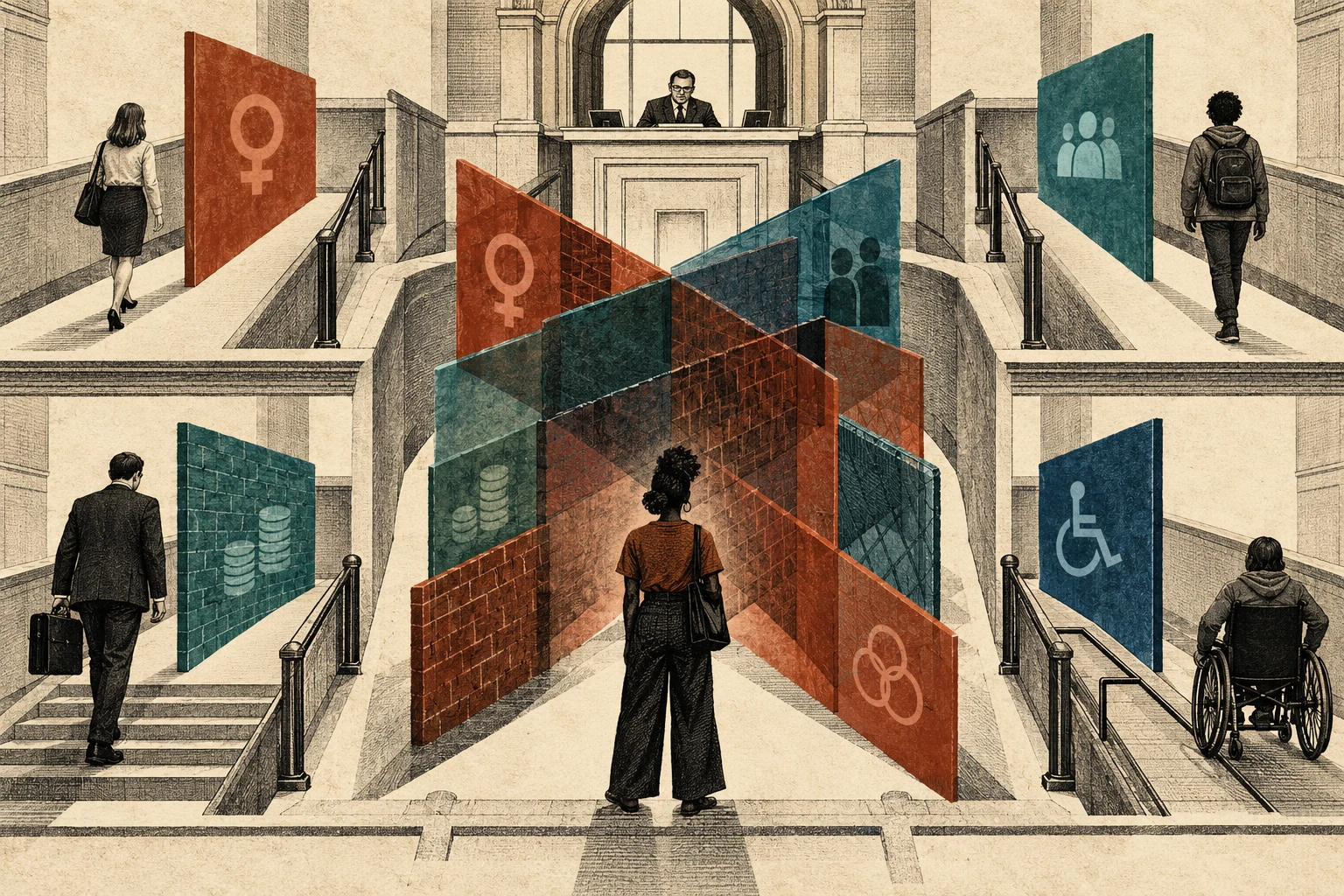
Intersecting barriers create a specific experience of exclusion that cannot be captured by analyzing each axis separately and simply adding the effects together.
AI-assisted illustration · conceptual metaphor View in visual quiz →Genesis and Global Lineage
The term was coined by the legal scholar Kimberlé Crenshaw—educated at Cornell, Harvard Law School, and the University of Wisconsin, and a professor at UCLA and Columbia—in her 1989 article Demarginalizing the Intersection of Race and Sex. Her point of departure was a series of federal employment-discrimination cases, most notably DeGraffenreid v. General Motors (1976), in which courts dismissed claims brought by Black women because the company hired both women (whowere white) and Black workers (who were men). Crenshaw’s metaphor of a traffic intersection, where an accident can be caused by cars traveling from several directions at once, was designed to expose an evidentiary blind spot in legal doctrine rather than to build a general theory of identity. In Mapping the Margins (1991), she extended the analysis across structural, political, and representational dimensions using fieldwork on domestic-violence shelters. The concept’s deeper lineage reaches back to nineteenth-century Black feminism (Sojourner Truth, Anna Julia Cooper) and the 1970s–1980s writings of the Combahee River Collective (whose 1977 manifesto spoke of “interlocking” systems of oppression), Angela Davis, bell hooks, and Patricia Hill Collins’s sociological “matrix of domination” (1990). In the 2000s the concept migrated into quantitative and qualitative sociology (Leslie McCall called it in 2005 perhaps the most important theoretical contribution of women’s studies), then into European Union and UN equality frameworks, and after 2014 into mass media, where both sides of the culture wars turned it into a political banner.
Central European Lineage
We found no documented link between this concept and the intellectual history or historical experience of Central Europe.
We found no documented link between this concept and the intellectual history or historical experience of Central Europe (by our methodology, this means “none found,” not “none exists”; as of October 2026).
Why Now
Three developments between 2018 and 2026 moved intersectionality from academic seminars into operational practice. First, audits of machine-learning systems gave the concept a crisp quantitative proof: Joy Buolamwini and Timnit Gebru’s Gender Shades study (2018) demonstrated that commercial gender-classification systems had error rates up to 34.7% for dark-skinned women compared with under 0.8% for light-skinned men, even though overall single-axis accuracy scores (87.9–93.7%) looked respectable; disaggregating error rates across intersectional subgroups has since become a standard requirement in AI auditing. Second, institutionalization advanced in European law: the European Union embedded intersectional analysis into its Gender Equality Strategy 2020–2025 and Anti-Racism Action Plan 2020–2025. Third, political backlash intensified: after 2020 in the United States—and at the federal executive level from 2025—intersectionality was placed on lists of terms stripped from government training programs and research grants, making it a primary trigger word in institutional politics. In Poland and Hungary, campaigns against “gender ideology” and the 2020 Polish debate over withdrawing from the Council of Europe’s Istanbul Convention meant that the term entered public circulation more often as a political accusation than as an analytical instrument.
Explanatory Power
The concept makes visible situations in which each variable looks benign on its own, yet their interaction produces severe exclusion. Consider the labor market: a manufacturing firm that employs many women in clerical roles and many minority men on the factory floor may employ zero minority women—and single-axis compliance statistics will report full equality on both counts. Consider public policy in Central Europe: as Angéla Kóczé’s 2009 study for the Central European University in Budapest showed, state programs for Roma targeted at “families” (implicitly represented by men) and gender-equality programs targeted at “women” (modeled on majority middle-class women) systematically bypass Romani women, whose specific barriers—school segregation, lack of healthcare access, compounded labor-market exclusion—fall between the two bureaucratic mandates. Consider clinical medicine and technology: a diagnostic algorithm that achieves 95% accuracy for women overall and 95% for older patients overall may drop to 70% accuracy for older women from an underrepresented ethnic group if they were virtually absent from the training data. Across all three domains, the underlying mechanism is identical: what econometrics calls an interaction term and epidemiology calls effect modification.
Axes of Debate
Analytical method versus political program
Patricia Hill Collins and Sirma Bilge defend the unity of theory and praxis, arguing that the concept was born in social movements and loses its critical purpose when detached from emancipatory commitment. Quantitative sociologists and legal scholars reply that unless analysis is separated from advocacy, one cannot specify when an interaction hypothesis is empirically false. Strongest counterargument: A framework that cannot be falsified—because every empirical pattern is read as confirmation of interlocking oppression—ceases to explain anything; Crenshaw herself emphasized that she was diagnosing a concrete doctrinal gap in antidiscrimination law rather than proposing a total theory of society. Nature of the dispute: substantive — it concerns whether the concept has truth conditions independent of political goals.
Which axes count, and where does class fit?
Feminist theorists (Jennifer Nash, Leslie McCall) and scholars of social class ask why the list of intersecting categories expands indefinitely and why socioeconomic class—central to the 1977 Combahee statement—has frequently been displaced in corporate and campus usage by cultural identities. Strongest counterargument: Following McCall’s intracategorical approach, relevant axes are selected relative to a specific research question rather than fixed in advance, so an open-ended list is a methodological feature rather than a flaw; the error lies only in failing to justify which variables are included in a given study. Nature of the dispute: mixed — part of the debate concerns research design, while part reflects competition within social movements over whether class or identity takes priority.
Legal universalism versus group categories
Liberal legal theorists and conservatives argue that antidiscrimination law should protect individuals equally, and that multiplying protected intersections leads to a hierarchy of victimhood and group quotas. Strongest counterargument: Crenshaw’s original argument was aimed precisely at rescuing individual justice: the concrete plaintiffs in DeGraffenreid lost their case because broad group categories (“women,” “Blacks”) were implicitly defined around their most privileged members; intersectional doctrine repairs universal protection rather than abolishing it. Nature of the dispute: rhetorical — in courtroom practice the issue concerns rules of evidence and comparator groups rather than the principle of equal treatment, even though public commentary stages it as a clash of worldviews.
Underappreciated Angle
The least discussed consequence of intersectionality is a practical problem of statistical power and data infrastructure. Every additional axis slices the sample more thinly: in a survey of a few thousand respondents, a three-way intersection of gender, age, and minority status may leave only a handful of observations, making standard confidence intervals useless. In public registries across much of Central Europe, where states historically avoid collecting racial or ethnic data out of post-1945 legal caution, intersectional disparities are formally invisible to official statistics. The exact same bottleneck governs machine learning: subgroups at the intersection of multiple minority traits are the sparsest in training corpora, causing models to fail on them most often, while privacy rules that prohibit collecting sensitive attributes prevent auditors from even measuring the error. Intersectionality is therefore not just a thesis about social power, but a sharp technical challenge to how states and digital platforms design their data infrastructure: those whom the statistical system cannot count in combination, the legal system cannot protect in practice.
One-Sentence Takeaway
At its analytical core, intersectionality is a statistical claim about the interaction of variables—one that loses its explanatory sharpness the moment it is treated as a badge of worldview rather than a testable hypothesis.
Related Concepts Network
How this concept reinforces, constrains, or complements other analytical frameworks in the corpus. View on graph →
-
Critical race theory (CRT) reinforces
Intersectionality grew out of the same Critical Race Theory milieu and provides its core tool for analyzing discrimination that cannot be seen along a single axis.
-
Epistemic injustice complements
People situated at the intersection of multiple categories often lack an established legal or public vocabulary for their experience to be recognized as discrimination.
-
Postcolonialism complements
Both frameworks ask whose lived experience is treated as the unstated norm and whose is pushed to the margins of a category.
-
DEI in tension
Corporate diversity programs adopted the vocabulary of intersectionality, but often turn an analysis of legal and institutional structures into identity checklists.
-
Culture wars in tension
In cultural conflicts the term functions as a tribal shibboleth on both sides, detached from its original evidentiary problem in antidiscrimination law.
-
Algorithmic bias reinforces
Audits of facial-recognition systems demonstrated that error rates for subgroups at the intersection of traits are far higher than the sum of errors for each trait taken separately.
-
Cultural hegemony complements
Single-axis categories in law and politics reflect the perspective of the most privileged members within each subordinated group.
Reading Canon & Translation Bridge
Foundational texts, introductions, and critical perspectives—with availability of English and Polish editions.
-
foundational text 1989 · English
Kimberlé Crenshaw, Demarginalizing the Intersection of Race and Sex: A Black Feminist Critique of Antidiscrimination Doctrine, Feminist Theory and Antiracist Politics
The University of Chicago Legal Forum article that introduced the term and analyzed employment lawsuits to show how single-axis legal doctrine erases Black women.
In English: original text written in English
In Polish: Polish edition not verified
-
foundational text 1991 · English
Kimberlé Crenshaw, Mapping the Margins: Intersectionality, Identity Politics, and Violence Against Women of Color
Expands the concept across three dimensions (structural, political, and representational) using material on violence against women; Stanford Law Review 43(6), pp. 1241–1299.
In English: original text written in English
In Polish: Polish edition not verified
-
foundational text 1977 · English
Combahee River Collective, The Combahee River Collective Statement
The Boston Black feminist manifesto on “interlocking” systems of oppression, widely recognized as the immediate intellectual precursor to the concept before the term was coined.
In English: original text written in English
In Polish: Polish edition not verified
-
introduction & synthesis 2016 · English
Patricia Hill Collins, Sirma Bilge, Intersectionality
The most systematic introduction (Polity Key Concepts series; 2nd ed. 2020), distinguishing intersectionality as an analytical lens from political praxis.
In English: original text written in English
In Polish: Polish edition not verified
-
introduction & synthesis 1990 · English
Patricia Hill Collins, Black Feminist Thought: Knowledge, Consciousness, and the Politics of Empowerment
The sociological account of the “matrix of domination” that, in parallel with Crenshaw, carried the problem from legal doctrine into social theory.
In English: original text written in English
In Polish: Polish edition not verified
-
critical perspective 2005 · English
Leslie McCall, The Complexity of Intersectionality
A landmark article in Signs distinguishing three methodological approaches (anticategorical, intracategorical, and intercategorical) and showing that without a method the concept remains a slogan.
In English: original text written in English
In Polish: Polish edition not verified
-
critical perspective 2008 · English
Jennifer C. Nash, Re-thinking Intersectionality
A critique from within Black feminism (Feminist Review 89): examines the treatment of Black women as the prototypical intersectional subject, ambiguity over whether the theory applies to everyone, and the lack of a defined methodology.
In English: original text written in English
In Polish: Polish edition not verified
-
cross-disciplinary 2009 · English
Angéla Kóczé (z udziałem Raluki Marii Popy), Missing Intersectionality: Race/Ethnicity, Gender, and Class in Current Research and Policies on Romani Women in Europe
A public-policy study (CEU Center for Policy Studies, Budapest) demonstrating what the concept changes in research and policy concerning Romani women in Central and Eastern Europe.
In English: original text written in English
In Polish: no Polish edition
Primary-Source Quotes
The most general statement of our politics at the present time would be that we are actively committed to struggling against racial, sexual, heterosexual, and class oppression, and see as our particular task the development of integrated analysis and practice based upon the fact that the major systems of oppression are interlocking.