Epistemology #014
Epistemic violence
original term: epistemic violence (Eng.) · epistemische Gewalt, przemoc poznawcza
Global-circulation concept — no documented lineage in Central Europe. jump to documentation ↓
Working Definition
Epistemic violence is harm inflicted on people specifically in their standing as subjects of knowledge: the invalidation, distortion, or wholesale erasure of their ways of knowing, conceptual categories, and testimony by an apparatus that holds the power to decide what counts as knowledge in the first place. In Gayatri Chakravorty Spivak's foundational postcolonial formulation (1988), it is a macro-structural process whereby imperial law, science, and education constitute the colonized population as an “Other” while obliterating their own frameworks, leaving the subaltern unable to speak in terms that the ruling archive can register. In philosopher Kristie Dotson's analytic formulation (2011), it is an identifiable interpersonal and institutional practice: a hearer, owing to pernicious ignorance, fails to meet the communicative vulnerability of a speaker in a linguistic exchange. In everyday polemics the phrase is often flattened into a synonym for any hostile disagreement or “silencing,” which blurs the crucial distinction between structural erasure and ordinary debate.
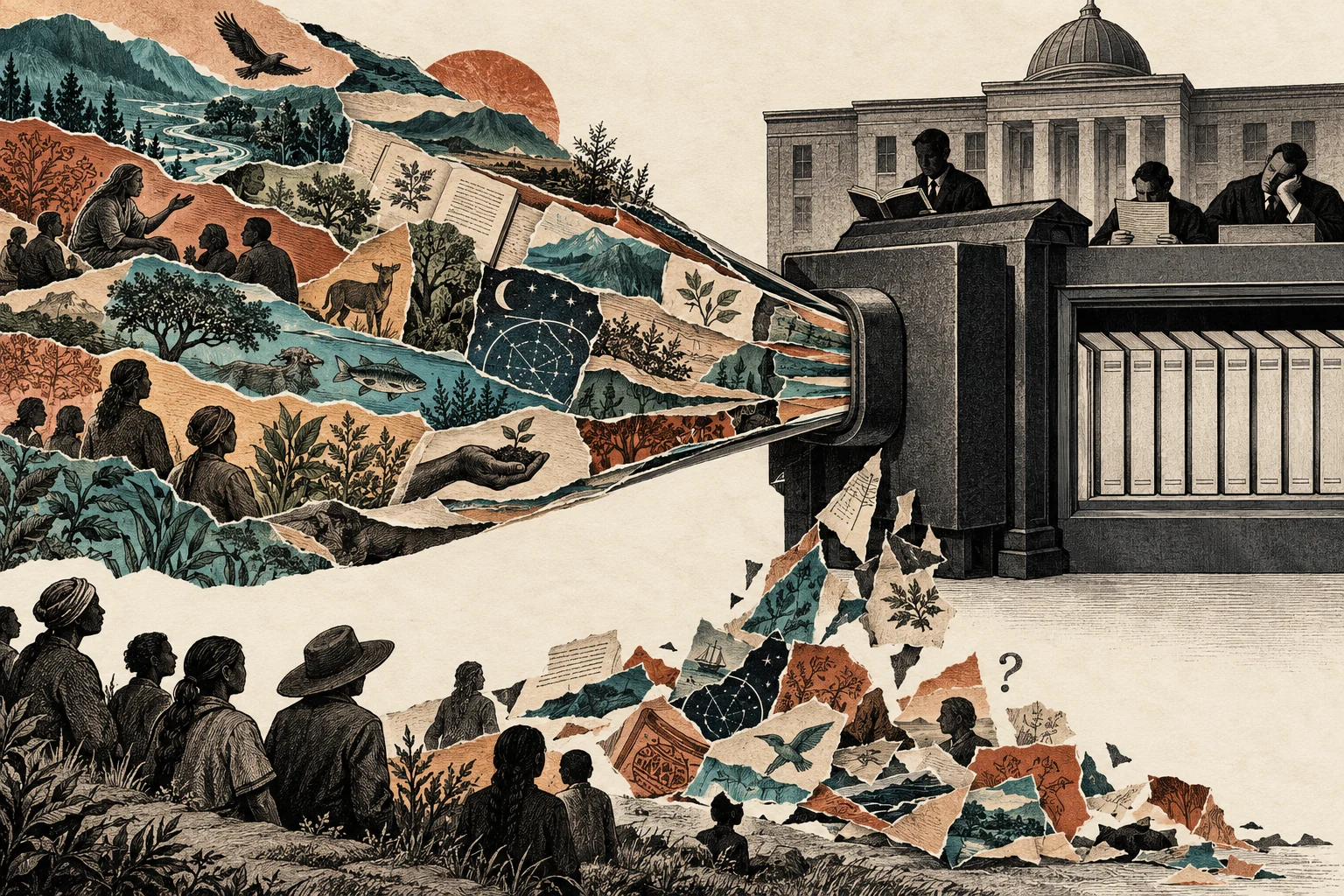
The official template recognizes only part of existing knowledge. What does not fit loses its place in the recognized archive.
AI-assisted illustration · conceptual metaphor View in visual quiz →Genesis and Global Lineage
The concept was forged by Indian literary theorist Gayatri Chakravorty Spivak in her lecture “Can the Subaltern Speak?”, first delivered at the University of Illinois in the summer of 1983, published in early form in Wedge (1985), and canonized in Marxism and the Interpretation of Culture (1988). Spivak adapted Michel Foucault's remark on the “epistemic violence” of the late-eighteenth-century European redefinition of madness and redirected it at the British Empire in India: the colonial codification of plural, local Hindu legal customs into a single rigid textual canon, Thomas Babington Macaulay's 1835 Minute on Indian Education (aimed at forming a class of intermediaries “Indian in blood and colour, but English in taste, in opinions, in morals, and in intellect”), and the colonial debate over sati (widow immolation), in which the voice of the woman herself disappears between two patriarchal scripts—“white men saving brown women from brown men” and nativist traditionalists claiming “the women actually wanted to die.” Her theoretical synthesis drew on Edward Said's Orientalism (1978), Ranajit Guha's Subaltern Studies collective, Jacques Derrida's deconstruction, and Antonio Gramsci's concept of the subaltern. A second major lineage opened in 2011 when Kristie Dotson brought epistemic violence into analytic feminist epistemology (Hypatia 26/2) alongside Miranda Fricker's epistemic injustice (2007), while Latin American decolonial thinkers (Aníbal Quijano, Walter Mignolo), Portuguese sociologist Boaventura de Sousa Santos (epistemicide, 2014), and Austrian peace researcher Claudia Brunner (Epistemische Gewalt, 2020) expanded the term to analyze the global hierarchy of academic and indigenous knowledge systems.
Central European Lineage
We found no documented link between this concept and the intellectual history or historical experience of Central Europe.
We found no documented link between this concept and the intellectual history or historical experience of Central Europe (by our methodology, this means “none found,” not “none exists”; as of October 2026).
Why Now
Between 2018 and 2026 three overlapping waves pushed epistemic violence from postcolonial theory seminars into institutional policy and geopolitical debate. First, inside universities and museums: following the Rhodes Must Fall movement (2015) and the November 2018 Sarr–Savoy report on the restitution of African cultural heritage commissioned by the French presidency, conflicts over colonial legacies shifted from physical monuments to syllabi, archival classifications, and provenance research—turning “decolonizing the curriculum” into formal university policy. Second, in artificial intelligence: Shakir Mohamed, Marie-Therese Png, and William Isaac formulated the program of Decolonial AI (Philosophy & Technology, 2020), pointing out that large language models and computer-vision systems trained overwhelmingly on English and high-resource Western datasets encode one cultural episteme as the universal human default while treating low-resource languages and local ontologies as statistical noise. Third, in Slavic and East European studies: Russia's full-scale invasion of Ukraine in February 2022 triggered a fierce reckoning over how Western academic curricula and security think tanks had for decades centered Moscow's imperial perspective while marginalizing Ukrainian, Baltic, Polish, and Caucasian scholarship (a dynamic Ewa Thompson had diagnosed in Imperial Knowledge in 2000 and Jan Smoleński and Jan Dutkiewicz dubbed westsplaining in March 2022), culminating in the Association for Slavic, East European, and Eurasian Studies (ASEEES) making “Decolonization” the official theme of its 2023 annual convention.
Explanatory Power
The concept makes visible a form of harm that occurs even when nobody tells a lie and nobody is physically gagged: the harm consists in organizing the rules of admissibility so that certain testimonies cannot register as knowledge at all. Consider three concrete settings. First, in colonial legal history: when British administrators in Bengal translated Sanskrit treatises to create “Anglo-Hindu law,” they did not simply ban local custom—they replaced a fluid, oral, regionally varied practice with a frozen textual code and then enforced that colonial reconstruction as the natives' “authentic” tradition. Second, in clinical medicine and empirical psychology (where Thomas Teo introduced the concept in 2010): when statistical differences between dominant and marginalized groups are interpreted by researchers as proof of intrinsic deficit in the marginalized group without examining structural confounders, or when a patient's pain report is preemptively filed under “somatization,” the speaker's words are heard acoustically but stripped of evidential standing—Dotson's testimonial quieting. Third, in data governance and AI: when a global health index or a foundation model adopts categories designed in California as universal, ways of life that do not fit the schema vanish into “missing data,” showing that absence from a dataset is rarely a neutral accident, but the downstream result of an earlier decision about what was worth measuring.
Axes of Debate
Macro-structure versus interpersonal act: Spivak versus Dotson
Postcolonial and decolonial theorists (Spivak, Brunner, Santos) treat epistemic violence as a structural property of an entire modern/colonial episteme (archives, legal codes, disciplinary canons) that no well-meaning individual listener can fix on their own; Kristie Dotson and analytic social epistemologists locate it in specific communicative exchanges where a hearer's pernicious ignorance causes a speaker to be ignored (quieting) or to self-censor (smothering). Strongest counterargument: A purely macro-structural account risks making every conceptual framework guilty of “violence” by definition whenever it selects some features of reality over others, losing the ability to distinguish imperial erasure from ordinary scientific abstraction; conversely, a purely interpersonal account misses how institutional training manufactures the hearer's ignorance in the first place. Nature of the dispute: substantive — it concerns the proper unit of analysis and where moral and institutional responsibility can be assigned.
Whether “violence” is the right concept
Liberal and analytic critics—including many philosophers who prefer Miranda Fricker's term epistemic injustice—argue that stretching the word violence to cover syllabus choices, peer-review rejections, or conceptual blind spots exemplifies “concept creep” (Nick Haslam, 2016), eroding the crucial moral and legal boundary between physical coercion and verbal disagreement and supplying a pretext to shut down uncomfortable inquiry under the slogan “speech is violence.” Strongest counterargument: Defenders of the term (Spivak, Dotson, Claudia Brunner drawing on Johan Galtung's theory of structural and cultural violence) reply that the word is not a loose metaphor: the systematic destruction of a community's language, legal standing, medical knowledge, and historical archive produces enduring material harm and legitimizes physical domination, and insisting that “violence” means only a blow to the body conveniently insulates those who rule through classification and law. Nature of the dispute: mixed — a substantive philosophical disagreement over narrow versus structural definitions of violence is entangled with campus and media battles over free speech.
Decolonizing knowledge versus agency and universal science
African political philosopher Olúfẹ́mi Táíwò (Against Decolonisation: Taking African Agency Seriously, 2022) and sociologist Vivek Chibber argue that sweeping calls to reject “Western epistemologies” as epistemic violence ironically infantalize post-independence African and Asian thinkers who deliberately appropriated, debated, and contributed to modern science, constitutional law, and Marxism on their own terms. Strongest counterargument: Boaventura de Sousa Santos and decolonial scholars reply that questioning the colonial history of academic canons does not mean rejecting the periodic table or germ theory, but ending the monocultural assumption that European social and historical categories are automatically universal without testing them against local realities (an ecology of knowledges). Nature of the dispute: substantive — it is decided case by case across specific disciplines (historiography and literary canons versus mathematics and medicine) rather than by grand manifestos.
Underappreciated Angle
The most subversive move in Spivak's “Can the Subaltern Speak?” is not her indictment of the British Empire, but her opening critique of her own radical Western allies—Michel Foucault and Gilles Deleuze—who had proclaimed in a famous 1972 conversation that “the masses know perfectly well, clearly” and can speak for themselves, so the radical intellectual need only step aside and let them talk. Spivak shows that this posture of self-effacing transparency is itself a subtle form of epistemic violence: by pretending to be a neutral microphone that merely “gives voice” to the oppressed, the metropolitan intellectual conceals their own institutional power in selecting who counts as an authentic representative and translating their speech into categories palatable to Western audiences. That critique carries a sharp, uncomfortable lesson for contemporary diversity, inclusion, and “participatory AI” initiatives: simply inviting a marginalized speaker onto a panel or adding a token dataset does not end epistemic violence if the underlying grid of concepts, incentives, and admissibility rules remains untouched. When speech is heard only on condition that it confirms what the host institution already expects an “authentic Other” to say, representation becomes the final stage of erasure rather than its cure.
One-Sentence Takeaway
Epistemic violence does not consist in taping someone's mouth shut, but in pre-arranging the rules of knowledge so that what they say cannot register as rational evidence—which is why merely “giving voice” without changing the frame leaves the silencing intact.
Related Concepts Network
How this concept reinforces, constrains, or complements other analytical frameworks in the corpus. View on graph →
-
Epistemic injustice complements
Kristie Dotson proposes epistemic violence as a broader alternative to Miranda Fricker's epistemic injustice: rather than focusing on a localized credibility deficit, it diagnoses a hearer's pernicious ignorance that prevents linguistic reciprocity altogether.
-
Postcolonialism reinforces
Born inside postcolonial critique, the concept names its central thesis: empire did not merely rule over bodies and territory, but legislated what counted as legitimate knowledge in the colonies.
-
Cultural hegemony complements
Gramscian hegemony describes how ruling groups manufacture consent among the subordinated, whereas epistemic violence describes the erasure of their conceptual categories; Spivak takes the term “subaltern” directly from Gramsci via Ranajit Guha.
-
Legibility complements
James C. Scott's account of high-modernist state simplification destroying local practical knowledge (mētis) in the name of administrative legibility is the domestic, bureaucratic cousin of imperial epistemic violence.
-
Algorithmic bias reinforces
Training corpora and classification ontologies decide whose experience is encoded as the “default” human baseline and whose becomes missing data, scaling epistemic violence into digital infrastructure.
-
Epistemic humility complements
Epistemic humility is the standard corrective proposed at the level of the individual listener, though it cannot by itself dismantle the institutional archives and legal codes that Spivak analyzes.
-
Cancel culture in tension
In contemporary campus and media controversies the phrase is sometimes deployed as a conversation-ending accusation, which critics cite as concept creep and defenders view as resistance to ongoing silencing.
Reading Canon & Translation Bridge
Foundational texts, introductions, and critical perspectives—with availability of English and Polish editions.
-
foundational text 1988 · English
Gayatri Chakravorty Spivak, Can the Subaltern Speak?
The foundational essay in Marxism and the Interpretation of Culture (ed. C. Nelson and L. Grossberg, pp. 271–313): moves from a critique of Foucault and Deleuze through the British codification of Hindu law and Macaulay's 1835 Minute on Indian Education to the colonial debate over sati.
In English: original text written in English
In Polish: “Czy podporządkowani inni mogą przemówić?”, Krytyka Polityczna (nr 24–25, s. 196–239) 2010, trans. Ewa Majewska
-
foundational text 2011 · English
Kristie Dotson, Tracking Epistemic Violence, Tracking Practices of Silencing
The article in Hypatia 26(2), pp. 236–257, that brought the concept into analytic social epistemology and distinguished two mechanisms of silencing: testimonial quieting and testimonial smothering.
In English: original text written in English
In Polish: Polish edition not verified
-
introduction & synthesis 2007 · English
Miranda Fricker, Epistemic Injustice: Power and the Ethics of Knowing
The most influential neighboring framework; essential reading to understand why analytic epistemologists often speak of “injustice” where postcolonial and feminist theorists speak of “violence.”
In English: original text written in English
In Polish: no Polish edition
-
introduction & synthesis 2020 · German
Claudia Brunner, Epistemische Gewalt. Wissen und Herrschaft in der kolonialen Moderne
The most comprehensive book-length systematization of the concept (transcript Verlag, 2020, open access, DOI 10.14361/9783839451311), connecting Spivak, Dotson, Latin American decoloniality, and peace and conflict studies (Johan Galtung's structural and cultural violence).
In English: English edition not verified
In Polish: Polish edition not verified
-
foundational text 1978 · English
Edward W. Said, Orientalism
The immediate intellectual precursor: demonstrates how European philology, history, and colonial administration constructed “the Orient” as an object of authoritative knowledge in order to govern it.
In English: original text written in English
In Polish: “Orientalizm”, Zysk i S-ka 2005, trans. Monika Wyrwas-Wiśniewska
-
cross-disciplinary 2000 · English
Ewa M. Thompson, Imperial Knowledge: Russian Literature and Colonialism
Applies Said's postcolonial lens to the Russian literary canon from Pushkin and Lermontov to Tolstoy and Solzhenitsyn, showing how imperial literature naturalized Russian rule over the Caucasus, Poland, and Ukraine.
In English: original text written in English
In Polish: “Trubadurzy imperium. Literatura rosyjska i kolonializm”, Universitas 2000, trans. Anna Sierszulska
-
cross-disciplinary 2014 · English
Boaventura de Sousa Santos, Epistemologies of the South: Justice Against Epistemicide
Extends the diagnosis from speech acts to the wholesale destruction of non-Western knowledge systems (“epistemicide”) and proposes an “ecology of knowledges” in place of monocultural universalism.
In English: original text written in English
In Polish: Polish edition not verified
-
critical perspective 2022 · English
Olúfẹ́mi Táíwò, Against Decolonisation: Taking African Agency Seriously
A sharp critique of blanket “decolonization of knowledge” programs from the standpoint of African political philosophy: argues that treating every modern scientific or philosophical concept as colonial epistemic violence strips post-independence African thinkers of agency.
In English: original text written in English
In Polish: Polish edition not verified
Primary-Source Quotes
The clearest available example of such epistemic violence is the remotely orchestrated, far-flung, and heterogeneous project to constitute the colonial subject as Other. This project is also the asymmetrical obliteration of the trace of that Other in its precarious Subject-ivity.
I offer an account of epistemic violence as the failure, owing to pernicious ignorance, of hearers to meet the vulnerabilities of speakers in linguistic exchanges.