Culture & Power #146
Critical race theory (CRT)
original term: critical race theory (Eng.) · krytyczna teoria rasy, teoria krytyczna rasy, rasizm systemowy
Global-circulation concept — no documented lineage in Central Europe. jump to documentation ↓
Working Definition
Critical race theory (CRT) is a movement in American legal scholarship that examines how race and racism are produced, maintained, and masked by law and formally neutral institutions. Its core working propositions are: race is a social and legal construction rather than a biological fact; racism is “ordinary”—built into the routine operation of rules rather than an aberration caused by individual prejudice; formal equality before the law (“color-blindness”) can lock in substantive material inequality; and major civil-rights advances occur when they converge with the strategic interests of the dominant majority. In popular political usage since 2020, the acronym CRT has been stretched to cover almost any discussion of race in schools or corporate trainings; in its technical sense, it refers to a specific corpus of legal texts written between 1976 and 1995 and their scholarly continuations.
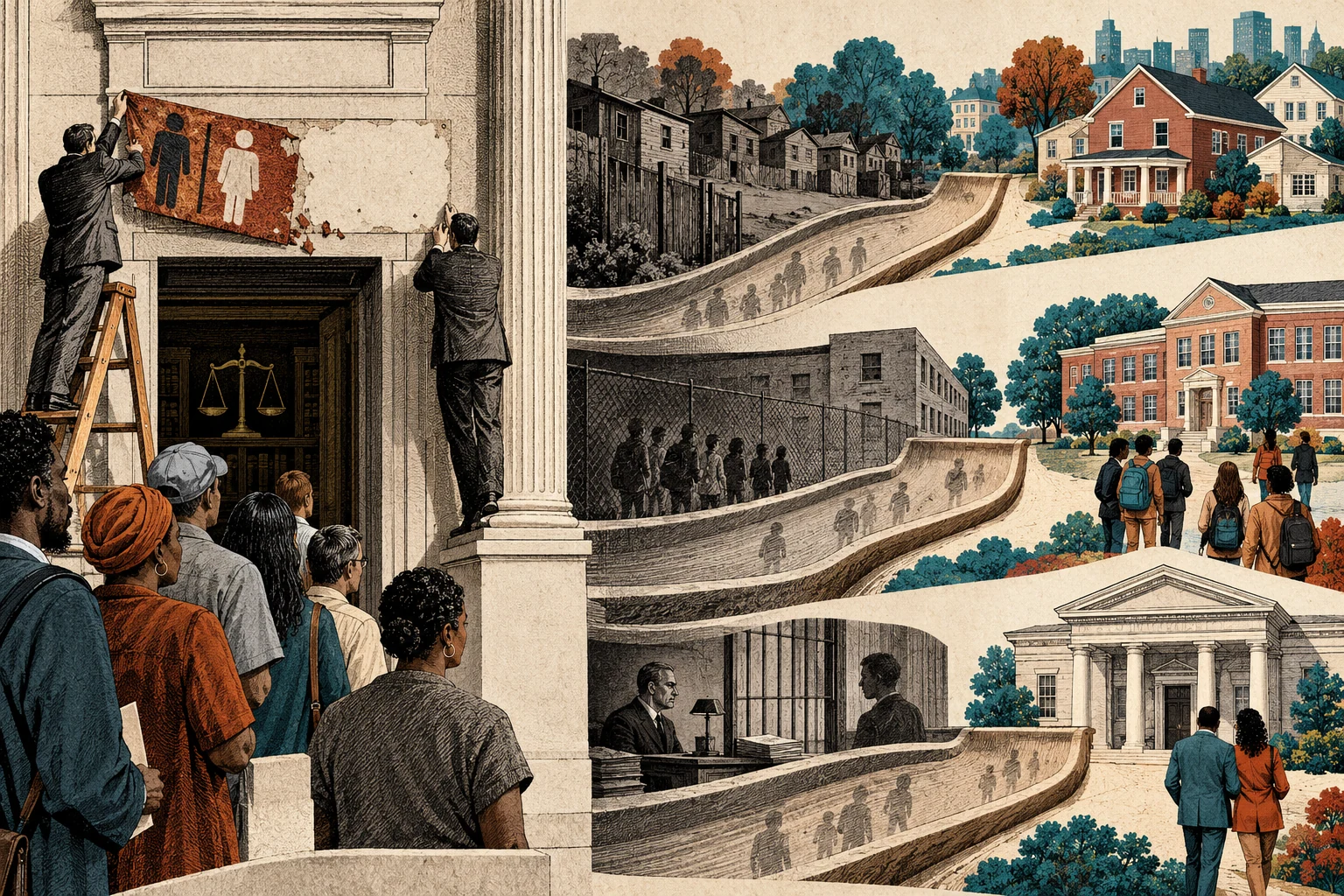
Removing an explicitly discriminatory rule does not automatically undo its entrenched institutional aftermath—illustrating the structural questions asked in this tradition.
AI-assisted illustration · conceptual metaphor View in visual quiz →Genesis and Global Lineage
The movement grew out of two distinct disappointments. The first concerned civil-rights law: decades after the landmark victories of the Civil Rights Movement (Brown v. Board of Education in 1954, the Civil Rights Act of 1964), deep racial disparities in wealth, housing, and schooling persisted, while the US Supreme Court increasingly interpreted the Equal Protection Clause as a mandate for strict color-blindness that struck down remedial affirmative action. Derrick Bell, the first tenured Black professor at Harvard Law School, responded in a 1980 Harvard Law Review comment by explaining Brown not as a triumph of moral awakening among judges, but through “interest convergence”: Cold War competition with the Soviet Union required Washington to repair its international image and modernize the Southern economy. The second disappointment concerned the academic left: Critical Legal Studies (CLS), which deconstructed the myth of legal neutrality, treated race as secondary to class and dismissed constitutional rights as mere illusions—whereas minority scholars knew that even formal rights offered indispensable protection. When Bell left Harvard in 1980, students including Kimberlé Crenshaw and Mari Matsuda organized an alternative course around his casebook Race, Racism and American Law. The movement’s name and institutional identity crystallized in July 1989 at a workshop in Madison, Wisconsin, convened by Crenshaw with twenty-three legal scholars, including Bell, Richard Delgado, Neil Gotanda, Patricia Williams, and Kendall Thomas, and was canonized in the 1995 anthology Critical Race Theory: The Key Writings That Formed the Movement.
Central European Lineage
We found no documented link between this concept and the intellectual history or historical experience of Central Europe.
We found no documented link between this concept and the intellectual history or historical experience of Central Europe (by our methodology, this means “none found,” not “none exists”; as of October 2026).
Why Now
The turning point in the term’s public life has an exact date: on September 22, 2020, following a campaign by conservative activist Christopher Rufo, President Donald Trump issued Executive Order 13950 barring federal contractors from workplace trainings involving “divisive concepts” (race or sex stereotyping and scapegoating). Although President Joe Biden revoked the order in January 2021, its language migrated directly into state legislatures. According to UCLA Law School’s CRT Forward Tracking Project, which monitored government actions through December 31, 2024, 870 anti-CRT bills, resolutions, executive orders, and school-board policies were introduced by 249 local, state, and federal bodies across 49 US states. States such as Texas and Florida (with its 2022 “Stop WOKE Act”) restricted how race and systemic inequality could be taught in public schools and universities. Simultaneously, after the murder of George Floyd in May 2020, corporations and universities rapidly expanded DEI programs that frequently borrowed the vocabulary of “systemic racism.” As a result, a three-letter acronym known in 2019 mainly to law-school seminar rooms became the central wedge issue of the 2021 Virginia gubernatorial election, and in 2025 the returning federal administration targeted “DEI ideology” across government agencies and university grants. Understanding the concept today requires separating what the legal texts actually argue from what the political label does in combat.
Explanatory Power
CRT makes structural inequality visible where no individual is breaking the law or expressing racial animus. Consider three mechanisms. First, Bell’s interest-convergence principle explains the historical rhythm of racial reform: 1950s school desegregation advanced when it served US Cold War diplomacy in decolonizing Africa and Asia, and stalled in the 1970s once court-ordered busing imposed direct costs on white middle-class suburbs. Second, the thesis that racism is “ordinary” and institutional explains why credit-scoring or predictive-policing algorithms trained on historical data reproduce racial segregation without containing any explicit “race” variable: a formally neutral rule inherits the cumulative geographic and economic effects of past non-neutral rules such as housing redlining. Third, the method of counter-storytelling highlights how disputes over legal facts often hinge on whose lived experience counts as credible evidence—an insight that illuminates why six decades of formal legal equality in the United States have barely narrowed the median wealth gap between white and Black households.
Axes of Debate
Color-blindness versus race-consciousness in constitutional law
Liberal and conservative constitutionalists—from Herbert Wechsler to Chief Justice John Roberts and the Supreme Court majority in Students for Fair Admissions v. Harvard (2023)—maintain that the only principled safeguard against racism is a strict prohibition on classifying citizens by race, even for remedial purposes. Strongest counterargument: A ban on noticing race freezes in place the material distribution produced by centuries of explicit racial classification; if an asymmetry was engineered consciously by law, it cannot be undone by legal amnesia, and color-blindness simply protects the head start of the incumbent group. Nature of the dispute: substantive — it concerns both an empirical question (whether race-neutral rules narrow or reproduce historical gaps) and a normative question (who should bear the cost of transition).
Counter-storytelling versus universal standards of legal proof
Internal critics at Harvard (Randall Kennedy, 1989) and liberal legal scholars (Daniel Farber and Suzanna Sherry in Beyond All Reason, 1997) argue that granting epistemic privilege to a “voice of color” and replacing doctrinal argument with personal narrative undermines the shared standards of evidence and falsifiability on which legal scholarship depends. Strongest counterargument: Critics assume that existing evidentiary standards are neutral, whereas those very standards historically discounted the testimony of minority witnesses and treated white middle-class experience as the objective baseline; counter-storytelling does not abolish evidence, but exposes unexamined presumptions built into legal doctrine. Nature of the dispute: mixed — the epistemological disagreement over objectivity in law is real, though both sides frequently caricature the other’s position.
Specialized legal theory versus omnipresent political label
Conservative legislators and parent-rights activists since 2020 use CRT as the name for school curricula and workplace trainings that allegedly teach collective racial guilt; defenders reply that nobody is assigning Derrick Bell’s Harvard Law Review articles in elementary school. Strongest counterargument: The defense that “CRT is only taught in law school” is partly evasive: while K–12 schools rarely teach Bell’s jurisprudence, key concepts popularized by the movement (systemic racism, white privilege, the critique of color-blindness) genuinely migrated into teacher training and corporate HR—albeit stripped of Bell’s own skepticism toward institutional virtue-signaling. Nature of the dispute: rhetorical — the combatants are fighting over ownership of a politically charged label rather than debating the truth of legal-historical propositions.
Underappreciated Angle
At the heart of classical CRT lies not progressive reformist optimism, but deep tragic pessimism. In Faces at the Bottom of the Well (1992), Derrick Bell advanced the thesis of the “permanence of racism”: full racial equality in America will never arrive, and the meaning of struggle lies in clear-eyed resistance without the illusion of final victory. That sensibility is far closer to political realism than to the therapeutic “diversity training” attributed to CRT by both its corporate champions and its right-wing detractors. From this realism flows a cold analytical corollary rarely read literally: if major reforms happen only through interest convergence, then moral appeals to the conscience of the majority are largely futile, and effective minority strategy must consist in forging hard coalitions of material self-interest. Understood this way, Bell’s principle is a portable instrument of political analysis that can be applied far beyond the United States—for instance in Central Europe, when asking why states in the region take steps to desegregate Romani schoolchildren (after the European Court of Human Rights judgment in D.H. and Others v. the Czech Republic, 2007) only when refusal threatens European Union structural funds, and quietly revert to segregated “special classes” the moment external conditionality relaxes.
One-Sentence Takeaway
Critical race theory does not claim that all individuals are racists; it claims that legal and institutional rules can reproduce racial hierarchy without a single racist in the room—and that such rules change only when altering them begins to pay off for the majority as well.
Related Concepts Network
How this concept reinforces, constrains, or complements other analytical frameworks in the corpus. View on graph →
-
Intersectionality complements
Crenshaw’s 1989 concept grew out of the same legal-scholarly milieu and adds to CRT the insight that axes of discrimination do not simply add up, but intersect.
-
Cultural hegemony reinforces
CRT’s thesis that racism is “ordinary” and embedded in institutional routines restates in legal language Gramsci’s idea of rule through consent rather than coercion alone.
-
Epistemic injustice complements
CRT’s call for a “voice of color” and counter-storytelling is an earlier, legal version of what Miranda Fricker later analyzed as testimonial and hermeneutical injustice.
-
Culture wars in tension
Since 2020 the acronym CRT has functioned in public debate as a catch-all label for any discussion of race in schools or workplaces, detaching it from the corpus of legal scholarship.
-
DEI in tension
Corporate diversity trainings are frequently conflated with CRT, even though most make no reference to legal theory and do not share its skepticism toward liberal reform.
-
Postcolonialism complements
Both currents read law and knowledge as instruments that reproduce hierarchy, but CRT emerged from the post-Brown v. Board American experience rather than overseas empire.
-
Overton window constrains
The public career of the acronym CRT shows that shifting the window can consist not in changing substantive views, but in opponents capturing the name itself.
Reading Canon & Translation Bridge
Foundational texts, introductions, and critical perspectives—with availability of English and Polish editions.
-
foundational text 1980 · English
Derrick A. Bell Jr., Brown v. Board of Education and the Interest-Convergence Dilemma
A Harvard Law Review comment (vol. 93, pp. 518–533) in which Bell formulates the interest-convergence principle: advances in racial equality occur only when they also serve the interests of the white majority.
In English: original text written in English
In Polish: no Polish edition
-
foundational text 1995 · English
Kimberlé Crenshaw, Neil Gotanda, Gary Peller, Kendall Thomas (red.), Critical Race Theory: The Key Writings That Formed the Movement
The foundational anthology with a programmatic introduction by the editors; the best place to verify what the movement actually argued before it became a political label.
In English: original text written in English
In Polish: Polish edition not verified
-
introduction & synthesis 2001 · English
Richard Delgado, Jean Stefancic, Critical Race Theory: An Introduction
The most widely cited textbook of the movement (4th ed., NYU Press, 2023); organizes the core tenets regarding the ordinariness of racism, the social construction of race, and counter-storytelling.
In English: original text written in English
In Polish: Polish edition not verified
-
introduction & synthesis 2011 · English
Kimberlé W. Crenshaw, Twenty Years of Critical Race Theory: Looking Back to Move Forward
An article in the Connecticut Law Review (vol. 43, p. 1253 ff.) in which a co-founder reconstructs the birth of the movement between liberal civil-rights reform and Critical Legal Studies, and assesses its standing in a “post-racial” era.
In English: original text written in English
In Polish: no Polish edition
-
foundational text 1992 · English
Derrick Bell, Faces at the Bottom of the Well: The Permanence of Racism
A collection of legal allegories and dialogues, including “The Space Traders,” showcasing the method of counter-storytelling and the thesis of the permanence of racism in its most literary form.
In English: original text written in English
In Polish: Polish edition not verified
-
critical perspective 1989 · English
Randall Kennedy, Racial Critiques of Legal Academia
A critique from within Harvard Law School: a Black law professor questions the claim that minority scholars possess a privileged “voice of color” in scholarship on race; the article that brought the dispute into the mainstream press.
In English: original text written in English
In Polish: no Polish edition
-
critical perspective 1997 · English
Daniel A. Farber, Suzanna Sherry, Beyond All Reason: The Radical Assault on Truth in American Law
The most systematic academic critique of the 1990s: argues that legal storytelling and radical constructivism undermine standards of evidence shared across legal scholarship.
In English: original text written in English
In Polish: Polish edition not verified
-
cross-disciplinary 2003 · English
Eduardo Bonilla-Silva, Racism without Racists: Color-Blind Racism and the Persistence of Racial Inequality in the United States
An empirical sociological study of “color-blind racism” showing how far beyond legal theory the thesis reaches that racial inequality is reproduced by ostensibly neutral rules.
In English: original text written in English
In Polish: Polish edition not verified
Primary-Source Quotes
The interest of blacks in achieving racial equality will be accommodated only when it converges with the interests of whites.