Epistemology #013
Epistemic injustice
original term: epistemic injustice (Eng.) · niesprawiedliwość poznawcza, niesprawiedliwość testymonialna, niesprawiedliwość hermeneutyczna
Central European lineage: 2 threads (historical experience) · 1943–2024 · jump to documentation ↓
Working Definition
Epistemic injustice is a wrong done to someone specifically in their capacity as a knower—as a person who conveys knowledge to others and makes sense of their own social experience. In her foundational 2007 treatise, British philosopher Miranda Fricker distinguishes two primary forms: testimonial injustice occurs when prejudice on the hearer's part (tracking the speaker's gender, race, class, accent, or nationality) causes the hearer to give the speaker's word less credibility than the evidence warrants; hermeneutical injustice occurs at a prior, structural stage when a gap in a society's shared interpretive resources puts a marginalized group at an unfair disadvantage in understanding and naming a significant area of their own experience. In casual usage the phrase is sometimes stretched to cover any situation where someone feels disagreed with. In its strict analytical sense, however, it requires showing that the credibility deficit or conceptual gap stems from structural identity power or hermeneutical marginalization rather than an innocent error or weak evidence.
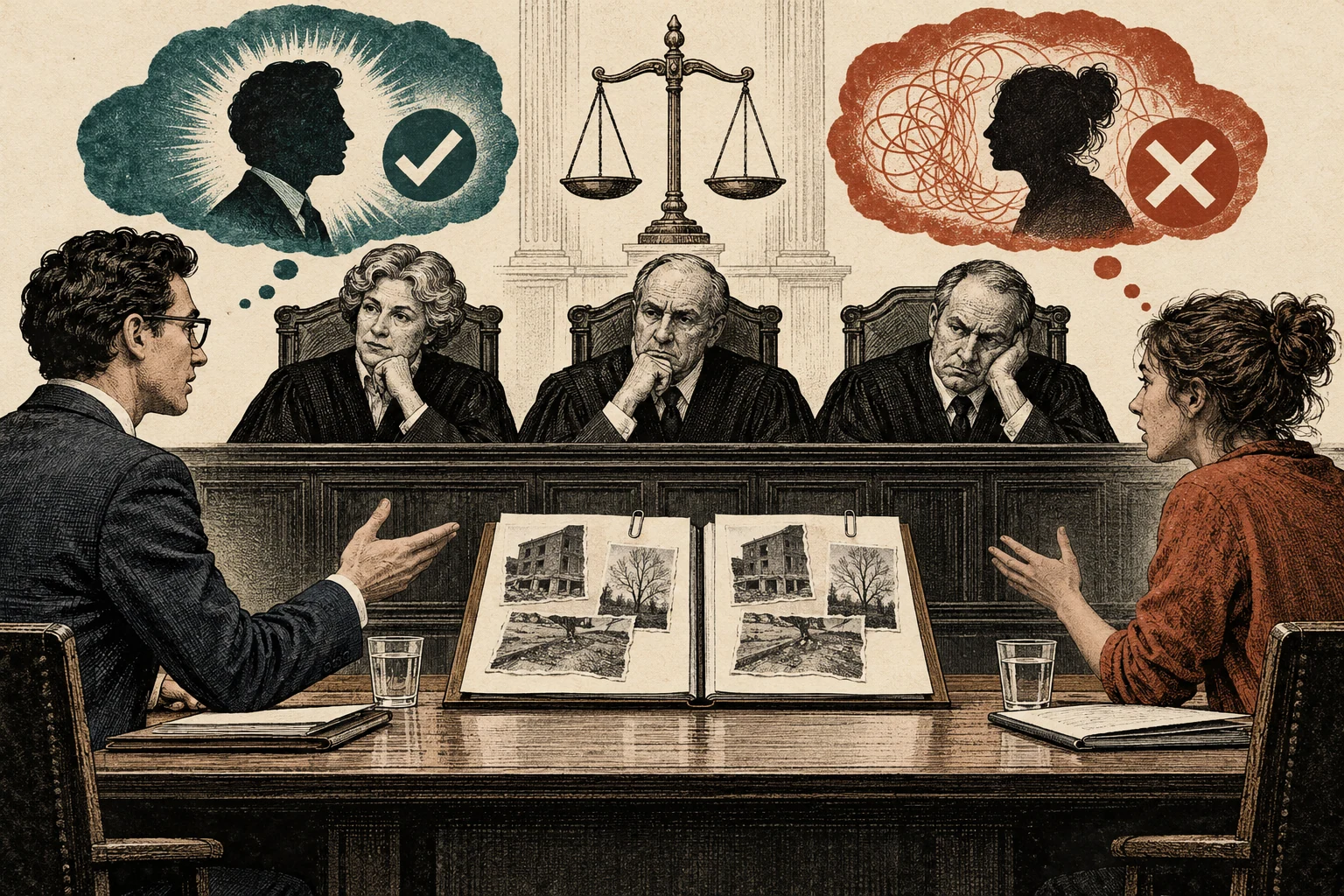
Similar testimonies receive different credibility depending on who is speaking. The harm concerns whether a person is recognized as a source of knowledge.
AI-assisted illustration · conceptual metaphor View in visual quiz →Genesis and Global Lineage
The concept was formulated by Miranda Fricker—educated at Oxford (DPhil 1996 under Sabina Lovibond and Bernard Williams)—first in her 1998 article “Rational Authority and Social Power: Towards a Truly Social Epistemology” and in full in her monograph Epistemic Injustice: Power and the Ethics of Knowing (Oxford University Press, 2007). Fricker wove together three traditions: virtue epistemology, feminist standpoint theory (Patricia Hill Collins, Nancy Hartsock), and Foucauldian accounts of social power. To make the mechanisms concrete, she analyzed two literary cases of testimonial injustice—the all-white jury's refusal to believe Tom Robinson in Harper Lee's To Kill a Mockingbird and Herbert Greenleaf's dismissal of Marge Sherwood as Relying on “female intuition” in Patricia Highsmith's The Talented Mr. Ripley—and one historical case of hermeneutical injustice from Susan Brownmiller's memoir of the US women's liberation movement: Carmita Wood, who quit her university administrative job in 1975 after relentless unwanted sexual advances from a professor and was denied unemployment benefits because the concept of sexual harassment did not yet exist in law or everyday language. Subsequent philosophers rapidly expanded and challenged Fricker's architecture: Kristie Dotson (2011) added testimonial quieting and testimonial smothering, Gaile Pohlhaus Jr. (2012) introduced willful hermeneutical ignorance (where dominant groups actively refuse to learn concepts forged by marginalized groups), and Elizabeth Anderson (2012) and José Medina (2013) pushed the remedy from individual listener virtue to institutional design.
Central European Lineage
While Fricker's concept originated in Anglo-American analytic feminism, two historical experiences from Central and Eastern Europe have become prominent test cases in the international literature on epistemic injustice. The first is the 1943 mission of Jan Karski—a courier of the Polish Underground State educated in law and diplomacy at Jan Kazimierz University in interwar Lwów (now Lviv, Ukraine)—who in late 1942 was secretly smuggled twice into the Warsaw Ghetto and into the Izbica transit ghetto (a staging point for the Bełżec extermination camp) to carry eyewitness testimony of the ongoing Holocaust to Allied leaders in London and Washington. After listening to Karski in Washington in July 1943, US Supreme Court Justice Felix Frankfurter replied, “I am unable to believe you,” clarifying to Polish Ambassador Jan Ciechanowski: “I did not say this young man is lying. I said I am unable to believe him. There is a difference.” Philosopher of education Judith Suissa (2016) analyzes this scene directly through Fricker's lens, showing that it exposes a critical boundary of the theory: Frankfurter held no identity prejudice against Karski, yet Karski's testimony failed because the Industrial destruction of European Jewry exceeded Frankfurter's imaginative and conceptual frame of what human beings could do. The second case is contemporary: after Russia's full-scale invasion of Ukraine in February 2022, Polish scholars Jan Smoleński and Jan Dutkiewicz popularized the Eastern European term westsplaining in The New Republic (March 2022), and Tereza Hendl, Olga Burlyuk, Mila O'Sullivan, and Aizada Arystanbek (Contemporary Security Policy, 2024) analyzed Western pundits' dismissal of Ukrainian and Central European scholarship through Fricker's framework as a systematic credibility deficit imposed on the region's knowers.
Documented regional lineage · Links: 2. Compiled: October 2026.
-
historical experience 73 years
Central European Source: Relacja Karskiego o Zagładzie i odpowiedź Felixa Frankfurtera: „I am unable to believe you” — Jan Karski; Warsaw and Izbica, German-occupied Poland (report delivered in London and Washington), 1943
Global Circulation: testimonial injustice (Fricker) as an analytical lens on disbelief toward Karski's Holocaust testimony — Judith Suissa, 2016
-
historical experience 2 years
Central European Source: Debata o „westsplainingu” po pełnoskalowej inwazji Rosji na Ukrainę — Jan Smoleński i Jan Dutkiewicz oraz badaczki z Europy Wschodniej i Azji Środkowej; Ukraine; Central and Eastern Europe, 2022
Global Circulation: epistemic injustice (Fricker) applied to Western security debates over Ukraine — Tereza Hendl, Olga Burlyuk, Mila O’Sullivan, Aizada Arystanbek, 2024
historical experience
73 yearsRelacja Karskiego o Zagładzie i odpowiedź Felixa Frankfurtera: „I am unable to believe you” — Jan Karski
1943 · Warsaw and Izbica, German-occupied Poland (report delivered in London and Washington)
testimonial injustice (Fricker) as an analytical lens on disbelief toward Karski's Holocaust testimony
2016 · Judith Suissa
- Claim & Connection
- Jan Karski, a courier of the Polish Underground State educated at Jan Kazimierz University in Lwów, was smuggled into the Warsaw Ghetto and the Izbica transit camp in late 1942 and delivered eyewitness reports to Allied leaders in London and Washington in 1943. US Supreme Court Justice Felix Frankfurter replied, “I am unable to believe you,” explaining to Polish Ambassador Jan Ciechanowski that he was not calling Karski a liar. Judith Suissa (2016) analyzes this encounter directly through Miranda Fricker's framework (testimonial injustice, “ethical poison”) and concludes that it marks a crucial boundary case: Frankfurter did not deflate Karski's credibility out of identity prejudice, but lacked the conceptual and imaginative capacity to absorb facts that exceeded his picture of possible human reality.
- Source Documentation
-
- scholarly study Judith Suissa, „Testimony, Holocaust Education and Making the Unthinkable Thinkable”, Journal of Philosophy of Education, Vol. 50, No. 2, 2016, s. 285–299, DOI 10.1111/1467–9752.12207 (wersja autorska w UCL Discovery); Section 1 “Jan Karski and epistemic injustice” (pp. 1–4 of author version): account of the Frankfurter meeting after Wood and Jankowski, quotes from Fricker 2007 (pp. 1, 20–22), and argument that the case falls outside Fricker's definition. discovery.ucl.ac.uk ↗
- biographical record Mordecai Paldiel, „Karski, Jan”, Encyclopaedia Judaica, wyd. 2 (encyclopedia.com); paragraph on law and diplomatic studies at Jan Kazimierz University in Lwów; 1942 mission; Frankfurter's words “I am unable to believe you”. encyclopedia.com ↗
- scholarly study United States Holocaust Memorial Museum, Holocaust Encyclopedia, „Jan Karski”; paragraphs on his mission into the Warsaw Ghetto and Izbica in late 1942 and his meeting with Roosevelt and Frankfurter in Washington in July 1943. encyclopedia.ushmm.org ↗
- Historical Context
- Historical experience from the region serving in the international philosophical literature as a boundary test case for Fricker's concept.
historical experience
2 yearsDebata o „westsplainingu” po pełnoskalowej inwazji Rosji na Ukrainę — Jan Smoleński i Jan Dutkiewicz oraz badaczki z Europy Wschodniej i Azji Środkowej
2022 · Ukraine; Central and Eastern Europe
epistemic injustice (Fricker) applied to Western security debates over Ukraine
2024 · Tereza Hendl, Olga Burlyuk, Mila O’Sullivan, Aizada Arystanbek
- Claim & Connection
- Following Russia's full-scale invasion of Ukraine on 24 February 2022, Jan Smoleński and Jan Dutkiewicz popularized the term “westsplaining” to describe Western pundits patronizingly lecturing Central and Eastern Europeans about their own region while dismissing local expertise. Tereza Hendl, Olga Burlyuk, Mila O’Sullivan, and Aizada Arystanbek (2024) analyze this dynamic explicitly through Fricker's (2007) concept of epistemic injustice: undermining Ukrainians in their capacity as knowers and treating them as passive objects of geopolitical analysis rather than credible subjects of knowledge about their own reality.
- Source Documentation
-
- reception / translation Tereza Hendl, Olga Burlyuk, Mila O’Sullivan, Aizada Arystanbek, „(En)Countering epistemic imperialism: A critique of “Westsplaining” and coloniality in dominant debates on Russia’s invasion of Ukraine”, Contemporary Security Policy, Vol. 45, No. 2, 2024, s. 171–209, DOI 10.1080/13523260.2023.2288468 (open access, CC BY-NC-ND 4.0); pp. 173–174: “the power dynamic of epistemic injustice, undermining Ukrainians in their capacity as knowers” citing Fricker 2007; p. 176: section “Westsplaining and the myth of Ukraine’s powerlessness”, citing Smoleński and Dutkiewicz 2022. opus.bibliothek.uni-augsburg.de ↗
- primary source Jan Smoleński, Jan Dutkiewicz, „The American Pundits Who Can’t Resist ‘Westsplaining’ Ukraine”, The New Republic, 4 marca 2022; full article (noting that the term had already circulated in Eastern European online debates); discussed in Hendl et al. 2024 on p. 176. newrepublic.com ↗
- Historical Context
- Smoleński and Dutkiewicz brought a term from Eastern European online discussions into international circulation; Hendl et al. (2024) combine Fricker's epistemic injustice with decolonial critiques of knowledge production.
Why Now
Three waves between 2017 and 2026 carried epistemic injustice from philosophy seminars into public institutions. First, the global #MeToo movement (from October 2017) turned both of Fricker's mechanisms—who is believed when reporting abuse, and how shared legal and workplace vocabularies transform private shame into a recognized public wrong—into front-page debates, coinciding with The Routledge Handbook of Epistemic Injustice (2017). Second, clinical medicine and bioethics adopted the concept following Havi Carel and Ian James Kidd's 2014 analysis: during the COVID-19 pandemic, studies such as Jane Ireson et al.'s 2022 research in Social Science & Medicine documented how Long COVID patients—suffering from a novel condition lacking a simple biomarker—experienced testimonial dismissal from physicians as “anxious” or “psychosomatic.” Third, in artificial intelligence, Jackie Kay, Atoosa Kasirzadeh, and Shakir Mohamed (2024) introduced “generative algorithmic epistemic injustice” to describe how large language models trained predominantly on English and Western corpora automate credibility deficits and hermeneutical gaps across global digital infrastructure.
Explanatory Power
Fricker's framework reveals that credibility is not earned on a level market of ideas, but distributed through social heuristics applied below conscious awareness. First, it separates the primary intrinsic harm of epistemic injustice—being degraded in one's standing as a rational knower—from its secondary practical harms (losing a court case, being denied a medical test, losing a job), explaining why prejudiced disbelief injures a person even if the practical outcome goes their way. Second, in healthcare and psychiatry, it explains why patients with chronic pain, endometriosis, or post-viral syndromes routinely lose out against “objective clinical indicators”: first-person testimony is assigned low weight relative to lab panels, prompting us to ask whether that weight reflects diagnostic base rates or stereotypes about “emotional” reporters. Third, in international scholarship and journalism, it diagnoses why a researcher from Kyiv, Warsaw, or Tbilisi writing about Russian imperialism is discounted as “too emotionally invested,” whereas a commentator in Chicago or Berlin without local languages is treated as a neutral authority—allocating credibility by passport rather than evidence.
Axes of Debate
Individual listener virtue versus institutional design
Political philosophers Elizabeth Anderson (2012) and José Medina (2013) argue that Fricker relies too heavily on individual virtue—teaching listeners to correct their credibility judgments in real time—whereas implicit biases operate unconsciously and under cognitive load, requiring structural remedies in courts, hiring committees, peer review, and clinical protocols. Strongest counterargument: Institutions are inhabited by human listeners; a formal rule that forces a committee to hear a witness cannot force it to believe them, and Fricker stresses that institutional rules and personal virtues are mutually reinforcing rather than rival solutions. Nature of the dispute: substantive — both camps agree on the diagnosis of structural prejudice and debate which lever of intervention shifts outcomes.
Credibility deficit versus the whole economy of credibility
José Medina (2013) and Arianna Falbo (2022) contend that Fricker errs by restricting testimonial injustice to credibility deficits: in real social hierarchies—a courtroom, a hospital ward, or a geopolitical panel—granting an unearned credibility excess to a privileged speaker directly causes the discounting of marginalized witnesses and breeds epistemic arrogance in the favored group. Strongest counterargument: Fricker replies that credibility is not generally a zero-sum scarce good like money, and that receiving too much trust in a single conversation does not insult one's capacity as a knower in the way a prejudiced deficit does—though she concedes that cumulative excess corrupts character over time. Nature of the dispute: substantive — it turns on whether credibility in high-stakes adversarial settings functions as a positional, zero-sum resource.
Concept creep versus radical decolonial critique
The concept faces pressure from two opposite flanks: analytic critics warn that in public rhetoric “epistemic injustice” is invoked to immunize weak claims against legitimate methodological skepticism, while decolonial theorists (Walter Mignolo) and Kristie Dotson (2012) argue that Fricker's framework is too conservative (“reductive”) because it seeks only fairer inclusion inside dominant Western epistemologies rather than questioning their monopoly. Strongest counterargument: Retaining Fricker's strict requirement of identity prejudice prevents the concept from degenerating into an excuse where every rejected hypothesis cries injustice, while Dotson's “third-order” exclusions can be analyzed alongside Fricker without discarding the precision of her two core mechanisms. Nature of the dispute: mixed — substantive regarding taxonomic boundaries, rhetorical when either side uses the label to foreclose empirical debate.
Underappreciated Angle
Jan Karski's 1943 encounter with Felix Frankfurter exposes a blind spot in theories of testimony that focus solely on prejudice against the speaker. Credibility depends not only on the listener's estimate of the speaker's honesty and competence, but on the listener's prior model of what can happen in the world. Frankfurter held no prejudice against Karski as a Pole or a Catholic—he respected Karski's courage—yet he could not believe him because industrial extermination camps lay outside what an enlightened jurist in 1943 Washington considered humanly possible. As Judith Suissa shows, this is not testimonial injustice in Fricker's strict sense, yet the catastrophic outcome is identical: true, urgent eyewitness testimony fails to register. This world-model hermeneutical gap on the listener's side strikes whenever witnesses report unprecedented catastrophes—genocides, novel pandemics, systemic financial frauds, ecological tipping points—precisely when firsthand testimony matters most because statistical baselines do not yet exist. Institutions built for sober skepticism are thus structurally most deaf to the messengers they can least afford to ignore.
One-Sentence Takeaway
Who we believe depends not only on our prejudices about the person speaking, but on the boundaries of what our picture of the world allows us to imagine as possible.
Related Concepts Network
How this concept reinforces, constrains, or complements other analytical frameworks in the corpus. View on graph →
-
Epistemic violence complements
Spivak and Dotson's epistemic violence describes the systemic erasure or silencing of entire ways of knowing, whereas Fricker analyzes the wrong done in specific acts of testimony or interpretation; Dotson bridges the two with “testimonial smothering.”
-
Epistemic humility reinforces
Fricker's corrective virtue of testimonial justice requires hearers to reflexively adjust their spontaneous credibility judgments upward when aware of potential prejudice—an operational form of epistemic humility.
-
Intersectionality complements
Credibility deficits compound along multiple intersecting axes of identity, and Fricker drew directly on Black feminist standpoint theory (Patricia Hill Collins) in formulating hermeneutical marginalization.
-
Algorithmic bias complements
Kay, Kasirzadeh, and Mohamed (2024) extend Fricker's framework to generative AI: models that systematically underweight certain languages and communities automate testimonial and hermeneutical injustice at scale.
-
Postcolonialism in tension
Decolonial theorists (Walter Mignolo's “epistemic disobedience”) argue that Fricker's framework merely redistributes credibility inside Western epistemic institutions rather than questioning their colonial foundations.
-
Cultural hegemony complements
A hermeneutical lacuna is the epistemic face of Gramscian hegemony: because dominant groups disproportionately shape the shared vocabulary, marginalized experiences remain nameless without anyone needing to censor them.
-
Preference falsification complements
Kristie Dotson shows that speakers who anticipate prejudiced disbelief preemptively truncate their own testimony (“testimonial smothering”)—the epistemic counterpart to Timur Kuran's self-censorship.
Reading Canon & Translation Bridge
Foundational texts, introductions, and critical perspectives—with availability of English and Polish editions.
-
foundational text 2007 · English
Miranda Fricker, Epistemic Injustice: Power and the Ethics of Knowing
The foundational monograph (Oxford University Press): defines testimonial and hermeneutical injustice, the economy of credibility, and the corrective virtues through literary examples (To Kill a Mockingbird, The Talented Mr. Ripley) and the case of Carmita Wood.
In English: original text written in English
In Polish: no Polish edition
-
critical perspective 2011 · English
Kristie Dotson, Tracking Epistemic Violence, Tracking Practices of Silencing
The landmark paper in Hypatia (26/2) introducing “testimonial quieting” and “testimonial smothering”—where a speaker self-censors because the audience lacks the competence to hear the testimony safely.
In English: original text written in English
In Polish: Polish edition not verified
-
critical perspective 2012 · English
Elizabeth Anderson, Epistemic Justice as a Virtue of Social Institutions
Argues in Social Epistemology (26/2) that individual hearer virtues are too fragile to overcome structural bias, shifting the burden of epistemic justice onto institutional design in courts, schools, and science.
In English: original text written in English
In Polish: Polish edition not verified
-
critical perspective 2013 · English
José Medina, The Epistemology of Resistance: Gender and Racial Oppression, Epistemic Injustice, and Resistant Imaginations
Pushes Fricker's account in a relational and polyphonic direction (Oxford University Press): argues that credibility excess among the privileged and “active ignorance” are the flip side of credibility deficits.
In English: original text written in English
In Polish: Polish edition not verified
-
introduction & synthesis 2017 · English
Ian James Kidd, José Medina, Gaile Pohlhaus Jr. (red.), The Routledge Handbook of Epistemic Injustice
The definitive thirty-seven-chapter reference volume mapping the first decade of debates, critiques, and applications across law, healthcare, psychiatry, education, and politics.
In English: original text written in English
In Polish: Polish edition not verified
-
introduction & synthesis 2024 · Polish
Renata Ziemińska, Niesprawiedliwość poznawcza według Mirandy Fricker. Zastosowania, zarzuty i kontynuacje
An overview in Studia Philosophica Wratislaviensia (19/2, pp. 5–18) introducing Fricker's framework to Polish philosophy, reviewing Arianna Falbo's critique, and contrasting it with decolonial “epistemic disobedience.”
In English: no English edition
In Polish: original text written in Polish
-
cross-disciplinary 2014 · English
Havi Carel, Ian James Kidd, Epistemic injustice in healthcare: a philosophial analysis
The paper in Medicine, Health Care and Philosophy (17/4) that opened the concept's most active field of empirical application: how ill persons have their testimony systematically discounted by clinical institutions.
In English: original text written in English
In Polish: Polish edition not verified
-
cross-disciplinary 2016 · English
Judith Suissa, Testimony, Holocaust Education and Making the Unthinkable Thinkable
An essay in Journal of Philosophy of Education (50/2) examining Jan Karski's 1943 encounter with Felix Frankfurter as a case of radical disbelief without identity prejudice, probing the limits of Fricker's definition.
In English: original text written in English
In Polish: Polish edition not verified
Primary-Source Quotes
The dysfunction of unduly deflated credibility may be not only an epistemic dysfunction, it may also be an ethical dysfunction. For the speaker who receives a prejudicially deflated degree of credibility from a hearer is thereby wronged — he is wronged specifically in his capacity as a knower.
Mr. Ambassador, I did not say this young man is lying. I said I am unable to believe him. There is a difference.