Algorithmic management
original term: algorithmic management (Eng.) · zarządzanie przez algorytm, kontrola algorytmiczna, algorithmic control
Global-circulation concept — no documented lineage in Central Europe. jump to documentation ↓
Working Definition
Algorithmic management is a set of organizational practices in which managerial functions traditionally performed by human supervisors—allocating tasks, setting piece-rate pay, pacing work speed, evaluating performance, and administering rewards or dismissals—are executed automatically by software operating on real-time behavioral telemetry, typically without transparent rules or a human supervisor with whom the worker can negotiate. The concept is institutional rather than mathematical: it refers not to a specific class of machine-learning algorithms, but to a workplace power relationship in which a boss's order arrives as a push notification on a screen and dismissal takes the form of an automated account deactivation. While casual commentary sometimes stretches the term to cover any workplace software, in rigorous labor sociology and employment law it designates automated systems that make or materially shape binding decisions over working conditions, schedules, and pay.
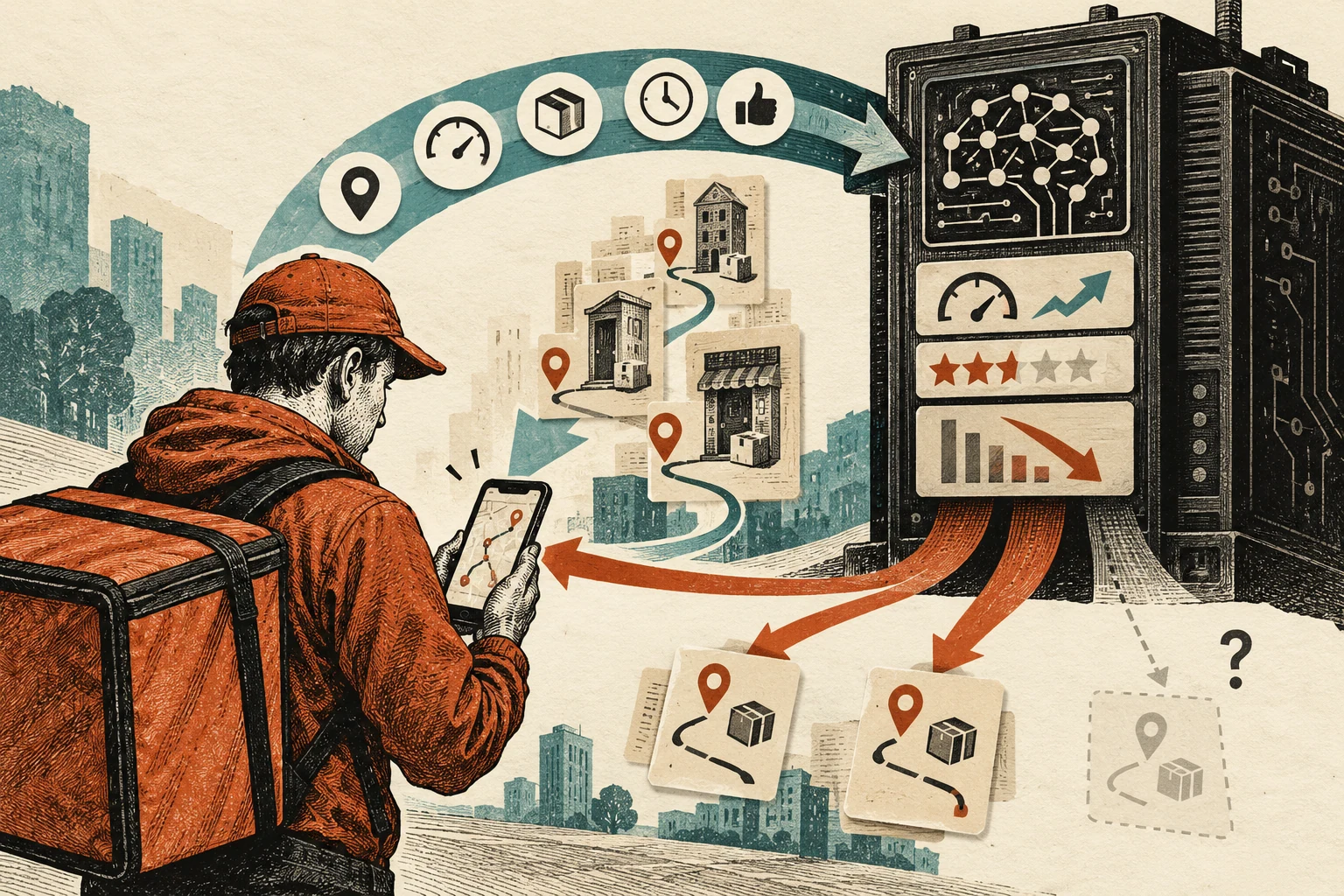
Task assignment and performance scoring feed back into an automated control loop where execution metrics govern a worker's subsequent duties.
AI-assisted illustration · conceptual metaphor View in visual quiz →Genesis and Global Lineage
The term was coined in 2015 by human-computer interaction researchers Min Kyung Lee, Daniel Kusbit, Evan Metsky, and Laura Dabbish at Carnegie Mellon University in an ACM CHI paper examining how Uber and Lyft replaced human dispatchers with software-mediated ride assignment, surge pricing, and passenger star ratings. One year later, Alex Rosenblat and Luke Stark shifted the analytical lens from interface design to workplace power in their landmark 2016 study Algorithmic Labor and Information Asymmetries: based on nine months of fieldwork with Uber drivers, they demonstrated that the platform exercises tight managerial control over workers legally classified as “independent contractors” by engineering structural information asymmetries (such as hiding a trip's destination and fare until after acceptance) and behavioral nudges. A third stream integrated these findings into organizational sociology: in 2020, Katherine Kellogg, Melissa Valentine, and Angèle Christin published Algorithms at Work: The New Contested Terrain of Control, situating algorithmic management within the labor-process tradition of Harry Braverman (1974) and Richard Edwards (1979) and showing how algorithms fuse technical control (assembly-line pacing) with bureaucratic control (company rulebooks) through six mechanisms: restricting, recommending, recording, rating, replacing, and rewarding. In the 2020s, the concept entered international policymaking through OECD and Eurofound reports and the EU Platform Work Directive (2024/2831).
Central European Lineage
We found no documented link between this concept and the intellectual history or historical experience of Central Europe.
We found no documented link between this concept and the intellectual history or historical experience of Central Europe (by our methodology, this means “none found,” not “none exists”; as of October 2026).
Why Now
Three developments between 2018 and 2026 turned algorithmic management into a central battleground of labor law. First, the COVID-19 pandemic of 2020–2021 revealed that app-dispatched food couriers, parcel drivers, and warehouse pickers functioned as essential urban infrastructure even as they worked under algorithmic discipline without paid sick leave; across Central Europe, where platforms such as Bolt, Glovo, Uber, and Pyszne.pl layered algorithmic dispatch atop preexisting national habits of non-standard civil-law contracts (umowa zlecenie) and bogus B2B self-employment, the period saw both a surge in migrant platform labor and the first courier strikes. Second, algorithmic management spilled beyond gig apps into conventional workplaces: Amazon fulfillment centers tracking “time off task” via handheld scanners, call centers analyzing voice tone in real time, and white-collar remote-work “bossware” logging keystrokes and webcam presence. Third, the European Union enacted binding statutory limits: Chapter III of the EU Platform Work Directive (adopted in October 2024 as Directive 2024/2831) banned automated processing of workers' emotional state or private conversations, mandated transparency on automated monitoring systems, and guaranteed human review of account suspensions or terminations—while the EU AI Act (2024) classified AI systems used for recruitment, task allocation, performance monitoring, and dismissal as “high-risk.”
Explanatory Power
Algorithmic management pierces the legal fiction of the “neutral technology marketplace,” making visible the managerial hierarchy where corporate accounting sees only software connecting independent micro-entrepreneurs. Three mechanisms illustrate its diagnostic reach. First, control through engineered uncertainty: a ride-hail or delivery driver is formally free to log off whenever they wish, yet when the app withholds destination details, changes piece-rate pay dynamically via opaque multipliers, and penalizes rejection rates by throttling future dispatches, formal scheduling freedom coexists with intense behavioral subordination. Second, automated Taylorism without a human buffer: in a logistics warehouse where barcode scanners measure the exact seconds between item picks and automatically generate warnings when “time off task” crosses a threshold, work pacing is stricter than under a human foreman because software does not recognize fatigue, a jammed conveyor, or a restroom break unless coded as an exception. Third, the outsourcing of discipline to customers: by tying a worker's continued access directly to a rolling average of customer star ratings (where dropping below 4.6 triggers automatic deactivation), the firm offloads supervision onto passengers while washing its hands of discriminatory bias when customers rate minority or accented workers lower.
Axes of Debate
A qualitatively new regime of power versus “Digital Taylorism” (Scientific Management 2.0)
Human-computer interaction researchers and policy technocrats often treat algorithmic management as a novel software-design challenge whose excesses can be fixed through UI transparency, fairness audits, and appeal buttons. Labor-process sociologists following Braverman and Edwards reply that algorithmic management is simply Frederick Winslow Taylor's 1911 Scientific Management equipped with cloud sensors—what Henri Schildt calls “scientific management 2.0”—pursuing the same capitalist imperative to strip tacit knowledge from the worker and concentrate control in management's hands. Strongest counterargument: While the underlying economic motive is Taylorist, the mode of execution introduces a qualitative rupture: Taylor needed human engineers with stopwatches and middle managers whose visible presence on the shop floor provided a human target for bargaining, whereas an algorithmic system monitors 100% of workers continuously at zero marginal cost and alters piece-rate parameters overnight across an entire country without a supervisor ever issuing a verbal order. Nature of the dispute: substantive — it determines whether classic collective labor law merely needs updated disclosure rules or whether algorithmic opacity requires new structural rights to co-determine software code.
Employment status: employees, independent contractors, or a third legal category?
Platform companies and free-market economists defend contractor status, arguing that the defining feature of app-based work is scheduling flexibility—working ten hours one week and zero the next across multiple apps—which traditional employment contracts would destroy. Trade unions, labor courts (such as the UK Supreme Court's 2021 ruling in Uber BV v Aslam), and the drafters of the EU Platform Work Directive counter that algorithmic control over pricing, customer allocation, and disciplinary rating constitutes the exact legal subordination that defines employment. Strongest counterargument: Creating a rigid binary in which any algorithmic coordination triggers full nine-to-five employment risks eliminating low-barrier supplemental income opportunities for students and migrants; conversely, carving out a “third category” (such as Spain's TRADE or California's Proposition 22) has historically served as a loophole to strip workers of minimum-wage and social-security protections. Nature of the dispute: mixed — beneath a genuine legal-design dilemma over decoupling social protection from fixed working hours lies a multibillion-dollar distributive battle over payroll taxes and labor costs.
Algorithmic transparency as empowerment versus transparency as an empty alibi
European regulators and explainable-AI advocates emphasize mandatory disclosures: giving workers a clear explanation of which variables feed the dispatch algorithm and how their score is calculated. Critical labor scholars warn that individual transparency without collective bargaining power is an illusion: a courier who receives a twenty-page PDF explaining the mathematical weights behind a pay cut is no less subordinate if they cannot negotiate the formula. Strongest counterargument: Individual transparency is insufficient on its own, but it is the indispensable epistemic precondition for collective action: unions and labor inspectors cannot challenge discriminatory deactivation rules or wage-skimming algorithms at the bargaining table or in court until the law forces platforms to hand over the variables. Nature of the dispute: substantive — a strategic disagreement over the relationship between informational rights and collective counter-power in the workplace.
Underappreciated Angle
Public debate over algorithmic management focuses almost exclusively on what happens to the worker at the bottom of the screen, while overlooking the disappearance of the manager in the middle. When an organization replaces human dispatchers, shift supervisors, and HR evaluators with an automated software layer, it dissolves institutional accountability into a distributed socio-technical chain. Who actually “fired” the deactivated courier or set the warehouse picking pace that caused a back injury? The software engineer in San Francisco or Tallinn who wrote the optimization objective claims they merely minimized delivery latency; the local country manager in Warsaw or Prague claims the parameters are set globally by the model; the customer who tapped three stars after a rainy-night delay was just answering a pop-up prompt; and the support chatbot repeats that “the system's decision is final.” Responsibility evaporates because no human person ever signed a dismissal order. Mandating “a human in the loop” to review automated deactivations achieves nothing if that human is herself a low-paid, algorithmically monitored call-center worker judged on how many appeals she closes per hour and lacking the authority to override the model. Genuine regulation begins with forcing the corporation to designate an identifiable human officer with both the legal liability and the technical power to turn the knob back.
One-Sentence Takeaway
Algorithmic management did not eliminate the boss; it atomized the boss into code so that orders arrive every ten seconds while human accountability never arrives at all.
Related Concepts Network
How this concept reinforces, constrains, or complements other analytical frameworks in the corpus. View on graph →
-
Platformization reinforces
Algorithmic management is the operational engine of the labor platform: without automated task dispatch, dynamic pricing, and continuous rating, the platform model could not scale beyond a single city.
-
Surveillance capitalism complements
Shoshana Zuboff analyzes the monetization of consumer behavioral data; algorithmic management shows how the very same telemetry and behavioral modification techniques are turned inward upon workers.
-
Technofeudalism in tension
The technofeudal thesis casts the platform worker as a digital serf paying rent, whereas algorithmic-management scholarship analyzes them as a worker subjected to a hyper-rationalized new form of managerial control.
-
Algorithmic bias complements
Automated worker-evaluation systems directly launder customer prejudices into employment decisions whenever passenger star ratings automatically govern access to shifts or account deactivation.
-
Explainable AI (XAI) reinforces
The statutory right of a courier or driver to an explanation for an automated account deactivation turns the technical problem of explainable AI into a concrete labor-law entitlement.
-
Technological solutionism constrains
The corporate narrative of neutral mathematical optimization matching supply and demand obscures the fact that wage rates, speed targets, and deactivation thresholds are managerial choices rather than laws of nature.
Reading Canon & Translation Bridge
Foundational texts, introductions, and critical perspectives—with availability of English and Polish editions.
-
foundational text 2015 · English
Min Kyung Lee, Daniel Kusbit, Evan Metsky, Laura Dabbish, Working with Machines: The Impact of Algorithmic and Data-Driven Management on Human Workers
The CHI 2015 paper that coined the term “algorithmic management,” examining Uber and Lyft drivers to show how software-driven work assignment, surge pricing, and passenger ratings replace the human dispatcher.
In English: original text written in English
In Polish: no Polish edition
-
foundational text 2016 · English
Alex Rosenblat, Luke Stark, Algorithmic Labor and Information Asymmetries: A Case Study of Uber's Drivers
A nine-month empirical study of Uber drivers in the International Journal of Communication (vol. 10) demonstrating how engineered information asymmetries allow a platform to exercise tight managerial control over workers classified on paper as independent contractors.
In English: original text written in English
In Polish: no Polish edition
-
introduction & synthesis 2018 · English
Alex Rosenblat, Uberland: How Algorithms Are Rewriting the Rules of Work
The book-length expansion of Rosenblat's fieldwork across North America: the most accessible ethnographic introduction to everyday life under an algorithmic boss.
In English: original text written in English
In Polish: Polish edition not verified
-
introduction & synthesis 2020 · English
Katherine C. Kellogg, Melissa A. Valentine, Angèle Christin, Algorithms at Work: The New Contested Terrain of Control
The authoritative synthesis in Academy of Management Annals organizing the field around the “6 Rs” of algorithmic control (restricting, recommending, recording, rating, replacing, and rewarding) in explicit dialogue with Richard Edwards's labor-process theory.
In English: original text written in English
In Polish: no Polish edition
-
critical perspective 1979 · English
Richard Edwards, Contested Terrain: The Transformation of the Workplace in the Twentieth Century
The classic historical typology of simple, technical, and bureaucratic workplace control—essential for recognizing algorithmic management as the fourth link in a long managerial chain rather than an unprecedented rupture.
In English: original text written in English
In Polish: Polish edition not verified
-
cross-disciplinary 1974 · English
Harry Braverman, Labor and Monopoly Capital: The Degradation of Work in the Twentieth Century
The foundational Marxist analysis of Frederick Winslow Taylor's “scientific management” as the systematic separation of conception from execution—whose twenty-first-century counterpart is proprietary black-box dispatch code.
In English: original text written in English
In Polish: Polish edition not verified
-
cross-disciplinary 2019 · English
Shoshana Zuboff, The Age of Surveillance Capitalism: The Fight for a Human Future at the New Frontier of Power
Provides the broader political-economic frame explaining why platforms harvest far more behavioral telemetry from workers than task dispatch alone requires.
In English: original text written in English
In Polish: Polish edition not verified