Systems & Complexity #051
Tragedy of the commons
original term: tragedy of the commons (Eng.) · tragedia wspólnego pastwiska, tragedia dóbr wspólnych
Central European lineage: 2 threads (anticipation, historical experience) · 1949–1998 · jump to documentation ↓
Working Definition
The tragedy of the commons is a social trap in which multiple users enjoy unfettered access to a finite shared resource, and each user captures the full private benefit of extracting one additional unit while the cost of depletion is shared across everyone. Repeated by every herdsman, the individually rational decision “I will add one more cow to the pasture” destroys the pasture, even though no one wished to ruin it. In colloquial usage, the phrase refers loosely to any abuse of a public good; in technical political economy, it applies strictly to rivalrous, non-excludable common-pool resources and distinguishes an unruled open-access regime from common property governed by community rules. That distinction determines whether “tragedy” is an iron law or merely one institutional scenario.
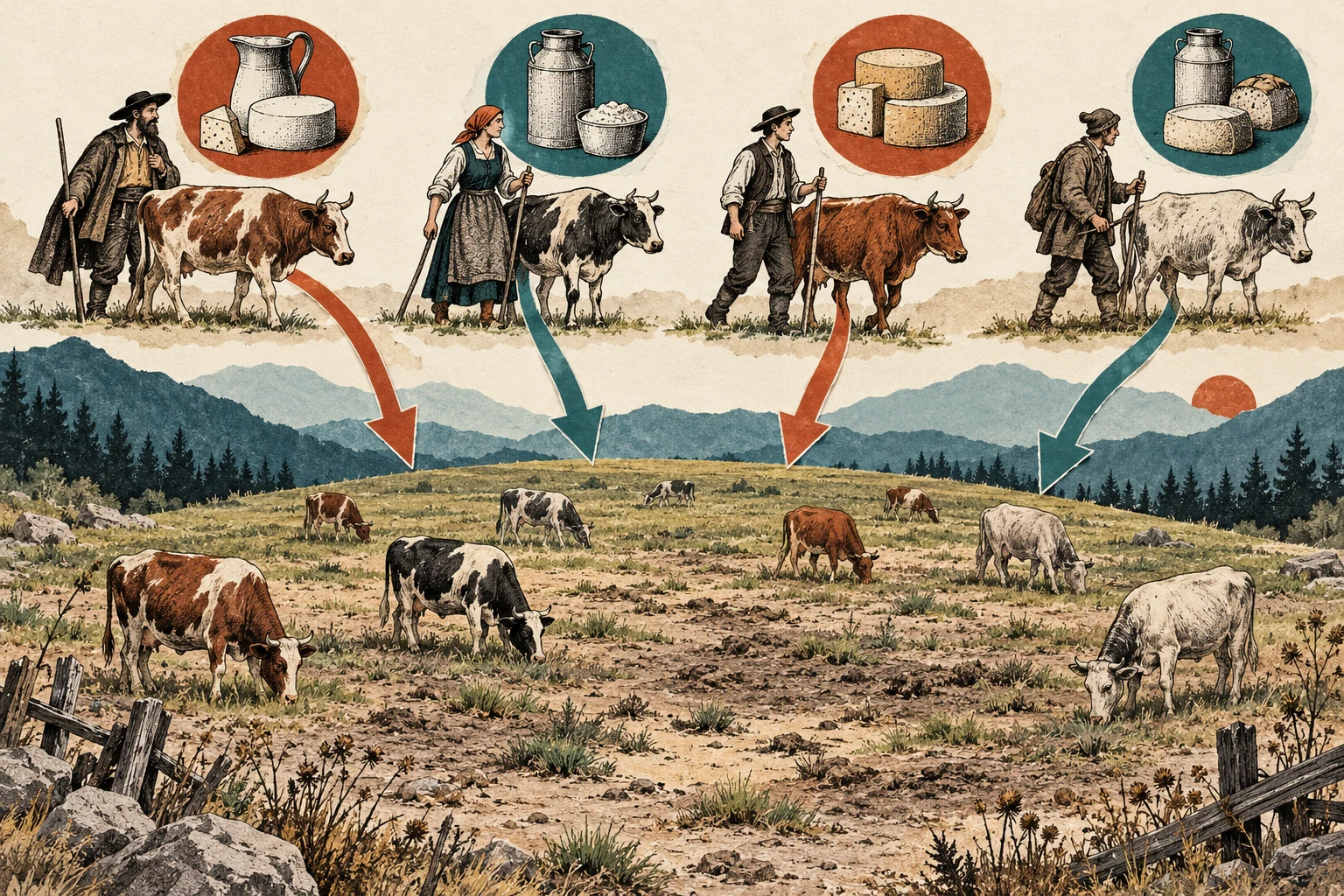
Each user gains by expanding their own grazing while the costs of depletion are shared across all, highlighting how common resources are governed.
AI-assisted illustration · conceptual metaphor View in visual quiz →Genesis and Global Lineage
The parable of the overgrazed pasture comes from an 1833 Oxford lecture by the political economist William Forster Lloyd, while the name was coined by the University of California biologist Garrett Hardin in Science on December 13, 1968. Hardin wrote at the height of neo-Malthusian anxieties over global population growth: the pasture was his metaphor for the planet, and his target was the freedom to breed, which he argued had to be curtailed through “mutual coercion, mutually agreed upon.” Resource economists had already formalized the underlying mechanism: H. Scott Gordon demonstrated in 1954 that an open-access fishery dissipates the entire economic rent of the fish stock. Yet Hardin’s parable was immediately captured by two opposing ideological camps at once: free-market economists used it to argue for sweeping privatization, while state-socialist and regulatory planners used it to argue for centralized state control—both assuming that resource users themselves are helpless to self-organize. Elinor Ostrom overturned that binary in Governing the Commons (1990), documenting Alpine pastures, Japanese mountain forests, and Spanish huerta irrigation communities that had sustainably governed shared resources for centuries without either private titles or state bureaucracy, work that earned her the 2009 Nobel Prize in Economics. Since Ostrom, the “tragedy” is treated in scholarship as a baseline failure mode of open access rather than an inevitable fate.
Central European Lineage
Two distinct threads connect the concept to Central and Eastern Europe. First, Ludwig von Mises—educated at the University of Vienna (doctorate in law, 1906) and for twenty-five years chief economic adviser at the Vienna Chamber of Commerce—formulated a closely related analysis nineteen years before Hardin. In Human Action (1949, Chapter XXIII, §6), examining the limits of property rights and external costs, Mises described the fate of unowned land: those who can extract timber, game, or fish cut down trees without regard for reforestation and use methods that prevent the repopulation of hunting and fishing grounds, ignoring soil erosion and depletion because the costs fall on others. Whereas Mises drew an exclusively property-rights conclusion, Hardin in 1968 (without citing Mises) admitted either privatization or public coercion; the link is an undocumented anticipation. Second, the post-1989 property transition across Central and Eastern Europe and the former Soviet Union inspired the concept’s famous mirror image. Working with the World Bank on post-socialist legal reform in the 1990s, the legal scholar Michael Heller coined the “tragedy of the anticommons” (Harvard Law Review, 1998) to explain why commercial storefronts in post-socialist cities stood vacant while brisk trade filled flimsy sidewalk kiosks: too many municipal agencies, restitution claimants, and insiders held overlapping veto rights over each shop space, proving that excessive fragmentation of exclusion rights can paralyze a resource just as surely as their absence.
Documented regional lineage · Links: 2. Compiled: October 2026.
-
anticipation 19 years
Central European Source: Ludwig von Mises, “Human Action: A Treatise on Economics, Part IV, Ch. XXIII, §6 “The Limits of Property Rights and the Problems of External Costs and External Economies””; Vienna, Austria, 1949
Global Circulation: tragedy of the commons — Garrett Hardin, 1968
-
historical experience 0 years — same text on both sides
Central European Source: Empty storefronts and street kiosks after the fall of communism: fragmented veto rights over commercial premises — Post-1989 property transition in the cities of Central and Eastern Europe and Russia; cities of post-socialist Eastern Europe (incl. Russia), 1998
Global Circulation: tragedy of the anticommons — Michael Heller, 1998
anticipation
19 yearsLudwig von Mises, “Human Action: A Treatise on Economics, Part IV, Ch. XXIII, §6 “The Limits of Property Rights and the Problems of External Costs and External Economies””
1949 · Vienna, Austria
tragedy of the commons
1968 · Garrett Hardin
- Claim & Connection
- Mises, educated at the University of Vienna (doctorate 1906) and active in the Vienna Chamber of Commerce, described in “Human Action” the mechanism of predatory depletion of unowned land: those able to extract crops, timber, game, and fish disregard soil erosion, resource exhaustion, and the replenishment of hunting and fishing grounds because the costs fall on others. This is an earlier formulation of a closely related insight; Hardin in 1968 does not cite Mises and instead derives the problem from William Forster Lloyd’s 1833 pamphlet.
- Source Documentation
-
- primary source Ludwig von Mises, Human Action: A Treatise on Economics, Yale University Press, New Haven 1949; tekst online Library of Economics and Liberty; Part IV, Ch. XXIII, §6: sentences “If land is not owned by anybody…”, “They cut down the trees without any regard for fresh shoots or reforestation.”. econlib.org ↗
- biographical record Wikipedia (en), hasło „Ludwig von Mises”; sections on law studies at the University of Vienna (doctorate 1906), work at the Chamber of Commerce from 1909, and emigration in 1934. en.wikipedia.org ↗
- reception / translation Garrett Hardin, „The Tragedy of the Commons”, Science, Vol. 162, No. 3859, 13 XII 1968, s. 1243–1248; p. 1244: reference to Lloyd (note 6, “Two Lectures on the Checks to Population,” 1833); no reference to Mises in text or notes; full text online via Garrett Hardin Society. garretthardinsociety.org ↗
- Historical Context
- Mises develops this point within a theory of external costs and property rights rather than a theory of the commons; his prescription (privatizing land as it becomes scarce) corresponds to one of the two institutional remedies Hardin admits. The earlier German treatise “Nationalökonomie” appeared in Geneva in 1940; whether it contains the exact same passage was not checked. H. Scott Gordon (1954), outside the region, also formalized the open-access fishery prior to Hardin.
historical experience
0 years — same text on both sidesEmpty storefronts and street kiosks after the fall of communism: fragmented veto rights over commercial premises — Post-1989 property transition in the cities of Central and Eastern Europe and Russia
1998 · cities of post-socialist Eastern Europe (incl. Russia)
tragedy of the anticommons
1998 · Michael Heller
- Claim & Connection
- Michael Heller built the mirror image of the concept—the “tragedy of the anticommons”—in 1998 on observations of post-socialist cities: because multiple public agencies and private claimants held overlapping rights to block the use of the same storefront, shops stood empty while retail trade spilled into metal kiosks on the sidewalks. The regional post-1989 transition served to demonstrate that a deficit of exclusion rights has a symmetrical counterpart in their excess.
- Source Documentation
-
- scholarly study Wikipedia (en), hasło „Tragedy of the anticommons”; paragraph on Heller’s article: Harvard Law Review 111(3), 1998, pp. 621–688, doi:10.2307/1342203; example of empty storefronts and street kiosks in Eastern European cities. en.wikipedia.org ↗
- biographical record Columbia Law School, strona wydziałowa Michaela Hellera; World Bank work on legal transition in post-socialist countries; publication list including the 1998 article. law.columbia.edu ↗
- Historical Context
- Heller’s full article could not be opened directly (JSTOR, doi:10.2307/1342203, paywalled at verification in 2026-10). English Wikipedia and Columbia Law School’s faculty page confirm the bibliographic details, Heller’s World Bank work on post-socialist transition, and the example of empty storefronts and street kiosks across Eastern European cities. The link concerns the historical case rather than the author’s origin.
Why Now
Three developments between 2018 and 2026 have made the tragedy of the commons an acute operational problem. First, climate governance: the global atmosphere is the ultimate open-access sink lacking a binding enforcement regime, and successive UN climate summits illustrate how hard it is to scale Ostrom’s community design principles up to 190 sovereign states. Second, the digital knowledge commons: since 2022, generative artificial intelligence models have been trained by scraping the open web’s text, code, and images as an unpriced common pool, triggering copyright lawsuits, paywalls, and robots.txt blockades—while simultaneously flooding that same web with synthetic outputs that threaten to degrade future training runs. Third, low-Earth orbit and antimicrobial resistance: the rapid deployment of mega-constellations of commercial satellites (raising the risk of a Kessler-syndrome orbital debris cascade) and the overuse of antibiotics in industrial livestock farming (flagged by the WHO as a top-ten global health threat) are textbook cases in which private actors pocket immediate returns while depositing tail risks into a shared planetary pool.
Explanatory Power
The concept separates resource destruction driven by malice from destruction driven by the aggregation of reasonable individual choices: without it, critics blame greed; with it, analysts inspect the incentive structure. Consider three cases. First, Baltic Sea fisheries, where annual cod quotas negotiated among EU member states represent a recurring struggle to replace open access with an enforceable common-pool regime before stocks cross a biological tipping point. Second, agricultural antibiotic use, where each livestock producer has a rational incentive to administer prophylactic antibiotics to prevent herd losses, while the cumulative cost—drug-resistant pathogens—falls on human hospitals worldwide. Third, public attention on digital platforms, where every publisher and advertiser intensifies clickbait and notification frequency to capture a slice of finite user attention, turning the shared information environment into noise. In each domain, the concept shows why moral appeals for self-restraint fail—and why durable solutions require altering access rules, monitoring, and graduated sanctions.
Axes of Debate
Privatization and state coercion versus polycentric self-governance (Mises and Hardin versus Ostrom)
Property-rights economists from Mises to Harold Demsetz argue that assigning clear private ownership is the surest way to make users internalize long-term depletion costs, while state-centric regulators favor top-down quotas; Elinor Ostrom and the Bloomington School counter with hundreds of empirical cases in which local user communities crafted and enforced their own rules more effectively than either market privatization or distant ministries. Strongest counterargument: Critics of romanticizing community governance point out that Ostrom’s successful cases almost all involve small, stable, face-to-face groups managing bounded local resources; for the global atmosphere, the high seas, or the open internet, there are no village elders or natural boundaries, so polycentric norms still require hard state-backed coercion at the macro-level. Nature of the dispute: substantive — both camps agree on the incentive trap of open access while disagreeing on which institutional architecture can scale to planetary resources.
Did Hardin describe a true “commons” or a lawless free-for-all?
Economic historians (such as E. P. Thompson and Susan Jane Buck Cox) and anthropologists point out that historical English and European village commons (including Polish rural land commons, wspólnoty gruntowe) were never open-access pastures: custom and manor courts strictly regulated who could graze how many head of cattle and when (stinting), meaning that Hardin confused a regulated community institution with an unowned free-for-all. Strongest counterargument: Even if Hardin’s historical metaphor was historically inaccurate, his formal model accurately captures resources that genuinely lack exclusion rules—from high-seas fisheries to orbital slots—and Hardin himself later conceded in 1994 that he should have titled his paper “The Tragedy of the Unmanaged Commons.” Nature of the dispute: mixed — the historical correction is substantively right, though it is sometimes used rhetorically to dismiss the very real problem of open-access depletion.
The Malthusian and exclusionary baggage of Hardin’s original text
Historians of science and social critics emphasize that Hardin’s 1968 essay was primarily an argument against reproductive freedom and welfare-state support for large families, and that his 1974 follow-up on “lifeboat ethics” explicitly opposed famine relief for poor nations—embedding natalism and exclusionary politics into the concept’s founding text. Strongest counterargument: A formal incentive model is independent of its author’s political biography: the same game-theoretic structure is used today by climate scientists, fisheries biologists, and commons activists who entirely reject Hardin’s demographic and eugenic prescriptions. Nature of the dispute: mixed — rhetorical insofar as biographical guilt-by-association is used to discredit the model, substantive where it exposes how the choice of metaphor shapes which policy options appear “natural.”
Underappreciated Angle
The most overlooked sentence in Hardin’s 1968 article is his opening declaration that the tragedy of the commons belongs to the class of “no technical solution problems”—problems that cannot be solved by changing only the techniques of the natural sciences while leaving human values or institutional rules untouched. Better fishing sonar only empties the ocean faster; more efficient data-center chips (by Jevons’s paradox) only accelerate the scraping of the digital commons. Equally neglected is Ostrom’s finding about how successful commons actually work: they endure not because community members are altruistic saints, but because rules are written by the users themselves, monitoring is a low-cost byproduct of everyday work, and sanctions are graduated—starting with a mild warning for a first infraction rather than draconian punishment. Most contemporary blueprints for governing global commons (from AI compute governance to carbon markets) ignore both of Ostrom’s conditions, attempting to substitute top-down external surveillance for user-designed rules—the exact institutional configuration that failed most often in her empirical archive.
One-Sentence Takeaway
The tragedy of the commons does not say that human beings are uniquely greedy; it says that open-access rules will turn reasonable people into resource destroyers, which is why the right question is never “who is selfish?” but “who writes the access rules and who monitors the boundary?”
Related Concepts Network
How this concept reinforces, constrains, or complements other analytical frameworks in the corpus. View on graph →
-
Externalities reinforces
The tragedy of the commons is a multi-actor case of negative externalities: each user of the resource shifts most of the depletion cost of their decision onto all other users.
-
Moloch and coordination failure reinforces
Both concepts describe a trap in which individually rational moves aggregate into a collectively ruinous outcome, and escape requires a credible binding commitment.
-
Planetary boundaries reinforces
The atmosphere, oceans, and biodiversity are global common-pool resources for which no durable governance regime in Ostrom’s sense yet exists.
-
Systems thinking complements
Hardin’s pasture is a reinforcing feedback loop hitting a carrying-capacity limit; systems thinking shows where institutions can insert a balancing loop.
-
Jevons paradox complements
Improving the technical efficiency of extracting a shared resource without restricting access can accelerate its exhaustion rather than postponing it.
-
Degrowth in tension
Degrowth reads the tragedy of the commons as an argument for capping the aggregate scale of economic throughput rather than merely redesigning property regimes.
Reading Canon & Translation Bridge
Foundational texts, introductions, and critical perspectives—with availability of English and Polish editions.
-
foundational text 1833 · English
William Forster Lloyd, Two Lectures on the Checks to Population
The Oxford lecture from which Hardin borrowed the parable of the overgrazed common pasture, showing that the core intuition predates the 1968 term by more than a century.
In English: original text written in English
In Polish: Polish edition not verified
-
foundational text 1968 · English
Garrett Hardin, The Tragedy of the Commons
The six pages in “Science” that named the phenomenon and tied it to population growth; essential reading not least to see how much of the text is structural argument and how much is Malthusian rhetoric.
In English: original text written in English
In Polish: Polish edition not verified
-
cross-disciplinary 1954 · English
H. Scott Gordon, The Economic Theory of a Common-Property Resource: The Fishery
Resource economics fourteen years before Hardin: a formal model of an open-access fishery in which resource rent is dissipated through overfishing (“Journal of Political Economy” 62(2), 1954, pp. 124–142).
In English: original text written in English
In Polish: Polish edition not verified
-
critical perspective 1990 · English
Elinor Ostrom, Governing the Commons: The Evolution of Institutions for Collective Action
The empirical refutation of Hardin’s fatalism: case studies of communities that sustainably governed pastures, forests, and irrigation systems for centuries without either state control or privatization, distilled into eight design principles.
In English: original text written in English
In Polish: “Dysponowanie wspólnymi zasobami”, Wolters Kluwer Polska 2013, trans. Zofia Wiankowska-Ładyka
-
cross-disciplinary 1949 · English
Ludwig von Mises, Human Action: A Treatise on Economics
Chapter XXIII, §6 offers a concise Austrian-school explanation of how the absence of property rights leads to predatory depletion of land, forests, and fisheries—a sharp foil to Ostrom’s institutionalism.
In English: original text written in English
In Polish: “Ludzkie działanie. Traktat o ekonomii”, Instytut Ludwiga von Misesa 2007, trans. Witold Falkowski
-
critical perspective 1998 · English
Michael A. Heller, The Tragedy of the Anticommons: Property in the Transition from Marx to Markets
The mirror inversion of the problem: when too many actors hold rights to block the use of a resource, the resource sits idle—a legal demonstration that privatization is no automatic panacea (“Harvard Law Review” 111(3), 1998, pp. 621–688).
In English: original text written in English
In Polish: Polish edition not verified
-
introduction & synthesis 2010 · English
Amy R. Poteete, Marco A. Janssen, Elinor Ostrom, Working Together: Collective Action, the Commons, and Multiple Methods in Practice
A synthesis of forty years of commons scholarship combining field studies, laboratory experiments, and agent-based models (Princeton University Press, 2010).
In English: original text written in English
In Polish: Polish edition not verified
Primary-Source Quotes
Ruin is the destination toward which all men rush, each pursuing his own best interest in a society that believes in the freedom of the commons. Freedom in a commons brings ruin to all.
They cut down the trees without any regard for fresh shoots or reforestation. In hunting and fishing they do not shrink from methods preventing the repopulation of the hunting and fishing grounds.