Horizon & Ecology #163
Existential risk
original term: existential risk (Eng.) · x-risk, katastrofa egzystencjalna, ryzyko globalnej katastrofy
Central European lineage: 1 thread (anticipation) · 1955–2002 · jump to documentation ↓
Working Definition
An existential risk (x-risk) is the risk of an event that would either annihilate Earth-originating intelligent life or permanently and drastically curtail its potential for future development. The definition has two prongs, and the second is more consequential than it first appears: it encompasses not only biological extinction, but also an irreversible civilizational collapse or a permanently locked-in totalitarian tyranny from which humanity could never rebuild its future. What separates existential risk from global catastrophic risk (a severe pandemic, a world war, or climate breakdown claiming hundreds of millions of lives) is the criterion of irreversibility: a disaster from which humanity eventually recovers is catastrophic, not existential. In everyday media usage, the term is routinely diluted to mean “anything very dangerous,” stripping it of its analytical force.
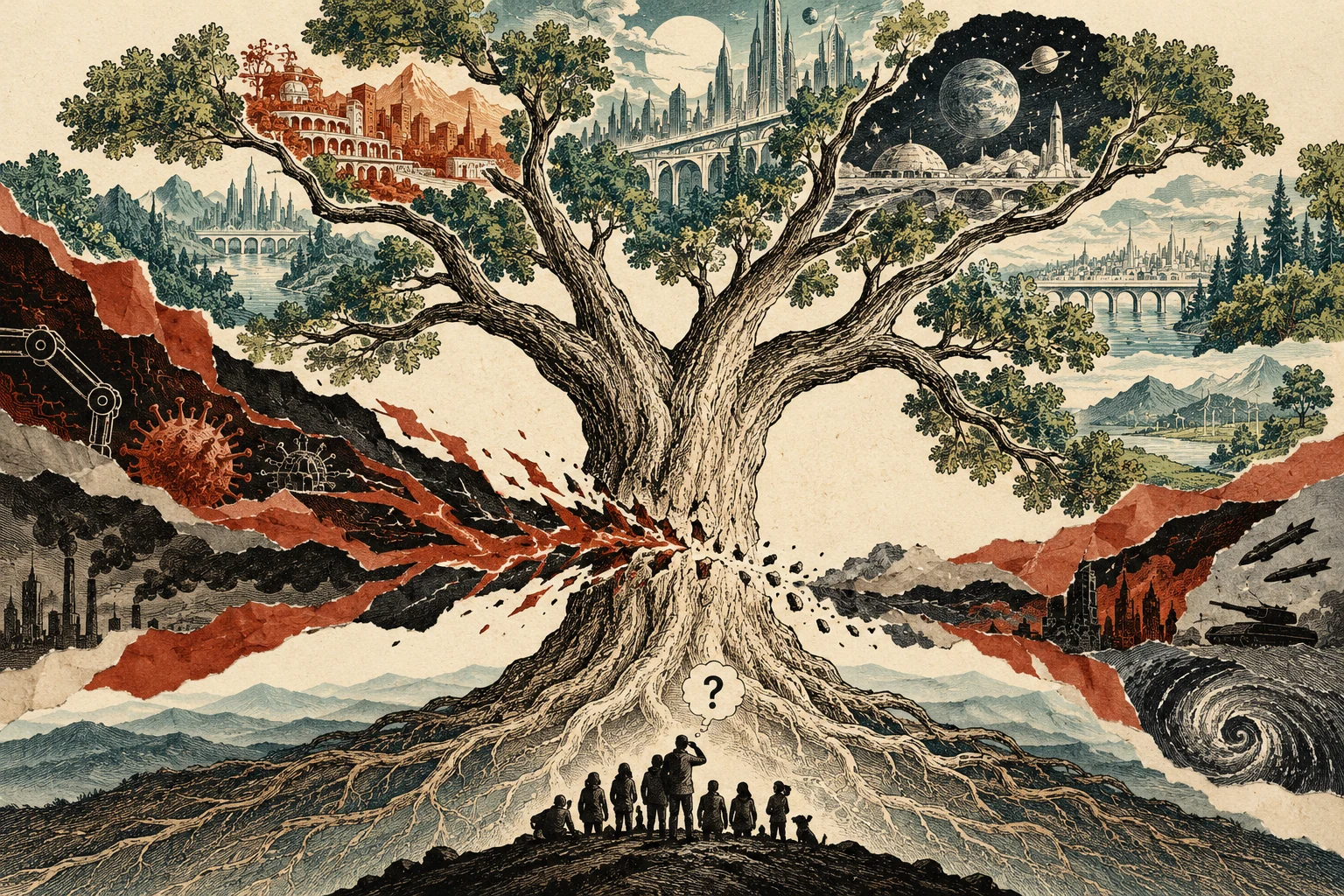
Severing the shared trunk threatens the entire canopy of future possibilities; the stakes involve permanently foreclosing humanity's potential, not just a severe present loss.
AI-assisted illustration · conceptual metaphor View in visual quiz →Genesis and Global Lineage
Nick Bostrom introduced the term and its conceptual framework in Existential Risks: Analyzing Human Extinction Scenarios and Related Hazards (Journal of Evolution and Technology, 2002; first draft 2001), proposing a fourfold typology (bangs, crunches, shrieks, whimpers) and an initial catalog of threats ranging from molecular nanotechnology and unaligned superintelligence to physics-experiment disasters. The argument reached its mature form in Existential Risk Prevention as Global Priority (Global Policy, 2013), which elaborated the maxipok rule already sketched in 2002: maximize the probability of an “okay outcome,” defined as any outcome that avoids existential catastrophe. Its backdrop included earlier Cold War and fin-de-siècle writing on human extinction—Jonathan Schell (The Fate of the Earth, 1982), John Leslie (The End of the World, 1996), and Martin Rees (Our Final Hour, 2003)—together with the transhumanist-utilitarian school centered on Oxford’s Future of Humanity Institute (2005–2024). Philosophically, the concept builds on Derek Parfit’s argument in Reasons and Persons (1984) that the moral difference between a war that kills 99% of humanity and one that kills 100% is vastly greater than the difference between 0% and 99%. In the 2020s, the concept was captured by two opposing circuits: the AI industry, where “existential risk” became simultaneously a warning and a marketing boast about model power, and critics who group it under the acronym TESCREAL alongside longtermism and transhumanism.
Central European Lineage
John von Neumann articulated a closely related diagnosis half a century earlier. Known to English-language readers primarily as an architect of Princeton mathematics and American Cold War strategy, von Neumann received his formative intellectual training in Budapest, attending the renowned Lutheran Fasori Gimnázium and earning his doctorate in mathematics at the University of Budapest in 1926 alongside chemical engineering studies in Zurich. In his June 1955 Fortune essay Can We Survive Technology?, he framed the problem of human survival at the exact planetary scale later adopted by the existential-risk literature: technological power had caught up with the physical dimensions of the Earth, the destructive reach of offensive weapons invalidated all realistic scales of defense, and “the finite, actual size of the earth” had for the first time become a critical constraint on survival. There is no evidence that this essay directly influenced Bostrom: in his 2002 paper, von Neumann appears only in a footnote via a secondhand remark that nuclear war was certain and would kill everyone. Von Neumann’s Budapest years explain his intellectual formation rather than the immediate context of the 1955 essay, which grew out of American thermonuclear strategy.
Documented regional lineage · Link: 1. Compiled: October 2026.
-
anticipation 47 years
Central European Source: John von Neumann, “Can We Survive Technology?”; Budapest, Hungary, 1955
Global Circulation: existential risk — Nick Bostrom, 2002
anticipation
47 yearsJohn von Neumann, “Can We Survive Technology?”
1955 · Budapest, Hungary
existential risk
2002 · Nick Bostrom
- Claim & Connection
- In his June 1955 essay, John von Neumann—educated in Budapest (the Lutheran Fasori Gimnázium and a doctorate in mathematics at the University of Budapest in 1926)—posed the question of human survival in the face of technology whose scale of operation had caught up with the scale of the planet: the effectiveness of offensive weapons invalidates all realistic scales of defense, and the finite size of the Earth becomes a critical constraint for the first time. This is an earlier formulation of a similar idea; in his foundational 2002 article, Bostrom does not cite this essay, mentioning only (in fn. 4, after Putnam) a reported remark by von Neumann on the certainty of a nuclear war in which everyone would perish.
- Source Documentation
-
- primary source John von Neumann, „Can We Survive Technology?”, Fortune, czerwiec 1955 (przedruk w sieci Fortune, 13 I 2013); paragraphs on the finite size of the Earth (“the finite, actual size of the earth”) and the effectiveness of offensive weapons; the conclusion of the essay was not opened. fortune.com ↗
- reception / translation Nick Bostrom, „Existential Risks: Analyzing Human Extinction Scenarios and Related Hazards”, Journal of Evolution and Technology, Vol. 9, No. 1, 2002; fn. 4: reported remark by von Neumann on the inevitability of nuclear war; Section 1.2: definition. nickbostrom.com ↗
- biographical record Wikipedia (en), hasło „John von Neumann”; education section: Fasori Evangélikus Gimnázium, doctorate at the University of Budapest (Pázmány Péter) 1926, concurrently ETH Zurich 1926. en.wikipedia.org ↗
- Historical Context
- The link concerns an earlier formulation of the problem, not a direct influence on Bostrom. Von Neumann's mathematical formation took place in Budapest concurrently with studies in Berlin and Zurich; his later career (Göttingen, Princeton, Los Alamos) lies outside the region. The full text of the essay (its conclusion) and the source cited by Bostrom for the anecdote were not checked. Fact review 2026-10-24: the Fortune online reprint (page dated June 1, 1955, text truncated before the end) contains both cited sentences; fn. 4 in Bostrom (after Putnam 1979) and the absence of a citation to the essay are confirmed; educational details match Wikipedia.
Why Now
Between 2018 and 2026, the center of gravity of existential risk shifted from academic philosophy to high-level politics. Toby Ord’s book The Precipice (March 2020) appeared in the very weeks when the COVID-19 pandemic demonstrated how poorly global institutions handle even a moderate catastrophic risk, let alone an existential one; Ord published explicit subjective probability estimates (a 1-in-6 total existential risk this century, including 1-in-10 from unaligned artificial general intelligence, or AGI). The UN Secretary-General incorporated “existential risks” into Our Common Agenda (2021), and the Pact for the Future adopted at the UN Summit of the Future (September 2024) institutionalized the language of intergenerational survival. Following the release of GPT-4 (March 2023), a May 2023 single-sentence statement issued by the Center for AI Safety and signed by the CEOs of OpenAI, Google DeepMind, and Anthropic equated “the risk of extinction from AI” with pandemics and nuclear war, while the intergovernmental Bletchley Declaration (November 2023) warned of serious, even catastrophic harm from frontier models. Meanwhile, the Bulletin of the Atomic Scientists moved its Doomsday Clock to 90 seconds to midnight (January 2023), 89 seconds (January 2025), and 85 seconds (January 2026). Conversely, the collapse of the cryptocurrency exchange FTX (November 2022)—a major funder of x-risk institutions—and Oxford’s closure of the Future of Humanity Institute (April 2024) triggered a fierce backlash over whose political and commercial interests the existential-risk frame actually serves.
Explanatory Power
The concept enforces a distinction that everyday language blurs: between the magnitude of a harm and its irreversibility. First, it reorders policy priorities by the product of probability and irreversibility rather than body count alone, explaining why in Ord’s calculus an asteroid impact (well studied and exceedingly improbable) weighs far less than an engineered pandemic. Second, it explains why markets and electoral politics systematically underinvest in survival: because the benefits of avoiding extinction accrue overwhelmingly to future generations who neither vote nor buy goods today, existential safety is a global public good across time. Third, it exposes an epistemic asymmetry: humanity cannot learn to manage existential risk by trial and error, because the first fatal mistake is also the last, meaning evidence will always remain indirect and contested. That asymmetry explains both the urgency of x-risk researchers and the frustration of critics who demand empirical track records where none can exist by definition.
Axes of Debate
Expected-value calculus versus numerical fanaticism
Moral philosophers and decision theorists (including Émile P. Torres and critics of “fanaticism” in population ethics) argue that multiplying astronomical numbers of hypothetical future lives by tiny probabilities can justify sacrificing almost any present good and crowds out every ordinary moral claim. Strongest counterargument: Ord and Bostrom reply that their core argument does not require astronomical numbers: one need only accept that human extinction is worse than any recoverable catastrophe and that our generation has real leverage over that risk for current global spending (a tiny fraction of a percent of world GDP) to appear indefensibly low. Nature of the dispute: substantive — it turns on whether and how moral value can be aggregated across generations under extreme uncertainty.
Which risks count as “existential”: AI versus climate and the biosphere
Earth-system scientists and environmental philosophers point out that the canonical x-risk literature classifies climate change and biodiversity loss as predominantly catastrophic rather than existential, diverting elite attention and philanthropic capital toward speculative superintelligence. Strongest counterargument: Defenders of the strict boundary reply that analytical precision is the entire value of the concept: if warming below runaway thresholds does not literally extinguish humanity, calling it an existential risk is rhetoric rather than analysis, and dulls our only tool for singling out strictly irreversible threats. Nature of the dispute: mixed — the debate over physical thresholds and feedback loops is substantive, whereas the struggle over attention and funding is largely rhetorical.
Genuine warning versus corporate marketing strategy
Critical AI scholars (Timnit Gebru and Torres, writing under the rubric of the TESCREAL bundle) contend that tech firms invoke human extinction to portray their products as godlike in power, deflect regulation away from present-day labor and copyright harms, and cast themselves as humanity’s indispensable guardians. Strongest counterargument: Regardless of industry motives, the concept was formulated two decades before the current generative-AI boom, and many x-risk researchers advocate hardware caps and licensing regimes far stricter than any lab wants; a genealogy of motives does not refute a physical or technical risk. Nature of the dispute: rhetorical — the two camps argue primarily over who has the legitimacy to speak about the future rather than over specific probability estimates.
Underappreciated Angle
The least scrutinized part of Bostrom’s definition is its second clause: “permanently and drastically curtail its potential.” Biological extinction is at least clear-cut, but who decides which futures count as a “curtailment of potential” and which count simply as a different human path? If humanity consciously chose to renounce space colonization or radical biological self-modification, Bostrom’s accounting would classify that restraint as an existential catastrophe, whereas many ethical and religious traditions would call it wisdom. Beneath the appearance of a neutral threat definition, the concept smuggles in a maximalist theory of the human good. That is also why thinkers like John von Neumann and Hans Jonas remain more durable guides here than many contemporary longtermists: both asked how humanity might survive its own technical power without presupposing a single mandatory blueprint for a flourishing future, and Jonas turned uncertainty itself into a method by giving priority to the bad prognosis over the good whenever irreversible stakes are on the table.
One-Sentence Takeaway
Existential risk is the only class of risk that humanity can never learn to estimate through trial and error, which is why every dispute over it is ultimately a dispute over how much we can know without running the experiment.
Related Concepts Network
How this concept reinforces, constrains, or complements other analytical frameworks in the corpus. View on graph →
-
Longtermism reinforces
Existential risk is the central argument of longtermism: if the future can be vast, losing it entirely matters far more than any catastrophe from which humanity can recover.
-
AI alignment reinforces
Misaligned artificial intelligence is treated in the literature as the largest single source of existential risk, and alignment is the proposed remedy.
-
Black Swan complements
Both concepts deal with tail events, but existential risk precludes trial-and-error learning because the catastrophe is by definition one-off and final.
-
Precautionary principle complements
The precautionary principle and Bostrom's maxipok rule are two responses to irreversibility, differing in whether they protect the present state or future potential.
-
Fermi paradox complements
The silence of the cosmos is often read as indirect evidence that technological civilizations generally fail to pass through the “Great Filter” of their own power.
-
Planetary boundaries in tension
The existential-risk literature typically classifies climate and biosphere breakdown as catastrophic rather than existential, which Earth-system researchers criticize as dangerous downplaying.
-
Moloch and coordination failure reinforces
Most anthropogenic existential risks arise from multipolar races in which each actor rationally accelerates even though all would prefer to slow down.
Reading Canon & Translation Bridge
Foundational texts, introductions, and critical perspectives—with availability of English and Polish editions.
-
foundational text 2002 · English
Nick Bostrom, Existential Risks: Analyzing Human Extinction Scenarios and Related Hazards
The article that named the concept and introduced its first typology (bangs, crunches, shrieks, whimpers); available in full online.
In English: original text written in English
In Polish: Polish edition not verified
-
foundational text 2013 · English
Nick Bostrom, Existential Risk Prevention as Global Priority
The mature version of the argument in “Global Policy” (vol. 4, no. 1, pp. 15–31): definition via human potential, the maxipok rule, and the calculation showing why even tiny risk reductions outweigh other goals.
In English: original text written in English
In Polish: Polish edition not verified
-
introduction & synthesis 2020 · English
Toby Ord, The Precipice: Existential Risk and the Future of Humanity
The most comprehensive introduction for general readers, offering explicit probability estimates (1 in 6 total risk this century, 1 in 10 from unaligned AI) and a history of threats from the Trinity test to pandemics.
In English: original text written in English
In Polish: Polish edition not verified
-
critical perspective 2024 · English
Émile P. Torres, Human Extinction: A History of the Science and Ethics of Annihilation
A history of the idea of human extinction from the Pre-Socratics to contemporary “x-risk,” written by a former participant in the movement who became its sharpest critic.
In English: original text written in English
In Polish: Polish edition not verified
-
critical perspective 2024 · English
Timnit Gebru, Émile P. Torres, The TESCREAL bundle: Eugenics and the promise of utopia through artificial general intelligence
An article in “First Monday” (vol. 29, no. 4) linking AI existential-risk rhetoric to the genealogy of eugenics and the commercial interests of AGI companies; polemical, but defines the main line of critique.
In English: original text written in English
In Polish: Polish edition not verified
-
cross-disciplinary 1979 · German
Hans Jonas, Das Prinzip Verantwortung. Versuch einer Ethik für die technologische Zivilisation
A philosophical precursor: the imperative to act so that the effects of one's action are compatible with the permanence of genuine human life on Earth, and the “heuristics of fear” as an ethical method in the face of irreversibility.
In English: English edition not verified
In Polish: “Zasada odpowiedzialności. Etyka dla cywilizacji technologicznej”, Platan 1996, trans. Marek Klimowicz (apendyks „Moc i niemoc subiektywności”: Tomasz Kowalski)
-
cross-disciplinary 1964 · Polish
Stanisław Lem, Summa Technologiae
A treatise on a civilization without technological limits that asks about the boundaries of “omnipotence” and whether humanity's problems will outgrow its intellect; provides context for whether technical power is self-destructive.
In English: “Summa Technologiae”, University of Minnesota Press 2013, trans. Joanna Zylinska
In Polish: original text written in Polish
Primary-Source Quotes
One where an adverse outcome would either annihilate Earth-originating intelligent life or permanently and drastically curtail its potential.
At long last, we begin to feel the effects of the finite, actual size of the earth in a critical way.