Systems & Complexity #065
Climate tipping points
original term: climate tipping points (Eng.) · klimatyczne punkty krytyczne, punkty przełomowe klimatu, elementy progowe systemu Ziemi (tipping elements)
Global-circulation concept — no documented lineage in Central Europe. jump to documentation ↓
Working Definition
A climate tipping point is a critical threshold beyond which a small additional perturbation in forcing—typically global mean surface temperature—triggers a self-sustaining transition in a large-scale component of the Earth system that cannot be reversed simply by dialing back the forcing. A subsystem capable of such behavior is called a tipping element: examples include the Greenland and West Antarctic ice sheets, the Atlantic Meridional Overturning Circulation (AMOC), the Amazon rainforest, and boreal permafrost. In popular usage, the phrase denotes any political “point of no return” in climate action; in technical usage, it describes a bifurcation in a dynamical system exhibiting hysteresis and its own intrinsic transition timescale, ranging from decades to millennia. The concept does not say that the resulting shift will be instantaneous, only that once initiated it becomes irreversible on human timescales.
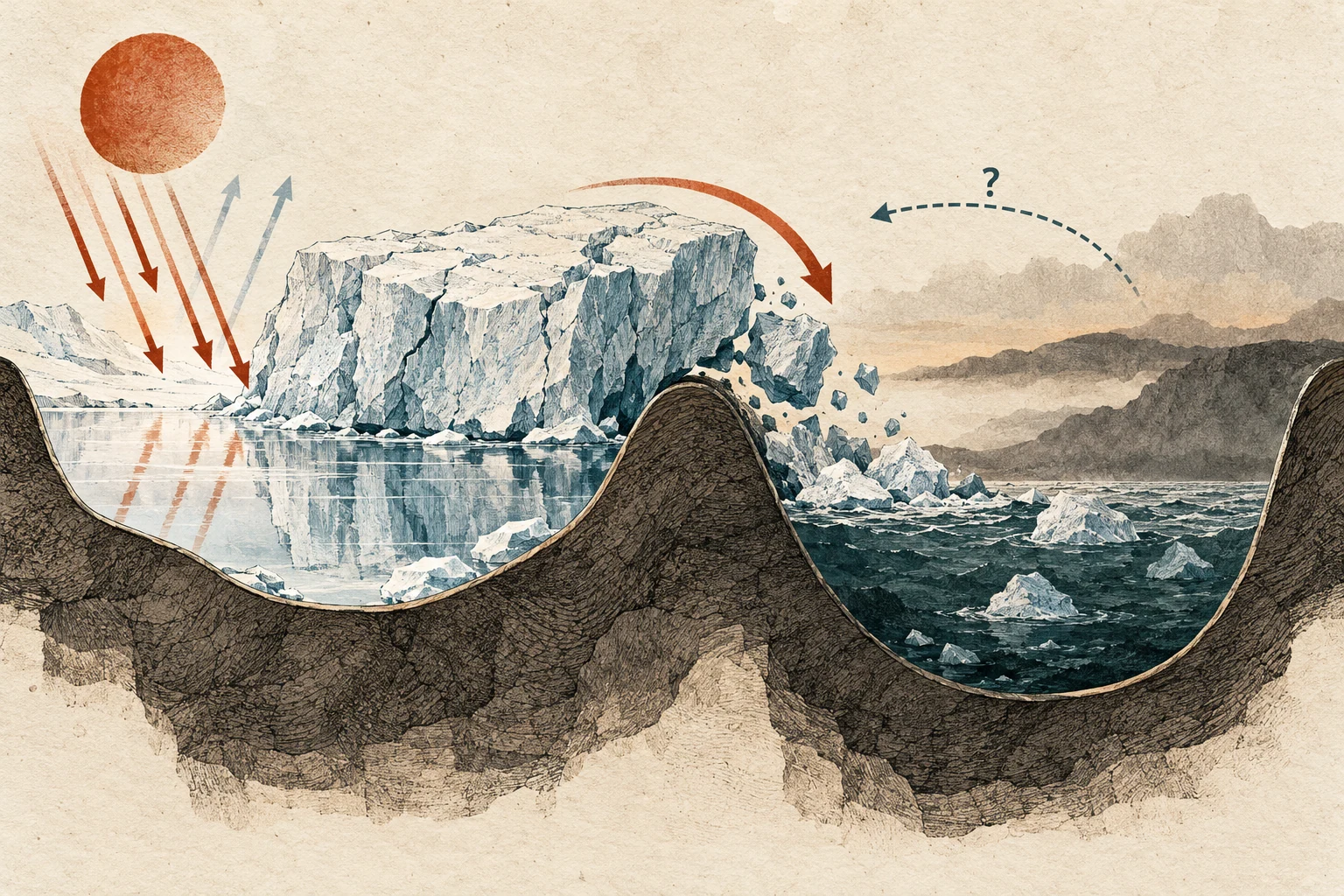
Once pushed past a threshold, a system can shift into a new state that is hard to reverse; the illustration does not plot a measurement of a specific climate threshold.
AI-assisted illustration · conceptual metaphor View in visual quiz →Genesis and Global Lineage
The physical core of the concept is older than its name: in 1961 Henry Stommel demonstrated that thermohaline ocean circulation can possess two stable equilibrium states and jump abruptly between them, and energy-balance climate models at the end of the 1960s revealed the runaway potential of the ice–albedo feedback. Meanwhile, the phrase tipping point traveled through the sociology of neighborhood racial segregation (Morton Grodzins and Thomas Schelling) and Malcolm Gladwell’s 2000 bestseller, from which climate communicators and scientists borrowed it in the mid-2000s. The canonical scientific formulation was provided in a 2008 PNAS paper led by Timothy Lenton with six co-authors, including Stefan Rahmstorf and Hans Joachim Schellnhuber of the Potsdam Institute for Climate Impact Research: it established a formal definition of a “tipping element,” a shortlist of nine policy-relevant candidates, and the prospect of statistical early warning systems. A second wave arrived between 2018 and 2022: the “Hothouse Earth” paper by Will Steffen and colleagues (2018), the 2019 Nature commentary by Lenton and co-authors that used the danger of tipping cascades to argue for a “planetary emergency,” and the 2022 Science synthesis by David Armstrong McKay and colleagues, which expanded the inventory to sixteen tipping elements with explicit temperature brackets. In parallel, climate movements and media commentary adopted the term as a shorthand for imminent global collapse, blurring the technical distinction between committing to a transition and the speed at which it unfolds.
Central European Lineage
We found no documented link between this concept and the intellectual history or historical experience of Central Europe.
We found no documented link between this concept and the intellectual history or historical experience of Central Europe (by our methodology, this means “none found,” not “none exists”; as of October 2026).
Why Now
Three milestones between 2018 and 2026 turned climate tipping points from a specialist modeling heuristic into a central instrument of international climate politics. First, the 2018 IPCC Special Report on Global Warming of 1.5°C and the “Hothouse Earth” paper of the same year shifted attention from smooth mean projections to nonlinear tail risks, giving climate advocacy a concrete language of thresholds. Second, the November 2019 Nature commentary argued that several tipping elements already show signs of destabilization, and the 2022 Science review assigned them explicit warming ranges, several of which begin below or around 1.5°C. Third, the Global Tipping Points Report—first issued in 2023 and updated ahead of COP30 in 2025 under Lenton’s coordination at the University of Exeter—concluded that warm-water coral reefs are already crossing their thermal threshold at current warming levels and that any temporary overshoot above 1.5°C pushes the planet into a high-risk zone. Against a backdrop of record global temperatures in 2023–2024, weakening proxy signals in the Atlantic circulation, and severe droughts in the Amazon basin, the concept became indispensable because conventional policy models built on smooth damage functions could not articulate why every tenth of a degree matters.
Explanatory Power
The concept decouples two moments that talk of “warming by X degrees” routinely conflates: the moment of commitment and the moment of full impact. First, it makes visible how the Greenland ice sheet can be condemned to eventual loss within this century even though its physical melting will take millennia; a policy horizon truncated at the year 2100 remains blind to that commitment. Second, it explains the stark asymmetry of temperature overshoot: a pathway in which global temperature temporarily exceeds 1.5°C before being drawn back down via carbon removal is not equivalent to staying below 1.5°C if a hysteretic threshold is crossed along the way. Third, it provides a framework for analyzing cascades: the loss of Arctic summer sea ice alters the freshwater budget of the North Atlantic, a weakened Atlantic circulation shifts the intertropical convergence zone and monsoon belts, and shifted monsoons threaten the dieback of tropical forests. Without the concept of coupled tipping elements, these appear as separate regional problems; with it, they form an interacting network in which systemic risk is a property of the whole rather than the sum of parts.
Axes of Debate
Planetary emergency versus integrated risk management
Earth-system scientists behind the 2019 Nature commentary and the Exeter reports argue that the mere possibility of an irreversible cascade under deep threshold uncertainty justifies emergency mobilization; climate economists such as Robert Kopp and Gernot Wagner reply from the standpoint of integrated assessment modeling that only a subset of tipping elements produce rapid shocks on human timescales, while others represent slow commitments unfolding over centuries. Strongest counterargument: If an ice-sheet transition takes five hundred years to play out, then under any positive discount rate and realistic capacity for coastal adaptation, calling it an immediate “emergency” is political rhetoric rather than a deduction from the physics; lumping fast decadal shifts together with millennial commitments in a single table is a category mistake. Nature of the dispute: mixed — disagreements over transition timescales are empirically tractable, whereas the battle over the word “emergency” concerns who holds the mandate to define political urgency.
Can thresholds be detected in advance
The early-warning-signals school (Marten Scheffer, Timothy Lenton) holds that universal dynamical indicators—such as critical slowing down and rising lag-1 autocorrelation or variance in observational time series—reveal when a subsystem is losing resilience and approaching a bifurcation; skeptics in physical climate modeling counter that these statistical signals break down under noise-induced or rate-induced tipping and are often identifiable in paleoclimate records only with hindsight. Strongest counterargument: For several headline candidates, including the AMOC, climate models do not even agree on whether a bistable threshold exists within realistic twenty-first-century forcing ranges, so claiming to detect “early warnings” of a collapse means reading a contested model hypothesis into short, noisy observational records. Nature of the dispute: substantive — it turns on the statistical power of time-series methods and the fidelity of paleoclimate reconstructions rather than value judgments.
Mobilizing warning versus paralyzing doomism
Science communicators and several prominent climatologists warn that “past the point of no return” framing breeds fatalism (climate doomism) and undermines public support for emissions cuts, whereas climate advocates and the authors of the tipping-points assessments see threshold risk as the single strongest argument for why every fraction of a degree of avoided warming counts. Strongest counterargument: Crossing one threshold does not render the others irrelevant; on the contrary, the cascade model is the sharpest argument against fatalism because it demonstrates that every tenth of a degree of warming prevented halts a specific domino that could otherwise destabilize the next. Nature of the dispute: rhetorical — both sides agree on the underlying Earth-system physics while disagreeing over the psychology of public persuasion.
Underappreciated Angle
The most fertile conceptual turn in recent years is the inversion of the framework: the very nonlinear properties that make the physical climate fragile near a threshold also characterize the socio-technical systems that drive emissions. Recent reports from the Exeter group develop a formal program of “positive tipping points” in solar photovoltaics, electric mobility, heat pumps, and dietary shifts—identifying price, infrastructural, and social-norm thresholds beyond which the adoption of clean technologies becomes self-accelerating. The analytical consequence is profound: if the twenty-first century is a race between a destructive cascade in the Earth system and a constructive cascade in socio-technical systems, then the core question of climate policy is not “what linear percentage of emissions will we cut by 2050?” but “which of two coupled nonlinear systems will cross its threshold first?” That shift moves the policy center of gravity from moral exhortation to targeted interventions—subsidies, procurement standards, and grid mandates—designed to push key clean-technology markets across their own tipping points so that reinforcing market feedbacks do the rest of the work.
One-Sentence Takeaway
A climate tipping point does not tell us when disaster will finish unfolding, but when what we choose to do afterward stops being able to call it back.
Related Concepts Network
How this concept reinforces, constrains, or complements other analytical frameworks in the corpus. View on graph →
-
Systems thinking reinforces
A climate tipping point is the most tangible example of a positive feedback loop that, beyond a critical threshold, ceases to be damped by negative feedbacks.
-
Complexity science complements
Bifurcation theory and early warning signals (critical slowing down) supply climate tipping points with the mathematical apparatus borrowed from ecology and dynamical systems physics.
-
Planetary boundaries complements
Johan Rockström’s planetary boundaries define a “safe operating space” specifically designed to keep humanity well clear of nonlinear Earth-system thresholds.
-
Anthropocene reinforces
The “Hothouse Earth” trajectory frames the Anthropocene as a sequence of cascading climate tipping points.
-
Black Swan in tension
Crossing a threshold is often portrayed as a bolt from the blue, whereas the tipping-points literature argues that thresholds can be mapped in advance and are therefore not Black Swans.
-
Existential risk complements
“Climate Endgame” scenarios ground assessments of catastrophic risk in cascades across tipping elements rather than in smooth, linear warming.
-
Polycrisis reinforces
The model of cascades across coupled tipping elements serves as the physical prototype for reasoning about mutually reinforcing global crises.
Reading Canon & Translation Bridge
Foundational texts, introductions, and critical perspectives—with availability of English and Polish editions.
-
foundational text 2008 · English
Timothy M. Lenton, Hermann Held, Elmar Kriegler, Jim W. Hall, Wolfgang Lucht, Stefan Rahmstorf, Hans Joachim Schellnhuber, Tipping elements in the Earth's climate system
The landmark paper in PNAS (vol. 105, no. 6, pp. 1786–1793) that introduced a formal definition of a “tipping element” and the first shortlist of nine policy-relevant candidates, inaugurating the modern scientific literature on the concept.
In English: original text written in English
In Polish: no Polish edition
-
foundational text 2019 · English
Timothy M. Lenton, Johan Rockström, Owen Gaffney, Stefan Rahmstorf, Katherine Richardson, Will Steffen, Hans Joachim Schellnhuber, Climate tipping points — too risky to bet against
A commentary in “Nature” that carried the concept from specialist literature into wider public debate, arguing that the risk of tipping cascades justifies declaring a planetary emergency.
In English: original text written in English
In Polish: no Polish edition
-
introduction & synthesis 2022 · English
David I. Armstrong McKay i in., Exceeding 1.5°C global warming could trigger multiple climate tipping points
A comprehensive review in “Science” updating the inventory to sixteen tipping elements with estimated temperature thresholds; the most widely cited synthesis today, directly linking the concept to the 1.5°C Paris target.
In English: original text written in English
In Polish: no Polish edition
-
introduction & synthesis 2018 · English
Will Steffen i in., Trajectories of the Earth System in the Anthropocene
The “Hothouse Earth” paper in PNAS: shows how a cascade of biogeophysical feedbacks could lock in warming even after human emissions are cut, bringing the image of a planetary threshold into policy language.
In English: original text written in English
In Polish: no Polish edition
-
critical perspective 2016 · English
Robert E. Kopp, Rachael L. Shwom, Gernot Wagner, Jiacan Yuan, Tipping elements and climate–economic shocks: Pathways toward integrated assessment
Dismantles the popular image of an overnight cliff: many thresholds represent an irreversible commitment to a change that still unfolds over centuries, and their link to immediate economic shocks remains poorly documented.
In English: original text written in English
In Polish: no Polish edition
-
cross-disciplinary 2009 · English
Marten Scheffer, Critical Transitions in Nature and Society
A foundational textbook on critical transitions in lakes, ecosystems, and societies that supplied climatology with the formal vocabulary of bifurcations, hysteresis, and early warning signals.
In English: original text written in English
In Polish: Polish edition not verified
-
cross-disciplinary 2022 · English
Luke Kemp i in., Climate Endgame: Exploring catastrophic climate change scenarios
Sets out a research agenda on worst-case climate scenarios from an existential-risk perspective, showing what climate tipping points imply for systemic risk assessment.
In English: original text written in English
In Polish: no Polish edition
-
introduction & synthesis 2019 · English
David Wallace-Wells, The Uninhabitable Earth: Life After Warming
A journalistic-essayistic synthesis that popularized cascading scenarios for a mass audience; best read as a document of the concept’s cultural reception rather than a primary source of physical data.
In English: original text written in English
In Polish: Polish edition not verified
Primary-Source Quotes
Here we introduce the term “tipping element” to describe large-scale components of the Earth system that may pass a tipping point.