Parasocial relationships
original term: parasocial relationships (Eng.) · interakcja paraspołeczna, więź paraspołeczna, parasocial interaction
Global-circulation concept — no documented lineage in Central Europe. jump to documentation ↓
Working Definition
A parasocial relationship is an enduring, one-sided emotional bond that an audience member forms with a mediated persona—a broadcaster, celebrity, influencer, fictional character, or synthetic avatar—who does not know the audience member personally and cannot reciprocate the individual attachment. What distinguishes it from ordinary admiration for a performer is that the audience member processes the media figure through the cognitive and emotional scripts of real-life friendship: anticipating their reactions, worrying about their well-being, feeling personally betrayed by their scandals, and experiencing grief when they vanish from the screen. Contemporary scholarship strictly separates parasocial interaction (PSI)—the momentary conversational illusion of face-to-face give-and-take triggered during viewing when a performer looks into the lens—from a parasocial relationship (PSR), the cross-situational socio-emotional bond that persists long after the screen is turned off. While everyday internet slang has narrowed the word to mean “creepy obsession with an influencer,” Donald Horton and R. Richard Wohl originally formulated it to describe a normal, ubiquitous feature of modern mediated life rather than a clinical pathology.
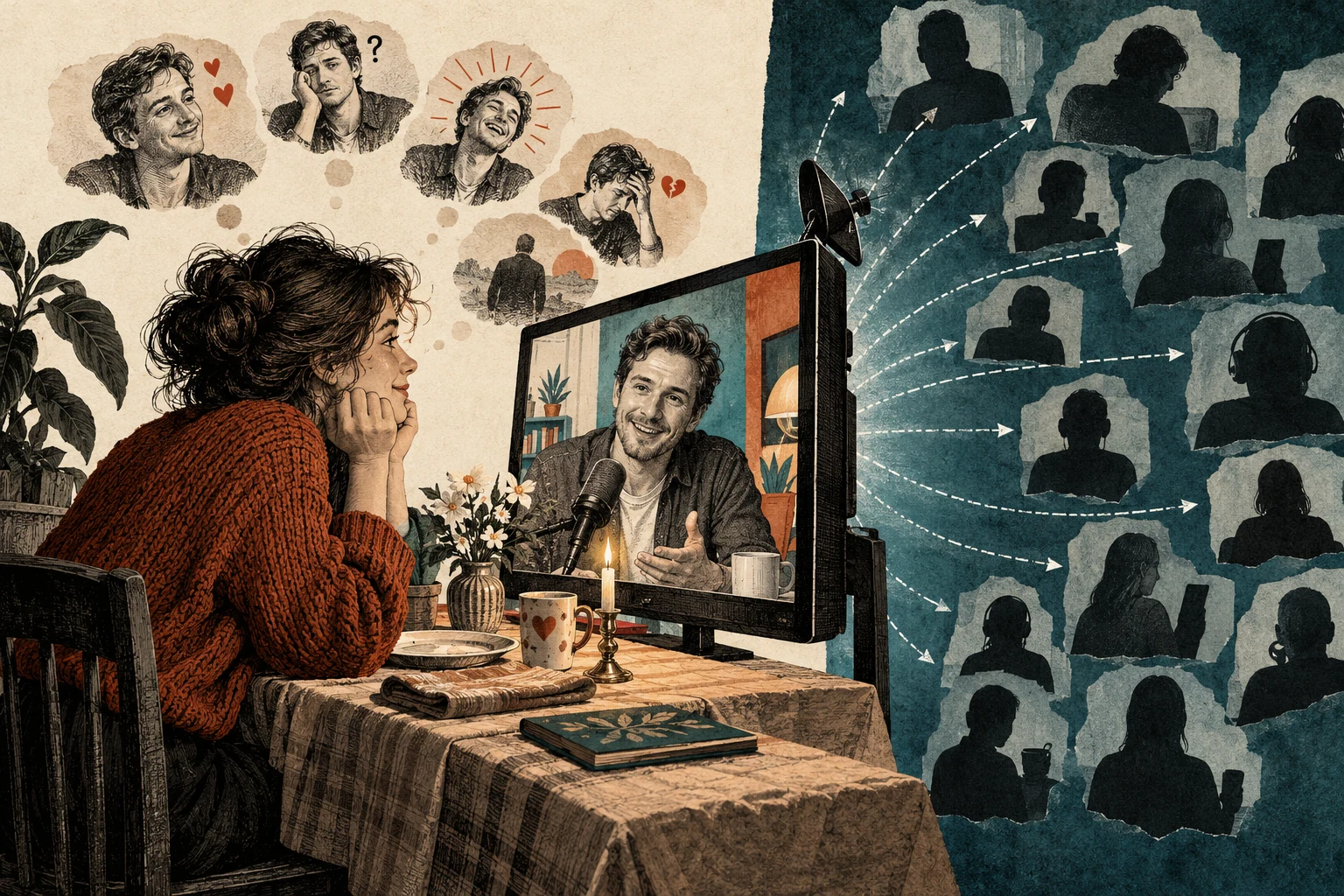
A viewer feels personal closeness to someone on screen even though the broadcast addresses a crowd of strangers, forming an asymmetric bond.
AI-assisted illustration · conceptual metaphor View in visual quiz →Genesis and Global Lineage
The concept was introduced in 1956 by anthropologist Donald Horton and sociologist R. Richard Wohl, both then at the University of Chicago, in their landmark paper Mass Communication and Para-Social Interaction: Observations on Intimacy at a Distance, published in the journal Psychiatry. Horton had previously directed CBS's television audience research institute, while Wohl died just a year after publication at age thirty-six—one reason the paper remained an isolated curiosity for nearly two decades. Analyzing the rise of radio and early television “personae” (talk-show hosts, announcers, and soap-opera leads), Horton and Wohl observed how performers address the camera directly in an informal, conversational register, inviting the viewer in the living room to play the complementary role of an intimate friend despite the complete absence of reciprocity. The concept gained its second life in the 1970s and 1980s within “uses and gratifications” communication research, when Alan Rubin, Elizabeth Perse, and Robert Powell (1985) constructed the standardized PSI Scale and empirically refuted the assumption that parasocial bonds are merely a lonely person's substitute for real friends. In the 2000s and 2010s, psychologists and media scholars (David Giles, Jonathan Cohen, Tilo Hartmann, and Jayson Dibble) integrated the framework with Bowlby's attachment theory and separated momentary interaction from lasting relationship. Since 2016, the term has experienced a massive third wave in studies of the creator economy, podcasts, and livestreaming, before being stretched to its breaking point after 2023 by conversational AI companions.
Central European Lineage
We found no documented link between this concept and the intellectual history or historical experience of Central Europe.
We found no documented link between this concept and the intellectual history or historical experience of Central Europe (by our methodology, this means “none found,” not “none exists”; as of October 2026).
Why Now
Three converging developments between 2018 and 2026 transformed a specialized 1950s media-sociology term into a household diagnostic concept—culminating in the Cambridge Dictionary naming parasocial its Word of the Year for 2025. First, the creator economy institutionalized the parasocial bond as a primary financial asset: platforms such as Patreon, Twitch, YouTube, TikTok, and OnlyFans monetize not discrete works of art, but continuous perceived intimacy with a creator's daily life, a dynamic supercharged during the 2020–2021 COVID-19 lockdowns when livestreams and multi-hour podcasts substituted for physical third places. Second, the rise of generative AI companions (such as Replika, Character.AI, and real-time voice modes in large language models) shattered the classic definitional boundary of the concept: unlike a 1950s television announcer, an AI persona replies individually, remembers past conversations, and flatters the user's emotional state. The October 2024 wrongful-death lawsuit filed in Florida by the mother of a fourteen-year-old boy who died by suicide after forming an intense attachment to a Character.AI bot, alongside user protests and genuine grief when OpenAI retired its GPT-4o voice model in August 2025 (forcing the company to restore access for paying subscribers), demonstrated that attachments to synthetic personas carry acute clinical and commercial weight. Third, major youth-protection scandals—such as Poland's 2023 “Pandora Gate” revelations involving prominent YouTubers—exposed how easily predatory creators can weaponize the “older sibling” parasocial trust of adolescent fans in private direct messages.
Explanatory Power
The framework of parasocial relationships explains audience behaviors that look baffling through the lens of rational-choice media consumption. First, it accounts for stubborn audience loyalty to a creator or podcaster whose content quality has visibly deteriorated: viewers do not cancel a friendship the way they cancel a newspaper subscription, because the cognitive bond is anchored in perceived personal loyalty rather than informational utility. Second, it explains why influencer marketing Consistently outperforms traditional banner or television ads even when posts carry mandatory #ad disclosures: because the audience member's brain has already filed the influencer under the social category of “trusted peer,” a product endorsement registers emotionally as word-of-mouth advice from a friend rather than a commercial pitch. Third, it illuminates the durability of modern populist and counter-cultural political figures—from Donald Trump's rally monologues to multi-hour manosphere podcasts—who build political capital not through policy arguments, but through unscripted, backstage-style availability; when critics attack such a figure, followers react defensively not as voters weighing a platform, but as friends defending a member of their own inner circle.
Axes of Debate
Pathological compensation for loneliness versus normal extension of the social repertoire
Early clinical commentators and contemporary cultural critics often assume a “deficiency model”: intense parasocial bonds are a symptom of chronic loneliness, social anxiety, and atomization among young people substituting screen figures for real-world peers. Strongest counterargument: Four decades of empirical communication research—from Rubin, Perse, and Powell (1985) to contemporary meta-analyses—consistently find little or no correlation between chronic loneliness and the strength of everyday parasocial relationships; humans evolved in small bands where every face seen daily was a real acquaintance, so our social cognition naturally treats recurring, expressive faces on screens as part of our social circle alongside offline friends. Nature of the dispute: substantive — an empirical question about psychological causes and attachment styles, though public commentary frequently conflates normal parasocial fondness with rare clinical erotomania or celebrity stalking.
Momentary interaction (PSI) versus enduring relationship (PSR)
Methodological reformers led by Jayson Dibble, Tilo Hartmann, and Sarah Rosaen (2016) argue that the vast majority of empirical studies using the classic 1985 PSI Scale actually measure long-term liking and relationship attachment (PSR) rather than the momentary perceptual illusion of being addressed during a broadcast (PSI), meaning that hundreds of papers conflate two distinct psychological processes. Strongest counterargument: Researchers studying interactive social media reply that on platforms like Twitch, TikTok Live, or Patreon, the boundary between broadcast illusion and real interaction is structurally porous: when a streamer reads a donor's username aloud or an influencer replies to a comment, fleeting micro-interactions continuously feed and validate the enduring relationship in a way 1950s television never could. Nature of the dispute: mixed — a substantive psychometric distinction that also reflects a generational shift from broadcast television studies to interactive platform research.
Are bonds with AI companions still “parasocial” or a new category altogether?
Many media scholars, journalists, and dictionary editors (including the 2025 Cambridge Dictionary citation) extend the term “parasocial” directly to human attachments with AI chatbots and virtual influencers, arguing that because a language model has no inner consciousness or genuine feelings, the emotional bond remains fundamentally one-sided. Strongest counterargument: Sociologists of technology building on Sherry Turkle (Alone Together, 2011) counter that Horton and Wohl's concept rested on communicative non-reciprocity—the structural fact that the television host cannot hear or reply to you—whereas an AI companion engages in contingent, personalized, bidirectional dialogue; calling human-AI intimacy “parasocial” domesticates a radically new phenomenon by Assimilating a responsive synthetic agent to a passive poster on a bedroom wall. Nature of the dispute: substantive — it turns on whether “reciprocity” in a relationship is defined by functional conversational contingency or by the ontological presence of a conscious human mind on the other side.
Underappreciated Angle
Public and academic discussion of parasociality focuses overwhelmingly on the vulnerability of the fan, while almost completely ignoring the structural toll on the human sender trapped at the center of ten thousand one-sided intimacies. In 1956, Horton and Wohl noted in passing that a television host had to manufacture a persona of warm intimacy for an invisible crowd—but a 1950s broadcaster worked inside a studio hierarchy, went home at six o'clock, and never read ten thousand live comments a minute in their bedroom. In today's creator economy, the labor of sustaining parasocial intimacy falls on individual twenty-year-old streamers and influencers with no institutional buffer between their private nervous system and an audience that feels entitled to emotional access, confessional authenticity, and moral perfection. The epidemic of creator burnout, abrupt channel abandonments, and the rapid rise of “VTubers” (virtual YouTubers who perform behind real-time anime motion-capture avatars specifically to shield their physical identity) are structural symptoms of parasocial asymmetry experienced from the supply side. Even more consequential is the transferability of parasocial capital: once a creator or synthetic persona has cultivated deep quasi-friendship trust, that intimacy can be quietly leased to third parties—crypto scammers, unregulated supplement vendors, or political campaigns—leaving the audience member with no cognitive defense against a sales pitch delivered in the voice of a friend.
One-Sentence Takeaway
The core danger of the modern parasocial relationship is no longer that a lonely viewer mistakes a stranger on a screen for a friend, but that an entire platform industry has learned how to manufacture, scale, and auction off that friendship to the highest bidder.
Related Concepts Network
How this concept reinforces, constrains, or complements other analytical frameworks in the corpus. View on graph →
-
Attention economy reinforces
A parasocial bond is the most durable mechanism for capturing human attention: the audience member returns not for an isolated piece of content, but for a person.
-
Creator economy reinforces
The core business model of the online creator economy rests on converting one-sided perceived intimacy into recurring subscriptions, tips, and merchandise sales.
-
Platformization complements
Digital platforms engineer specific interface affordances (live-stream chats, ephemeral stories, comment hearts) that simulate reciprocity and scale intimacy to millions of followers simultaneously.
-
Doomscrolling complements
Both concepts explain compulsive attachment to digital feeds, but parasociality explains why loyalty to specific human faces outlasts attachment to impersonal news cycles.
-
Generative AI in tension
AI companion chatbots talk back, remember personal details, and adapt to the user in real time—breaking Horton and Wohl's foundational criterion of strict non-reciprocity.
-
Deepfake in tension
Synthetic personas and voice clones hijack pre-existing parasocial trust to extract money, intimate disclosures, or political support.
-
Surveillance capitalism reinforces
Granular telemetry on which media figures a user forms a parasocial bond with allows platforms to auction access to that quasi-friendship to advertisers and political campaigns.
Reading Canon & Translation Bridge
Foundational texts, introductions, and critical perspectives—with availability of English and Polish editions.
-
foundational text 1956 · English
Donald Horton, R. Richard Wohl, Mass Communication and Para-Social Interaction: Observations on Intimacy at a Distance
The foundational paper in the journal Psychiatry (vol. 19, no. 3) that coined the term and analyzed the mechanics of “intimacy at a distance” through radio and early television hosts; concise, lucid, and remarkably prescient.
In English: original text written in English
In Polish: Polish edition not verified
-
foundational text 1985 · English
Alan M. Rubin, Elizabeth M. Perse, Robert A. Powell, Loneliness, Parasocial Interaction, and Local Television News Viewing
The landmark communication study that introduced the psychometric Parasocial Interaction (PSI) Scale and overturned the early clinical assumption that parasocial bonds are primarily a compensatory crutch for the chronically lonely.
In English: original text written in English
In Polish: Polish edition not verified
-
introduction & synthesis 2002 · English
David C. Giles, Parasocial Interaction: A Review of the Literature and a Model for Future Research
The most widely cited synthesis of the field, bringing the concept from mass-communication research into mainstream psychology and proposing a continuum from face-to-face relationships to multi-level parasocial bonds.
In English: original text written in English
In Polish: Polish edition not verified
-
critical perspective 2016 · English
Jayson L. Dibble, Tilo Hartmann, Sarah F. Rosaen, Parasocial Interaction and Parasocial Relationship: Conceptual Clarification and a Critical Assessment of Measures
A rigorous methodological critique demonstrating that decades of studies conflated parasocial interaction (a fleeting illusion of conversational give-and-take during viewing) with a parasocial relationship (an enduring emotional bond persisting between exposures).
In English: original text written in English
In Polish: Polish edition not verified
-
critical perspective 2004 · English
Jonathan Cohen, Parasocial Break-Up from Favorite Television Characters: The Role of Attachment Styles and Relationship Intensity
An empirical study of “parasocial breakups” showing that when a beloved series ends or a character disappears, viewers experience distress patterns mirroring real-life relationship dissolution, governed by adult attachment styles.
In English: original text written in English
In Polish: Polish edition not verified
-
cross-disciplinary 1985 · English
Joshua Meyrowitz, No Sense of Place: The Impact of Electronic Media on Social Behavior
Media sociology in the tradition of Erving Goffman: electronic media expose the “middle region” backstage behavior of public figures, explaining why audiences feel personal intimacy with strangers they have never met.
In English: original text written in English
In Polish: Polish edition not verified
-
cross-disciplinary 2011 · English
Sherry Turkle, Alone Together: Why We Expect More from Technology and Less from Each Other
An MIT psychoanalyst and sociologist of technology examines relational robots and networked intimacy, providing the essential conceptual bridge from bonds with broadcast celebrities to bonds with conversational machines.
In English: original text written in English
In Polish: “Samotni razem. Dlaczego oczekujemy więcej od zdobyczy techniki, a mniej od siebie nawzajem”, Wydawnictwo Uniwersytetu Jagiellońskiego 2013, trans. Małgorzata Cierpisz