Creator economy
original term: creator economy (Eng.) · gospodarka twórców, ekonomia pasji, passion economy
Global-circulation concept — no documented lineage in Central Europe. jump to documentation ↓
Working Definition
The creator economy is an institutional arrangement in which individuals earn a living directly from an audience gathered around their own persona and voice rather than by selling discrete works through a traditional publisher, studio, or employer; digital platforms supply global distribution, payment rails, and recommendation algorithms, retaining a cut of revenue and full ownership of audience data in return. Operationally, we speak of the creator economy when three conditions hold: entry is open to anyone without institutional gatekeepers, the core commodity being monetized is ongoing personal relationship and distinctiveness (as opposed to interchangeable gig labor like driving for Uber), and income is stitched together from multiple micro-streams including ad-revenue sharing, fan subscriptions, tips, brand sponsorships, and digital merchandise. In everyday usage, the term simply refers to YouTubers, TikTokers, and newsletter writers; in political economy and media studies, it designates a regime of cultural production that shifts capital outlay and market risk onto the individual while keeping distribution infrastructure centralized.
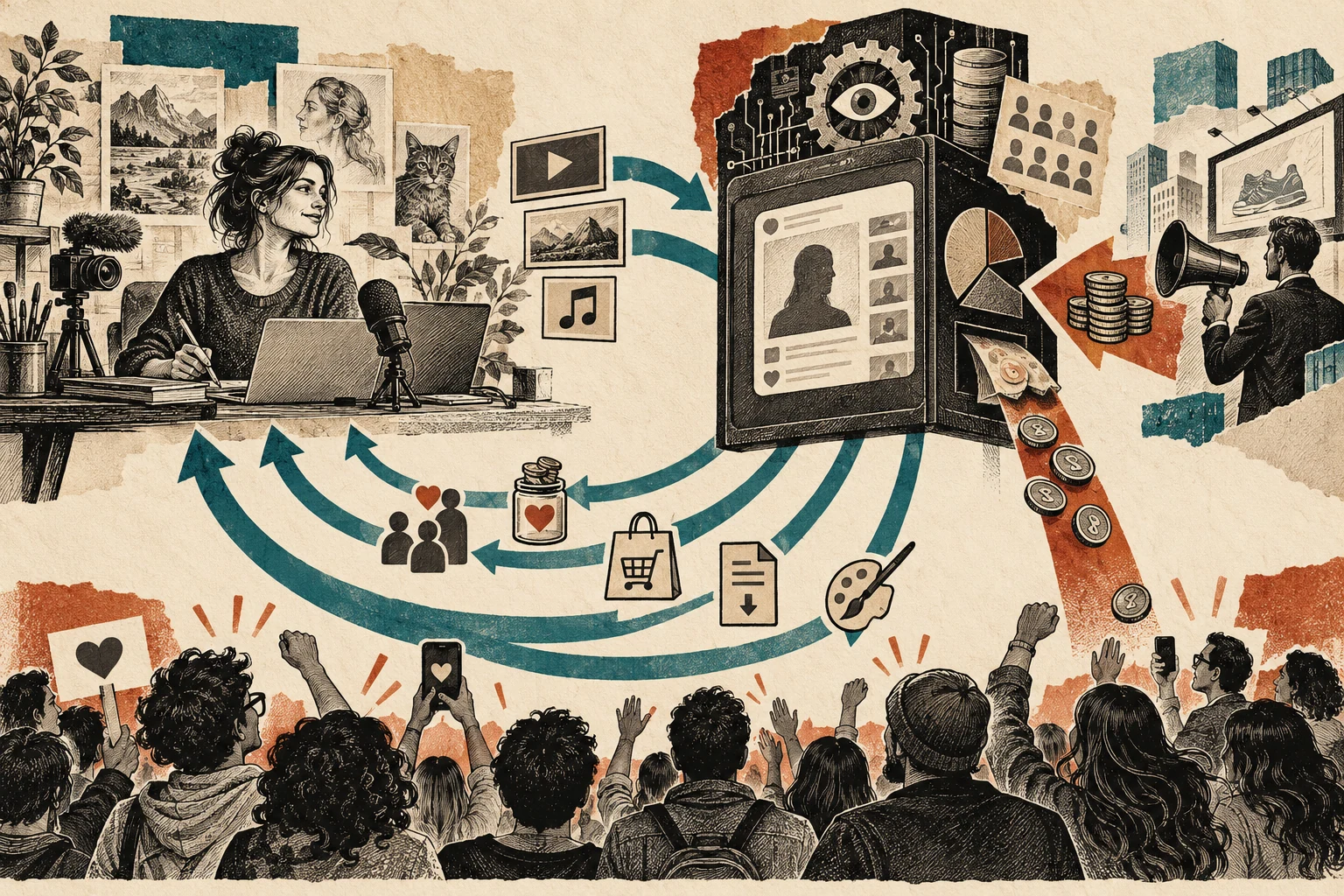
A creator sustains an audience relationship through content, commissions, and varied forms of support while the platform mediates the exchange and takes a cut.
AI-assisted illustration · conceptual metaphor View in visual quiz →Genesis and Global Lineage
The foundational arithmetic of the concept was sketched in March 2008 by Wired co-founder Kevin Kelly in his blog post 1,000 True Fans: thanks to the internet’s elimination of middlemen, an independent artist no longer needs a mass hit, only a thousand devoted patrons willing to spend a hundred dollars a year each. The technical and financial infrastructure arrived in two waves: ad-revenue sharing pioneered by the YouTube Partner Program in 2007, followed by direct fan-funding platforms led by Patreon (founded in 2013). Around 2011, YouTube deliberately promoted the neutral occupational label “creator” in place of “YouTube star” or “amateur uploader.” The explicit venture-capital framework was articulated by Li Jin, then a partner at Andreessen Horowitz, in her October 2019 essay The Passion Economy and the Future of Work, which contrasted new SaaS and patronage tools that reward individuality against first-generation gig platforms that flatten workers into standardized commodities. The concept thus emerged from three interlocking circuits—Silicon Valley techno-optimism, platform marketing, and venture-capital thesis-making—before being critically adopted by sociologists of digital labor and media scholars (Stuart Cunningham and David Craig’s “social media entertainment”).
Central European Lineage
We found no documented link between this concept and the intellectual history or historical experience of Central Europe.
We found no documented link between this concept and the intellectual history or historical experience of Central Europe (by our methodology, this means “none found,” not “none exists”; as of October 2026).
Why Now
Between 2020 and 2026, the creator economy went through a dramatic boom-and-reckoning cycle. During the COVID-19 lockdowns of 2020–2021, screen time surged and major platforms launched billion-dollar “creator funds”—TikTok and Snapchat in 2020, Meta in July 2021—to lock in talent, while Substack, Twitch, and OnlyFans demonstrated that direct subscriptions could out-earn programmatic advertising for niche voices. From late 2022 onward, the pendulum swung back: advertising downturns, the shuttering or restructuring of fixed creator funds, and above all the explosion of generative AI text, image, and video models from 2023 onward flooded recommendation feeds with zero-marginal-cost synthetic media, eroding the scarcity of human expression on which the model rested. At the same time, regulatory authorities closed the era of informal monetization: the EU Digital Services Act (2024) imposed transparency rules on recommendation and shadowbanning, while national consumer-protection agencies—such as Poland’s Office of Competition and Consumer Protection (UOKiK) from 2021–2023—began imposing strict financial penalties on influencers for unlabeled sponsorships. The concept is analytically urgent today because a decade of empirical tax and payout data has finally made it possible to measure who actually captures the value generated in this ecosystem.
Explanatory Power
The concept brings into focus three structural dynamics that celebratory talk of “new media” obscures. First, it explains the extreme skewness of earnings: across virtually every platform, the top fraction of one percent of accounts captures the overwhelming majority of revenue—an outcome that, following Sherwin Rosen’s 1981 model of superstar economics, flows inevitably from near-zero reproduction costs and global recommendation pools rather than a contingent flaw in an algorithm; the promise that “anyone can make a living from their passion” is true as an open lottery ticket and false as a median expectation. Second, it reveals the radical externalization of risk: whereas a legacy newspaper, record label, or television network paid salaries or advances and absorbed the cost of flops, a platform provides only a stage, leaving equipment costs, health insurance, legal liability, and audience fickleness entirely on the individual. Third, it exposes a new species of monopsonistic dependency: the creator has no boss, yet depends on a single corporate landlord that can unilaterally alter revenue splits, demonetize a channel, or pivot its ranking algorithm overnight. In Central Europe, local patronage infrastructures such as Poland’s Patronite (founded in 2015) have enabled investigative journalists, podcasters, and independent radio stations (Radio Nowy Świat, Radio 357) to survive outside both state-controlled media and programmatic ad networks—yet their revenue still flows through platform intermediaries and algorithmic discovery funnels they do not own.
Axes of Debate
Entrepreneurial emancipation versus aspirational exploitation
Venture capitalists and platform executives (Li Jin, Jack Conte of Patreon) frame the creator economy as a renaissance of artisan independence that liberates creative workers from corporate hierarchy and gatekeepers. Sociologists of digital labor (Brooke Erin Duffy, Tiziana Terranova, Rebecca Giblin, and Cory Doctorow) diagnose it instead as a system of “aspirational labor” in which millions of unpaid or underpaid users generate cultural content and engagement for free in the hope of reaching the monetized top tier, while the platform captures guaranteed ad and data value across the entire long tail. Strongest counterargument: Proponents reply that most long-tail creators participate voluntarily for intrinsic expression or side income, and that comparing their precarious payouts to tenured staff jobs in legacy media is a false baseline because legacy gatekeepers excluded 99% of aspiring entrants from publishing at all. Nature of the dispute: substantive — the disagreement hinges on whether an economic system should be judged by its openness of entry or by the median distribution of its rewards.
Direct fan patronage versus algorithmic advertising
Advocates of subscription and patronage platforms (Patreon, Substack, Poland’s Patronite) argue that direct recurring payments from “1,000 true fans” insulate creators from brand safety censorship and the clickbait incentives of ad-funded algorithms. Critics counter that patronage platforms have no organic discovery engine of their own: a creator can convert fans into paying subscribers on Patreon or Substack only after first building an audience inside the algorithmic funnels of YouTube, TikTok, X, or Instagram. Strongest counterargument: Empirical churn data show that direct subscription models impose a relentless treadmill of their own, often accelerating creator burnout faster than ad-supported models because any pause in output triggers an immediate, visible drop in monthly recurring revenue. Nature of the dispute: mixed — the structural analysis of discovery versus monetization is substantive, while claims of “escaping the algorithm” often function as marketing rhetoric for subscription startups.
A genuinely new economy versus the oldest labor market in culture
Cultural economists point out that winner-take-all income distributions, multi-jobbing, and unpaid apprenticeship have characterized literary, musical, and visual-arts labor markets since the nineteenth century; from this perspective, “creator economy” is merely Silicon Valley rebranding of classic artistic precarity. Strongest counterargument: What is structurally new is the replacement of human editorial selection before publication with automated algorithmic selection after publication, which shifts the creator’s craft from satisfying a genre standard to continuously optimizing behavioral retention metrics (watch time, click-through rate) in real time. Nature of the dispute: mixed — rhetorical regarding the novelty of the label, substantive regarding how algorithmic feedback loops alter the nature of cultural work itself.
Underappreciated Angle
The least analyzed transformation in the creator economy is the shift in the object of labor from a finished work to an ongoing parasocial relationship. A contemporary creator rarely sells a self-contained essay, song, or film; they sell continuous personal presence, intimacy, and reliability, with individual posts serving merely as maintenance pings for that relationship. This explains two puzzles at once. First, it shows why burnout among full-time creators differs from classic writer’s block: when the product is the creator’s own life and uninterrupted availability, pausing production feels like dissolving the asset itself. Second, it explains why generative AI poses a paradoxical threat: while synthetic media effortlessly flood the bottom of the market with cheap informational filler and background illustration, they simultaneously raise the premium on verifiable human biography and parasocial trust—yet at the exact same time, the creator does not legally own the social graph through which that trust is maintained. If a platform suspends an account, the relationship vanishes overnight, which is why the most consequential struggle in the creator economy is not over ad-revenue percentages, but over portable audience protocols (RSS, email lists, open social graphs) that determine who actually owns the bond between speaker and public.
One-Sentence Takeaway
The creator economy did not eliminate the middleman between artist and audience; it replaced the gatekeeper who selected works in advance with a platform landlord that owns the audience afterward.
Related Concepts Network
How this concept reinforces, constrains, or complements other analytical frameworks in the corpus. View on graph →
-
Attention economy reinforces
A creator monetizes the scarce audience attention they have gathered, and the market price of that attention sets the ceiling of their income regardless of craft quality.
-
Platformization complements
The creator economy is the labor-supply side of cultural platformization: independent cultural production made structurally dependent on the infrastructure of a few tech firms.
-
Algorithmic management reinforces
An independent creator has no human boss, but answers to a recommendation algorithm that dictates video length, posting cadence, and topical format.
-
Precarization complements
Creator income is volatile, unbenefited, and unbuffered by employment law, making it an archetypal case of precarious labor in the cultural sector.
-
Network effects constrains
Platform network effects concentrate audiences around a tiny fraction of top accounts, causing the promise of democratized middle-class income to collide with a steep power-law distribution.
-
Enshittification in tension
Platforms initially woo creators with generous revenue splits and creator funds, then tighten payouts and organic reach once creators and their audiences are locked in.
-
Surveillance capitalism complements
Creator content serves as the bait that keeps users on-platform to be behaviorally profiled; the creator supplies the cultural work while the platform retains the audience data.
Reading Canon & Translation Bridge
Foundational texts, introductions, and critical perspectives—with availability of English and Polish editions.
-
foundational text 2019 · English
Li Jin, The Passion Economy and the Future of Work
The Andreessen Horowitz essay that gave the concept its venture-capital thesis: software platforms that let individuals monetize distinctive personality and niche expertise rather than commoditized gig labor like Uber.
In English: original text written in English
In Polish: no Polish edition
-
foundational text 2008 · English
Kevin Kelly, 1,000 True Fans
The seminal blog post on The Technium from which the foundational arithmetic of the creator economy derives: an independent artist needs not millions of mass-market buyers, but a thousand devoted patrons paying a hundred dollars a year.
In English: original text written in English
In Polish: Polish edition not verified
-
introduction & synthesis 2019 · English
Stuart Cunningham, David Craig, Social Media Entertainment: The New Intersection of Hollywood and Silicon Valley
The most comprehensive academic study of the professionalized creator industry across YouTube and rival platforms, analyzing multichannel networks, brand sponsorship, and its structural divergence from legacy Hollywood.
In English: original text written in English
In Polish: Polish edition not verified
-
critical perspective 2017 · English
Brooke Erin Duffy, (Not) Getting Paid to Do What You Love: Gender, Social Media, and Aspirational Work
An ethnography of fashion bloggers and influencers that coined “aspirational labor”: unpaid, self-branded work performed in the hope of eventual monetization.
In English: original text written in English
In Polish: Polish edition not verified
-
critical perspective 2022 · English
Rebecca Giblin, Cory Doctorow, Chokepoint Capitalism: How Big Tech and Big Content Captured Creative Labor Markets and How We'll Win Them Back
An analysis of the monopsonistic bottlenecks through which tech platforms and media conglomerates capture the lion's share of creative revenue, paired with legal and collective-bargaining remedies.
In English: original text written in English
In Polish: Polish edition not verified
-
cross-disciplinary 1981 · English
Sherwin Rosen, The Economics of Superstars
The classic “American Economic Review” paper explaining why, when the marginal cost of reproducing a performance approaches zero, small differences in perceived talent translate into extreme concentration of income.
In English: original text written in English
In Polish: Polish edition not verified
-
cross-disciplinary 2000 · English
Tiziana Terranova, Free Labor: Producing Culture for the Digital Economy
An early autonomist Marxist theorization of unpaid digital cultural production that explains why the value generated by user-creators accrues primarily to the owners of network infrastructure.
In English: original text written in English
In Polish: Polish edition not verified
Primary-Source Quotes
New integrated platforms empower entrepreneurs to monetize individuality and creativity.
A True Fan is defined as someone who will purchase anything and everything you produce.