Cognitive Science #037
Doomscrolling
original term: doomscrolling (Eng.) · doomsurfing, kompulsywne przeglądanie złych wiadomości, scrollowanie zagłady
Global-circulation concept — no documented lineage in Central Europe. jump to documentation ↓
Working Definition
Doomscrolling (sometimes paired with doomsurfing) is the prolonged, poorly regulated scrolling through streams of predominantly negative or threatening news, persisted in despite rising anxiety, emotional exhaustion, and diminishing informational returns. Three elements lock together to produce the phenomenon: negatively valenced threat content, an interface architecture stripped of natural stopping boundaries (infinite scroll), and a self-reinforcing affective loop in which anxiety drives the search for threat-monitoring updates while each new fragment of bad news deepens the underlying anxiety. In everyday speech the word is used lightly for any late-night news-checking habit; in its psychometric sense (operationalized in scales by Bhakti Sharma et al. and Seydi Ahmet Satici et al. in 2022), it is a measurable behavioral disposition distinct from generic social-media addiction and ordinary civic news monitoring. The diagnosis attaches not to the volume of news consumed, but to the broken feedback loop: the user scrolls because they are afraid, and remains afraid because they scroll.
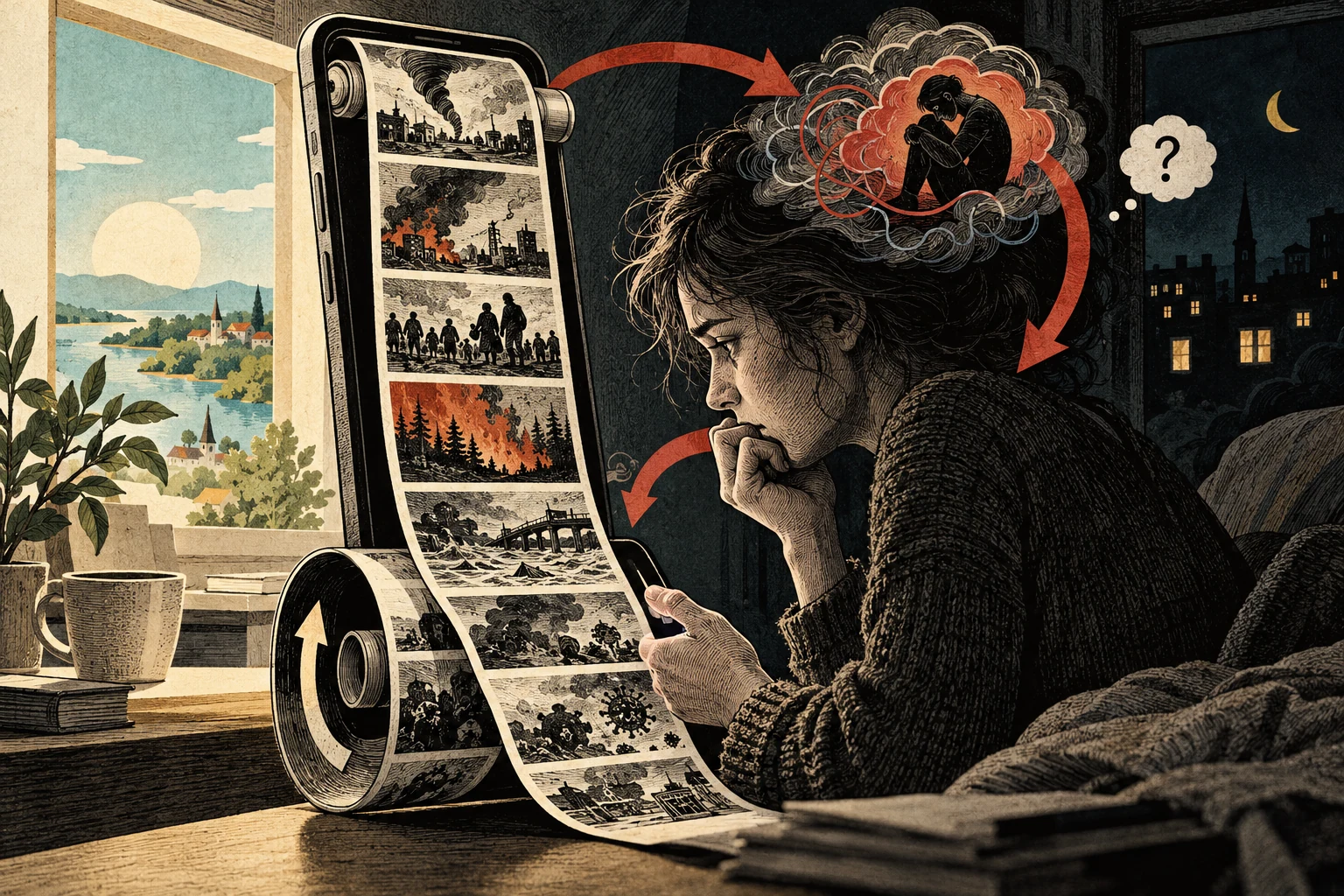
Each batch of alarming news prompts further scrolling in a repetitive loop linking attention, anxiety, and difficulty stopping.
AI-assisted illustration · conceptual metaphor View in visual quiz →Genesis and Global Lineage
Unlike academic terms minted in peer-reviewed journals, doomscrolling emerged from vernacular Twitter slang around autumn 2018 before exploding into global circulation in March–April 2020 during the first COVID-19 lockdowns (championed by journalist Karen Ho's late-night reminders to stop doomscrolling). By July 2020, The New York Times was publishing guides on breaking the habit; the Macquarie Dictionary named it Word of the Year for 2020; and Merriam-Webster added it in 2023. Empirical science arrived in two waves shortly afterward. First, clinical psychologists (such as Matthew Price et al., 2022) used daily-diary tracking during the 2020 pandemic to link daily bad-news exposure with spikes in depression and PTSD symptoms. Second, media psychologists and psychometricians (Sharma, Lee, & Johnson 2022; Satici et al. 2022) constructed validated scales (such as the 15-item DS-15), anchoring the phenomenon in two older traditions: evolutionary negativity bias in news reactivity (documented across 17 countries by Stuart Soroka et al. in PNAS, 2019) and human–computer interaction critiques of infinite scroll (invented by Aza Raskin in 2006, who later regretted removing the “unit of completion” from web pages).
Central European Lineage
We found no documented link between this concept and the intellectual history or historical experience of Central Europe.
We found no documented link between this concept and the intellectual history or historical experience of Central Europe (by our methodology, this means “none found,” not “none exists”; as of October 2026).
Why Now
Between 2020 and 2026, doomscrolling evolved through three historical shocks that shifted its meaning from lockdown boredom to geopolitical survival anxiety. The first wave was the COVID-19 pandemic (2020–2021), when billions of people confined indoors faced an invisible pathogen and live mortality counters. The second wave hit on February 24, 2022, with Russia's full-scale invasion of Ukraine, transforming doomscrolling across Ukraine and frontline Central Europe into visceral war monitoring. In Kharkiv—under daily missile bombardment—psychologists Yurii Melnyk and Anatoliy Stadnik published a 12-item Doomscrolling Questionnaire in 2024 calibrated to wartime conditions, while in neighboring Poland, studies in 2026 (Patrycja Uram et al.'s two-sample study of over 1,000 respondents and Aleksandra Rogowska, Davide Marengo, and Iga Chlebowska's Polish validation of the Doomscrolling Scale in Chronic Stress, June 2026) showed that doomscrolling mediates between social-media compulsion and chronic war anxiety. A third wave—fueled by the Gaza war from October 2023, live-streamed drone warfare on Telegram and X, and climate disasters—cemented the pattern as a permanent feature of crisis experience.
Explanatory Power
The concept separates two things that journalism and common sense conflate: being well-informed and being immersed in a live feed. First, it explains why the heaviest consumers of breaking-news threads often possess the most fragmented understanding of an event: Sharma et al. (2022) found that doomscrolling correlates positively with political interest, yet hours of rapid vertical scanning through decontextualized clips leaves the brain with high autonomic arousal and low structural comprehension. Second, it illuminates the illusion of control in acute crises: as the 2024 Kharkiv manual notes, during the opening days of a war or pandemic, checking Telegram or X every three minutes feels subjectively like keeping watch on the ramparts (“if I see the missile alert first, I won't be caught off guard”), while objectively depriving the person of the sleep and executive focus required for actual preparedness. Third, it shows that the pathology resides in the marriage of human evolutionary negativity bias with an algorithmic feed that removes the horizon: in an ancestral village, a threat signal ended when the predator left; on a global smartphone feed of eight billion people, there is always a genuine catastrophe happening somewhere at 2 a.m.
Axes of Debate
Clinical compulsion versus rational civic monitoring in a real crisis
Clinical psychologists and psychometricians (Satici et al. 2022; Price et al. 2022) measure doomscrolling on a continuum of maladaptive behavior linked to neuroticism, FOMO, distress, and compulsive smartphone use. Media sociologists Brita Ytre-Arne and Hallvard Moe (Journalism Studies, 2021) object that turning crisis news consumption into a clinical syndrome risks pathologizing citizens who are trying to orient themselves during a genuine emergency. Strongest counterargument: Cross-sectional scales cannot easily separate a person who is anxious because they scroll too much from a person in Warsaw, Kharkiv, or Tel Aviv who scrolls because missiles are flying; diagnosing the behavior without reference to the threat environment blames the thermometer for the fever. Nature of the dispute: substantive — whether the diagnostic threshold should be defined by raw screen time and distress or by functional impairment relative to real-world threat.
Negativity of content versus intolerance of predictive uncertainty
Mainstream media-psychology accounts (following Soroka's negativity-bias model) assume that the active toxin in doomscrolling is the negative emotional valence of bad news. A Czech neuropsychiatric team led by Ladislav Kesner and Jiří Horáček (JMIR Mental Health, 2025), using predictive processing, counters that the real engine is unresolvable uncertainty: the brain keeps scrolling to reduce prediction error about an unpredictable future, only to encounter fragmented narratives that increase uncertainty further. Strongest counterargument: If the driver is predictive uncertainty rather than sad headlines, “positive news” filters will not cure crisis scrolling—yet neither can individual therapy for “uncertainty tolerance” absolve platforms that package every headline as an open-ended cliffhanger. Nature of the dispute: mixed — the neurocognitive debate between valence and uncertainty is empirically testable, while its policy implications split between therapy and media reform.
Personal “digital hygiene” versus predatory choice architecture
Self-help journalism and corporate digital-wellbeing tools frame doomscrolling as a failure of individual bedtime willpower. Critics of the attention economy point out that infinite scroll, pull-to-refresh (modeled on slot-machine reinforcement schedules), autoplay video, and outrage-weighted ranking algorithms are engineered to defeat human stopping cues. Strongest counterargument: Billions of people use the same infinite-scroll apps daily without falling into debilitating doomscrolling; individual differences in baseline anxiety and trauma history explain substantial variance, meaning interface regulation and psychological support are complements. Nature of the dispute: rhetorical — both sides agree on how variable-reward feeds interact with anxious brains, differing over whether to send the bill to product managers or users.
Underappreciated Angle
The most penetrating analysis of doomscrolling comes not from addiction psychology, but from the theory of reading and narrative form. In her 2022 essay On Not Being Able to Read, literary scholar Laura Salisbury observes that what happens during doomscrolling is the opposite of reading: the scroller is unable to read at length, skimming instead across an endless vertical ribbon in search of a narrative ending that the medium refuses to provide. Every news format prior to the algorithmic feed had a built-in architecture of finitude: a morning newspaper had a back page where you folded the paper; an evening broadcast lasted thirty minutes and signed off. That formal boundary allowed a citizen to fulfill their duty to know what happened and then legitimately stop, because the edition was complete. Infinite scroll abolished the “edition.” Because the feed has no bottom, the anxious brain never receives the completion signal, leaving the threat-monitoring loop perpetually open. As Melnyk and Stadnik's 2024 Kharkiv manual notes, severe doomscrolling eventually breeds a suspicion that “the real truth is hidden deeper down in the feed”—turning scrolling into a detective investigation without a final page. The deepest antidote is the editorial restoration of finite forms: digests, editions, and briefings with a hard stop.
One-Sentence Takeaway
Doomscrolling is caused not by consuming too much news, but by consuming news inside an architecture stripped of an ending—where an anxious mind keeps searching for a signal that it is safe to stop inside a feed explicitly engineered never to give one.
Related Concepts Network
How this concept reinforces, constrains, or complements other analytical frameworks in the corpus. View on graph →
-
Attention economy reinforces
Infinite scroll and engagement-based algorithmic ranking form the exact technical infrastructure in which threat-laden material wins the battle for attention and keeps the thumb moving.
-
Epistemic bubbles vs. echo chambers complements
Doomscrolling describes the affective rhythm and compulsion of news consumption, whereas echo chambers describe its ideological composition; one can doomscroll endlessly across a diverse mainstream diet.
-
Burnout complements
Both concepts diagnose exhaustion without a clean stopping boundary: chronic affective load that reproduces itself during apparent “rest” rather than dissipating.
-
Disinformation in tension
The disinformation framework asks whether individual claims are true or false, whereas doomscrolling shows that a relentless feed of 100% factually accurate catastrophe reports can paralyze agency just as effectively.
-
Nudge and behavioral economics in tension
Interface patterns that eliminate natural stopping cues (“sludge” and dark patterns) are the dark twin of behavioral nudging, sparking debate over whether responsibility lies with choice architecture or individual self-control.
-
Existential risk complements
Headlines about climate tipping points, pandemics, and nuclear escalation supply the raw fuel of doomscrolling, transmuting public macro-risks into private, helpless somatic anxiety.
Reading Canon & Translation Bridge
Foundational texts, introductions, and critical perspectives—with availability of English and Polish editions.
-
foundational text 2022 · English
Bhakti Sharma, Susanna S. Lee, Benjamin K. Johnson, The Dark at the End of the Tunnel: Doomscrolling on Social Media Newsfeeds
The paper in “Technology, Mind, and Behavior” (3:1) that first operationalized doomscrolling as a distinct behavioral construct and mapped its demographic, personality, and media-use correlates.
In English: original text written in English
In Polish: no Polish edition
-
foundational text 2022 · English
Matthew Price, Alison C. Legrand, Zoe M. F. Brier i in., Doomscrolling during COVID-19: The Negative Association between Daily Social and Traditional Media Consumption and Mental Health Symptoms during the COVID-19 Pandemic
A daily-diary study in “Psychological Trauma” (14:8, pp. 1338–1346) tracking day-to-day pandemic media exposure alongside depression and PTSD symptoms; the most widely cited empirical study of the phenomenon.
In English: original text written in English
In Polish: no Polish edition
-
foundational text 2022 · English
Seydi Ahmet Satici, Emine Gocet Tekin, M. Engin Deniz, Begum Satici, Doomscrolling Scale: Its Association with Personality Traits, Psychological Distress, Social Media Use, and Wellbeing
Introduces the 15-item Doomscrolling Scale (DS-15) in “Applied Research in Quality of Life” (18, 2023, pp. 833–847; online 2022), which became the standard psychometric instrument adapted across languages, including Polish.
In English: original text written in English
In Polish: no Polish edition
-
critical perspective 2021 · English
Brita Ytre-Arne, Hallvard Moe, Doomscrolling, Monitoring and Avoiding: News Use in COVID-19 Pandemic Lockdown
A media-sociology study in “Journalism Studies” (22:13, pp. 1739–1755) situating doomscrolling alongside civic monitoring and strategic news avoidance as fluid practices rather than a fixed psychiatric pathology.
In English: original text written in English
In Polish: no Polish edition
-
critical perspective 2022 · English
Laura Salisbury, On Not Being Able to Read: Doomscrolling and Anxiety in Pandemic Times
A literary-theoretical essay in “Textual Practice” (37:6, pp. 887–918) interpreting doomscrolling not as a failure of digital willpower, but as a breakdown of narrative time and the capacity to read to an ending.
In English: original text written in English
In Polish: no Polish edition
-
critical perspective 2025 · English
Ladislav Kesner, Veronika Juríčková, Dominika Grygarová, Jiří Horáček, Impact of Media-Induced Uncertainty on Mental Health: Narrative-Based Perspective
A Czech neuroscience and mental-health team in “JMIR Mental Health” (12, e68640) shifts explanatory weight from the sheer “negativity” of news to predictive uncertainty, arguing for building uncertainty tolerance rather than digital detox alone.
In English: original text written in English
In Polish: no Polish edition
-
cross-disciplinary 2019 · English
Stuart Soroka, Patrick Fournier, Lilach Nir, Cross-National Evidence of a Negativity Bias in Psychophysiological Reactions to News
A 17-country psychophysiological experiment in “PNAS” (116:38, pp. 18888–18892) demonstrating that human nervous systems exhibit higher skin-conductance and heart-rate reactivity to negative news across cultures, with substantial individual variation.
In English: original text written in English
In Polish: no Polish edition
-
introduction & synthesis 2010 · English
Nicholas Carr, The Shallows: What the Internet Is Doing to Our Brains
The classic accessible account of how digital feed architectures reshape attention and deep reading; predates the word “doomscrolling” by a decade, but explains the media soil from which it grew.
In English: original text written in English
In Polish: “Płytki umysł. Jak internet wpływa na nasz mózg”, Helion 2012, trans. Katarzyna Rojek
Primary-Source Quotes
Follow the analysis and forecasts of negative news regularly. Watching the news creates an illusion of control, a sense of safety and security.