Horizon & Ecology #172
Net zero
original term: net zero (Eng.) · zerowe emisje netto, neutralność klimatyczna, neutralność węglowa
Global-circulation concept — no documented lineage in Central Europe. jump to documentation ↓
Working Definition
Net zero is the state in which the amount of greenhouse gases added to the atmosphere by human activity over a given period equals the amount removed from it by human-directed sinks. Operationally, the term means nothing until three parameters are specified: the basket of gases covered (CO2 alone versus all greenhouse gases), the boundary of the accounting entity (the planet as a whole, a nation-state, or a corporation with or without its Scope 3 supply chain), and the nature of the subtraction (durable physical removal from the atmosphere versus purchasing an avoided-emissions carbon credit from someone else). In its geophysical version, applied to the entire planet and to CO2, net zero is the physical prerequisite for halting global warming. In its degraded corporate version, it is a bookkeeping promise that can be met on paper without cutting one’s own fossil-fuel emissions at all.
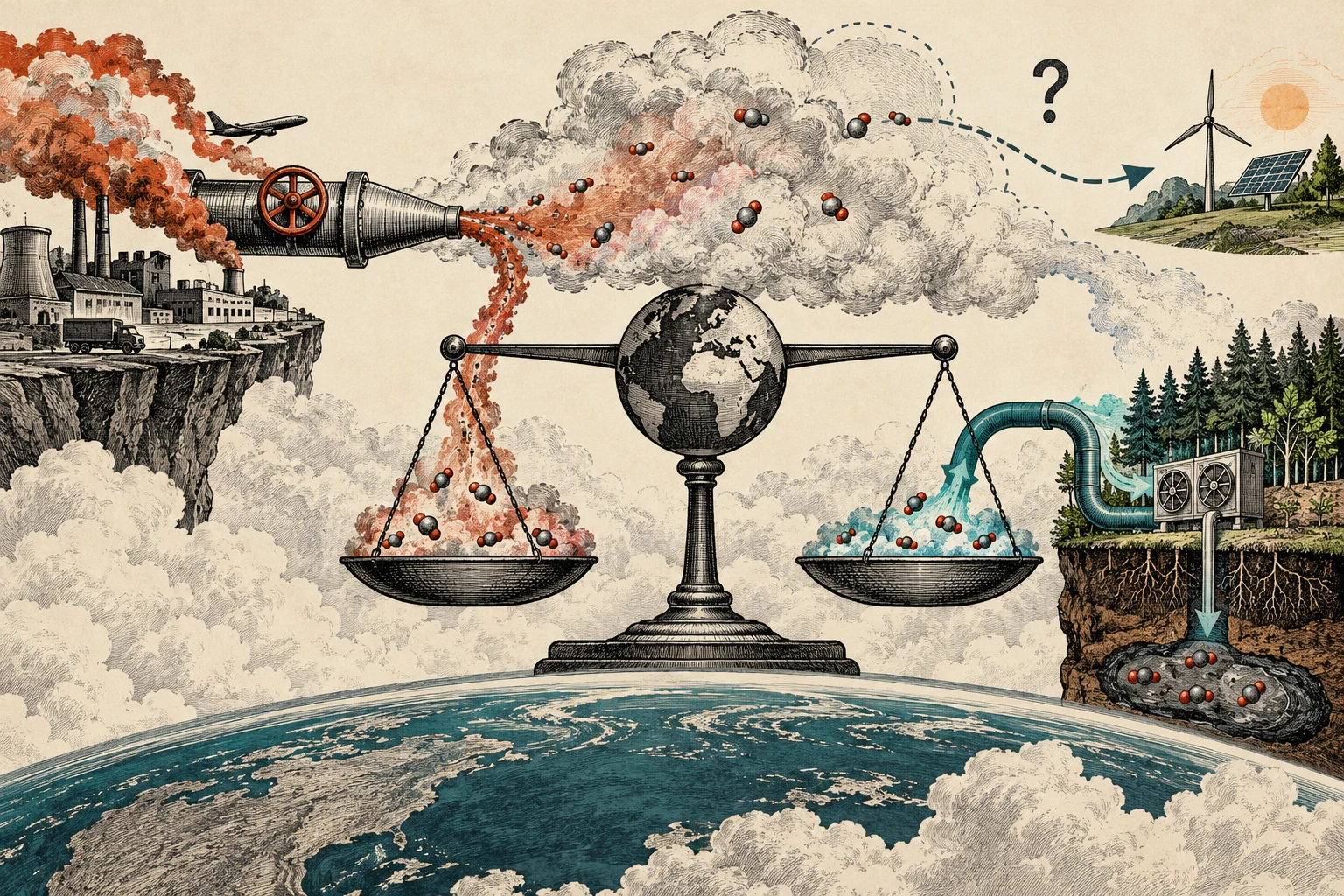
Residual emissions are balanced by atmospheric removal, while cutting emissions, avoiding them, and removing already emitted gas remain distinct actions.
AI-assisted illustration · conceptual metaphor View in visual quiz →Genesis and Global Lineage
The concept grew out of atmospheric physics rather than environmental diplomacy. In April 2009, two independent teams—Myles Allen and colleagues at Oxford, and H. Damon Matthews, Nathan Gillett, Peter Stott, and Kirsten Zickfeld—demonstrated in Nature that peak global warming is approximately proportional to cumulative total CO2 emissions across time, regardless of the annual emission pathway. The policy implication was stark: stabilizing global temperature does not happen when annual emissions fall to a “low” level, but only when net additions of CO2 reach zero. Earlier climate policy had spoken of stabilizing atmospheric concentrations; now the target became a flow balance. In December 2015, Article 4.1 of the Paris Agreement codified this requirement as achieving “a balance between anthropogenic emissions by sources and removals by sinks of greenhouse gases in the second half of this century,” without using the phrase net zero itself. What turned the phrase into a global watchword was the IPCC’s Special Report on Global Warming of 1.5°C (SR15, October 2018), which headline-summarized the pathway as cutting global net anthropogenic CO2 emissions by about 45% from 2010 levels by 2030 and reaching net zero around 2050. From that moment, the concept migrated rapidly from climate physics into law and corporate accounting: the United Kingdom legislated a 2050 net-zero target in June 2019, the European Union enacted the European Climate Law in 2021 (after protracted bargaining in which coal-reliant Poland sought opt-outs from the national-level 2050 commitment), and thousands of firms signed voluntary pledges. The conceptual capture lies in translating a planetary physical condition into an entity-level accounting target serviced via cheap carbon offsets.
Central European Lineage
We found no documented link between this concept and the intellectual history or historical experience of Central Europe.
We found no documented link between this concept and the intellectual history or historical experience of Central Europe (by our methodology, this means “none found,” not “none exists”; as of October 2026).
Why Now
Between 2018 and 2026, net zero traveled from a scientific finding to the world’s most ubiquitous climate pledge, and then into a crisis of credibility. Following the 2018 IPCC report, legislative and diplomatic declarations cascaded: the UK (2019) and EU (2021) laws, China’s pledge of carbon neutrality before 2060, India’s 2070 target, and the UN-backed Race to Zero campaign for non-state actors. According to the Climate Action Tracker (as of October 2025), roughly 145 countries have announced or are considering net-zero targets covering around three-quarters of global emissions, yet only six of the 41 governments evaluated in detail have target architectures rated as “acceptable.” In May 2021, the International Energy Agency’s landmark report Net Zero by 2050 concluded that its 1.5°C pathway left no room for approving new oil and gas fields or coal mines beyond projects already committed, turning net zero into a direct weapon in battles over fossil-fuel finance. Simultaneously, scientific and regulatory pushback mounted: in April 2021 climate scientists James Dyke, Robert Watson, and Wolfgang Knorr called net zero a “dangerous trap,” and in November 2022 the UN High-Level Expert Group chaired by Catherine McKenna (Integrity Matters) declared that corporate net-zero claims paired with continued fossil-fuel expansion or cheap offsets constitute greenwashing. The concept is indispensable today because it has become the reserve currency of climate politics—and its exchange rate has to be audited line by line.
Explanatory Power
Net zero makes visible three structural realities that percentage-reduction targets obscure. First, what determines peak warming is the area under the curve, not the endpoint date: a country that delays cuts in the 2020s and 2030s does not “make up for it” by hitting zero on December 31, 2049, because every extra ton emitted in the meantime permanently consumes the global carbon budget. Second, every net-zero pledge is implicitly a claim on scarce carbon dioxide removal (CDR) capacity: when the 31 national long-term strategies analyzed by Climate Action Tracker assume average residual emissions of 20% of 2019 levels in their target year, they presuppose biological or geological sinks of matching scale—and globally there is not enough sustainable land or storage capacity to cover everyone’s residuals at once. Third, the choice of metric is never neutral: defining net zero in terms of $\text{CO}2-equivalent (\text{GWP}{100}) allows emitters to offset long-lived fossil \text{CO}_2$ with reductions in short-lived methane, even though their physical effects on temperature diverge sharply (holding methane emissions constant stabilizes its warming contribution, whereas holding CO2 emissions constant above zero continues to heat the planet). Two national plans both labeled “Net Zero 2050”—one built on 90% gross emission cuts and 10% geological storage, the other on 60% cuts and 40% forestry offsets—describe two completely different future climates.
Axes of Debate
Physical balance versus bookkeeping balance
Sam Fankhauser, Myles Allen, and the Oxford Net Zero team defend the concept provided it obeys strict guardrails: front-loaded gross emission cuts, durable removal, and like-for-like permanence (balancing fossil carbon with geological storage rather than vulnerable biological sinks), with no double counting. Arrayed on the other side are voluntary carbon-market brokers and loose corporate standards that treat any verified ton of avoided emissions as interchangeable with a ton of fossil carbon burned. Strongest counterargument: Proponents of flexible offsetting argue that without liquid, low-cost carbon markets, most private firms and capital-constrained developing states will simply refuse to adopt binding targets, and that an imperfect market mobilizes private capital for tropical forest protection that public budgets have failed to deliver. Nature of the dispute: substantive — whether bookkeeping zero translates into atmospheric stabilization is an empirical question, and independent audits since 2023 have overwhelmingly found that avoided-deforestation and cookstove offsets fail to deliver physical equivalence.
Does the concept itself deter mitigation?
Climate researchers Kevin Anderson and Glen Peters (2016), followed more polemically by James Dyke, Robert Watson, and Wolfgang Knorr (2021), argue that attaching “net” to “zero” created a massive moral hazard: it let integrated assessment models close 1.5°C and 2°C budgets on paper by penciling in hundreds of gigatons of mid-century negative emissions that do not exist at scale, giving politicians cover to delay fossil-fuel phaseouts. Strongest counterargument: Allen and co-authors reply that without “net” no physically honest target could be set, because hard-to-abate emissions (agricultural nitrous oxide and methane, cement calcination) cannot reach literal zero; the alternative to net zero is abandoning temperature stabilization altogether, so the remedy is separating reduction targets from removal targets rather than discarding the physics. Nature of the dispute: mixed — the carbon-cycle equations are settled, while how model assumptions alter political behavior belongs to the political economy of expertise.
Planetary net zero versus uniform national deadlines
Joeri Rogelj, Oliver Geden, Annette Cowie, and Andy Reisinger (2021), alongside climate-justice negotiators from the Global South, emphasize that “global net zero around 2050” is a planetary aggregate derived from IPCC scenarios, not a prescription that every single country must cross the zero line in the same year; demanding that low-income countries with tiny historical emissions hit zero on the same schedule as early industrializers freezes global inequality. Strongest counterargument: Diplomats from developed economies counter that differentiated target dates without a legally binding global carbon-budget formula invite every major emitter to claim special status, whereas a shared mid-century horizon creates a focal point that can be backed by technology transfers and climate finance. Nature of the dispute: mixed — the accounting link between national trajectories and global cumulative emissions is substantive, while the division of the remaining budget is an irreducibly political conflict over historical responsibility.
Underappreciated Angle
The least appreciated property of net zero is that it is a one-sided ratchet: it sets a ceiling on warming, not a thermostat that brings temperatures back down. Because CO2 accumulates in the atmosphere-ocean system for centuries to millennia, bringing net CO2 emissions to zero simply stops global average temperature from rising further—and holds it at whatever peak level it has reached on the day net zero is achieved. Hitting net zero in 2050 at 1.7^\circC or 1.8^\circC locks in 1.7^\circC or 1.8^\circC for generations; actually cooling the planet back down requires net-negative emissions, meaning an economy that physically extracts and stores more carbon every year than it emits, a commitment almost no government has costed or legislated. That physical asymmetry exposes a dangerous communication illusion: public campaigns routinely portray “Net Zero 2050” as a finish line beyond which the climate crisis is over, whereas in reality every year of high emissions before the finish line permanently raises the altitude of the plateau on which humanity will have to live afterward.
One-Sentence Takeaway
Net zero is not a finish line after which the climate returns to normal, but the temperature plateau on which humanity agrees to remain—and the little word “net” decides whether that plateau is governed by atmospheric physics or by creative accounting.
Related Concepts Network
How this concept reinforces, constrains, or complements other analytical frameworks in the corpus. View on graph →
-
Carbon dioxide removal (CDR) complements
The word “net” exists only by virtue of carbon dioxide removal; without credible CDR, net zero collapses into gross zero.
-
Climate tipping points reinforces
The date at which net zero is reached determines cumulative emissions and thus peak warming—deciding which Earth-system tipping points are crossed.
-
Goodhart’s law in tension
Once net zero becomes a target metric, the balance can easily be achieved on paper (through cheap offsets or boundary shifting) without altering the physical flow of emissions.
-
ESG complements
Corporate net-zero pledges are today the primary vehicle of the “E” pillar in ESG, and disputes over their integrity are disputes over the credibility of ESG itself.
-
Planetary boundaries complements
Net zero operationalizes a single planetary boundary (climate), but the means used to reach it—especially large-scale afforestation and BECCS—can transgress others, such as land-system change and biosphere integrity.
-
Degrowth in tension
Degrowth scholars charge that mainstream net-zero models presuppose perpetual GDP growth and are therefore forced to pencil in vast, unproven negative emissions in the second half of the century.
-
Climate justice in tension
A global net-zero target around 2050 does not specify who reaches zero when; dividing the remaining carbon budget is a question of political justice, not atmospheric physics.
Reading Canon & Translation Bridge
Foundational texts, introductions, and critical perspectives—with availability of English and Polish editions.
-
foundational text 2009 · English
Myles R. Allen, David J. Frame, Chris Huntingford, Chris D. Jones, Jason A. Lowe, Malte Meinshausen, Nicolai Meinshausen, Warming caused by cumulative carbon emissions towards the trillionth tonne
The landmark “Nature” article (vol. 458, pp. 1163–1166) demonstrating that peak global warming depends on cumulative total CO2 emissions rather than their annual rate—from which it follows that warming stops only at net zero.
In English: original text written in English
In Polish: no Polish edition
-
foundational text 2015 · English
Joeri Rogelj, Michiel Schaeffer, Malte Meinshausen, Reto Knutti, Joseph Alcamo, Keywan Riahi, William Hare, Zero emission targets as long-term global goals for climate protection
Published on the eve of the Paris conference (“Environmental Research Letters”, vol. 10, 105007), translating cumulative-carbon physics into a diplomatic target and distinguishing net zero CO2 from net zero across all greenhouse gases.
In English: original text written in English
In Polish: no Polish edition
-
introduction & synthesis 2022 · English
Sam Fankhauser, Stephen M. Smith, Myles Allen i in., The meaning of net zero and how to get it right
A synthesis in “Nature Climate Change” (vol. 12, pp. 15–21) setting out seven attributes of credible net zero—from front-loaded emission cuts to like-for-like storage permanence—now the standard benchmark in the field.
In English: original text written in English
In Polish: no Polish edition
-
introduction & synthesis 2022 · English
Myles R. Allen, Pierre Friedlingstein, Cécile A. J. Girardin, Stuart Jenkins, Yadvinder Malhi, Eli Mitchell-Larson, Glen P. Peters, Lavanya Rajamani, Net Zero: Science, Origins, and Implications
The fullest history of the concept (“Annual Review of Environment and Resources”, vol. 47, pp. 849–887): traces the shift from concentration stabilization through the IPCC and UNFCCC to Paris, arguing that what matters is the durability of the balance.
In English: original text written in English
In Polish: no Polish edition
-
critical perspective 2016 · English
Kevin Anderson, Glen Peters, The trouble with negative emissions
A short, influential piece in “Science” (vol. 354, pp. 182–183) naming the moral hazard built into climate scenarios that rely on vast future negative emissions; the starting point for subsequent critiques of net zero.
In English: original text written in English
In Polish: no Polish edition
-
critical perspective 2021 · English
James Dyke, Robert Watson, Wolfgang Knorr, Climate scientists: concept of net zero is a dangerous trap
An essay in “The Conversation” (April 22, 2021) in which three prominent Earth scientists accuse their own research community of having licensed a “burn now, pay later” policy through net-zero modeling.
In English: original text written in English
In Polish: Polish edition not verified
-
cross-disciplinary 2016 · English
Oliver Geden, An actionable climate target
A political scientist's commentary from Berlin's SWP (“Nature Geoscience”, vol. 9, pp. 340–342): argues that temperature targets are politically non-operational, whereas net zero translates directly into ministerial and corporate decisions.
In English: original text written in English
In Polish: no Polish edition
-
introduction & synthesis 2018 · Polish
Marcin Popkiewicz, Aleksandra Kardaś, Szymon Malinowski, Nauka o klimacie
The standard Polish compendium of climate physics (Katowice–Warsaw 2018), clearly explaining the proportionality between cumulative emissions and warming from which the necessity of net zero derives.
In English: English edition not verified
In Polish: original text written in Polish
Primary-Source Quotes
Halting global warming thus requires virtually zero annual CO2 emissions at some point.
…so as to achieve a balance between anthropogenic emissions by sources and removals by sinks of greenhouse gases in the second half of this century…