AI Architecture #122
Diffusion models
original term: diffusion models (Eng.) · probabilistyczne modele dyfuzyjne z odszumianiem, denoising diffusion probabilistic models, DDPM
Global-circulation concept — no documented lineage in Central Europe. jump to documentation ↓
Working Definition
A diffusion model is a generative model trained to reverse a gradual data-destruction process: Gaussian noise is added to an image, audio signal, or molecular structure across many small steps until only pure noise remains, and a neural network learns to undo each step. Generation begins by sampling random noise and passing it through the learned sequence of denoising steps toward a sample that resembles the training distribution. Technically, at each noise level the network approximates the gradient of the log probability density of the data (the score function), meaning it never computes the global probability of an image directly, but always knows “which direction” leads toward higher probability. In popular usage, the term has become synonymous with text-to-image generators (Stable Diffusion, Midjourney, DALL·E), obscuring the fact that diffusion is a general-purpose framework for learning continuous distributions, widely used in structural biology, audio synthesis, and robotics.
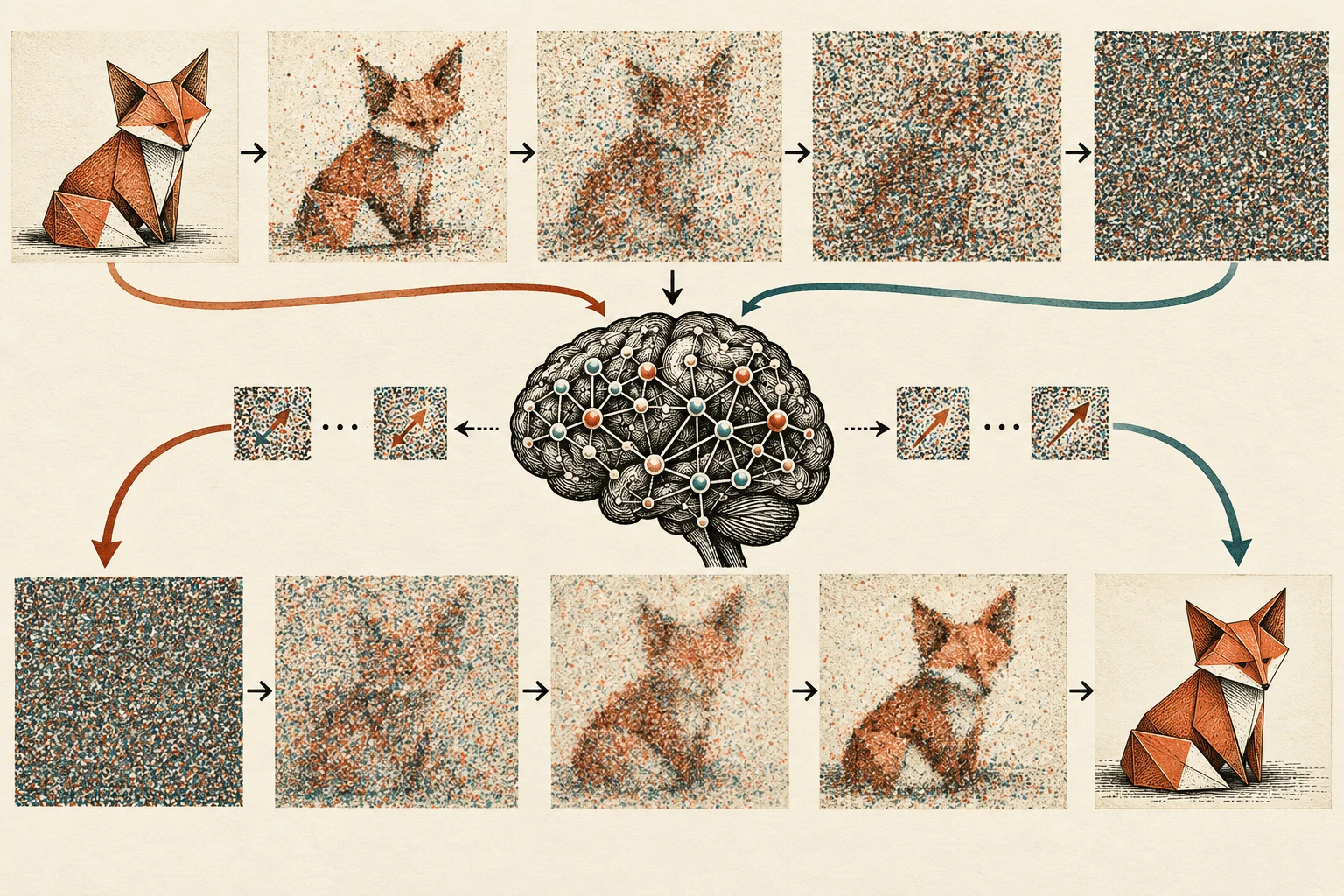
Successive denoising steps build up image structure rather than uncovering a single pre-existing photograph hidden inside random noise.
AI-assisted illustration · conceptual metaphor View in visual quiz →Genesis and Global Lineage
The core idea was formulated in 2015 by Jascha Sohl-Dickstein and colleagues at Stanford in Deep Unsupervised Learning using Nonequilibrium Thermodynamics (ICML 2015), drawing explicitly on the statistical physics of nonequilibrium processes: if forward diffusion destroys structure through a Markov chain of tiny Gaussian perturbations, the time-reversed process shares the same functional form and can be learned by a neural network. At the height of the Generative Adversarial Network (GAN) era inaugurated by Ian Goodfellow (2014), the paper attracted little notice because its generated samples looked blurry. The breakthrough arrived five years later along two converging paths. Yang Song and Stefano Ermon (2019) extended Aapo Hyvärinen’s statistical score matching (2005) into a generative method driven by Langevin dynamics, while Jonathan Ho, Ajay Jain, and Pieter Abbeel at UC Berkeley demonstrated in Denoising Diffusion Probabilistic Models (2020) that a simplified training objective—predicting the exact noise added at each step—produced images rivaling the best GANs. In 2021, Song, Sohl-Dickstein, and coauthors unified both lineages in the language of stochastic differential equations (SDEs). That same year Prafulla Dhariwal and Alexander Nichol at OpenAI declared that “diffusion models beat GANs on image synthesis,” and in 2022 Björn Ommer’s group in Munich moved the diffusion process into the compressed latent space of an autoencoder, creating Stable Diffusion and making high-resolution synthesis possible on a single consumer GPU. Since then, product marketing and media discourse have treated “diffusion” as shorthand for AI art, while research has evolved rapidly toward broader continuous-time families—flow matching, consistency models, and discrete diffusion—increasingly removed from the original thermodynamic metaphor.
Central European Lineage
We found no documented link between this concept and the intellectual history or historical experience of Central Europe.
We found no documented link between this concept and the intellectual history or historical experience of Central Europe (by our methodology, this means “none found,” not “none exists”; as of October 2026).
Why Now
Between 2022 and 2024, diffusion ceased to be a conference algorithm and became cultural and scientific infrastructure. In April 2022 OpenAI unveiled DALL·E 2, followed by Google’s Imagen in May, and in August 2022 Stability AI released the open weights of Stable Diffusion, spawning within months a massive global ecosystem of community fine-tunes, LoRA adapters, and visual plugins. In January 2023 visual artists filed a class-action lawsuit against Stability AI, Midjourney, and DeviantArt, while Getty Images sued Stability AI in the United Kingdom (and in February 2023 in the United States), turning the question of scraped training data from an ethical debate into high-stakes copyright litigation. That same month, Nicholas Carlini’s team proved empirically that diffusion models memorize and regurgitate verbatim training images. In February 2024 OpenAI previewed its Sora video generator, built on a Diffusion Transformer (DiT) architecture, and in May 2024 Google DeepMind’s AlphaFold 3 replaced its earlier structural module with a diffusion module operating directly on atomic coordinates—demonstrating that the exact same mathematical machinery generates both commercial illustrations and biomolecular complexes. Simultaneously, the European Union’s AI Act (2024) introduced mandatory labeling and provenance obligations for synthetic content, aimed directly at the outputs of this class of models.
Explanatory Power
The concept reveals that “generative AI” actually encompasses two fundamentally different generative mechanisms with contrasting failure modes and economics. An autoregressive language model builds its output sequentially, token by token, inheriting every earlier commitment; a diffusion model refines the entire canvas simultaneously across dozens of passes, moving from coarse global composition to fine texture. This perspective explains three practical puzzles. First, it clarifies why image generators struggled for so long to render legible text or count five fingers on a hand: global layout crystallizes early at high noise levels, whereas rigid, discrete symbolic constraints are unnatural for a continuous local smoothing process. Second, it illuminates the distinct economics of visual inference: because generating a single sample requires running the neural network puluhan times in sequence, an entire sub-discipline (distillation, consistency models, fast ODE solvers) is essentially a battle to cut the number of denoising steps from fifty down to four or one. Third, it explains why diffusion excels at scientific inverse problems: reconstructing a sharp MRI scan from sparse sensor measurements or designing a protein backbone around a target binding site is literally conditional denoising—guiding a noisy trajectory toward the manifold of physically valid structures that satisfy an external constraint.
Axes of Debate
Diffusion versus autoregression
Language-model researchers argue that the autoregressive Transformer is a universal architecture and that images and video can be generated just as effectively as sequences of discrete visual tokens (a line running from DALL·E 1 and Google’s Parti to unified multimodal models), making continuous diffusion a transitional stage. Proponents of diffusion reply that continuous physical signals—light, sound, atomic coordinates—possess a continuous geometry, and iterative whole-canvas refinement is far more natural than imposing an arbitrary left-to-right raster order on pixels. Strongest counterargument: The marriage of both paradigms in Diffusion Transformers (Peebles and Xie’s DiT, 2023; Sora, 2024) and recent experiments with discrete text diffusion suggest the dichotomy is false: the real design choice concerns the inference schedule (parallel iterative refinement versus sequential commitment), not the backbone network architecture. Nature of the dispute: mixed — it rests on substantive empirical trade-offs in compute and sample quality, but is amplified by laboratory rivalry over whether all modalities can be folded into a single next-token paradigm.
Memorization, training data, and copyright
Visual artists, photo agencies, and privacy researchers contend that diffusion models trained on billions of scraped web images (such as LAION-5B) memorize and reproduce copyrighted works and personal likenesses, as Carlini et al. (2023) demonstrated experimentally. AI companies and parts of the machine-learning community respond that verbatim memorization occurs almost exclusively on heavily duplicated training images, whereas a typical generated output is a novel statistical synthesis. Strongest counterargument: Even rare verbatim regurgitation of an identifiable person’s photograph or a recognizable artwork is a qualitative legal violation, not a statistical rounding error; the defense that a model “usually does not copy” works in distributional metrics like FID, but fails under copyright and data-protection law. Nature of the dispute: substantive — both sides agree on the empirical role of dataset duplication, but disagree fundamentally on what threshold of memorization is legally and ethically acceptable.
Physical theory versus engineering convenience
The pioneers of the field (Sohl-Dickstein, Song, Ermon) treat the connection to nonequilibrium thermodynamics, Fokker–Planck equations, and stochastic differential equations as a genuine source of mathematical discovery (time-reversal formulas, probability-flow ODEs). Many practitioners and theorists counter that a working diffusion model is simply a denoising autoencoder trained across multiple noise scales, and that thermodynamic vocabulary is decorative scaffolding that obscures a straightforward regression problem. Strongest counterargument: Several of the most impactful algorithmic advances between 2021 and 2024—such as Tero Karras’s noise-schedule design and the shift to flow matching and optimal transport trajectories—came directly from analyzing generation as a continuous-time differential trajectory, an insight invisible from a purely autoencoder perspective. Nature of the dispute: substantive — it concerns which mathematical framing is more heuristically fertile for discovering faster and more stable training and sampling algorithms.
Underappreciated Angle
The least discussed property of diffusion models is that they never learn a probability distribution itself—only its local gradient (score). A diffusion model knows which direction from any noisy point leads toward “more probable” data, but it cannot state the absolute likelihood of a finished image, nor can it easily tell whether it is operating inside a densely supported region of the training data or extrapolating blindly into an empty corner of state space. Outside of art generation, this carries serious consequences: a diffusion model reconstructing a medical scan or proposing a novel molecular conformation produces outputs that look locally self-consistent and sharp by construction, yet has no native way to signal where its epistemic uncertainty is highest. A second overlooked implication concerns the role of random noise itself. Classical signal processing treated noise solely as an enemy to be filtered out; diffusion turns noise into the seed of variation, because it is the initial draw from a random number generator—not the user’s text prompt alone—that determines which specific image out of millions of prompt-compatible possibilities crystallizes. Authorship in diffusion systems is thus split three ways between the human (conditioning prompt), the model (learned score field), and the pseudorandom seed (trajectory selection)—a tripartite structure that copyright debates over AI-generated art have barely begun to address.
One-Sentence Takeaway
A diffusion model does not know what the world looks like as a whole; it knows only which direction from random noise points slightly closer to the world, and repeats that blind local step until an image emerges.
Related Concepts Network
How this concept reinforces, constrains, or complements other analytical frameworks in the corpus. View on graph →
-
Generative AI reinforces
Alongside autoregressive sequence modeling, diffusion is one of the two core techniques driving the generative AI wave across images, video, audio, and molecular design.
-
Transformer complements
Transformers dominate text while diffusion dominates images; since 2023 the two have converged in Diffusion Transformer (DiT) architectures.
-
Foundation models complements
Large diffusion models trained on billions of image–text pairs have become visual foundation models, adapted to downstream tasks via conditioning and fine-tuning.
-
Synthetic media reinforces
The collapse in the cost of generating photorealistic images and video through diffusion is the direct technical driver behind the flood of synthetic media.
-
Deepfake reinforces
Diffusion models lowered the barrier to creating deepfakes from training a specialized GAN to typing a text prompt.
-
Model collapse in tension
Diffusion-generated images are scraped back into subsequent web-scale training sets, raising the question of how generative models degrade when trained on their own outputs.
-
Model hallucinations constrains
In open-ended image synthesis, “hallucination” loses its standard meaning because the goal is a plausible sample rather than a factual statement; the concept applies only in inverse problems like medical reconstruction.
-
Scaling laws complements
Diffusion sample quality scales predictably with data and compute, but iterative multi-step sampling imposes an inference economy distinct from single-pass token generation.
Reading Canon & Translation Bridge
Foundational texts, introductions, and critical perspectives—with availability of English and Polish editions.
-
foundational text 2015 · English
Jascha Sohl-Dickstein, Eric A. Weiss, Niru Maheswaranathan, Surya Ganguli, Deep Unsupervised Learning using Nonequilibrium Thermodynamics
The original formulation of the idea: slowly destroy structure in data through a forward diffusion process and train a neural network to reverse it step by step—five years ahead of the practical breakthrough.
In English: original text written in English
In Polish: no Polish edition
-
foundational text 2020 · English
Jonathan Ho, Ajay Jain, Pieter Abbeel, Denoising Diffusion Probabilistic Models
The paper that launched the practical career of the concept: a simplified training objective (predicting the added Gaussian noise) that achieved image quality competitive with GANs on CIFAR-10 and LSUN.
In English: original text written in English
In Polish: no Polish edition
-
foundational text 2021 · English
Yang Song, Jascha Sohl-Dickstein, Diederik P. Kingma, Abhishek Kumar, Stefano Ermon, Ben Poole, Score-Based Generative Modeling through Stochastic Differential Equations
Unifies discrete-step diffusion and score matching into a single continuous-time framework of stochastic differential equations (SDEs), showing DDPM to be a discretization of a continuous process.
In English: original text written in English
In Polish: no Polish edition
-
introduction & synthesis 2022 · English
Calvin Luo, Understanding Diffusion Models: A Unified Perspective
The most accessible derivation connecting hierarchical variational autoencoders to the three equivalent diffusion training objectives (predicting the clean image, the noise, or the score), bridged by Tweedie’s formula.
In English: original text written in English
In Polish: no Polish edition
-
critical perspective 2023 · English
Nicholas Carlini, Jamie Hayes, Milad Nasr, Matthew Jagielski, Vikash Sehwag, Florian Tramèr, Borja Balle, Daphne Ippolito, Eric Wallace, Extracting Training Data from Diffusion Models
Empirical proof that diffusion models memorize and regurgitate individual training images—including photographs of identifiable people—and preserve privacy worse than comparable GANs.
In English: original text written in English
In Polish: no Polish edition
-
critical perspective 2022 · English
Robin Rombach, Andreas Blattmann, Dominik Lorenz, Patrick Esser, Björn Ommer, High-Resolution Image Synthesis with Latent Diffusion Models
The paper behind Stable Diffusion: moves the diffusion process from pixel space into the compressed latent space of an autoencoder, overcoming the prohibitive compute cost of pixel-level diffusion.
In English: original text written in English
In Polish: no Polish edition
-
cross-disciplinary 2005 · English
Aapo Hyvärinen, Estimation of Non-Normalized Statistical Models by Score Matching
The statistical origin of the score-matching idea: how to fit a probability model when the density is known only up to an intractable normalizing constant—the essential mathematical precursor to Song and Ermon.
In English: original text written in English
In Polish: no Polish edition
Primary-Source Quotes
Creating noise from data is easy; creating data from noise is generative modeling.
diffusion models memorize individual images from their training data and emit them at generation time