AI Architecture #135
Red teaming
original term: red teaming (Eng.) · red team, zespół czerwony, testowanie adwersarialne
Global-circulation concept — no documented lineage in Central Europe. jump to documentation ↓
Working Definition
Red teaming is the structured practice of subjecting one’s own system, strategic plan, or machine learning model to attacks by an independent team tasked with thinking like a determined adversary in order to uncover failure modes that the designers failed to anticipate. In its technical and regulatory AI definition—codified by U.S. Executive Order 14110 (2023), NIST, and frontier laboratories such as Anthropic and Google DeepMind—it denotes a systematic pre-deployment testing effort to elicit harmful behaviors, security vulnerabilities, or dangerous capabilities (such as cyber-offense or biosecurity uplift) in a controlled environment. In everyday internet parlance, the phrase is used loosely for any ad-hoc attempt to “jailbreak” a chatbot into swearing or bypassing its content filters. Keeping the two apart is critical: rigorous red teaming operates with an explicit threat model, documentation protocol, and remediation loop, whereas casual jailbreaking aims only at a viral screenshot.
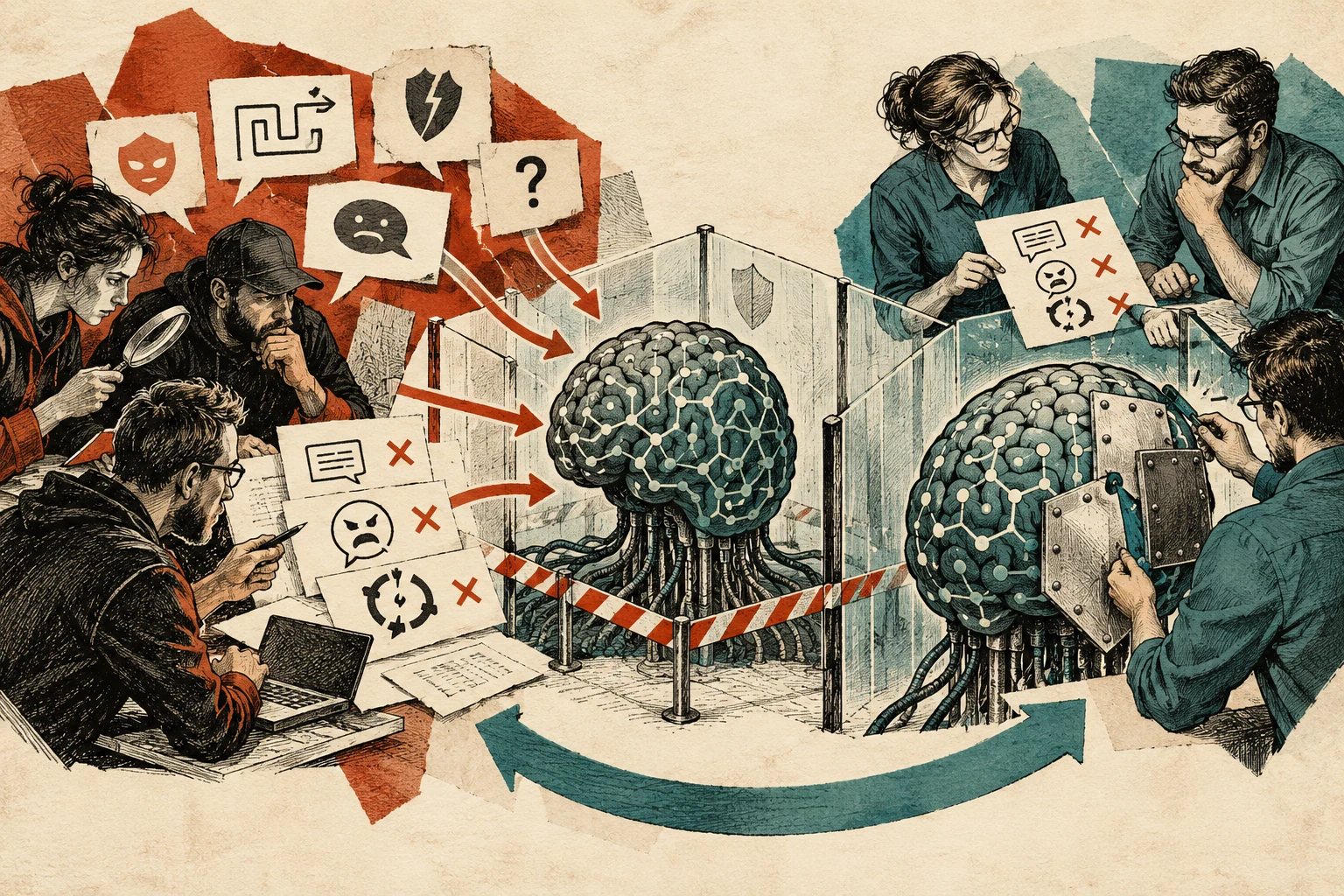
A team deliberately probes for weak points in a controlled exercise, feeding findings back to builders for remediation.
AI-assisted illustration · conceptual metaphor View in visual quiz →Genesis and Global Lineage
The practice originated in military wargaming, where one side role-plays the enemy: the color convention pitting a hostile “Red Team” against a defending “Blue Team” dates to nineteenth-century Prussian Kriegsspiel and was institutionalized in Cold War simulations at RAND and the U.S. Department of Defense. A second lineage comes from intelligence alternative analysis: after failing to anticipate the 1973 Yom Kippur War, Israel’s Military Intelligence (Aman) created a Devil’s Advocate unit (Ipcha Mistabra) mandated to argue contrarian hypotheses, and after 9/11 and the 2003 Iraq WMD assessments, the U.S. Army established the Red Team Leader Course at Fort Leavenworth. A third lineage arose in offensive cybersecurity (penetration testing, as in NATO CCDCOE’s annual Locked Shields exercises in Tallinn). Micah Zenko’s monograph Red Team (2015) synthesized these into simulations, vulnerability probes, and alternative analysis. While Microsoft formed an AI Red Team in 2018, the concept entered the generative AI canon in 2022 through two simultaneous papers: Ethan Perez et al. at DeepMind (Red Teaming Language Models with Language Models) trained one LLM to attack another, and Deep Ganguli et al. at Anthropic (Red Teaming Language Models to Reduce Harms) published 38,961 human adversarial conversations across model scales. Since 2023, AI labs and lawmakers have adopted it as the standard pre-release ritual for foundation models—often narrowing institutional self-critique into a hunt for prompt-level filter bypasses.
Central European Lineage
We found no documented link between this concept and the intellectual history or historical experience of Central Europe.
We found no documented link between this concept and the intellectual history or historical experience of Central Europe (by our methodology, this means “none found,” not “none exists”; as of October 2026).
Why Now
Between 2022 and 2026, AI red teaming moved from internal lab experiment to mandatory international governance. In August 2023, at DEF CON 31 in Las Vegas, the White House co-sponsored the first public Generative AI Red Team Challenge, where thousands of participants exchanged over 164,000 adversarial prompts with models from eight AI companies. On October 30, 2023, President Biden’s Executive Order 14110 wrote a statutory definition of “AI red-teaming” into federal policy and ordered developers of foundation models above 1026 FLOP to share red-team results with the government (and after the order’s revocation in January 2025, its technical definition remained in NIST’s July 2024 Generative AI guidance). In the EU, Article 55(1)(b) of the AI Act (2024, applicable August 2025) legally requires providers of general-purpose AI models with systemic risk to conduct and document adversarial testing. Meanwhile, as labs published elaborate red-teaming taxonomies (such as Anthropic’s June 2024 framework covering CBRN experts, automated attacks, and multimodal probing), academic scrutiny grew: at AIES 2024, the Best Paper Award went to Michael Feffer, Zachary Lipton, Hoda Heidari, and coauthors at Carnegie Mellon for Red-Teaming for Generative AI: Silver Bullet or Security Theater?, showing the field still lacked consensus on what constitutes a rigorous audit.
Explanatory Power
The concept highlights the structural gap between “scoring 92% on a static safety benchmark” and “surviving forty hours of probing by someone paid to break it.” Standard benchmarks evaluate a fixed distribution chosen by creators; a red team searches for out-of-distribution corners where training assumptions fail. First, in DeepMind’s 2022 automated red-teaming study, Perez et al. found that their 280B-parameter chatbot not only generated offensive stereotypes when provoked, but spontaneously handed out real phone numbers of hospitals and private citizens memorized from its training corpus—a failure no multiple-choice benchmark tested for. Second, in Anthropic’s 2022 scaling study, Ganguli et al. discovered that models aligned via Reinforcement Learning from Human Feedback (RLHF) became progressively harder for human red teamers to break as parameter count grew, whereas models aligned via prompt engineering showed flat resistance curves across scale. Third, organizational red teaming (such as Gary Klein’s project premortem, where a team imagines its deployment has already caused a catastrophe and writes the history of how it happened) surfaces institutional blind spots that polite risk meetings suppress.
Axes of Debate
Rigorous engineering evaluation versus performative “security theater”
Researchers led by Michael Feffer, Zachary Lipton, and Hoda Heidari (2024) analyzed dozens of industry red-teaming reports and showed they vary wildly in threat models, sample sizes, and disclosure: when a firm hand-picks a dozen external academics for two weeks under an NDA, provides an unstable API without weights or training data, and summarizes findings in three paragraphs of a system card, red teaming becomes a PR shield rather than a falsifiable audit. Strongest counterargument: Lab safety teams reply that probing an open-ended general-purpose model across biology, cyber-offense, and persuasion is inherently exploratory; the adversarial transcripts collected directly train safety classifiers and refusal boundaries, producing measurable drops in attack success rates between model generations. Nature of the dispute: mixed — the lack of standardized protocols is a substantive methodological flaw, while corporate launch summaries often serve a rhetorical legitimating function.
Automated LLM red teaming versus human domain experts and diverse communities
Proponents of automated red teaming (following Perez et al., 2022) argue that only LLMs attacking LLMs can generate millions of test permutations overnight at low cost, whereas human red teamers are slow, costly, and face psychological burnout from toxic outputs. Strongest counterargument: An attacker LLM searches only within the statistical distribution of known attacks; human specialists (virologists testing lab protocols), speakers of low-resource languages, and marginalized communities consistently uncover novel multi-turn vulnerabilities and cultural blind spots that automated generators miss—which is why labs combine automated scaling with human specialist teams. Nature of the dispute: substantive — concerning the optimal allocation of safety budgets between automated breadth and human depth.
Open scientific disclosure of exploits versus dual-use biosecurity and cyber secrecy
Academic security auditors insist that red-teaming prompts, jailbreak transcripts, and evaluation datasets must be published openly so independent scientists can reproduce and verify vendor safety claims. Strongest counterargument: In dual-use domains—chemical, biological, radiological, and nuclear (CBRN) weapons assistance or zero-day cyber exploits—publishing the exact prompt sequence and response that bypassed guardrails to synthesize a pathogen is an information hazard handing a working recipe to bad actors; labs and state AI Safety Institutes therefore restrict raw transcripts in those categories to vetted auditors. Nature of the dispute: substantive — mirroring coordinated vulnerability disclosure in cybersecurity, sharpened because an LLM jailbreak cannot be deterministically patched like a memory bug.
Underappreciated Angle
When the AI industry borrowed red teaming from the military and intelligence world, it quietly amputated the most important half of the doctrine. In Israeli intelligence after 1973 and U.S. Army doctrine at Fort Leavenworth, a red team was not a group of technicians hired to poke at hardware on a workbench; it was an institutional counterweight empowered to challenge the commander’s strategic framing—asking whether the mission’s assumptions were delusional and whether the operation should be aborted. As Subhabrata Majumdar, Brian Pendleton, and Abhishek Gupta note in Red Teaming AI Red Teaming (2025), AI red teaming has shrunk the practice from the organizational level down to the artifact level: external testers type clever prompts into a chat box for three weeks before a scheduled launch, without the mandate or governance authority to question the business model or cancel the release date. Moreover, because every exercise is bounded by the backgrounds of those recruited onto the team, the catalog of discovered flaws is never an objective map of total risk—it is a mirror of who was invited into the room. A red team permitted to break the refusal filter, but never permitted to halt the launch, performs only half the job for which the name was invented.
One-Sentence Takeaway
An AI system is only as safe as the imagination, mandate, and independence of the people paid to break it—and a red team that is allowed to test the prompts, but never allowed to stop the deployment, is only half a red team.
Related Concepts Network
How this concept reinforces, constrains, or complements other analytical frameworks in the corpus. View on graph →
-
AI alignment complements
Red teaming serves as the empirical stress test of alignment: rather than assuming training objectives succeeded, it actively searches for inputs where the model behaves contrary to its designers’ intent.
-
RLHF in tension
Red teams generate adversarial transcripts used to train RLHF safety filters, yet their own findings show that post-RLHF models become harder to break superficially rather than intrinsically safe.
-
Prompt injection reinforces
Direct and indirect prompt injections are today the single most common class of vulnerabilities uncovered during red-teaming exercises on agentic AI systems.
-
Goodhart’s law constrains
Once the count of discovered and patched jailbreak prompts becomes the headline safety metric, teams optimize for passing a static red-team benchmark rather than addressing structural risk.
-
Frontier AI complements
Mandatory adversarial testing in both U.S. policy frameworks and the EU AI Act applies specifically to frontier / systemic-risk models, turning red teaming into a statutory release gate.
-
AI governance complements
Red teaming became one of the first oversight obligations lawmakers wrote into binding AI regulations—even before standardization bodies agreed on how to grade a red-team audit.
-
Dual-use technology in tension
Testing by breaking generates actionable knowledge about exploits and dangerous capabilities that is itself dual-use: it helps defenders patch the system while potentially lowering the barrier for attackers.
Reading Canon & Translation Bridge
Foundational texts, introductions, and critical perspectives—with availability of English and Polish editions.
-
foundational text 2022 · English
Deep Ganguli i in., Red Teaming Language Models to Reduce Harms: Methods, Scaling Behaviors, and Lessons Learned
Anthropic’s foundational report on systematic human red teaming of language models across scales (2.7B, 13B, and 52B parameters), releasing a dataset of 38,961 adversarial attacks and observing that RLHF models grow increasingly resistant to human red teamers as scale increases.
In English: original text written in English
In Polish: no Polish edition
-
foundational text 2022 · English
Ethan Perez i in., Red Teaming Language Models with Language Models
DeepMind’s landmark paper automating the red team: one language model is prompted or trained to generate adversarial test cases against a target 280B-parameter chatbot (Gopher/Dialogue-Prompted Gopher), uncovering tens of thousands of offensive outputs and training-data leaks.
In English: original text written in English
In Polish: no Polish edition
-
introduction & synthesis 2015 · English
Micah Zenko, Red Team: How to Succeed By Thinking Like the Enemy
The broadest historical monograph on the practice prior to generative AI: covers military wargaming, intelligence agencies, physical security, and corporate red teams, distinguishing simulations, vulnerability probes, and alternative analysis.
In English: original text written in English
In Polish: no Polish edition
-
critical perspective 2024 · English
Michael Feffer, Anusha Sinha, Wesley Hanwen Deng, Zachary C. Lipton, Hoda Heidari, Red-Teaming for Generative AI: Silver Bullet or Security Theater?
A systematic critique of industry AI red-teaming reports (Best Paper Award at AIES 2024), showing how vague threat models, arbitrary team composition, and non-reproducible protocols risk turning red teaming into performative security theater.
In English: original text written in English
In Polish: no Polish edition
-
critical perspective 2025 · English
Subhabrata Majumdar, Brian Pendleton, Abhishek Gupta, Red Teaming AI Red Teaming
Argues that AI red teaming has narrowed into hunting prompt-level model bugs while abandoning the classical intelligence mission of challenging organizational assumptions and deployment decisions.
In English: original text written in English
In Polish: no Polish edition
-
cross-disciplinary 2017 · English
Bryce G. Hoffman, Red Teaming: How Your Business Can Conquer the Competition by Challenging Everything
Translates U.S. Army red-teaming doctrine (from the University of Foreign Military and Cultural Studies at Fort Leavenworth) into corporate strategy, illustrating both its decision-making value and its commercialization as a consulting product.
In English: original text written in English
In Polish: Polish edition not verified
-
cross-disciplinary 2007 · English
Gary Klein, Performing a Project Premortem
A classic two-page cognitive technique in “Harvard Business Review”: before launching a project, the team assumes it has already failed catastrophically and writes the history of why—the simplest organizational variant of red teaming one’s own plan.
In English: original text written in English
In Polish: Polish edition not verified
Primary-Source Quotes
The term „AI red-teaming” means a structured testing effort to find flaws and vulnerabilities in an AI system, often in a controlled environment and in collaboration with developers of AI.
gestures towards red-teaming (based on public definitions) as a panacea for every possible risk verge on security theater.