Horizon & Ecology #182
Loss and damage (L&D)
original term: loss and damage (Eng.) · L&D, straty i szkody klimatyczne, fundusz strat i szkód
Global-circulation concept — no documented lineage in Central Europe. jump to documentation ↓
Working Definition
Loss and damage (L&D) refers to the adverse impacts of climate change that have not been prevented by mitigation and cannot be neutralized by adaptation—covering both sudden extreme weather events and slow-onset processes such as sea-level rise, desertification, and glacial retreat. In UN Framework Convention on Climate Change (UNFCCC) negotiations, the term designates a third policy pillar alongside mitigation and adaptation and a dedicated funding stream for particularly vulnerable developing countries. In public debate it serves as shorthand for “climate compensation,” though UN treaties systematically avoid that word. Analytically, it distinguishes irreversible “losses” (lives, territory, culture, ecosystems) from repairable “damages” (roads, crops, housing), since only the latter can be priced and insured.
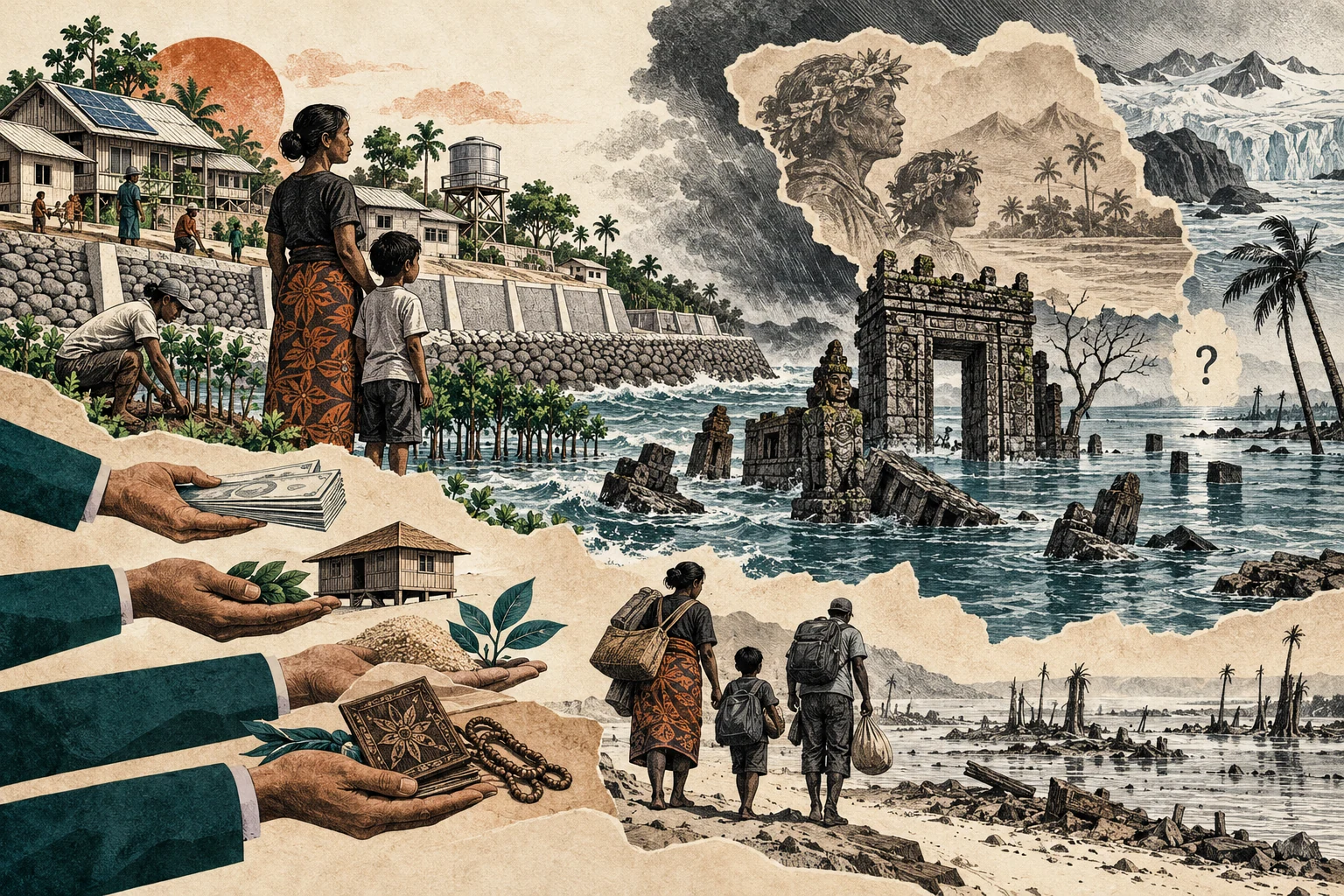
Even with protective measures, some losses cannot be avoided or undone, and support also concerns lost places, ties, and heritage beyond simple monetary pricing.
AI-assisted illustration · conceptual metaphor View in visual quiz →Genesis and Global Lineage
The concept originated in diplomacy rather than academia. In 1991, during the drafting of the UNFCCC, the Alliance of Small Island States (AOSIS) proposed an international insurance pool funded by industrialized nations to compensate low-lying islands for sea-level rise; wealthy states rejected it, and the 1992 convention omitted any mention of loss and damage. The phrase returned in the Bali Action Plan (2007), Cancún (2010), and Doha (2012), and crystallized at COP19 in Warsaw (2013), where Decision 2/CP.19 established the Warsaw International Mechanism for Loss and Damage (named solely after the host city) with mandates for knowledge, coordination, and support—but no money or liability. The Paris Agreement (2015) devoted Article 8 to L&D at the price of Paragraph 51 of the accompanying decision, which barred any basis for “liability or compensation.” After thirty years, COP27 in Sharm el-Sheikh (2022) agreed to create a fund, operationalized at COP28 in Dubai (2023). Movements speak of “reparations” and Northern negotiators of “risk management,” using the exact same three words.
Central European Lineage
We found no documented link between this concept and the intellectual history or historical experience of Central Europe.
We found no documented link between this concept and the intellectual history or historical experience of Central Europe (by our methodology, this means “none found,” not “none exists”; as of October 2026).
Why Now
Between 2018 and 2026, loss and damage moved from the diplomatic periphery to the center of global climate politics for three reasons. First, the IPCC’s Special Report on 1.5°C (2018) and Working Group II contribution to the Sixth Assessment Report (2022) empirically documented “hard and soft limits to adaptation”—thresholds beyond which no locally feasible engineering or social adjustment can prevent severe loss, such as the death of tropical coral reefs or the salinization of small island freshwater lenses. Second, the rapid maturation of extreme-event attribution science (pioneered by the World Weather Attribution network) made it possible within days of a disaster to calculate how much anthropogenic warming increased the probability and intensity of a specific heatwave, drought, or monsoon flood, turning diffuse historical responsibility into a quantifiable probabilistic share. Third, the catastrophic floods in Pakistan in the summer of 2022—which submerged roughly a third of the country and caused over $30 billion in economic damages in a state responsible for less than 1% of historical global emissions—provided the G77 and China negotiating bloc with moral and political leverage that Northern delegations could no longer deflect at COP27 a few months later. Since then, the battle has shifted from whether a fund should exist to who must contribute (including whether high-emitting emerging economies like China or Gulf petrostates should be donors) and how to bridge the gulf between hundreds of millions of dollars in initial pledges and estimated needs running into hundreds of billions per year.
Explanatory Power
The L&D framework makes visible three dynamics that mitigation and adaptation frameworks obscure. First, it establishes that a substantial category of climate harm is already locked in and unavoidable, transforming the policy question from technical risk reduction to distributive politics. Without the category of loss and damage, every climate catastrophe in a poor country can be framed as “inadequate local adaptation,” subtly shifting blame onto the victim’s governance or building codes. Second, L&D forces international financial institutions to confront “non-economic loss and damage” (NELD)—the destruction of ancestral burial grounds, indigenous knowledge, biodiversity, and sense of place—which cannot be captured by cost–benefit analysis yet often represents the deepest existential threat to affected communities. Third, the micro-politics of UNFCCC drafting exposes the real structure of global power: three decades of fierce diplomatic combat over excluding the single word “compensation” reveal more about sovereign fear of legal precedent than dozens of aspirational declarations. Practically, the concept explains why Northern donors strongly prefer parametric insurance schemes (which frame payouts as technical risk-sharing without admitting fault), why small island states negotiate differently from large developing powers like India (for islands, physical survival is at stake; for major emerging economies, setting precedents of Northern financial obligation), and why developing nations fought against permanently housing the fund inside the donor-dominated World Bank without independent governance guarantees.
Axes of Debate
Historical liability and reparations versus no-fault solidarity and risk management
Developing nations (G77+China, AOSIS, the Least Developed Countries), climate justice movements, and scholars of international environmental law ground L&D in the Polluter Pays Principle and the customary international law rule against causing transboundary harm; developed nations, led by the United States and the European Union, have insisted since 1991 that any finance must be framed strictly as voluntary humanitarian solidarity and disaster risk management. Strongest counterargument: Defenders of the Paris compromise argue that attributing a specific dollar share of a single cyclone to a specific state’s nineteenth-century coal emissions remains legally tenuous, and that insisting on formal legal liability would trigger open-ended sovereign exposure that no Northern parliament would ever ratify—making Paragraph 51 the unavoidable political price for creating an operational fund at all. Nature of the dispute: substantive — whether transfers are understood as installments on an ecological debt or as discretionary aid directly determines governance: debtors do not get to dictate conditionalities to creditors, whereas charity donors routinely do.
Insurance and catastrophe finance versus hard limits to adaptation
Reinsurance companies, multilateral development banks, and risk-management researchers (including architects of G7-backed initiatives like InsuResilience and the Global Shield) treat L&D as an extension of comprehensive disaster risk finance: early warning systems, sovereign catastrophe bonds, and regional risk pools. Scholars emphasizing limits to adaptation reply that insurance presupposes random, reversible shocks, whereas slow-onset certainties like sea-level rise or glacial melt are fundamentally uninsurable at affordable premiums. Strongest counterargument: From the standpoint of a devastated community after a cyclone, a rapid automated payout from a parametric insurance pool within two weeks is worth far more than waiting a decade for an international tribunal to adjudicate historical reparations; as Emily Boyd and colleagues’ typology shows, operational tools need not wait for philosophical consensus. Nature of the dispute: mixed — the technical debate over which financial instrument fits sudden versus slow-onset events is substantive, but promoting insurance also serves rhetorically to shift premium costs onto vulnerable states and depoliticize responsibility.
The COP27/COP28 Fund as historic breakthrough versus legitimating safety valve
UN diplomats and mainstream policy advocates hail the creation of the Loss and Damage Fund in 2022–2023 as a historic structural victory for the Global South after thirty years of stonewalling. Critics from political economy and radical climate movements argue that a voluntary fund capitalized with less than $1 billion—roughly a thousandth of estimated annual developing-country damages—and hosted on an interim basis by the World Bank functions as a symbolic safety valve that buys diplomatic peace while fossil-fuel expansion continues. Strongest counterargument: Institutionalists point out that multilateral architectures in the UN system grow through institutional lock-in rather than their opening balance sheet: establishing an independent board, direct access modalities, and an official budget line permanently alters what vulnerable states can demand in future replenishment cycles. Nature of the dispute: rhetorical — both camps agree on the stark numerical gap between pledges and actual damages, differing over whether an underfunded institution represents a stepping stone or a distraction.
Underappreciated Angle
The least examined dimension of loss and damage is epistemological and cultural rather than financial: the concept forces modern policy institutions to admit that parts of the planetary future have already been permanently lost, requiring a shift from managing risk to administering irreversible loss. Risk management is built on the optimistic premise that the worst can still be prevented through smarter engineering; administering loss requires naming, distributing, and mourning what cannot be restored. By inserting “non-economic losses” into the Paris Rulebook and the Warsaw Mechanism’s workplan, climate negotiators inadvertently introduced collective grief, cultural erasure, and territorial disappearance as official objects of public international policy. A second overlooked angle is the impending boomerang effect on the Global North itself. Wealthy nations designed the L&D architecture assuming they would only ever be donors, never recipients; yet events like the 2021 Ahr Valley floods in Germany, recurring megafires in Southern Europe and North America, and uninsurable coastal zones in Florida and Australia mean that Northern budgets are already absorbing massive domestic loss and damage without calling it by its UN name. Once Northern treasuries and insurers are forced to tally their own unadaptable losses at home, their diplomatic insistence that L&D is too vague to quantify will become impossible to sustain.
One-Sentence Takeaway
Loss and damage marks the moment when international climate policy stops promising that it will prevent the worst and begins fighting over who must pay for what it has already failed to prevent.
Related Concepts Network
How this concept reinforces, constrains, or complements other analytical frameworks in the corpus. View on graph →
-
Climate adaptation complements
Loss and damage begins where adaptation proves impossible, arrives too late, or becomes prohibitively expensive; the two concepts compete for the same political and financial budget.
-
Climate justice reinforces
L&D is the institutional translation of the demand that the costs of warming be borne by those who caused it rather than those who suffer its impacts.
-
Climate tipping points reinforces
Crossing tipping points turns reversible risk into irreversible loss—precisely the domain that adaptation can no longer cover.
-
Net zero in tension
The slower net emissions fall, the larger the share of the climate agenda consumed by the bill for harms already inflicted, shifting the balance from prevention to repair.
-
Externalities complements
Loss and damage represents an interstate externality of greenhouse gas emissions that neither markets nor domestic courts internalize, necessitating a dedicated multilateral mechanism.
-
Postcolonialism reinforces
The dispute over climate compensation reproduces the North–South divide and the vocabulary of historical ecological debt familiar from postcolonial debates.
-
Planetary boundaries complements
The planetary boundaries framework maps where the safe operating space ends; L&D asks who pays once that boundary has already been crossed.
Reading Canon & Translation Bridge
Foundational texts, introductions, and critical perspectives—with availability of English and Polish editions.
-
foundational text 2013 · English
UNFCCC, Conference of the Parties, Decision 2/CP.19: Warsaw international mechanism for loss and damage associated with climate change impacts (FCCC/CP/2013/10/Add.1)
The text that gave the concept an institution: it defines the scope (extreme weather events and slow-onset processes), sets out the mechanism’s functions, and explicitly states that loss and damage involves more than what can be reduced by adaptation.
In English: original text written in English
In Polish: Polish edition not verified
-
foundational text 2022 · English
UNFCCC, Conference of the Parties / CMA, Decision -/CP.27 -/CMA.4: Funding arrangements for responding to loss and damage associated with the adverse effects of climate change, including a focus on addressing loss and damage (advance unedited version)
The Sharm el-Sheikh decision establishing new funding arrangements and a dedicated fund; it illustrates how cautious diplomatic wording (“responding to,” without the word “compensation”) secures the consent of developed nations.
In English: original text written in English
In Polish: Polish edition not verified
-
introduction & synthesis 2015 · English
Erin Roberts, Saleemul Huq, Coming full circle: the history of loss and damage under the UNFCCC
A concise history of the concept from the 1991 AOSIS insurance proposal to the Warsaw Mechanism, co-authored by one of the key architects of the Least Developed Countries’ negotiating agenda.
In English: original text written in English
In Polish: Polish edition not verified
-
introduction & synthesis 2019 · English
Reinhard Mechler, Laurens M. Bouwer, Thomas Schinko, Swenja Surminski, JoAnne Linnerooth-Bayer (red.), Loss and Damage from Climate Change: Concepts, Methods and Policy Options
The most comprehensive academic synthesis (open access, Springer): covers attribution methods, non-economic losses, climate risk insurance, and policy options; bibliographic records date the release to November 2018 with a 2019 copyright.
In English: original text written in English
In Polish: Polish edition not verified
-
critical perspective 2016 · English
Lisa Vanhala, Cecilie Hestbaek, Framing Climate Change Loss and Damage in UNFCCC Negotiations
An analysis of frame contestation in UN negotiations: demonstrates that the constructive ambiguity of the concept (liability and compensation versus risk management) was the condition of its political survival rather than a flaw to be eliminated.
In English: original text written in English
In Polish: Polish edition not verified
-
critical perspective 2015 · English
Ivo Wallimann-Helmer, Justice for climate loss and damage
A philosophical anatomy of the concept: examines which principles of justice (corrective, distributive, or ability to pay) can be defended when specific weather harms cannot be uniquely traced to a single culprit.
In English: original text written in English
In Polish: Polish edition not verified
-
cross-disciplinary 2004 · English
Richard S.J. Tol, Roda Verheyen, State responsibility and compensation for climate change damages—a legal and economic assessment
An early encounter between public international law and climate economics: asks whether state liability for climate damages can be derived from customary international law and estimates its potential financial scale.
In English: original text written in English
In Polish: Polish edition not verified
-
cross-disciplinary 2017 · English
Emily Boyd, Rachel A. James, Richard G. Jones, Hannah R. Young, Friederike E. L. Otto, A typology of loss and damage perspectives
An empirical study at the interface of climate science and policy: identifies four competing understandings of L&D among stakeholders, ranging from routine disaster risk reduction to existential limits to adaptation and historical liability.
In English: original text written in English
In Polish: Polish edition not verified
Primary-Source Quotes
Agrees that Article 8 of the Agreement does not involve or provide a basis for any liability or compensation;
Also acknowledging that loss and damage associated with the adverse effects of climate change includes, and in some cases involves more than, that which can be reduced by adaptation,