Culture & Power #141
Hypernormalization
original term: hypernormalization (Eng.) · hipernormalizacja, HyperNormalisation, fasada normalności
Central European lineage: 4 threads (historical experience, documented influence, anticipation, counterpoint) · 1978–2016 · jump to documentation ↓
Working Definition
Hypernormalization is a state of a public communication system in which the faithful reproduction of an established form—stock phrases, compulsory ceremonies, bureaucratic reports—matters more than whether that form describes anything in the outside world. The language does not lie in the ordinary sense, because nobody expects it to refer to reality anymore; its job is to signal membership and keep institutional routines running. In its technical anthropological sense (Alexei Yurchak), the term captures a shift from the constative to the performative dimension of authoritative utterances; in its popular sense (Adam Curtis), it denotes collective consent to a world everyone knows is fake because no one can imagine a viable alternative. Both senses share the absence of an outside alternative, while differing over the role of conscious awareness.
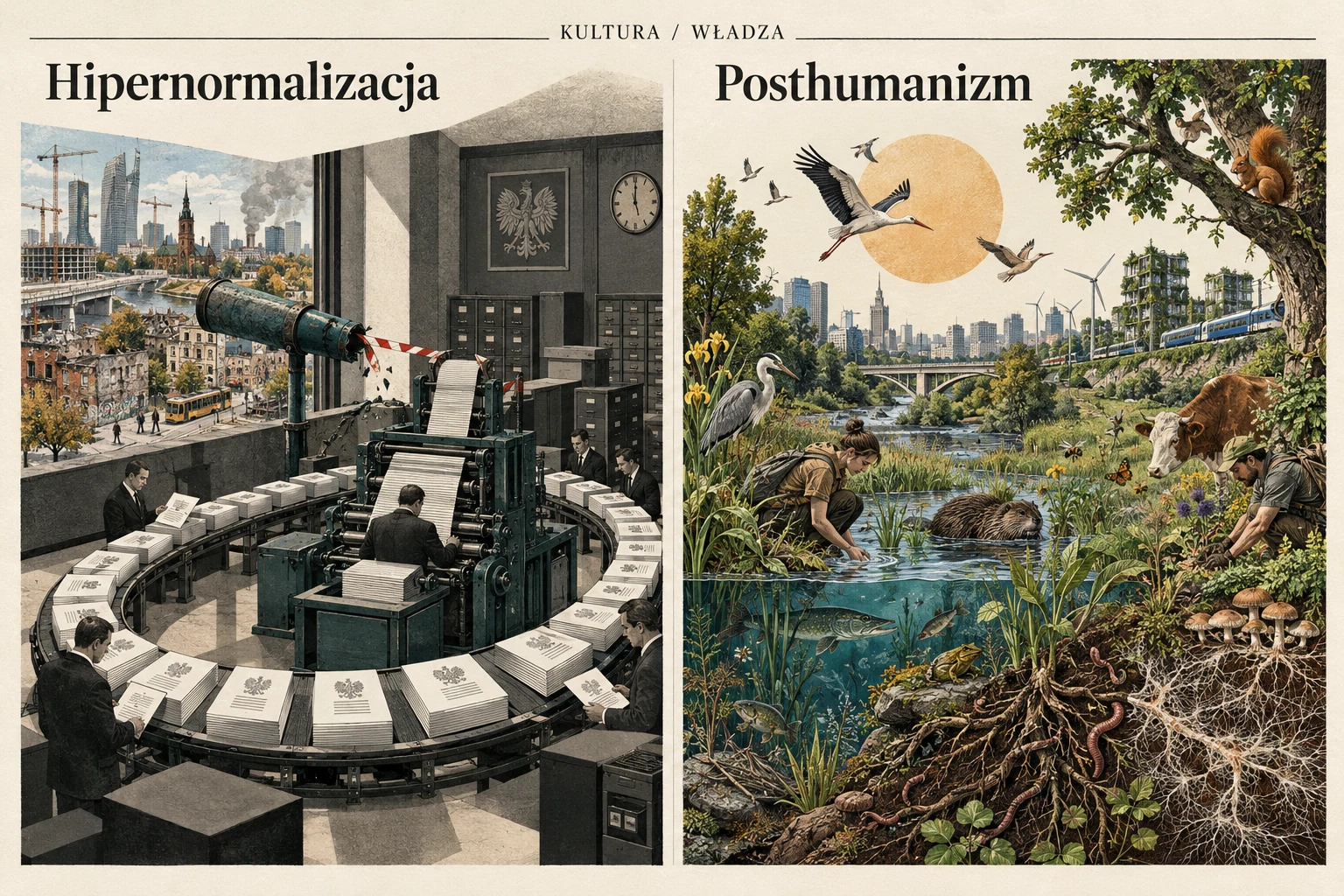
Reports circulate and repeat the same form even though the link to changing reality has been severed.
AI-assisted illustration · conceptual metaphor View in visual quiz →Genesis and Global Lineage
The term was coined by the anthropologist Alexei Yurchak in Everything Was Forever, Until It Was No More (Princeton 2005; expanded Russian edition, 2014), built on material from late Soviet socialism between the mid-1950s and perestroika. Drawing on J. L. Austin’s speech-act theory and Mikhail Bakhtin’s concept of “authoritative discourse,” Yurchak argued that after Stalin’s death there was no longer an external arbiter standing above the system who could judge the ideological correctness of content, so the only safe criterion became strict fidelity to the form of prior utterances. Official language became “hypernormalized”: sentences grew longer, more citational, and more predictable, reproducible without being read. The book challenged two rival schools at once—totalitarianism understood as terror plus lies, and “everyday resistance” models that posit a hidden truth beneath a public mask. In 2016 the British documentary filmmaker Adam Curtis borrowed the word for the title of a 166-minute BBC film and extended it to the West after 1975, arguing that bankers, politicians, and techno-utopians had retreated from managing a complex world into a simpler managed fiction. Since then, the term has circulated chiefly in Curtis’s version, which assumes far greater conscious cynicism than Yurchak attributed to his Soviet subjects.
Central European Lineage
The concept grew out of a case directly bordering Central Europe—the late USSR, which Yurchak knew firsthand from Leningrad (now Saint Petersburg) before earning his anthropology doctorate at Duke (1997) and writing his monograph at Berkeley—and Curtis explicitly noted in Adbusters that he took the term from this “Russian historian.” An earlier formulation of a closely related diagnosis originated in Czechoslovakia: writing in 1978 at Hrádeček, his country house in north-eastern Bohemia during internal exile, Václav Havel observed in Moc bezmocných (The Power of the Powerless) that post-totalitarian ideology had become a “formalized language deprived of semantic contact with reality,” in which a citizen need not believe the mystifications but must behave as though he did. Yurchak knew Havel’s essay, yet dismissed “living in truth” as an emancipatory grand narrative and rejected the binary of truth and falsehood—a move criticized by Kevin Platt and Benjamin Nathans in 2011. Rather than direct influence, Havel represents an earlier and morally contrasting observation of the same structure. A third strand is a Baltic counterpoint from Vilnius University: Jūratė Kavaliauskaitė (2014) and Tomas Vaiseta (2012) argue that Yurchak’s uniform “discursive formation” blurs the deep divisions of the era, that the constative norms actually enforced constrained performative choices, and that an ethnography of Soviet Russia cannot be projected onto an undifferentiated “Soviet space” encompassing occupied Soviet Lithuania.
Documented regional lineage · Links: 4. Compiled: October 2026.
-
anticipation 27 years
Central European Source: Václav Havel, “Moc bezmocných”; Hrádeček, Czechoslovakia (now Czechia), 1978
Global Circulation: hypernormalization — Aleksiej Jurczak, 2005
-
historical experience 0 years — same text on both sides
Central European Source: Aleksiej Jurczak, “Everything Was Forever, Until It Was No More: The Last Soviet Generation”; Leningrad, USSR (now Saint Petersburg, Russia), 2005
Global Circulation: hypernormalization as a feature of late socialist language — Aleksiej Jurczak, 2005
-
documented influence 11 years
Central European Source: Aleksiej Jurczak, “Everything Was Forever, Until It Was No More: The Last Soviet Generation”; Leningrad, USSR (now Saint Petersburg, Russia); Berkeley, California, USA, 2005
Global Circulation: HyperNormalisation (BBC documentary film) — Adam Curtis, 2016
-
counterpoint 9 years — regional source later than global formulation
Central European Source: Jūratė Kavaliauskaitė, “Alexei’aus Yurchako politiškumo samprata ir vėlyvojo sovietmečio paradoksai”; Vilnius, Lithuania, 2014
Global Circulation: hypernormalization and the “performative shift” (Yurchak) — Aleksiej Jurczak, 2005
historical experience
0 years — same text on both sidesAleksiej Jurczak, “Everything Was Forever, Until It Was No More: The Last Soviet Generation”
2005 · Leningrad, USSR (now Saint Petersburg, Russia)
hypernormalization as a feature of late socialist language
2005 · Aleksiej Jurczak
- Claim & Connection
- The term originated as a description of a specific case: the language and rituals of the late USSR (from the mid-1950s to the mid-1980s), which Yurchak knew from his own experience in Leningrad—he earned a degree in physics in Russia and managed the Leningrad band AVIA—and described after completing his doctorate in anthropology at Duke (1997). On p. 50 of his book he writes that authoritative language became “hypernormalized”: its constative dimension detached from reality, and what mattered was the reproduction of form.
- Source Documentation
-
- biographical record Alexei Yurchak, profil w Department of Anthropology, UC Berkeley; physics studies in Russia; PhD in anthropology, Duke 1997; 2007 Vucinich Prize for the book. anthropology.berkeley.edu ↗
- biographical record Alexei Yurchak, Wikipedia (en); born 1960 in Leningrad; physics training; band AVIA; Princeton University Press 2005; Russian edition NLO 2014. en.wikipedia.org ↗
- scholarly study Jacob Filipp, „Notes on: Everything Was Forever, Until It Was No More” (notatki z cytatami i numerami stron); p. 50: “The language had become what I term hypernormalized”. jacobfilipp.com ↗
- bibliographic record Princeton University Press, strona książki (wydanie Princeton Classics 2026, z przedmową autora); publisher description: analysis of “hypernormalization”; endorsement by Adam Curtis. press.princeton.edu ↗
- Historical Context
- Russia and the USSR belong to the region’s neighborhood; the link is included because the late USSR is the source case of the concept and a shared experience across the Eastern Bloc. Year 2005 according to the publisher and catalogs; some texts cite 2006. Page number 50 comes from reading notes rather than an open copy. Verification 2026-10: the Berkeley profile and Wikipedia state only “graduate degree in physics from Russia” / “trained as a physicist,” without naming the university or city—hence the claim uses “earned a degree in physics in Russia.”
documented influence
11 yearsAleksiej Jurczak, “Everything Was Forever, Until It Was No More: The Last Soviet Generation”
2005 · Leningrad, USSR (now Saint Petersburg, Russia); Berkeley, California, USA
HyperNormalisation (BBC documentary film)
2016 · Adam Curtis
- Claim & Connection
- Curtis explicitly attributes the term to Yurchak: in an essay for Adbusters he writes that “this historian, Alexei Yurchak, coined the phrase ‘HyperNormalisation’” to describe the feeling that everyone knew the system was failing and fake, yet no one could imagine any alternative vision. His film of October 16, 2016 extends the term to the West after 1975, departing from Yurchak’s narrower linguistic sense.
- Source Documentation
-
- reception / translation Adam Curtis, „What is Hypernormalization?”, Adbusters, nr 149; paragraph on the “Russian historian” and the sentence crediting Yurchak with coining the term. adbusters.org ↗
- scholarly study UC Berkeley Anthropology, „Adam Curtis BBC Documentary »Hypernormalisation« Inspired by Professor Alexei Yurchak”, 9 XII 2016; note on the film being inspired by Yurchak’s book. anthropology.berkeley.edu ↗
- scholarly study „HyperNormalisation”, Wikipedia (en); premiere October 16, 2016 on BBC iPlayer, 166 min; origin of the term. en.wikipedia.org ↗
- Historical Context
- The source lies in the region’s neighborhood (USSR) and was written in the US; the link is documented in Curtis’s own words. The film shows a semantic shift: for Yurchak hypernormalization concerns the form of language, whereas for Curtis it denotes conscious consent to falsehood.
anticipation
27 yearsVáclav Havel, “Moc bezmocných”
1978 · Hrádeček, Czechoslovakia (now Czechia)
hypernormalization
2005 · Aleksiej Jurczak
- Claim & Connection
- In 1978 Havel described the ideology of the “post-totalitarian” system as a “formalized language deprived of semantic contact with reality,” in which individuals “need not believe” all these mystifications, but must behave as though they did—precisely the structure Yurchak later called the collapse of the constative dimension alongside the preservation of the performative. Yurchak knows Havel’s “living in truth,” but classifies it among the “grand narratives” of emancipatory rhetoric and rejects the opposition of truth and falsehood as one of the binary schemas used to describe socialism; this is therefore not an influence, but an earlier formulation of a closely related diagnosis from a different position.
- Source Documentation
-
- primary source Václav Havel, „Moc bezmocných” (Hrádeček, 1978), tekst w archiwum projektu Československý disent (ÚSD AV ČR); Section IV: “Člověk nemusí všem těmto mystifikacím věřit…”; Section V: ideology as “zformalizovaný jazyk, zbavený sémantického kontaktu se skutečností”. disent.usd.cas.cz ↗
- scholarly study Kevin M. F. Platt, Benjamin Nathans, „Socialist in Form, Indeterminate in Content: The Ins and Outs of Late Soviet Culture”, Ab Imperio 2011, nr 2, s. 301–324; p. 316: Yurchak classifies “living in truth” among the “grand narratives” of emancipatory rhetoric (quote from the book, n. 32), the authors’ polemic, and the charge that his portrayal of the dissident is “bordering on caricature”. live-sas-www-history.pantheon.sas.upenn.edu ↗
- Historical Context
- The similarity concerns the description of ritualized language; the difference concerns evaluation: Havel sees a lie, whereas Yurchak sees a performative shift without a lie. Verification 2026-10: Havel’s quotes checked in the Československý disent archive PDF (Sections IV and V; dated “Hrádeček, říjen 1978”); Platt and Nathans passage checked in the PDF (Ab Imperio 2/2011, pp. 301–324).
counterpoint
9 years — regional source later than global formulationJūratė Kavaliauskaitė, “Alexei’aus Yurchako politiškumo samprata ir vėlyvojo sovietmečio paradoksai”
2014 · Vilnius, Lithuania
hypernormalization and the “performative shift” (Yurchak)
2005 · Aleksiej Jurczak
- Claim & Connection
- Scholars at Vilnius University challenge Yurchak’s framework: Kavaliauskaitė notes that Yurchak studies the society of Soviet Russia yet speaks of the “Soviet system” and “Soviet people” as an undifferentiated space that could also be applied to Soviet Lithuania, points out contradictions in his concepts of “authoritative discourse” and “performative shift” as well as his omission of deep divisions of the era, while Tomas Vaiseta (2012) argues that Yurchak overlooks how the constative dimension constrained performative choices.
- Source Documentation
-
- primary source Jūratė Kavaliauskaitė, „Alexei’aus Yurchako politiškumo samprata ir vėlyvojo sovietmečio paradoksai” (ang. abstrakt: „Alexei Yurchak's The Concept of the Political, and the Paradoxes of Soviet Life during the Late Soviet Period”), Sociologija. Mintis ir veiksmas 2014, t. 35, nr 2, s. 236–251, DOI 10.15388/SocMintVei.2014.2.8780; full text (PDF): pp. 236–237 (introduction and aim of the article: the image of the USSR as “nediferencijuotos geopolitinės-kultūrinės erdvės,” also applied to Soviet Lithuania); p. 251 (English abstract, affiliation: TSPMI, Vilnius University). journals.vu.lt ↗
- primary source Tomas Vaiseta, „Sovietinio veltėdžiavimo fenomenas kasdienybės praktikų ir jų trajektorijų požiūriu”, Lietuvos istorijos studijos 2012, t. 29, s. 111–126, DOI 10.15388/LIS.2012.0.7446; abstract. epublications.vu.lt ↗
- Historical Context
- Both texts appeared in journals of Vilnius University. Verification 2026-10: Kavaliauskaitė’s text read in full (PDF)—affiliation in the article: Institute of International Relations and Political Science (TSPMI), Vilnius University; Vaiseta: abstract read.
Why Now
Three sequences of events between 2016 and 2026 gave the concept a second life. First, the premiere of Curtis’s film (October 16, 2016) fell precisely between the Brexit referendum (June 23) and the election of Donald Trump (November 8), turning the word into a shorthand among commentators for a politics in which public declarations were no longer checked against facts. Second, the 2020–2022 pandemic and Russia’s full-scale invasion of Ukraine since 2022 displayed two distinct modes of the phenomenon: in Russia, the official vocabulary of the “special military operation” with its mandatory formulas reenacted the mechanics Yurchak had described, leaving pollsters debating what they were actually measuring when asking citizens about support for the war. Third, between 2023 and 2026 the concept was applied to Western corporate and institutional language: ESG reports, responsible-AI pledges, and corporate “values” statements that nobody reads for information, yet which must be produced in the exact prescribed format. Hypernormalization captures this production more accurately than “greenwashing,” because it does not assume that anyone on the receiving end expected substantive truth in the first place.
Explanatory Power
The concept makes visible the durability of systems sustained neither by true believers nor by rebels, but by performers of form. Consider three domains. First, bureaucratic reporting: whether the ritual reporting of plan fulfillment in People’s Poland (sprawozdawczość PRL), a quarterly corporate culture deck, or a regulatory compliance self-assessment, such documents are written to pass inspection rather than to inform; their content can be predicted without reading them, while real work happens elsewhere. Second, political communication: ritual condemnations, expressions of “deep concern,” and boilerplate statements after tragedies whose absence would cause a scandal, yet whose presence signifies nothing. Third, academic and AI culture: grant applications, institutional mission statements, and safety policies increasingly generated by large language models trained on an already hypernormalized corpus—where machine language reproduces form more seamlessly than humans ever could because it never possessed a constative dimension to begin with. In each case, hypernormalization shifts the diagnostic question from “who is lying?” to “where has actual life migrated, now that it no longer resides in official language?”
Axes of Debate
Conscious cynicism (Curtis) versus operating in form without belief or disbelief (Yurchak)
Curtis and post-2016 commentators assume that “everyone knew it was fake”—a thesis of universal cynicism. Anthropologists reading Yurchak reply that his book was written precisely against that picture: most participants took no stance on the truth value of slogans because the question of their literal truth had ceased to arise. Strongest counterargument: If nobody takes a stance, hypernormalization becomes indistinguishable from ordinary institutional routine and loses its critical edge; Curtis’s version, however simplified, at least identifies accountable actors. Nature of the dispute: mixed — a disagreement over psychological facts (what people “knew”) is simultaneously a dispute over whether the concept should serve as an ethnographic diagnosis or a political indictment.
A uniform discursive formation versus the divisions of the era (Platt, Nathans, Baltic scholars)
Historians of dissent (Platt and Nathans in Ab Imperio, 2011) and scholars at Vilnius University argue that Yurchak’s model smooths over differences between Moscow and the non-Russian republics, between the 1960s and the 1980s, and between prisoners of conscience and “normal people,” reducing the dissident to a caricature. Strongest counterargument: Yurchak replies that he is asking not what caused the Soviet collapse, but what conditions made that collapse simultaneously possible and completely unexpected; for that question, diversity of attitudes matters less than the shared form everyone reproduced. Nature of the dispute: substantive — it concerns how broadly one can generalize from Leningrad ethnographic material.
A Soviet peculiarity versus a feature of every bureaucracy
Sovietologists treat hypernormalization as the product of a specific historical configuration: the monopoly of a single state ideology left without a supreme arbiter after 1953. Organizational sociologists and critics of corporate capitalism see the same mechanism wherever reporting outweighs action. Strongest counterargument: In systems with political competition and a free press, official formulas are continually tested by opponents and cannot detach completely from reference; exporting the concept to the West ignores the difference between the absence of correction and its mere weakness. Nature of the dispute: substantive — it arbitrates the scope of applicability rather than the validity of the original description.
Underappreciated Angle
Yurchak did not write a book about decay, but about productivity. For him, hypernormalized form was the precondition for the emergence of a vast zone of unofficial meanings: informal study circles, rock bands, the “Imaginary West,” and living vnye—simultaneously inside and outside the system, beside it rather than against it. Performing the compulsory school assembly or May Day parade bought time and space for everything else. This reverses the standard intuition: a frozen public language does not prove that society is dead, only that social life has migrated to places nobody reports on. If the same mechanism operates today, the right question to ask about a corporation, a university, or a political party is not “how much falsehood is in their communiqués?” but “what is growing in the unmonitored space those communiqués shield?”—and whether the eventual collapse of the form will reveal mature alternatives or an emptiness underneath.
One-Sentence Takeaway
A system does not need you to believe or to lie; it only needs you to reproduce the form correctly, leaving you free to arrange the rest of your life beside it.
Related Concepts Network
How this concept reinforces, constrains, or complements other analytical frameworks in the corpus. View on graph →
-
Preference falsification complements
Kuran describes individuals concealing their true views, whereas Yurchak describes a state in which asking about true views ceases to make sense because only the correct reproduction of form matters.
-
Post-truth in tension
Post-truth assumes an audience that can be deceived; hypernormalization describes an audience that no longer expects truth from official language.
-
Hyperreality reinforces
Baudrillard’s simulacra and the “pseudo-reality” of ritual describe the same detachment of the sign from its referent, though from French media theory rather than Soviet ethnography.
-
Overton window constrains
The window assumes that the boundaries of the sayable shift; in a state of hypernormalization those boundaries are frozen while all change happens in unofficial meanings underneath.
-
Cultural hegemony in tension
Gramsci assumes consent to content; Yurchak shows consent solely to form, without belief and without counter-belief.
-
Legibility complements
A state that makes society legible to itself through reports and indicators generates a language that eventually describes only itself.
-
Goodhart’s law reinforces
When the form of a report becomes the target, its informational content vanishes; hypernormalization is Goodhart’s law applied to an entire public language.
Reading Canon & Translation Bridge
Foundational texts, introductions, and critical perspectives—with availability of English and Polish editions.
-
foundational text 2005 · English
Alexei Yurchak, Everything Was Forever, Until It Was No More: The Last Soviet Generation
The source of the term: an ethnography of the last Soviet generation that replaces the binary opposition between state and society with an analysis of authoritative language and its performative shift; an expanded Russian edition appeared in 2014 (NLO).
In English: original text written in English
In Polish: Polish edition not verified
-
introduction & synthesis 2003 · English
Alexei Yurchak, Soviet Hegemony of Form: Everything Was Forever, Until It Was No More
An article in Comparative Studies in Society and History (vol. 45, pp. 480–510) summarizing the book’s thesis in thirty pages; the quickest entry point into its conceptual apparatus.
In English: original text written in English
In Polish: no Polish edition
-
critical perspective 2011 · English
Kevin M. F. Platt, Benjamin Nathans, Socialist in Form, Indeterminate in Content: The Ins and Outs of Late Soviet Culture
The fullest polemic with Yurchak (Ab Imperio 2011, no. 2): charges him with a caricatural portrait of dissidents and an overly uniform “discursive formation,” while quoting in the epigraph a letter in which Yurchak replies to a review by Sheila Fitzpatrick.
In English: original text written in English
In Polish: no Polish edition
-
cross-disciplinary 1978 · Czech
Václav Havel, Moc bezmocných
The classic essay on a ritual in which one need not believe, yet which one must perform; reading it alongside Yurchak shows what Yurchak adopted and what he rejected.
In English: “The Power of the Powerless: Citizens Against the State in Central-Eastern Europe”, Hutchinson 1985, trans. Paul Wilson
In Polish: “Siła bezsilnych i inne eseje”, Agora 2011, trans. Andrzej S. Jagodziński
-
cross-disciplinary 1999 · English
Lisa Wedeen, Ambiguities of Domination: Politics, Rhetoric, and Symbols in Contemporary Syria
The politics of “as if” in Assad’s Syria: a cult in which nobody believes operates as an instrument of discipline, showing that the phenomenon is not a Soviet peculiarity.
In English: original text written in English
In Polish: Polish edition not verified
-
introduction & synthesis 2014 · English
Peter Pomerantsev, Nothing Is True and Everything Is Possible: The Surreal Heart of the New Russia
Reportage from Russian television of the 2000s, in which the hypernormalization of the late USSR receives a post-Soviet continuation: falsehood that is open, cynical, and managed.
In English: original text written in English
In Polish: “Jądro dziwności. Nowa Rosja”, Czarne 2015, trans. Iga Noszczyk
-
cross-disciplinary 1995 · English
Timur Kuran, Private Truths, Public Lies: The Social Consequences of Preference Falsification
An economic model of public conformism against which Yurchak formulates his alternative: not hidden truth beneath a mask, but living in form without content.
In English: original text written in English
In Polish: no Polish edition
Primary-Source Quotes
Člověk nemusí všem těmto mystifikacím věřit. Musí se však chovat tak, jako by jim věřil, anebo je musí aspoň mlčky tolerovat, anebo musí aspoň vycházet dobře s těmi, kteří jimi operují.
Individuals need not believe all these mystifications, but they must behave as though they did, or they must at least tolerate them in silence, or even only get along well with those who work with them. (trans.: Paul Wilson (1985))