Content moderation
original term: content moderation (Eng.) · moderowanie treści, komercyjna moderacja treści
Global-circulation concept — no documented lineage in Central Europe. jump to documentation ↓
Working Definition
Content moderation is the totality of decisions, rules, and socio-technical mechanisms by which an online service operator determines which user expressions remain visible, to whom, and in what ranking position, and which are removed, labeled, downranked, or demonetized. It encompasses written policies (terms of service and “community standards”), the human workers who enforce them, and the software systems that filter speech both before publication and after user reports. In everyday parlance, the term simply means “deleting posts” and is frequently equated with censorship; in its technical sense within legal scholarship and platform studies, it denotes industrial-scale speech governance in which the vast majority of decisions are executed by automated classifiers and an individual takedown is merely the most visible of many administrative interventions.
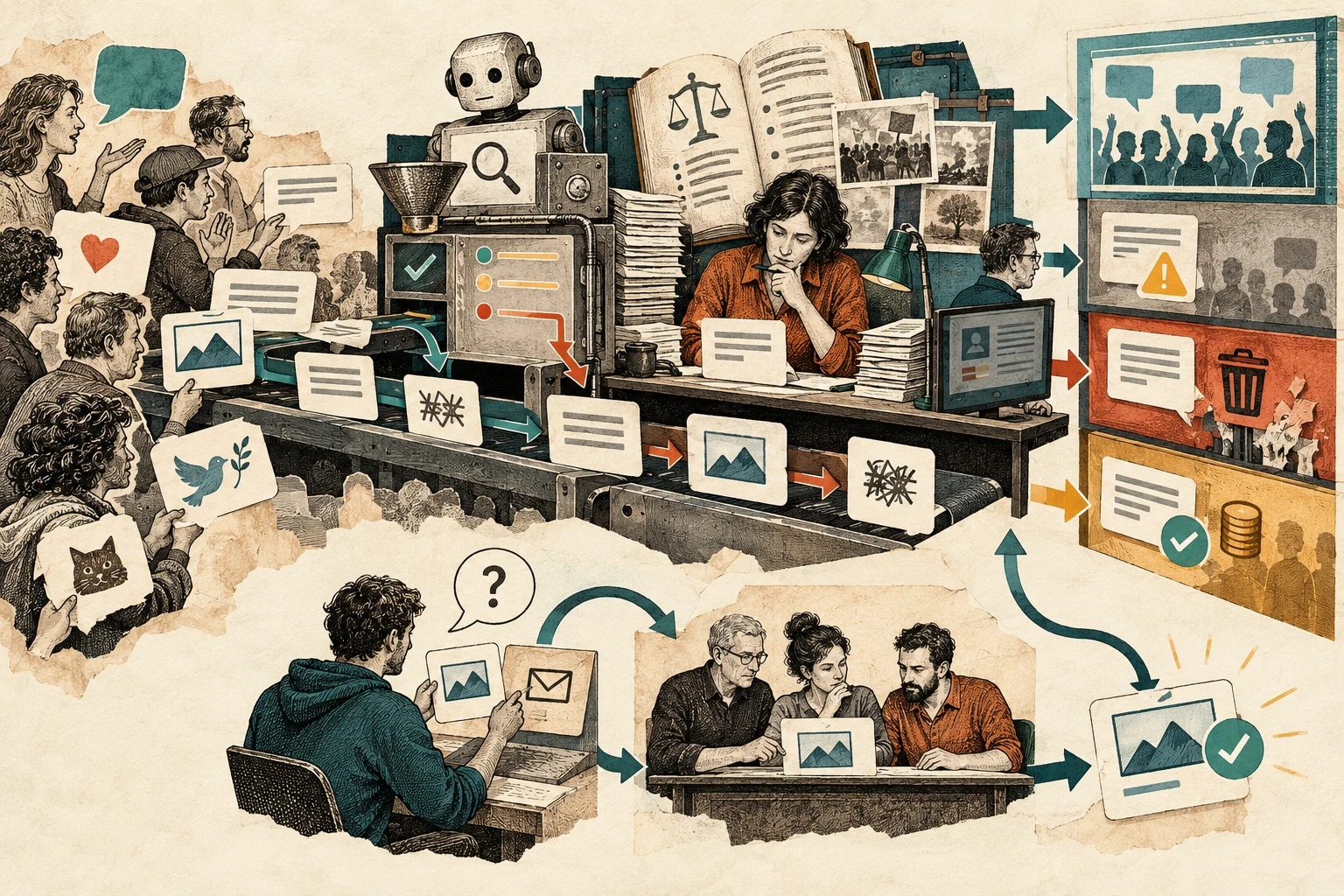
Content is reviewed against rules and context with decisions subject to appeal, showing that moderation involves much more than simple deletion.
AI-assisted illustration · conceptual metaphor View in visual quiz →Genesis and Global Lineage
The concept has two distinct roots. Its practical origin dates back to volunteer moderators of Usenet newsgroups, mailing lists, and early web forums in the 1980s and 1990s, who pruned spam and banned trolls to keep conversation possible. Its theoretical formulation was provided by James Grimmelmann in The Virtues of Moderation (2015), who analyzed moderation as commons management in the spirit of Elinor Ostrom and mapped out its operational grammar: four verbs (exclude, price, organize, norm) and four pairs of adverbs (automatic or manual, transparent or secret, ex ante or ex post, centralized or decentralized). Three years later, two landmark works shifted the analytical focus from volunteer communities to global corporations: Kate Klonick’s The New Governors (2018) drew on insider interviews to reconstruct how Facebook, Twitter, and YouTube built quasi-legal systems of speech adjudication, while Tarleton Gillespie’s Custodians of the Internet (2018) argued that moderation is not a peripheral chore of platforms, but their defining commodity. Sarah T. Roberts added the labor dimension in Behind the Screen (2019), coining “commercial content moderation” to name the outsourced global workforce that keeps seemingly automated platforms clean. Since 2020, the term has been heavily politicized: in the United States it became a partisan watchword for “Big Tech censorship,” whereas in the European Union it was codified as a formal legal category in the Digital Services Act.
Central European Lineage
We found no documented link between this concept and the intellectual history or historical experience of Central Europe.
We found no documented link between this concept and the intellectual history or historical experience of Central Europe (by our methodology, this means “none found,” not “none exists”; as of October 2026).
Why Now
Between 2018 and 2026, content moderation moved from the back office of tech companies to the center of constitutional and geopolitical conflict. Germany’s Network Enforcement Act (NetzDG, passed on June 30, 2017, and fully enforced from January 2018) required platforms to remove “manifestly unlawful” content within 24 hours, establishing a regulatory template quickly imitated by authoritarian states including Russia. Meta established its independent Oversight Board, which issued its first rulings on January 28, 2021, and on May 5, 2021, upheld the suspension of Donald Trump’s account—an unprecedented experiment in creating a quasi-constitutional court for a private corporation. In the European Union, Regulation 2022/2065—the Digital Services Act (DSA)—entered into force on November 16, 2022, and became fully applicable on February 17, 2024: for the first time, binding statutory law obliges platforms to provide statements of reasons for moderation decisions and offer an internal appeals process. Simultaneously, Elon Musk’s acquisition of Twitter in October 2022 and sweeping layoffs across trust and safety teams demonstrated how rapidly moderation infrastructure can be dismantled, followed in January 2025 by Meta’s announcement that it would end third-party fact-checking in the United States. In Poland, a landmark civil lawsuit brought by the harm-reduction NGO Społeczna Inicjatywa Narkopolityki (SIN) against Meta—assisted by the Warsaw-based digital rights group Fundacja Panoptykon after SIN’s educational pages were deleted in 2018—produced a protective injunction in June 2019 and a first-instance judgment from the Warsaw Regional Court on March 13, 2024, ordering restoration of the accounts and an official apology under Polish personal-rights law.
Explanatory Power
The concept makes it visible that “free speech online” is never a state of nature, but the engineered output of specific design choices. First, it exposes the asymmetry of scale: a platform processing billions of uploads daily cannot adjudicate each post like a court of law, meaning that the fate of expression is decided by classifier confidence thresholds, queue prioritization, and acceptable error rates rather than abstract principles—which is why Evelyn Douek advocates regulatory auditing of moderation systems rather than individual case review. Second, it separates hard removal from soft demotion: a user whose post is algorithmically downranked in recommendation feeds receives no notification, meaning that most speech governance happens silently without triggering public debates over censorship. Third, it uncovers the hidden supply chain of human labor: behind “automated” filtering stands a worker in Manila, Nairobi, or Katowice who has seconds to evaluate graphic violence, bearing psychological costs that never appear on a platform’s balance sheet. Together, these insights disentangle three questions that public commentary routinely conflates: who writes the rules, who enforces them, and who absorbs the cost of errors.
Axes of Debate
Is private moderation censorship?
Politicians and commentators—especially on the American right after Donald Trump’s suspension in January 2021, but also civil-liberties groups criticizing state mandates like NetzDG and the DSA—argue that dominant platforms exercise a public-square function, making their terms-of-service enforcement an unaccountable form of prior restraint and censorship without due process. Strongest counterargument: Grimmelmann demonstrates that an unmoderated space does not blossom into ideal freedom, but collapses into spam, harassment, and pornography (as happened to the Los Angeles Times “wikitorial” experiment in 2005); refusing to moderate is itself an allocative decision that hands control of the forum to the loudest and most automated actors. Nature of the dispute: mixed — the legal question of whether platforms bear state-like obligations is substantive, but the label “censorship” is deployed by all sides as a rhetorical weapon of political mobilization.
Human reviewers versus automated classifiers
Platform engineers and executives argue that only automated classifiers—and, since 2023, multimodal large language models—can operate at the speed and scale of global traffic while sparing human workers trauma. Critics such as Gorwa, Binns, and Katzenbach reply that automation does not resolve the crisis of legitimacy but buries it inside opaque probability scores whose false positives remain invisible to victims. Strongest counterargument: Human moderation at Facebook’s scale is economically feasible only as low-wage outsourced piecework, which Sarah T. Roberts documents as an industry rife with PTSD and high turnover; in practice, the alternative to an imperfect classifier is not a deliberative judge, but an exhausted subcontractor given eight seconds per ticket. Nature of the dispute: substantive — it concerns measurable false-positive and false-negative rates, context sensitivity, and the real human and financial costs of both regimes.
Statutory procedural regulation versus corporate self-regulation
European regulators and proponents of the Digital Services Act champion a procedural model: the state does not dictate which viewpoints are permitted, but mandates transparent rules, reasoned notices, appeals, and independent risk audits. Critics, ranging from U.S. First Amendment scholars to digital rights advocates, warn that statutory takedown deadlines and heavy fines incentivize platforms toward precautionary over-removal of lawful speech. Strongest counterargument: Flagship experiments in corporate self-regulation, such as Meta’s Oversight Board, review only a few dozen cases a year out of hundreds of millions of enforcement actions, and their funding and charter remain ultimately dependent on the corporation they oversee; self-regulation without binding external sanction remains a public-relations gesture. Nature of the dispute: substantive — both camps draw on empirical evidence of regulatory side effects and disagree over how to weigh institutional capture against over-blocking.
Underappreciated Angle
The least examined effect of content moderation is not what it deletes, but how it reshapes expression in advance: because platform rules are written to be enforced by classifiers, whatever is easiest to detect automatically becomes what is most strictly policed. Female nipples are computationally simple to flag, whereas ironic harassment or coded threats are hard, so platforms have spent a decade removing far more nudity than intimidation. For the exact same structural reason, smaller languages—including Polish, Czech, Hungarian, and Slovak—suffer worse moderation in both directions simultaneously: more genuine hate speech and coordinated scams stay up because classifiers and contractor teams are under-resourced for those languages, while more benign satire, historical discussion, and activist speech is mistakenly deleted because models miss local idiom. While Washington and Brussels debate the grand constitutional philosophy of “Big Tech censorship,” the everyday quality of speech governance in Central Europe often comes down to whether a Californian corporation employs enough reviewers who can actually read Slovak.
One-Sentence Takeaway
Every platform moderates—the real question is never whether someone decides what you see, but who decides, by what rules, and whether you are even told when a decision has been made.
Related Concepts Network
How this concept reinforces, constrains, or complements other analytical frameworks in the corpus. View on graph →
-
Platformization reinforces
The more public life migrates onto a handful of private platforms, the more their moderation rules replace constitutional law as the de facto governance of speech.
-
Algorithmic management complements
Moderation at the scale of billions of posts is possible only through automated classifiers, which themselves become a covert regulator of public discourse.
-
Algorithmic amplification complements
Removing content is only one lever; quiet reduction of reach (demotion) is a form of moderation that the user never sees.
-
Overton window in tension
Platform rules set the boundaries of what can be said in public, but they do so through administrative enforcement rather than the social debate assumed by the window metaphor.
-
Cancel culture constrains
Debates over cancel culture conflate bottom-up peer pressure from users with top-down institutional enforcement; the concept of content moderation separates the two.
-
Disinformation in tension
Combating disinformation is both the most frequent justification for expanding moderation and the primary source of accusations of political censorship.
-
Enshittification complements
Deep cuts to trust and safety teams after 2022 are a textbook symptom of platforms shifting value away from users toward owners.
Reading Canon & Translation Bridge
Foundational texts, introductions, and critical perspectives—with availability of English and Polish editions.
-
foundational text 2015 · English
James Grimmelmann, The Virtues of Moderation
The first systematic taxonomy of moderation as a commons-governance mechanism: four verbs (exclude, price, organize, norm) and four pairs of adverbs, illustrated through Wikipedia, MetaFilter, and Reddit.
In English: original text written in English
In Polish: no Polish edition
-
foundational text 2018 · English
Kate Klonick, The New Governors: The People, Rules, and Processes Governing Online Speech
An article in the “Harvard Law Review” (vol. 131, pp. 1598–1670) that drew on interviews with employees at Facebook, Twitter, and YouTube to show how ad hoc decisions evolved into quasi-legal rule systems, naming platforms the “New Governors.”
In English: original text written in English
In Polish: no Polish edition
-
foundational text 2018 · English
Tarleton Gillespie, Custodians of the Internet: Platforms, Content Moderation, and the Hidden Decisions That Shape Social Media
Advances the thesis that moderation is not an auxiliary feature of a platform but its core product: a platform is by definition a service that decides what stays and what disappears while hiding that choice behind the metaphor of a neutral conduit.
In English: original text written in English
In Polish: Polish edition not verified
-
critical perspective 2019 · English
Sarah T. Roberts, Behind the Screen: Content Moderation in the Shadows of Social Media
An ethnography of “commercial content moderation” (the author's term): the labor of thousands of low-paid workers in Manila, Dublin, and Silicon Valley without whom no “automated” platform could function.
In English: original text written in English
In Polish: Polish edition not verified
-
introduction & synthesis 2022 · English
Evelyn Douek, Content Moderation as Systems Thinking
An article in the “Harvard Law Review” (vol. 136, p. 526) shifting attention from individual takedown decisions to the systemic design of moderation—queues, thresholds, classifiers—and proposing regulatory oversight of the system rather than individual cases.
In English: original text written in English
In Polish: no Polish edition
-
critical perspective 2020 · English
Robert Gorwa, Reuben Binns, Christian Katzenbach, Algorithmic content moderation: Technical and political challenges in the automation of platform governance
An article in "Big Data & Society" showing that automating moderation does not solve legitimacy problems but conceals them: classifier errors remain invisible to those affected.
In English: original text written in English
In Polish: no Polish edition
-
cross-disciplinary 1990 · English
Elinor Ostrom, Governing the Commons: The Evolution of Institutions for Collective Action
The institutional framework on which Grimmelmann builds his taxonomy: a community can govern a shared resource without state or market if it maintains clear boundaries, graduated sanctions, and low-cost dispute resolution.
In English: original text written in English
In Polish: Polish edition not verified
Primary-Source Quotes
The difference is moderation: the governance mechanisms that structure participation in a community to facilitate cooperation and prevent abuse.