Epistemology #011
Post-truth
original term: post-truth (Eng.) · post-prawda, polityka postprawdy, postfaktyczność
Central European lineage: 1 thread (historical experience) · 2014 · jump to documentation ↓
Working Definition
Post-truth is not a condition in which nobody knows what is true, but an environment in which factual truth has ceased to be the decisive criterion for accepting claims in public debate: empirical evidence loses out to emotion and tribal loyalty, and getting caught in a lie no longer carries a reputational or political penalty. The dictionary definition (Oxford Dictionaries, 2016) describes these external circumstances; philosopher Lee McIntyre's definition adds the active posture behind them—a claim to ideological supremacy whereby partisans compel belief regardless of evidence. What separates post-truth from classical twentieth-century propaganda is its goal: old propaganda laboured to persuade citizens of a single coherent fabrication, whereas post-truth succeeds as soon as the public gives up asking which version is true. Analytically, it diagnoses a shift in the economy of credibility in which the social reward for signaling group loyalty outweighs the penalty for falsehood.
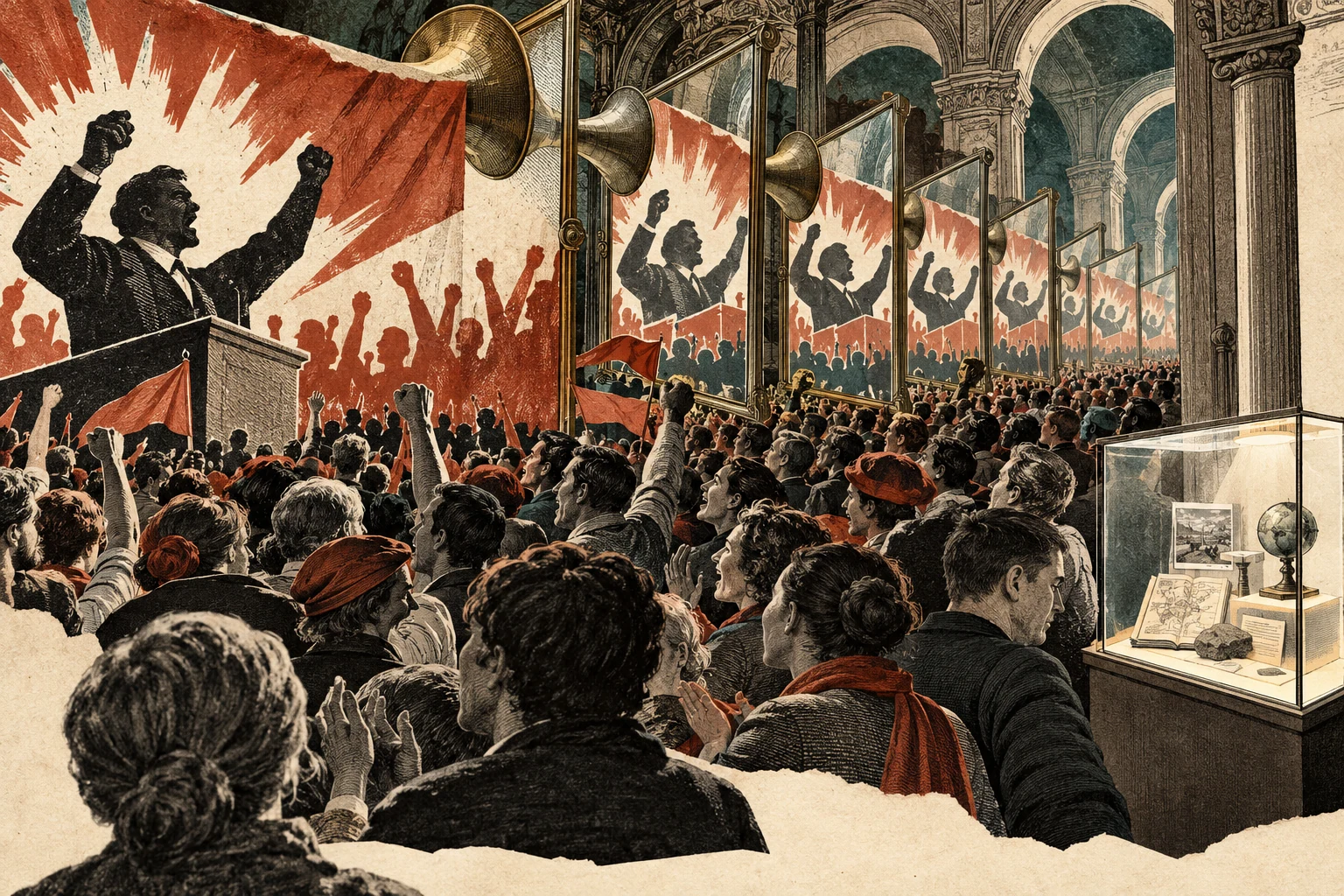
Visible evidence loses out to emotion and group belonging. Facts remain present, but they carry less weight in public judgment.
AI-assisted illustration · conceptual metaphor View in visual quiz →Genesis and Global Lineage
The modern term has an exact birth date: in the 6/13 January 1992 issue of The Nation, Serbian-born American screenwriter Steve Tesich published an essay titled “A Government of Lies.” His starting point was not Orwell, but what he called the “Watergate syndrome”: a public so traumatized by revelations of state deceit from Nixon through the Iran–Contra affair and the 1991 Gulf War that it began to prefer comfort to truth, “freely decid[ing] that we want to live in some post-truth world.” Twelve years later, Ralph Keyes's The Post-Truth Era (2004) examined the normalization of everyday euphemism for deception, while philosopher Harry G. Frankfurt's On Bullshit (1986 essay; 2005 book) supplied the crucial analytical distinction between the liar, who still cares about the truth enough to hide it, and the bullshitter, who is indifferent to reality altogether. Following the June 2016 British Brexit referendum and the November 2016 US presidential election, Oxford Dictionaries named post-truth its Word of the Year on 15 November 2016 after documenting a roughly 2,000% surge in usage over 2015. Lee McIntyre's Post-Truth (2018) synthesized its intellectual lineage: corporate science denial (from Big Tobacco's 1953 “doubt is our product” strategy to fossil-fuel lobbying), cognitive biases, the fragmentation of legacy media into partisan feeds, and the ironic right-wing capture of postmodernist arguments against objectivity. Almost immediately, however, the concept also became a partisan club—each camp branding the other's falsehoods “post-truth”—while sociologist Steve Fuller (2018) recast it as a perennial power game between establishers (“lions”) and disruptors (“foxes”) of epistemic rules.
Central European Lineage
While the English term originated in the United States, the Russian information war accompanying the annexation of Crimea and the war in the Donbas in 2014 made Ukraine the paradigmatic historical laboratory for major strands of the post-truth literature. In their November 2014 report The Menace of Unreality: How the Kremlin Weaponizes Information, Culture and Money, Peter Pomerantsev and Michael Weiss showed that Russian state television was no longer trying to convince audiences of a coherent Soviet-style ideology, but flooding the information space with contradictory fabrications—such as the infamous hoax of a child crucified by Ukrainian soldiers in Sloviansk—in order “to confuse, blackmail, demoralize, subvert and paralyze.” The civic counter-response also began in Kyiv before “post-truth” became a Western buzzword: on 2 March 2014, faculty, students, and alumni of the Mohyla School of Journalism launched StopFake to systematically verify and debunk Kremlin disinformation about Ukraine. Historian Timothy Snyder argues in The Road to Unfreedom (2018) that the 2014 assault on Ukraine and the barrage of mutually incompatible Russian explanations for the shooting down of Malaysia Airlines Flight MH17 in July 2014 served as an unheeded dress rehearsal for the techniques deployed in Western elections in 2016, summarizing the lesson from twentieth-century Central and Eastern European history in Lesson 10 of On Tyranny (2017): “Post-truth is pre-fascism.”
Documented regional lineage · Link: 1. Compiled: October 2026.
-
historical experience 0 years — same text on both sides
Central European Source: Dezinformacja wokół Krymu, Donbasu i zestrzelenia MH17 (2014); uruchomienie StopFake w Kijowie 2 marca 2014 r. — Rosyjska wojna informacyjna towarzysząca aneksji Krymu i wojnie w Donbasie; odpowiedź StopFake; Kyiv, Crimea and the Donbas, Ukraine, 2014
Global Circulation: post-truth as the export of Russia's “war on reality” (weaponization of information) — Peter Pomerantsev i Michael Weiss (2014); Timothy Snyder (2017–2018), 2014
historical experience
0 years — same text on both sidesDezinformacja wokół Krymu, Donbasu i zestrzelenia MH17 (2014); uruchomienie StopFake w Kijowie 2 marca 2014 r. — Rosyjska wojna informacyjna towarzysząca aneksji Krymu i wojnie w Donbasie; odpowiedź StopFake
2014 · Kyiv, Crimea and the Donbas, Ukraine
post-truth as the export of Russia's “war on reality” (weaponization of information)
2014 · Peter Pomerantsev i Michael Weiss (2014); Timothy Snyder (2017–2018)
- Claim & Connection
- The report “The Menace of Unreality” (November 2014) described Russian state media as an engine for multiplying contradictory versions of events in Ukraine whose aim is confusion and paralysis rather than persuasion; the Ukrainian fact-checking project StopFake (launched in Kyiv on 2 March 2014) was created to verify and refute this propaganda. In The Road to Unfreedom (2018), Timothy Snyder treats the 2014 invasion of Ukraine and the conflicting narratives around the downing of Flight MH17 as an unheeded warning of methods that reached the 2016 US campaign, and in On Tyranny (2017) he coins the maxim “post-truth is pre-fascism.” The Ukrainian experience thus serves in major strands of the post-truth literature as a paradigmatic historical case.
- Source Documentation
-
- scholarly study Peter Pomerantsev, Michael Weiss, „The Menace of Unreality: How the Kremlin Weaponizes Information, Culture and Money”, The Interpreter / Institute of Modern Russia, New York, 22 XI 2014; introduction and executive summary: Russian state media spreading disinformation about Ukraine (the fabricated story of a crucified child); information used as a weapon “to confuse, blackmail, demoralize, subvert and paralyze”; goal: “to sow confusion via conspiracy theories and proliferate falsehoods”. interpretermag.com ↗
- scholarly study StopFake, „About us”; para. 1: project launched on 2 March 2014 by faculty, alumni, and students of the Mohyla School of Journalism; goal: “to verify and refute disinformation and propaganda about events in Ukraine”. stopfake.org ↗
- scholarly study Publishers Weekly, recenzja: Timothy Snyder, „The Road to Unfreedom: Russia, Europe, America”, Tim Duggan Books, New York 2018; review of 26 Feb 2018: the 2014 invasion as “the warning that went unheeded”; MH17 narrative (over 80% of Russians did not blame Russia); interference in the 2016 US election. publishersweekly.com ↗
- scholarly study Critics at Large, recenzja: Timothy Snyder, „On Tyranny: Twenty Lessons from the Twentieth Century” (2017); Lesson 10 “Believe in Truth”; quote “Post-truth is pre-fascism”; examples from 20th-century European totalitarianism and Putin's information warfare. criticsatlarge.ca ↗
- biographical record Wikipedia (en), „Peter Pomerantsev”; born 1977 in Kyiv; family emigrated in 1978; Westminster School, University of Edinburgh; worked in television in Moscow 2001–2010. en.wikipedia.org ↗
- Historical Context
- The link concerns Ukraine as the site where information warfare of this type was deployed and countered early on (2014). Two biographical candidates were checked and excluded under the formation rule: Steve Tesich (born 1942 in Užice, emigrated to the US at age 14, educated at Indiana and Columbia) and Peter Pomerantsev (born in Kyiv, raised and educated in the UK from 1978).
Why Now
Events between 2018 and 2026 repeatedly renewed the concept's relevance. In February 2020 the WHO declared an “infodemic” around COVID-19 as biomedical questions were absorbed into identity warfare, and in 2021 the Nobel Peace Prize went to journalists Maria Ressa and Dmitry Muratov for defending factual reporting under authoritarian pressure. Russia's full-scale invasion of Ukraine in February 2022 showed that state narratives of “denazification” need not be empirically believable to organize domestic compliance. In the EU, the Digital Services Act (DSA, enacted in 2022 and fully applicable from February 2024) translated the debate into law by requiring very large online platforms to assess and mitigate systemic disinformation risks. Meanwhile, generative AI drove the cost of synthetic audio and video toward zero: two days before Slovakia's September 2023 parliamentary election, an audio deepfake of opposition leader Michal Šimečka discussing vote-rigging went viral during the pre-election moratorium. And when Meta ended its US third-party fact-checking program in January 2025, the question shifted from whether post-truth exists to which institutions are willing to pay to resist it.
Explanatory Power
The concept explains three puzzles that traditional theories of lying and ignorance miss. First, why factual corrections often fail to change political behavior: when endorsing a claim functions as a badge of group membership rather than a report on the world, a fact-check is processed as a status attack by an out-group, stiffening loyalty rather than revising belief. Second, why repeating a demonstrably false claim in public can strengthen a leader's authority: as Hannah Arendt noted in “Truth and Politics” (1967), demanding that followers assent to an obvious falsehood acts as a costly loyalty test—anyone willing to repeat a blatant lie against their own eyes has burned their bridges to the opposition. Third, why a “firehose of falsehood” destroys accountability more effectively than a single polished lie: when Russian state media broadcast half a dozen mutually exclusive theories within days of the downing of Flight MH17, the aim was not to prove any one theory true, but to convince spectators that everyone has a “version” and objective truth is unknowable. Post-truth begins where repair procedures exist on paper, but nobody expects a speaker to pay a price for ignoring them.
Axes of Debate
Novel epoch versus perennial democratic struggle
Historians of ideas such as Sophia Rosenfeld (Democracy and Truth, 2019) and sociologists of knowledge such as Steve Fuller (2018) argue that fierce contests between technocratic experts and populist common sense have accompanied modern democracy since the eighteenth-century pamphlet wars; from this perspective, talk of a sudden “post-truth era” reflects the status panic of traditional gatekeepers who lost their broadcast monopoly. Strongest counterargument: What changed in the 2010s was not the human propensity to lie, but the institutional price of getting caught: in an algorithmic attention economy where audiences self-sort into partisan feeds, exposure of a fabrication no longer costs a speaker their platform or following—a structural shift Tesich already glimpsed in 1992. Nature of the dispute: substantive — it turns on whether we measure the phenomenon by the historical volume of political falsehoods or by the breakdown of reputational sanctions against them.
Did academic postmodernism pave the way?
Lee McIntyre (2018) argues that late-twentieth-century academic postmodernism—by treating scientific objectivity as a power narrative—inadvertently supplied right-wing science deniers and authoritarian propagandists with the relativist vocabulary of “alternative facts,” echoing Bruno Latour's 2004 lament in “Why Has Critique Run out of Steam?” Strongest counterargument: Tobacco and fossil-fuel lobbyists perfected the strategy of manufacturing scientific doubt in the 1950s and 1960s through Madison Avenue PR firms without ever reading Derrida or Foucault; blaming humanities seminars mistakes a culture-war scapegoat for a multi-billion-dollar corporate and state apparatus. Nature of the dispute: mixed — tracing the diffuse migration of philosophical slogans into political consulting is empirically elusive, and the accusation often serves to settle scores inside the university.
Elite moral panic versus empirical measurement
Quantitative communication researchers—such as Ceren Budak, Brendan Nyhan, and colleagues in Nature (2024)—demonstrate that online consumption of demonstrably false “fake news” websites is heavily concentrated among a small, already hyper-partisan minority of users, arguing that sweeping diagnoses of a “post-truth society” exaggerate the electoral impact of online misinformation. Strongest counterargument: Studies that count clicks on fringe fake-news domains miss the primary artery of post-truth politics: false claims broadcast directly by heads of state, party leaders, and mainstream partisan television networks, which reach tens of millions without needing any shady URL. Nature of the dispute: substantive — the disagreement hinges on the unit of empirical measurement: fringe domain clicks versus elite political speech.
Underappreciated Angle
Because recent scholarship focuses on the supply side—troll farms, algorithms, and deepfakes—it often forgets that Steve Tesich introduced the term in 1992 from the demand side: post-truth is actively chosen by audiences who prefer flattering self-esteem to uncomfortable reality. A second neglected insight comes from Central and Eastern Europe: the true fuel of post-truth is not gullibility, but universal cynicism. As Peter Pomerantsev observed in Moscow, a regime does not need people to believe its lies; it only needs them to conclude that everyone lies, that independent journalism and science are just another racket, and that checking facts is for fools. Reflexive distrust of all official claims—often mistaken in post-authoritarian societies for streetwise immunity—is in fact the ideal breeding ground for post-truth: a citizen who trusts no institution and no procedure defaults to whichever narrator flatters their identity. True resilience is not blanket suspicion, but conditional trust in auditable procedures.
One-Sentence Takeaway
Post-truth begins not when politicians lie, but when getting caught in a lie stops costing them anything—and that price is ultimately set by the audience, not the speaker.
Related Concepts Network
How this concept reinforces, constrains, or complements other analytical frameworks in the corpus. View on graph →
-
Disinformation complements
Disinformation is the deliberate act of a sender; post-truth describes the demand-side conditions among audiences under which lying ceases to carry a reputational penalty.
-
Information disorder complements
Wardle and Derakhshan's typology (mis-, dis-, malinformation) classifies polluted content, whereas post-truth describes the political climate in which audiences stop caring about the distinction.
-
Motivated reasoning reinforces
The cognitive mechanism whereby a factual correction is experienced as an attack on group identity and therefore fails to revise belief.
-
Epistemic bubbles vs. echo chambers reinforces
Echo chambers lower the reputational cost of falsehood inside the group while raising the social cost of correcting one's own camp.
-
Hypernormalization in tension
Under hypernormalization nobody believes the official fiction yet everyone performs it; under post-truth belief is often sincere because it functions as a badge of tribal loyalty.
-
Hyperreality complements
Baudrillard's thesis of signs detached from referents forms the philosophical backdrop to debates over whether postmodernism paved the way for post-truth politics.
-
Prebunking constrains
Psychological inoculation is the leading practical countermeasure to post-truth: teaching citizens to recognize manipulation tropes before they encounter them.
Reading Canon & Translation Bridge
Foundational texts, introductions, and critical perspectives—with availability of English and Polish editions.
-
foundational text 2018 · English
Lee McIntyre, Post-Truth
A concise synthesis from the philosophy of science (MIT Press Essential Knowledge): traces post-truth to organized science denial, cognitive biases, the decline of legacy media, and the right-wing appropriation of postmodernist tropes.
In English: original text written in English
In Polish: no Polish edition
-
foundational text 1992 · English
Steve Tesich, A Government of Lies
The essay in The Nation (6/13 January 1992) where the term first appeared in its modern sense—Approaching the phenomenon from the demand side: a free public that chooses self-esteem and comfort over hard truth.
In English: original text written in English
In Polish: no Polish edition
-
foundational text 2004 · English
Ralph Keyes, The Post-Truth Era: Dishonesty and Deception in Contemporary Life
The first book bearing the phrase in its title: an examination of everyday dishonesty and the “ethical twilight zone” between truth and falsehood, published twelve years before the 2016 Word of the Year.
In English: original text written in English
In Polish: “Czas postprawdy. Nieszczerość i oszustwa w codziennym życiu”, Wydawnictwo Naukowe PWN 2018, trans. Paweł Tomanek
-
cross-disciplinary 1967 · English
Hannah Arendt, Truth and Politics
The classic distinction between factual truth and rational truth, showing how organized political lying destroys not belief in specific facts, but the very sense by which we orient ourselves in the real world.
In English: original text written in English
In Polish: “Prawda i polityka, w: Między czasem minionym a przyszłym. Osiem ćwiczeń z myśli politycznej”, Fundacja Aletheia 1994, trans. Mieczysław Godyń, Wojciech Madej
-
cross-disciplinary 2005 · English
Harry G. Frankfurt, On Bullshit
Provides the essential analytical distinction: bullshit differs from lying by its complete indifference to how things really are, capturing the exact posture of the speaker under post-truth conditions.
In English: original text written in English
In Polish: “O wciskaniu kitu”, Czuły Barbarzyńca Press 2008, trans. Hanna Pustuła-Lewicka
-
introduction & synthesis 2014 · English
Peter Pomerantsev, Nothing Is True and Everything Is Possible: The Surreal Heart of the New Russia
First-hand reportage from inside Russian television between 2001 and 2010: shows how state media manufacture universal cynicism rather than ideological conviction, and why that suffices to sustain power.
In English: original text written in English
In Polish: “Jądro dziwności. Nowa Rosja”, Wydawnictwo Czarne 2015, trans. Iga Noszczyk
-
introduction & synthesis 2018 · English
Timothy Snyder, The Road to Unfreedom: Russia, Europe, America
Traces the trajectory from Ivan Ilyin and Vladimir Putin through the 2014 invasion of Ukraine to the 2016 US election; the most forceful historical account of post-truth as a technique of political warfare.
In English: original text written in English
In Polish: “Droga do niewolności. Rosja, Europa, Ameryka”, Znak Horyzont 2019, trans. Bartłomiej Pietrzyk
-
critical perspective 2018 · English
Steve Fuller, Post-Truth: Knowledge as a Power Game
A sociologist of knowledge defends the “post-truth condition” as a permanent contest over who gets to set the rules of epistemic legitimacy—a provocation that forces defenders of “facts” to specify what institutional authority they are defending.
In English: original text written in English
In Polish: no Polish edition
Primary-Source Quotes
We, by our actions, are saying that this is no longer necessary, that we have acquired a spiritual mechanism that can denude truth of any significance. In a very fundamental way we, as a free people, have freely decided that we want to live in some post-truth world.
Post-truth: relating to or denoting circumstances in which objective facts are less influential in shaping public opinion than appeals to emotion and personal belief.