Epistemology #021
Epistemic bubbles vs. echo chambers
original term: epistemic bubbles vs. echo chambers (Eng.) · bańka filtrująca, bańka epistemiczna, komora echa
Central European lineage: 1 thread (anticipation) · 1935–2020 · jump to documentation ↓
Working Definition
An epistemic bubble is an informational structure in which relevant voices fail to reach the recipient—through homophilous social networks, selective source habits, or algorithmic personalization, usually without anyone's deliberate design. An echo chamber is a social structure in which outside voices do arrive, but have been preemptively discredited: members have been trained to distrust anyone outside the group. The first is a failure of coverage and access; the second is a pathology of trust. In everyday journalism both terms, alongside Eli Pariser's “filter bubble,” are often used interchangeably; in C. Thi Nguyen's framework, the distinction decides whether mere exposure to counter-evidence heals the problem or actively inflames it.
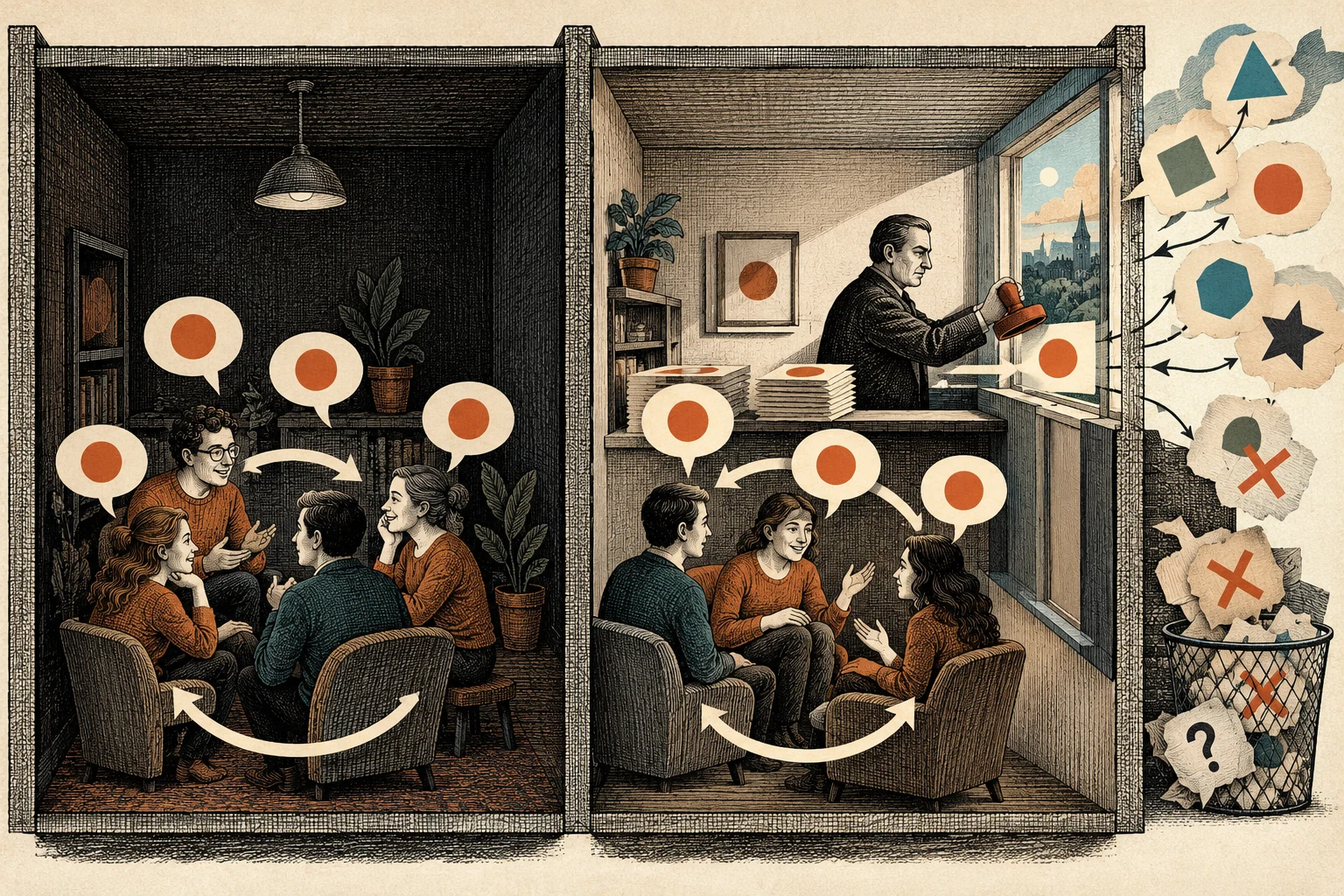
In one room outside voices fail to enter; in the other they arrive, but the group's dynamic strips them of credibility in advance.
AI-assisted illustration · conceptual metaphor View in visual quiz →Genesis and Global Lineage
The intellectual lineage runs through three main stages. In Republic.com (2001), Cass Sunstein warned against the “Daily Me,” a personalized news feed that fragments the shared civic experience of citizens. In Echo Chamber (2008), Kathleen Hall Jamieson and Joseph Cappella empirically studied the media ecosystem of Rush Limbaugh, Fox News, and the Wall Street Journal editorial page, showing that its power lay not in isolating listeners from outside claims, but in training them to treat mainstream journalism as morally and epistemically corrupt. In The Filter Bubble (2011), Eli Pariser shifted the blame onto algorithmic curation: Google and Facebook personalization was said to filter the world invisibly behind the user's back. C. Thi Nguyen, in an Aeon essay (2018) and an Episteme paper (online 2018, print 2020), brought analytical order to the field: a bubble is omission by filtering, whereas an echo chamber is active exclusion through the systematic discrediting of outsiders. Popular commentary subsequently collapsed both terms into a single indictment of social media, losing the very distinction that gives the concept its diagnostic force.
Central European Lineage
The Lwów bacteriologist and philosopher of medicine Ludwik Fleck formulated a striking anticipation of this mechanism in Entstehung und Entwicklung einer wissenschaftlichen Tatsache (Basel 1935; Genesis and Development of a Scientific Fact, 1979). Educated at Jan Kazimierz University in interwar Lwów (then in Poland, now Lviv, Ukraine) and directing serological laboratories there from the 1920s alongside the analytic milieu of the Lvov–Warsaw School, Fleck described the “thought collective” (Denkkollektiv) divided into an esoteric circle of specialists and an exoteric circle of laypeople who adopt a thought style through trust in those specialists. Every mature thought style, Fleck argued, exhibits a “tendency to persist” (Beharrungstendenz): contradictions are not sought out because they appear unthinkable; when they occur, they go unnoticed; if encountered, they are passed over in silence; if forced into the open, they are absorbed into the system through auxiliary explanations; at the limit, the style even generates observations conforming to expectation. This is an early epistemological model of how a cognitive community immunizes itself against outside testimony—closely parallel to what Nguyen calls an echo chamber, with the crucial difference that Fleck analyzed normal science rather than partisan media and did not posit deliberate reputational sabotage of outsiders. We found no evidence that Nguyen or Pariser drew on Fleck; the connection remains a conceptual anticipation rather than a documented influence.
Documented regional lineage · Link: 1. Compiled: October 2026.
-
anticipation 85 years
Central European Source: Ludwik Fleck, “Entstehung und Entwicklung einer wissenschaftlichen Tatsache”; Lwów, Poland (now Lviv, Ukraine), 1935
Global Circulation: echo chamber as a structure that actively discredits outside voices — C. Thi Nguyen, 2020
anticipation
85 yearsLudwik Fleck, “Entstehung und Entwicklung einer wissenschaftlichen Tatsache”
1935 · Lwów, Poland (now Lviv, Ukraine)
echo chamber as a structure that actively discredits outside voices
2020 · C. Thi Nguyen
- Claim & Connection
- Trained and working as a bacteriologist in interwar Lwów, Fleck described in 1935 a “thought collective” with esoteric and exoteric circles and the tendency of a thought style to persist: contradictions are not sought out, remain unnoticed, are passed over in silence, or are forced into the system through auxiliary explanations. This is an earlier account of a similar mechanism making an epistemic community resistant to outside evidence; we found no trace that Nguyen drew on Fleck.
- Source Documentation
-
- scholarly study Stanford Encyclopedia of Philosophy, hasło „Ludwik Fleck”; biographical sections and sections on Denkstil, Denkkollektiv, esoteric and exoteric circles; persistence of style despite anomalies. plato.stanford.edu ↗
- scholarly study Wikipedia (de), hasło „Ludwik Fleck”; five mechanisms of Beharrungstendenz: failure to seek counter-evidence, non-perception, silence, auxiliary explanation, fabrication of consonant observations. de.wikipedia.org ↗
- reception / translation C. Thi Nguyen, „Echo Chambers and Epistemic Bubbles”, Episteme 17 (2), 2020, s. 141–161; abstract: the echo chamber as active exclusion and discrediting of voices. cambridge.org ↗
- Historical Context
- Fleck's primary text was not opened directly here; the description of the mechanisms comes from secondary literature. Fleck writes about science rather than media, and does not attribute deliberate discrediting to the collective—a feature central to Nguyen. A verifier should check the section on the persistence of opinion systems in the German or Polish edition.
Why Now
Following the Cambridge Analytica scandal (March 2018), the 2016 and 2020 US presidential elections, and the Brexit referendum (nor was Central Europe immune, as Poland's post-2015 split between state broadcasting and private outlets fostered rival partisan ecosystems), the diagnosis that “algorithms locked us inside bubbles” became the default explanation for political polarization. At the same time, counter-evidence mounted rapidly. A comprehensive Reuters Institute literature review (Ross Arguedas et al., January 2022) estimated the share of citizens trapped in strictly partisan news echo chambers in countries like the UK at only a few percent, noting that search engines and social platforms typically broaden rather than narrow users' informational diets, and that audience polarization remains lower across much of Europe than in the United States. Large-scale field experiments on Facebook and Instagram feeds during the 2020 US campaign, published from 2023 onward through Meta's academic collaboration, likewise failed to show that switching users to chronological feeds reduced polarization over several weeks. The distinction is therefore needed today not as a slogan, but as a triage tool: to determine whether we are facing a deficit of exposure or destroyed institutional trust—because that determines whether “more exposure to the other side” acts as medicine or poison.
Explanatory Power
Separating epistemic bubbles from echo chambers explains why fact-checking and “both-sides” exposure campaigns so frequently backfire. Inside an epistemic bubble, new testimony works: a person who simply had not heard a relevant argument hears it and updates their view. Inside an echo chamber, the very same counter-evidence is processed through a pre-installed rule—“outsiders lie to subvert us”—and thus serves as fresh confirmation of the enemy's malice, reinforcing the structure. Three concrete applications illustrate this. First, anti-vaccine movements: members usually know the standard medical arguments well, but have been trained to view public-health institutions as corrupt, so pouring in more statistical data fails while rebuilding trust through insiders can succeed. Second, newsroom initiatives launched after 2016 to “burst filter bubbles” by pairing opposing readers: they addressed a problem of access when the core barrier was distrust. Third, exiting an echo chamber resembles leaving a high-control sect—it requires a “social reboot” of whom one trusts rather than a debate over isolated propositions, which explains why de-radicalization typically happens through personal relationships rather than fact-checks.
Axes of Debate
Algorithmic curation versus user self-selection
Eli Pariser and platform-regulation advocates argue that algorithmic personalization acts as an invisible censor for which system designers bear primary responsibility. Empirical media researchers (Bakshy, Messing, and Adamic in Science, 2015; the Reuters Institute team) reply that user choices and social homophily account for a larger share of narrowed exposure than algorithmic ranking, and that platforms often expose users to more diverse sources than offline habits do. Strongest counterargument: The 2015 Science study was conducted by Facebook researchers on proprietary data, and a user's “own choice” on a platform is already shaped by prior algorithmic recommendations and interface defaults, making a clean separation of the two factors artificial. Nature of the dispute: mixed — the debate over effect sizes is substantive and empirical, while the battle over how to assign moral and regulatory blame is largely rhetorical.
How prevalent echo chambers actually are
Media scholars working with behavioral tracking data (Richard Fletcher, Rasmus Kleis Nielsen) point out that sealed partisan echo chambers encompass only a small minority of the public, whereas the far larger democratic problem is low news consumption altogether. Political philosophers and elite-polarization researchers counter that population share is the wrong metric: a small, disciplined faction with weaponized distrust can still capture party agendas and public debate. Strongest counterargument: Standard media-exposure surveys measure epistemic bubbles, not echo chambers; tracking which outlets someone visits does not reveal whom they trust or how they process contrary claims—so data said to “refute echo chambers” often measure a different phenomenon from the one Nguyen defines. Nature of the dispute: substantive — it turns on how to operationalize an echo chamber in empirical research.
Structural trap versus individual epistemic vice
Nguyen emphasizes that an echo-chamber member can be locally rational: they trust authorities they have reason to deem reliable and apply epistemic rules they were taught within their community. Virtue epistemologists reply that someone who systematically refuses to audit their own authorities exhibits an intellectual vice for which they remain accountable. Strongest counterargument: If echo-chamber members are treated as entirely blameless captives of a structure, no member has a normative reason from within to question their stance; a theory that absolves agents of responsibility also strips away the agency needed for exit. Nature of the dispute: substantive — a foundational disagreement over the boundaries of testimony-dependent rationality.
Underappreciated Angle
Echo chambers are routinely described as pathologies of rampant skepticism and distrust, yet they actually run on a surplus of trust: their members trust their internal authorities far more intensely than an ordinary reader trusts a newspaper. That is why blanket appeals to “think for yourself,” “do your own research,” and “be skeptical of the media” so often act as fuel for an echo chamber rather than its cure—they train habits of blanket discrediting, and discrediting outside testimony is the chamber's engine. The flip side is equally uncomfortable: no cognitive community, from a bacteriology laboratory to an investigative newsroom, can function without selective epistemic trust; as Fleck showed, shared trust is the precondition for stabilizing any scientific fact at all. The boundary between a healthy thought collective and a pathological echo chamber therefore does not lie where trust in insiders begins, but where distrust of outsiders hardens into an unfalsifiable rule that may never be tested.
One-Sentence Takeaway
When showing someone counter-evidence only deepens their conviction, you are facing not a shortage of information (a bubble) but a structure of preemptively destroyed trust (an echo chamber)—and no amount of extra facts will fix it without first rebuilding who is trusted.
Related Concepts Network
How this concept reinforces, constrains, or complements other analytical frameworks in the corpus. View on graph →
-
Preference falsification complements
Inside an echo chamber, the cost of expressing dissent before one's own group rises, so members falsify their preferences even among allies.
-
Affective polarization reinforces
An echo chamber turns disagreement over views into distrust of persons, because discrediting the source is its core mechanism rather than a side effect.
-
Disinformation complements
Disinformation takes root most effectively where trust in independent sources has already been undermined in advance.
-
Network epistemology reinforces
Both concepts diagnose structural flaws in how testimony flows between people rather than defects in an isolated individual mind.
-
Epistemic humility constrains
Appeals to epistemic humility fail inside an echo chamber because its members are already humble—toward their own authorities.
-
Algorithmic management in tension
The filter bubble thesis blames the algorithm, whereas empirical studies indicate that user self-selection weighs more heavily than algorithmic personalization.
Reading Canon & Translation Bridge
Foundational texts, introductions, and critical perspectives—with availability of English and Polish editions.
-
foundational text 2020 · English
C. Thi Nguyen, Echo Chambers and Epistemic Bubbles
The article in “Episteme” 17 (2), pp. 141–161 (online 2018), which separates the two phenomena by the criterion of trust rather than exposure and derives distinct remedies from that distinction.
In English: original text written in English
In Polish: no Polish edition
-
foundational text 2011 · English
Eli Pariser, The Filter Bubble: What the Internet Is Hiding from You
The book that popularized the term “filter bubble” and the thesis of personalization as invisible censorship; read today as a document from the early era of recommendation algorithms.
In English: original text written in English
In Polish: Polish edition not verified
-
foundational text 2008 · English
Kathleen Hall Jamieson, Joseph N. Cappella, Echo Chamber: Rush Limbaugh and the Conservative Media Establishment
An empirical study of the conservative media ecosystem in the United States, from which Nguyen draws his paradigm case of an echo chamber: training listeners to distrust all outside sources.
In English: original text written in English
In Polish: Polish edition not verified
-
introduction & synthesis 2001 · English
Cass R. Sunstein, Republic.com
An early warning against the “Daily Me,” or personalized news diet, which set the frame for debates over the fragmentation of the public sphere a decade before Pariser.
In English: original text written in English
In Polish: Polish edition not verified
-
critical perspective 2022 · English
Amy Ross Arguedas, Craig T. Robertson, Richard Fletcher, Rasmus Kleis Nielsen, Echo chambers, filter bubbles, and polarisation: a literature review
A Reuters Institute review showing that sealed echo chambers encompass only a small minority of audiences and that algorithms tend to broaden rather than narrow news diets.
In English: original text written in English
In Polish: no Polish edition
-
critical perspective 2015 · English
Eytan Bakshy, Solomon Messing, Lada A. Adamic, Exposure to ideologically diverse news and opinion on Facebook
A “Science” study on Facebook data attributing a larger share of reduced cross-cutting exposure to user choices than to the algorithm; criticized for conflicts of interest, yet still a benchmark reference.
In English: original text written in English
In Polish: no Polish edition
-
cross-disciplinary 1935 · German
Ludwik Fleck, Entstehung und Entwicklung einer wissenschaftlichen Tatsache
Sociology of scientific cognition from interwar Lwów: a thought collective that cannot see its own anomalies is the closest ancestor of the echo chamber in the theory of knowledge.
In English: “Genesis and Development of a Scientific Fact”, University of Chicago Press 1979, trans. Fred Bradley, Thaddeus J. Trenn
In Polish: “Powstanie i rozwój faktu naukowego”, Wydawnictwo Lubelskie 1986, trans. Maria Tuszkiewicz
Primary-Source Quotes
other relevant voices have been actively excluded and discredited