Epistemology #024
Information disorder
original term: information disorder (Eng.) · zaburzenie informacyjne, nieład informacyjny, mis-/dis-/mal-information
Global-circulation concept — no documented lineage in Central Europe. jump to documentation ↓
Working Definition
Information disorder is an umbrella analytical framework for three distinct forms of pollution in the information ecosystem, classified along two axes: whether the content is false and whether it is shared with intent to cause harm. Mis-information is false or misleading content shared without malicious intent; dis-information is false content knowingly fabricated or disseminated to harm a person, social group, organization, or country; mal-information is genuine, factually accurate information weaponized to inflict harm—such as strategic leaks of private correspondence, doxing, or revenge porn. The framework further requires analyzing every episode across three elements (agent, message, interpreter) and three lifecycle phases (creation, production, distribution), because a single piece of content can change category as it travels: state-crafted disinformation reshared in good faith by an anxious parent becomes misinformation at the point of distribution. Its authors explicitly designed the taxonomy to retire the term “fake news,” which they argued was both analytically hopelessly vague and politically weaponized to discredit independent journalism.
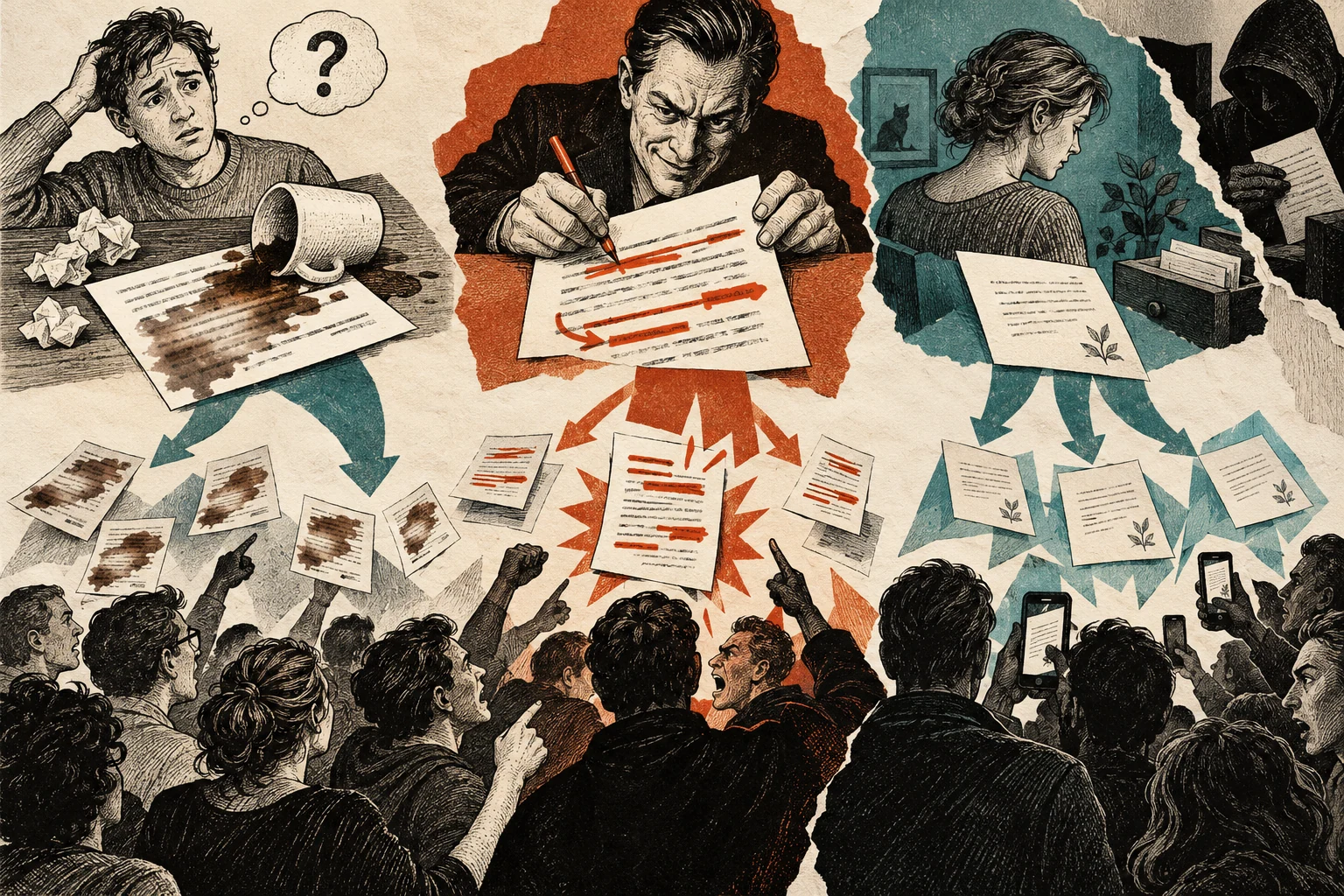
Honest mistakes, deliberate falsehoods, and the harmful deployment of true information operate through distinct mechanisms; not every damaging message in circulation is simply false.
AI-assisted illustration · conceptual metaphor View in visual quiz →Genesis and Global Lineage
The framework was formulated by Claire Wardle and Hossein Derakhshan in their report Information Disorder: Toward an interdisciplinary framework for research and policy making, published by the Council of Europe in October 2017. Wardle, a British communication scholar with a PhD from the University of Pennsylvania who then led the verification nonprofit First Draft, had published an influential seven-part continuum of problematic content in February 2017—ranging from satire and misleading headlines to imposter content and 100% fabricated stories—which became a core pillar of the report. Derakhshan, an Iranian-Canadian blogger and media researcher who returned to the internet in 2014 after six years in an Iranian prison to find the open hyperlink web replaced by closed social feeds (described in his 2015 essay The Web We Have to Save), contributed the crucial third category of mal-information. Written in the immediate wake of the 2016 Brexit referendum, the 2016 US presidential election, and Russian active-measures revelations (and mapping early European fact-checking responses including Ukraine's StopFake, founded in 2014, and Central European initiatives such as Poland and Slovakia's Demagog or the Czech Interior Ministry's Center Against Terrorism and Hybrid Threats), the report drew on James Carey's ritual view of communication, Erving Goffman's dramaturgy, and motivated-reasoning psychology to emphasize that people share dubious posts primarily to signal group identity rather than to convey literal propositions. The three-part taxonomy was rapidly adopted by the European Commission's 2018 Code of Practice on Disinformation, UNESCO handbooks, and platform trust-and-safety teams—though in bureaucratic circulation it was frequently flattened into a three-word glossary, stripping out its sociological sections on ritual sharing and institutional trust.
Central European Lineage
We found no documented link between this concept and the intellectual history or historical experience of Central Europe.
We found no documented link between this concept and the intellectual history or historical experience of Central Europe (by our methodology, this means “none found,” not “none exists”; as of October 2026).
Why Now
Since 2018, Wardle and Derakhshan's taxonomy has become the standard operating vocabulary of democratic governance and platform regulation. The European Democracy Action Plan (2020) and the EU's Digital Services Act (enforced for very large online platforms from 2023) rely directly on its distinction between illegal content, intentional disinformation, and unwitting misinformation. The COVID-19 pandemic and the “infodemic” declared by the WHO in February 2020 exposed how thin the boundary between categories can be in real time: a physician repeating outdated clinical guidance (misinformation) circulated alongside commercial networks peddling toxic miracle cures (disinformation). Following Russia's full-scale invasion of Ukraine in February 2022, the category of mal-information gained urgent strategic weight across Eastern and Central Europe: doxing, selective leaks, and publishing genuine personal data of soldiers, aid volunteers, or refugees became weapons of war against which traditional truth-checking is powerless. Meanwhile, the explosion of generative AI since 2023 has driven the marginal cost of the production phase near zero, while the global election year of 2024 sharpened a methodological debate over whether the true bottleneck lies in synthetic supply or in audience demand and elite amplification.
Explanatory Power
The framework's primary diagnostic achievement is breaking the monolithic panic over “online lies” into structurally distinct problems requiring different interventions. First, by separating intent from falsity, it shows why a state-sponsored influence operation designed by a professional agency (creation and production) but amplified by ordinary citizens in private WhatsApp or Messenger groups (distribution) cannot be solved by punishing end users as liars. Second, the concept of mal-information accounts for high-impact political operations in which not a single document is forged—such as the 2016 DNC email leaks or the 2017 MacronLeaks dump forty-eight hours before the French presidential runoff, where genuine private files were weaponized through timing and framing (and where Macron's team famously countered by seeding false files among genuine ones to slow verification). Third, tracking the three lifecycle phases shows how content mutates ownership over time: a satirical meme stripped of its original frame becomes misinformation in a family group chat, and is then harvested by a political operative as disinformation—demonstrating why counting “fake news URLs” without mapping the chain of agents and interpreters misses how manipulation actually works.
Axes of Debate
Message-level taxonomy versus asymmetric media ecosystems
Media-ecosystem researchers such as Yochai Benkler, Robert Faris, and Hal Roberts (Network Propaganda, 2018) argue that focusing on individual messages and their classification misses the macro-structure: in asymmetric media systems, domestic partisan television and politicians drive polarization and elite falsehoods on a scale that dwarfs discrete viral hoaxes or foreign troll farms. Strongest counterargument: Wardle and Derakhshan's framework explicitly includes institutional actors under the agent element and visual/broadcast formats under the message element; the reduction of their model to URL-level fact-checking is a distortion of policy implementation rather than a flaw of the report itself. Nature of the dispute: substantive — a disagreement over the primary unit of causal analysis: discrete communicative artifacts versus macro-institutional media architectures.
Moral panic over scale versus empirical skepticism
Cognitive scientists and empirical communication scholars (Sacha Altay, Manon Berriche, and Alberto Acerbi in Misinformation on Misinformation, 2023; alongside earlier tracking studies by Andrew Guess and Brendan Nyhan) demonstrate that measurable exposure to outright false news is small, heavily concentrated among a narrow fringe of partisan heavy users, and rarely alters voting behavior—suggesting that the label “information disorder” pathologizes the entire public sphere on thin evidence. Strongest counterargument: Behavioral web-tracking panels mainly capture desktop browser visits to blacklisted domains while missing encrypted messaging apps, video platforms, and visual memes—and the damage of targeted mal-information or anti-refugee scapegoating does not require a majority of the population to click a fake domain. Nature of the dispute: substantive — it turns on what current empirical instruments can actually observe and measure across closed digital channels.
Intent and mal-information versus free-speech law
Legal scholars and civil-liberties organizations warn that making “intent to harm” and mal-information operational categories for platform moderation or state regulators is perilous: moderators cannot read a speaker's mind, and policing “true information shared to cause harm” easily slides into suppressing whistleblowers, investigative journalism, and legitimate political embarrassment of the powerful. Strongest counterargument: The authors designed an analytical matrix for researchers and policy diagnosis, not a takedown statute for speech codes; recognizing that genuine leaks can be weaponized in hybrid warfare does not entail banning investigative reporting. Nature of the dispute: mixed — the legal critique targets regulatory misuse, yet the framework invited such translation by being commissioned and promoted as a direct policy blueprint.
Underappreciated Angle
The least read—and most subversive—chapter of Wardle and Derakhshan's report is its discussion of the interpreter and ritual communication. Drawing on James Carey's distinction between the “transmission view” of communication (sending data packets across space) and the “ritual view” (performing shared beliefs to maintain a community in time), the authors point out that sharing a dubious headline on social media is rarely a failed attempt at amateur journalism; it is a Durkheimian ritual of solidarity saying “look who our enemies are.” This insight quietly undercuts much of the multi-million-dollar fact-checking industry that adopted the report's vocabulary: if a user shares a post to perform tribal belonging, replying with a literal factual correction addresses the transmission layer while leaving the ritual layer untouched—or worse, turns the correction itself into a badge of establishment hostility. Equally neglected is the report's warning about the collapse of local newspapers: where local civic reporting vanishes, communities lose the everyday institutional tether of shared factual reality, leaving a vacuum that national partisan narratives effortlessly fill.
One-Sentence Takeaway
The most dangerous pollution in the public sphere need not be false (mal-information), and the most viral falsehood need not be literally believed by those who share it—what matters is how agents, messages, and identity rituals interlock across creation, production, and distribution.
Related Concepts Network
How this concept reinforces, constrains, or complements other analytical frameworks in the corpus. View on graph →
-
Disinformation complements
Wardle and Derakhshan's framework disaggregates everyday “disinformation” into three distinct types along two axes: falsity and intent to harm.
-
Post-truth constrains
Instead of a sweeping diagnosis of an era in which facts no longer matter, it offers an operational taxonomy of messages, agents, and interpreters.
-
Prebunking reinforces
Breaking the phenomenon into phases of creation, production, and distribution pinpoints where preemptive inoculation can work and where intervention arrives too late.
-
Brandolini’s law complements
The cost asymmetry of refuting bullshit explains why, in Wardle and Derakhshan's framework, the distribution phase is far more dangerous than the creation phase.
-
Epistemic bubbles vs. echo chambers complements
The “interpreter” element of the framework presupposes that the very same message becomes a different social act inside different echo chambers.
-
Content moderation in tension
The category of mal-information (genuine information shared to cause harm) cannot be adjudicated by truth-based moderation rules and opens a fierce dispute over the limits of takedowns.
-
Network epistemology reinforces
The framework tracks how epistemic trust migrates from institutional gatekeepers to peer networks, explaining why horizontal sharing by ordinary users is so potent.
-
Deepfake reinforces
Synthetic media slash the cost of the production phase and blur the boundary between fabricated content and manipulated genuine content.
Reading Canon & Translation Bridge
Foundational texts, introductions, and critical perspectives—with availability of English and Polish editions.
-
foundational text 2017 · English
Claire Wardle, Hossein Derakhshan, Information Disorder: Toward an interdisciplinary framework for research and policy making
The Council of Europe report that introduces the term, the three content types, the three elements (agent, message, interpreter), and the three phases; essential reading because most subsequent EU and platform policies adopted its taxonomy.
In English: original text written in English
In Polish: Polish edition not verified
-
foundational text 2018 · English
David M. J. Lazer i in., The science of fake news
A concise manifesto by sixteen researchers in “Science” that, alongside the Council of Europe report, called for an interdisciplinary research agenda and empirical measurement of exposure rather than guesswork.
In English: original text written in English
In Polish: Polish edition not verified
-
critical perspective 2023 · English
Sacha Altay, Manon Berriche, Alberto Acerbi, Misinformation on Misinformation: Conceptual and Methodological Challenges
A review article that challenges six widespread assumptions about misinformation (including its reach and causal power) and argues that moral panic is often less empirically grounded than the phenomenon itself.
In English: original text written in English
In Polish: Polish edition not verified
-
introduction & synthesis 2018 · English
Yochai Benkler, Robert Faris, Hal Roberts, Network Propaganda: Manipulation, Disinformation, and Radicalization in American Politics
An analysis of millions of articles and shares from the 2016 US election cycle that shifts explanatory weight from foreign bots to the asymmetric structure of the domestic media ecosystem.
In English: original text written in English
In Polish: Polish edition not verified
-
introduction & synthesis 2020 · English
Thomas Rid, Active Measures: The Secret History of Disinformation and Political Warfare
A century-long history of disinformation as intelligence craft, showing that the new framework describes old operational practices in new channels and that most operations rely on unwitting amplification by the target society.
In English: original text written in English
In Polish: Polish edition not verified
-
introduction & synthesis 2019 · English
Peter Pomerantsev, This Is Not Propaganda: Adventures in the War Against Reality
Reportage from the Philippines, Ukraine, Russia, and the UK showing that contemporary information operations aim not to persuade audiences of a coherent falsehood, but to exhaust them into giving up on truth altogether.
In English: original text written in English
In Polish: Polish edition not verified
-
cross-disciplinary 1967 · English
Hannah Arendt, Truth and Politics
A classic political-philosophy essay on the fragility of factual truth in the face of organized lying, reminding us that the chief result of mass falsehood is not belief in lies, but the destruction of the sense by which we orient ourselves in the real world.
In English: original text written in English
In Polish: Polish edition not verified
Primary-Source Quotes
Mis-information is when false information is shared, but no harm is meant. Dis-information is when false information is knowingly shared to cause harm. Mal-information is when genuine information is shared to cause harm, often by moving information designed to stay private into the public sphere.