AI Architecture #111
Foundation models
original term: foundation models (Eng.) · modele fundamentowe, modele fundacyjne, modele AI ogólnego przeznaczenia
Central European lineage: 1 thread (documented influence) · 2010–2021 · jump to documentation ↓
Working Definition
A foundation model is a machine-learning model trained on broad data at massive scale—typically via self-supervision—that is not built for a single narrow application, but serves as a shared base to be adapted (through fine-tuning, in-context prompting, or post-training layers) across a wide variety of downstream tasks. Crucially, the term describes a model’s architectural and economic position in a software supply chain rather than a specific neural architecture or parameter count: a single model becomes “foundational” when hundreds of distinct medical, legal, coding, or consumer systems are built atop it, whereas a similarly large model trained solely for weather forecasting or protein folding is not. In casual usage, “foundation model” is often treated as a synonym for a large language model (LLM); in its precise technical sense it spans text, vision, audio, robotics, and multimodal systems, while in European Union law (the 2024 AI Act) its regulatory counterpart is codified as a “general-purpose AI (GPAI) model.”
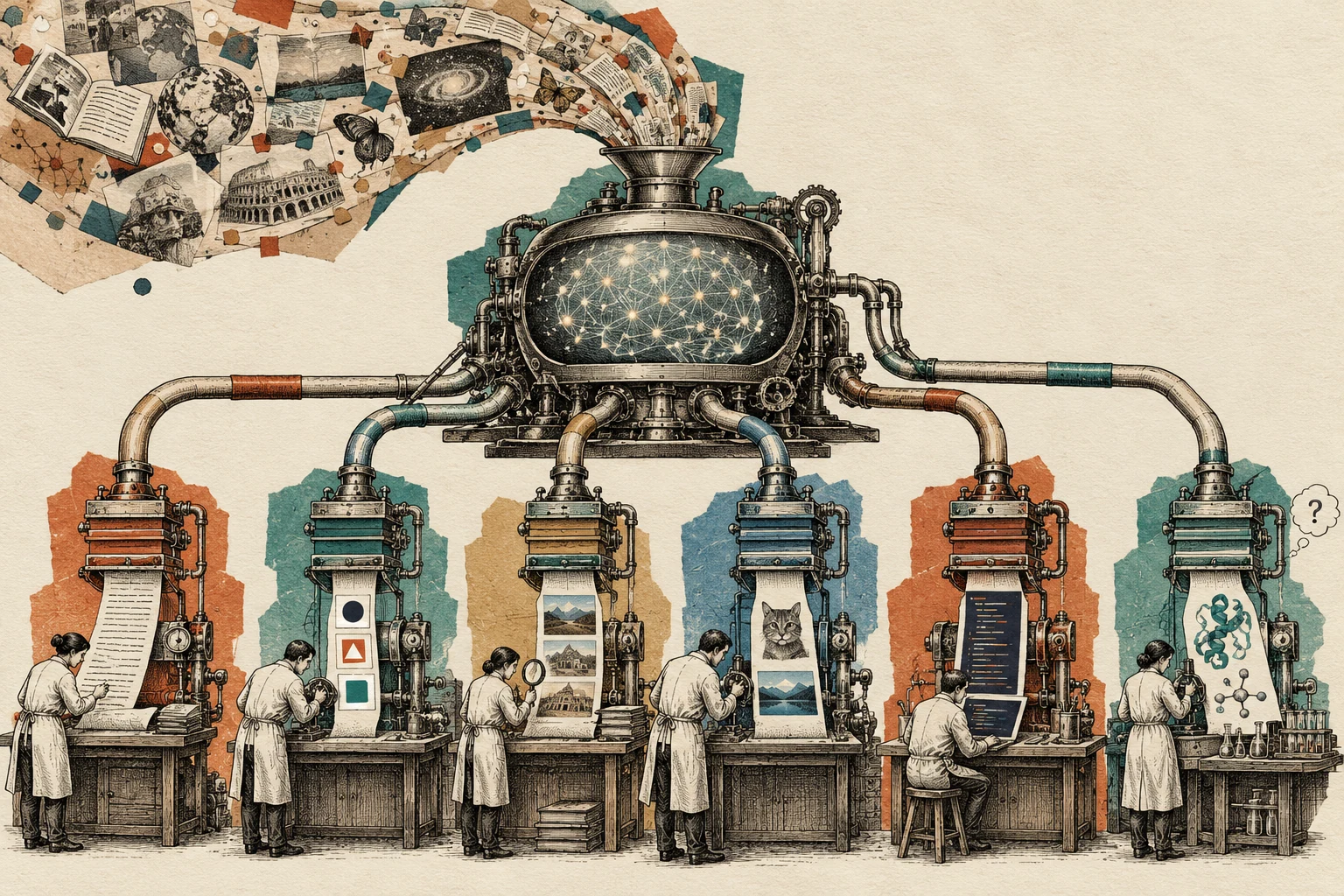
The same pretrained core serves as the base for several applications, with downstream adaptation drawing on capabilities acquired from broad pretraining.
AI-assisted illustration · conceptual metaphor View in visual quiz →Genesis and Global Lineage
The term was coined in August 2021 in the 214-page report On the Opportunities and Risks of Foundation Models, co-authored by 114 Stanford researchers led by Rishi Bommasani and Percy Liang to launch the Center for Research on Foundation Models (CRFM). The report did not invent a new algorithm: transfer learning, ELMo, BERT (2018), and GPT-3 (2020) already existed. Instead, the Stanford team named an institutional and epistemic shift defined by two properties: emergence (capabilities implicitly induced by scale rather than explicitly programmed) and homogenization (the consolidation of the AI field around a handful of shared base models, so downstream systems inherit the same capabilities and blind spots). The authors rejected existing labels: “large language model” excluded vision and multimodal systems; “self-supervised model” described a training objective rather than downstream use; and “pretrained model” implied the important work happens afterward. They chose the noun adjunct foundation over foundational to convey an architectural substructure that is indispensable yet unfinished—a base whose cracks threaten the entire building. Within two years, the term entered statutory law: U.S. Executive Order 14110 (October 2023) defined “dual-use foundation models,” while the EU AI Act (2024) adopted “general-purpose AI model” after intense lobbying over upstream versus downstream liability.
Central European Lineage
When the 2021 Stanford CRFM report reconstructs the technical genealogy of self-supervised pretraining (Section 1.1), it traces the paradigm “dating back to word embeddings” and explicitly cites the 2013 word2vec paper by Tomáš Mikolov and colleagues. Mikolov received his entire academic formation in Central Europe, at the Faculty of Information Technology of the Brno University of Technology (Vysoké učení technické v Brně, VUT) in Czechia. Working in Jan Černocký’s speech group in Brno, Mikolov published Recurrent neural network based language model at Interspeech 2010 and defended his PhD dissertation, Statistical Language Models Based on Neural Networks, in October 2012, before moving to Google where word2vec was completed months later. Neither the socio-technical coinage “foundation model” nor the Stanford authors come from the region, but the initial self-supervised representation-learning step they identify as the start of the lineage grew directly out of the Brno school of neural speech modeling.
Documented regional lineage · Link: 1. Compiled: October 2026.
-
documented influence 11 years
Central European Source: Tomáš Mikolov, “Doktorat „Statistical Language Models Based on Neural Networks” (Wydział Informatyki VUT Brno, obrona 2 X 2012) oraz model językowy RNN (Interspeech 2010); w 2013 r. w Google: word2vec”; Brno, Czechoslovakia / Czech Republic (now Czechia), 2010
Global Circulation: foundation models — Rishi Bommasani, Percy Liang i in. (Stanford CRFM), 2021
documented influence
11 yearsTomáš Mikolov, “Doktorat „Statistical Language Models Based on Neural Networks” (Wydział Informatyki VUT Brno, obrona 2 X 2012) oraz model językowy RNN (Interspeech 2010); w 2013 r. w Google: word2vec”
2010 · Brno, Czechoslovakia / Czech Republic (now Czechia)
foundation models
2021 · Rishi Bommasani, Percy Liang i in. (Stanford CRFM)
- Claim & Connection
- The Stanford CRFM report that coined the term traces the lineage of self-supervised pretraining “dating back to word embeddings” and explicitly cites Mikolov et al. (2013, word2vec) at that juncture. Mikolov received his academic formation in Brno: he defended his PhD on neural language models at the Brno University of Technology (VUT) in 2012 and, with Jan Černocký's speech group there, published the recurrent neural network language model at Interspeech 2010 before developing word2vec at Google. The link concerns a specific technical precursor cited by the report's authors rather than the socio-technical term itself.
- Source Documentation
-
- reception / translation Rishi Bommasani i in., „On the Opportunities and Risks of Foundation Models”, arXiv:2108.07258, v1 16 VIII 2021; Section 1.1 “Emergence and homogenization”: sentence “There had been considerable progress in self-supervised learning dating back to word embeddings” citing Mikolov et al. 2013. arxiv.org ↗
- primary source Tomáš Mikolov, Kai Chen, Greg Corrado, Jeffrey Dean, „Efficient Estimation of Word Representations in Vector Space”, arXiv:1301.3781, v1 16 I 2013; abstract page. arxiv.org ↗
- primary source Tomáš Mikolov, Martin Karafiát, Lukáš Burget, Jan Černocký, Sanjeev Khudanpur, „Recurrent neural network based language model”, Interspeech 2010; article page in ISCA Archive. isca-archive.org ↗
- biographical record Vysoké učení technické v Brně, Fakulta informačních technologií, karta rozprawy doktorskiej „Statistical Language Models Based on Neural Networks”, promotor Jan Černocký; defense date October 2, 2012. fit.vut.cz ↗
- Historical Context
- Formation: studies and PhD at Brno University of Technology (VUT); word2vec and subsequent work at Google and Meta took place outside the region. No Central European link was found for the coinage “foundation model” itself or for the Stanford CRFM authors.
Why Now
Between 2020 and 2026, foundation models moved from a research pattern to a contested layer of global digital infrastructure. GPT-3 (2020) showed that a single pretrained model could be adapted via prompts; Stanford CRFM (2021) named the paradigm; and ChatGPT (2022) and GPT-4 (2023) turned upstream model APIs into a utility layer for millions of businesses. Regulation followed: during late-2023 trilogue negotiations on the EU AI Act (Regulation 2024/1689), rules for “foundation models” (termed “general-purpose AI models” in Articles 51–55) nearly derailed the law as France, Germany, and Italy sought to shield European startups like Mistral and Aleph Alpha. The final compromise created a two-tier regime: baseline transparency and copyright-summary obligations for all GPAI models, plus stringent risk-mitigation duties for models presumed to pose “systemic risk” above 1025 training FLOPs. Simultaneously, open-weight models—Meta’s Llama, Mistral, and China’s Qwen and DeepSeek (2024–2025)—ignited debates over sovereign AI infrastructure, spurring domestic initiatives in Central Europe such as Poland’s open-source Bielik (2024) and state-backed PLLuM (2024–2025).
Explanatory Power
The concept makes visible supply-chain dependencies that disappear when analysts look only at end-user applications. First, it explains the downstream cascade of defects (homogenization of failure): if five hundred hospital triage tools, banking chatbots, and welfare assistants call the same foundation model, a single latent bias, hallucination, or prompt-injection vulnerability in that base model propagates across all five hundred institutions—meaning that auditing a downstream app without access to upstream training data and weights is regulatory theater. Second, it clarifies AI’s political economy: because pretraining requires hundreds of millions of dollars in GPUs and energy while adaptation is cheap, the market gravitates toward an oligopoly of upstream “model landlords” collecting API rent from thin application wrappers. Third, it maps legal responsibility when three distinct actors—upstream model developer, midstream fine-tuner, and downstream deployer—contribute to a harmful decision.
Axes of Debate
Does the metaphor of a “foundation” illuminate or propagandize?
Cognitive scientists and AI critics led by Gary Marcus and Ernest Davis (Has AI Found a New Foundation?, 2021), along with computer-vision pioneer Jitendra Malik at CRFM’s launch workshop, argued that calling statistical predictors “foundation models” is academic PR that presupposes reliability; as Malik quipped, “These models are castles in the air. They have no foundations whatsoever.” Strongest counterargument: Bommasani and Liang replied in Reflections on Foundation Models (2021) that the metaphor was chosen precisely to highlight systemic fragility: if an unfinished foundation is poured with cracks, every story built atop it is endangered—making the shared label a prerequisite for critical auditing. Nature of the dispute: mixed — partly a substantive disagreement over whether self-supervised scaling yields reliable world models, partly a rhetorical battle over how Stanford’s branding legitimized Big Tech’s roadmap.
Defining the category for law: generality of output versus compute thresholds
U.S. policymakers (as in the 2023 Executive Order) and AI safety institutes favor defining regulated foundation models by hard input thresholds—such as 1026 training FLOPs—because compute is an auditable physical bottleneck. European lawmakers in the AI Act defined the base category qualitatively by “significant generality” across distinct tasks, using the 1025 FLOP threshold only as a rebuttable presumption for the “systemic risk” tier. Strongest counterargument: Algorithmic efficiency gains, synthetic data, and distillation mean smaller models trained below a fixed FLOP threshold in 2026 regularly match or exceed 2023 giants—causing static compute thresholds to age rapidly unless paired with capability evaluations. Nature of the dispute: substantive — a regulatory trade-off between bright-line administrative enforceability (compute) and conceptual accuracy (functional generality).
Homogenization as monoculture risk versus open-weight democratization
CRFM authors and scholars of algorithmic monoculture (Jon Kleinberg, Manish Raghavan) warn that relying on a few closed foundation models creates correlated systemic risk and concentrates cultural power. Advocates of open-weight models (Meta, Mistral, Hugging Face, and regional consortia like Poland’s PLLuM) argue that releasing weights publicly breaks this monopoly and lets local institutions inspect and adapt their own infrastructure. Strongest counterargument: Releasing weights after pretraining does not democratize pretraining itself: the capital, GPU clusters, and web-scale data pipelines needed to create a competitive base model remain concentrated in a dozen global corporations, and downstream fine-tuners still inherit the biases baked into the upstream checkpoint. Nature of the dispute: substantive — both camps accept the diagnosis of infrastructural concentration, but disagree on whether weight distribution suffices to decentralize power.
Underappreciated Angle
The most profound shift captured by the concept is epistemological: it quietly moved the primary unit of computer science from the algorithm to the artifact. For half a century, machine learning operated like a mathematical science: a lab published a method (SVMs, backpropagation, LSTM, ResNet), and any university lab could re-implement the equations from scratch. A foundation model, by contrast, is a singular historical artifact—a multi-gigabyte matrix of weights produced by a one-off industrial run costing tens or hundreds of millions of dollars on a proprietary data mixture no outsider can inspect or replicate. Consequently, most academic “AI research” since 2021 no longer consists of training new learning algorithms from scratch, but of probing, benchmarking, or fine-tuning corporate artifacts whose internal formation remains opaque. Artificial intelligence has begun to resemble big-instrument sciences like particle physics—except that the “telescopes” (GPT, Claude, Gemini, Llama) are privately owned commercial products rather than public consortia like CERN.
One-Sentence Takeaway
A foundation model is not a specific neural network architecture, but a position of power in a technical supply chain: whoever pretrains the base decides the default capabilities and hidden failure modes of every system built on top of it.
Related Concepts Network
How this concept reinforces, constrains, or complements other analytical frameworks in the corpus. View on graph →
-
Large language models (LLMs) complements
Large language models are the most prominent—but not the only—class of foundation models; the Stanford CRFM term was coined specifically to encompass image, code, protein, and multimodal models as well.
-
Transformer reinforces
The Transformer architecture made it computationally feasible to pretrain a single model at a scale where adapting it to hundreds of downstream tasks became cheaper than training task-specific networks.
-
Scaling laws reinforces
Empirical power-law relationships connecting data, parameters, and compute provide the economic rationale for building one massive general-purpose model instead of many narrow ones.
-
In-context learning complements
Adapting a model via natural-language prompts without updating its weights is the lowest-friction mechanism for turning a foundation model into a task-specific tool.
-
Frontier AI in tension
“Frontier” defines models by the outer edge of capability and catastrophic risk, whereas “foundation” defines them by their infrastructural role in a downstream ecosystem; public policy frequently conflates the two.
-
Platformization reinforces
A foundation model functions as an economic platform: a single upstream provider, thousands of dependent downstream application builders, and high switching costs.
-
Model hallucinations constrains
Flaws and fabrications baked into a foundation model are inherited by every downstream application built atop it, subverting the architectural metaphor of a solid “foundation.”
Reading Canon & Translation Bridge
Foundational texts, introductions, and critical perspectives—with availability of English and Polish editions.
-
foundational text 2021 · English
Rishi Bommasani, Drew A. Hudson, Ehsan Adeli i in., On the Opportunities and Risks of Foundation Models
The 214-page manifesto by 114 Stanford researchers that coined the term and organized the field around two defining properties: emergence of capabilities and homogenization of methodologies.
In English: original text written in English
In Polish: no Polish edition
-
foundational text 2020 · English
Tom B. Brown i in., Language Models are Few-Shot Learners
The GPT-3 paper demonstrating that a single 175-billion-parameter pretrained model adapts to diverse tasks through prompting alone—the empirical shock that prompted the need for a new infrastructural concept.
In English: original text written in English
In Polish: no Polish edition
-
introduction & synthesis 2021 · English
Rishi Bommasani, Percy Liang, Reflections on Foundation Models
A concise follow-up essay by the report's lead authors responding to early critiques of the name: explains why they chose “foundation” over “foundational” to signify an unfinished base rather than infallible first principles.
In English: original text written in English
In Polish: no Polish edition
-
critical perspective 2021 · English
Gary Marcus, Ernest Davis, Has AI Found a New Foundation?
A sharp polemic in “The Gradient” (September 11, 2021) charging that the name prematurely canonizes statistical scaling and quoting computer-vision pioneer Jitendra Malik's quip about “castles in the air.”
In English: original text written in English
In Polish: no Polish edition
-
critical perspective 2021 · English
Emily M. Bender, Timnit Gebru, Angelina McMillan-Major, Margaret Mitchell, On the Dangers of Stochastic Parrots: Can Language Models Be Too Big?
The landmark FAccT 2021 paper on environmental costs, uncurated web corpora, and the illusion of communicative intent, in whose immediate shadow the Stanford CRFM report was written.
In English: original text written in English
In Polish: no Polish edition
-
cross-disciplinary 2020 · English
Jared Kaplan i in., Scaling Laws for Neural Language Models
Empirical power-law scaling curves written in the style of experimental physics, explaining why capital concentrates into a single massive pretraining run.
In English: original text written in English
In Polish: no Polish edition
-
cross-disciplinary 2021 · English
Kate Crawford, Atlas of AI: Power, Politics, and the Planetary Costs of Artificial Intelligence
A political geography of AI's material supply chain—lithium mines, energy grids, data-labeling labor, and cloud estates—that reads the “foundation” as physical extraction rather than software metaphor.
In English: original text written in English
In Polish: Polish edition not verified
Primary-Source Quotes
A foundation model is any model that is trained on broad data (generally using self-supervision at scale) that can be adapted (e.g., fine-tuned) to a wide range of downstream tasks.
These models are castles in the air. They have no foundations whatsoever.