AI Architecture #110
Transformer
original term: Transformer (Eng.) · architektura transformer, sieć transformerowa, self-attention
Central European lineage: 3 threads (author from the region, documented influence) · 2013–2017 · jump to documentation ↓
Working Definition
A Transformer is a neural-network architecture for processing sequential data in which every element (token) computes its updated representation by simultaneously attending to all other tokens in the sequence through learned weighted associations (self-attention), rather than processing tokens step-by-step in chronological order like recurrent neural networks. Because the attention weights are computed dynamically from projections of the input data (queries, keys, and values), the network learns directly which distant parts of a sequence bear on one another regardless of how many words or pixels separate them. In its strict engineering sense, the term designates a specific modular stack combining multi-head scaled dot-product attention, position-wise feed-forward layers, residual connections, layer normalization, and positional encodings. In popular discourse, “Transformer” has become metonymic for modern generative AI as a whole—obscuring the fact that it is one specific, and in principle replaceable, mathematical routing mechanism.
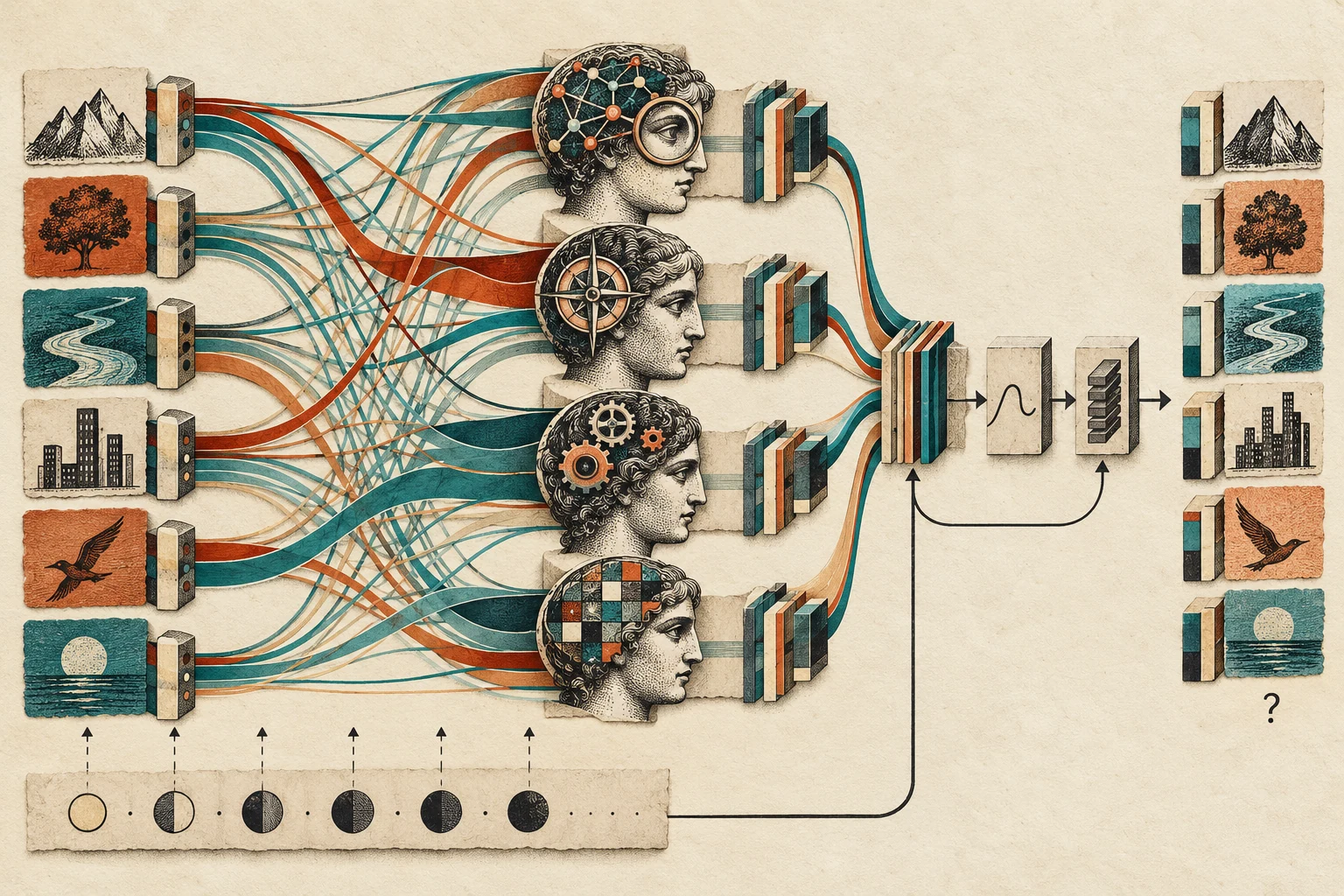
Sequence elements gain context through weighted relations to other elements, with multiple attention heads capturing distinct dependencies without implying human consciousness.
AI-assisted illustration · conceptual metaphor View in visual quiz →Genesis and Global Lineage
The architecture was introduced in Attention Is All You Need by eight Google researchers—Ashish Vaswani, Noam Shazeer, Niki Parmar, Jakob Uszkoreit, Llion Jones, Aidan N. Gomez, Łukasz Kaiser, and Illia Polosukhin—posted to arXiv in June 2017 and presented at NIPS 2017. It solved a core bottleneck in neural machine translation: recurrent models (LSTMs, GRUs) processed tokens sequentially from left to right, preventing parallelization across GPU clusters and degrading long-range dependencies. Its lineage combines the 2014 encoder-decoder framework (Sutskever et al.; Cho et al.), differentiable soft attention introduced by Dzmitry Bahdanau, Kyunghyun Cho, and Yoshua Bengio in 2014, 2015 refinements by Luong et al., and Uszkoreit’s proposal to drop recurrence entirely in favor of self-attention. After 2017, the blueprint branched into encoder-only models (BERT, 2018), autoregressive decoder-only models (OpenAI’s GPT series from 2018), and cross-domain adaptations like the Vision Transformer (ViT, 2020) and AlphaFold 2 (2020). Meanwhile, Jürgen Schmidhuber has argued that his 1992 “Fast Weight Programmers” were mathematically equivalent to linearized Transformers.
Central European Lineage
Two of the eight equal co-authors of the 2017 paper received their formative academic education in Central and Eastern Europe, and a third researcher educated in the region authored the 2014 attention paper on which the Transformer built. First, Łukasz Kaiser (born 1981 in Wrocław) studied computer science at the University of Wrocław (Uniwersytet Wrocławski), earned his doctorate at RWTH Aachen (2008), and completed his habilitacja degree at the University of Wrocław in 2013 before joining Google Brain (and OpenAI in 2021). As the 2017 contribution footnote records, Kaiser and Aidan Gomez built the tensor2tensor codebase that “massively accelerated” the team’s research. Second, Illia Polosukhin—who “with Ashish [Vaswani], designed and implemented the first Transformer models”—studied from 2008 to 2013 at the National Technical University “Kharkiv Polytechnic Institute” in Ukraine before moving to the United States and later co-founding NEAR Protocol. Third, the soft-attention mechanism cited as reference [2] was introduced in 2014 by lead author Dzmitry Bahdanau, an alumnus of the Belarusian State University Lyceum and Faculty of Applied Mathematics and Computer Science in Minsk, who conducted the research in Bremen and Montreal. While the 2017 paper was written at Google in California, the mathematical and algorithmic training traditions of Wrocław, Kharkiv, and Minsk directly fed the decade’s most influential AI architecture.
Documented regional lineage · Links: 3. Compiled: October 2026.
-
author from the region 4 years
Central European Source: Łukasz Kaiser, “Studia informatyczne w Instytucie Informatyki Uniwersytetu Wrocławskiego; habilitacja tamże (2013)”; Wrocław, Poland, 2013
Global Circulation: Transformer (Attention Is All You Need) — Ashish Vaswani, Noam Shazeer, Niki Parmar, Jakob Uszkoreit, Llion Jones, Aidan N. Gomez, Łukasz Kaiser, Illia Polosukhin, 2017
-
author from the region 4 years
Central European Source: Illia Polosukhin, “Studia w Narodowym Uniwersytecie Technicznym „Charkowski Instytut Politechniczny” (2008–2013)”; Kharkiv, Ukraine, 2013
Global Circulation: Transformer (Attention Is All You Need) — Ashish Vaswani, Noam Shazeer, Niki Parmar, Jakob Uszkoreit, Llion Jones, Aidan N. Gomez, Łukasz Kaiser, Illia Polosukhin, 2017
-
documented influence 3 years
Central European Source: Dzmitry Bahdanau, “Neural Machine Translation by Jointly Learning to Align and Translate (z Kyunghyunem Cho i Yoshuą Bengio)”; Minsk, Belarus (formation); Bremen, Germany and Montreal, Canada (work), 2014
Global Circulation: Transformer (Attention Is All You Need) — Ashish Vaswani, Noam Shazeer, Niki Parmar, Jakob Uszkoreit, Llion Jones, Aidan N. Gomez, Łukasz Kaiser, Illia Polosukhin, 2017
author from the region
4 yearsŁukasz Kaiser, “Studia informatyczne w Instytucie Informatyki Uniwersytetu Wrocławskiego; habilitacja tamże (2013)”
2013 · Wrocław, Poland
Transformer (Attention Is All You Need)
2017 · Ashish Vaswani, Noam Shazeer, Niki Parmar, Jakob Uszkoreit, Llion Jones, Aidan N. Gomez, Łukasz Kaiser, Illia Polosukhin
- Claim & Connection
- One of the eight equal co-authors of the 2017 paper was born in Wrocław, graduated in computer science from the University of Wrocław, and earned his post-doctoral habilitation degree there in 2013 (completing his PhD at RWTH Aachen in 2008). According to the paper's author-contribution note, Kaiser and Aidan Gomez built the tensor2tensor library in which the paper's models were developed and tested. This represents co-authorship within an eight-person team rather than sole authorship.
- Source Documentation
-
- primary source Ashish Vaswani i in., „Attention Is All You Need”, NIPS 2017; arXiv:1706.03762; p. 1, equal-contribution footnote (*); Google Brain affiliation. arxiv.org ↗
- biographical record Instytut Informatyki Uniwersytetu Wrocławskiego, „Łukasz Kaiser – nasz absolwent – wśród autorów systemu GPT-4!”; paragraph 1: alumnus of the Institute; co-creator of the Transformer architecture and the TensorFlow library. ii.uni.wroc.pl ↗
- biographical record Hasło „Łukasz Kaiser”, Wikipedia (pl); paragraph 1: born 1981 in Wrocław; PhD RWTH Aachen 2008; habilitation University of Wrocław 2013; Google Brain from 2013; OpenAI from 2021. pl.wikipedia.org ↗
- Historical Context
- The Institute's page identifies Kaiser as an alumnus; the year 2013 in the metadata marks his habilitation at the University of Wrocław. The 2017 paper itself was written at Google Brain in California.
author from the region
4 yearsIllia Polosukhin, “Studia w Narodowym Uniwersytecie Technicznym „Charkowski Instytut Politechniczny” (2008–2013)”
2013 · Kharkiv, Ukraine
Transformer (Attention Is All You Need)
2017 · Ashish Vaswani, Noam Shazeer, Niki Parmar, Jakob Uszkoreit, Llion Jones, Aidan N. Gomez, Łukasz Kaiser, Illia Polosukhin
- Claim & Connection
- Co-author of the 2017 paper who, according to the author-contribution note, together with Ashish Vaswani designed and implemented the first Transformer models while working at Google Research. The department page of the National Technical University “Kharkiv Polytechnic Institute” (NTU “KhPI”) documents his studies there from 2008 to 2013, which is also cited by Wikidata.
- Source Documentation
-
- primary source Ashish Vaswani i in., „Attention Is All You Need”, NIPS 2017; arXiv:1706.03762; p. 1, contribution note: “Ashish, with Illia, designed and implemented the first Transformer models”; footnote ‡: work performed at Google Research. arxiv.org ↗
- biographical record Katedra Komputerowej Matematyki i Analizy Danych NTU „ChPI”, „Історія успіху: Ілля Полосухін”; biographical note: studies 2008–2013; co-author of “Attention Is All You Need” at Google Research; co-founder of NEAR Protocol (2017). web.kpi.kharkov.ua ↗
- bibliographic record Wikidata, pozycja Q110864222 „Illia Polosukhin”; property “educated at”: Kharkiv Polytechnic Institute, 2008–2013, sourcing the NTU “KhPI” department page. wikidata.org ↗
- scholarly study Hasło „Увага — це все, що вам треба”, Wikipedia (uk); lead paragraph: “Ukrainian Illia Polosukhin” among the authors. uk.wikipedia.org ↗
- Historical Context
- Polosukhin's Kharkiv academic formation (2008–2013) is confirmed by the official NTU “KhPI” department page (2024 entry) referenced by Wikidata; his co-authorship and core engineering role are documented in the paper's contribution footnote.
documented influence
3 yearsDzmitry Bahdanau, “Neural Machine Translation by Jointly Learning to Align and Translate (z Kyunghyunem Cho i Yoshuą Bengio)”
2014 · Minsk, Belarus (formation); Bremen, Germany and Montreal, Canada (work)
Transformer (Attention Is All You Need)
2017 · Ashish Vaswani, Noam Shazeer, Niki Parmar, Jakob Uszkoreit, Llion Jones, Aidan N. Gomez, Łukasz Kaiser, Illia Polosukhin
- Claim & Connection
- The neural attention mechanism on which the Transformer architecture entirely rests was introduced in a landmark 2014 paper whose first author is Dzmitry Bahdanau—an alumnus of the Belarusian State University Lyceum and the Faculty of Applied Mathematics and Computer Science at the Belarusian State University in Minsk, who carried out the research on attention during his master's studies in Bremen and doctoral visit in Montreal. The 2017 Transformer paper explicitly cites Bahdanau et al. as reference [2] when introducing attention mechanisms.
- Source Documentation
-
- primary source Dzmitry Bahdanau, Kyunghyun Cho, Yoshua Bengio, „Neural Machine Translation by Jointly Learning to Align and Translate”, arXiv:1409.0473 (1 IX 2014), ICLR 2015; abstract: soft search over the source sentence instead of compressing it into a fixed-length vector. arxiv.org ↗
- reception / translation Ashish Vaswani i in., „Attention Is All You Need”, NIPS 2017; arXiv:1706.03762; Section 1, paragraph 3: “Attention mechanisms have become an integral part…” citing [2]; bibliography entry [2]. arxiv.org ↗
- biographical record Hasło „Дзмітрый Багданаў”, Wikipedia (be); biographical section: BSU Lyceum, Faculty of Applied Mathematics and Computer Science at Belarusian State University (Minsk), MSc Jacobs University Bremen 2014, PhD Montreal 2019. be.wikipedia.org ↗
- Historical Context
- The 2014 source paper was written outside the region (Bremen and Montreal), while its lead author received his foundational mathematical and computer-science education in Minsk.
Why Now
Between 2018 and 2026, an architecture originally benchmarked on sentence translation became the computational substrate of almost the entire AI industry. BERT (2018) overhauled Google Search; GPT-3 (2020) showed that scaling a decoder-only Transformer to 175 billion parameters unlocked few-shot in-context learning; OpenAI’s scaling-laws paper (Kaplan et al., 2020) proved Transformer test loss falls as a power law with compute; and ChatGPT (2022) brought autoregressive Transformers into mass culture. By 2026, Attention Is All You Need had well over 250,000 citations. Simultaneously, from 2023 onward, the architecture’s quadratic (O(N2)) cost in sequence length N sparked an intense race both to engineer million-token Transformers (via FlashAttention, ring attention, and sparse attention) and to replace self-attention with linear-time selective state-space models such as Mamba (Gu and Dao, 2023) or hybrid recurrent-attention designs. Without understanding the Transformer, public debates over AI capabilities, hallucinations, and energy demand treat “AI” as magic rather than a specific matrix-multiplication circuit.
Explanatory Power
The concept explains why contemporary AI systems exhibit their characteristic profile of superpowers and blind spots as direct consequences of a specific mathematical circuit. First, it explains the economics of the context window: because standard self-attention compares every token with every other token, doubling document length quadruples attention compute and inflates the key-value (KV) memory cache—making a model’s “working memory” a hard hardware trade-off. Second, it grounds emergent behavior in concrete internal mechanisms: mechanistic interpretability research (Elhage, Nanda, Olsson et al., 2021–2022) showed that two-layer compositions of attention heads form “induction heads” that search prior context for [A][B] … [A] and predict [B], explaining how a frozen network learns new patterns inside a prompt. Third, it explains the post-2020 unification of AI subfields: because the Transformer block operates agnostically on vector sequences, the exact same software and GPU kernels process subword tokens, 16 \times 16 image patches, audio spectrograms, proteins, and robotic trajectories—shifting advantage from domain-specific heuristics toward unified compute and data scale.
Axes of Debate
Priority: Google Brain (2017) versus Schmidhuber’s Fast Weight Programmers (1992)
Jürgen Schmidhuber and collaborators (Schlag, Irie, Schmidhuber, 2021) argue that his 1992 “Fast Weight Programmers”—where a slow network generates dynamic outer-product weight matrices for a second network using vectors analogous to keys and values—is mathematically equivalent to a linearized Transformer, noting he also used the phrase “internal spotlight of attention” in 1993. Strongest counterargument: Deep-learning historians and practitioners reply that formal equivalence holds only when softmax normalization is removed (linear attention), whereas it was precisely the combination of softmax scaled dot-product attention, multi-head projections, residual layer norms, and massive GPU parallelization in Vaswani et al. (2017) that outperformed LSTMs at scale. Nature of the dispute: mixed — the mathematical equivalence for linearized unnormalized attention is substantive, while the broader dispute over historical credit is largely rhetorical.
Is attention explanation?
Following Sarthak Jain and Byron Wallace (Attention is not Explanation, 2019), NLP researchers showed that attention heatmaps can be scrambled or adversarially altered without changing a Transformer’s final prediction, warning against reading attention weights as a transparent window into model reasoning. Sarah Wiegreffe and Yuval Pinter (Attention is not not Explanation, 2019) countered that alternative weight distributions must be trained specifically to deceive, leaving attention a useful diagnostic signal. Strongest counterargument: Mechanistic interpretability researchers (Anthropic, Neel Nanda) bypassed the surface heatmap debate by showing that while single-layer attention maps can mislead, causal interventions (activation patching) on multi-layer attention and MLP compositions isolate reproducible algorithmic circuits whose causal role can be proven experimentally. Nature of the dispute: substantive — adjudicated by activation-patching experiments testing whether specific heads are necessary and sufficient for downstream behaviors.
The eternal architecture versus the return of recurrence and state-space models
Architects of sub-quadratic sequence models—such as Albert Gu and Tri Dao (S4 and Mamba, 2021–2023) and creators of RWKV and RetNet—argue that quadratic O(N2) attention cost and growing KV-cache memory during inference are unsustainable for million-token sequences, continuous streams, and on-device deployment, advocating linear-time state-space models with constant inference memory. Strongest counterargument: Defenders point out that compressed fixed-size recurrent states struggle with exact “needle-in-a-haystack” associative recall over long distances compared to full all-to-all attention, and that hardware-aware kernels (like FlashAttention) keep pure or hybrid Transformers ahead at frontier scales. Nature of the dispute: substantive — an engineering contest over Pareto frontiers of recall accuracy, training throughput, and inference memory, increasingly converging on hybrid architectures interleaving state-space layers with full self-attention layers.
Underappreciated Angle
The most overlooked dimension of the Transformer is institutional and sociological: the footnote on page one of Attention Is All You Need. In a discipline prone to hierarchy disputes, the eight co-authors added an asterisk declaring “Equal contribution. Listing order is random,” followed by a candid paragraph detailing who proposed replacing recurrence, who invented scaled dot-product and multi-head attention, and who built tensor2tensor. Even more striking is what followed: within six years, all eight co-authors had left Google to found or join rival frontier AI companies—OpenAI, Cohere, Adept, Character.AI, Essential AI, NEAR Protocol, Inceptive, and Sakana AI. The Transformer is thus the ultimate case study in how a corporate lab published its most valuable breakthrough openly without patent enforcement, watched the preprint seed an industry that disrupted its own search monopoly, and lost all eight inventors to competitors. For Central and Eastern Europe, the lesson is equally sharp: academic faculties in Wrocław, Kharkiv, and Minsk proved fully capable of training minds who co-invented the foundational architecture of modern AI—yet the ecosystems assembling the compute and capital to turn that training into global infrastructure lay in California, Montreal, and London.
One-Sentence Takeaway
The Transformer did not teach machines how to think; it taught them how to look at every part of a sequence at once in parallel on graphics chips—and everything since has been a consequence of scaling that one trick.
Related Concepts Network
How this concept reinforces, constrains, or complements other analytical frameworks in the corpus. View on graph →
-
Large language models (LLMs) reinforces
Contemporary large language models are overwhelmingly decoder-only Transformers; without this parallelizable architecture, the training scales achieved after 2018 would not have been possible.
-
Scaling laws complements
Empirical scaling laws describe how cross-entropy loss in Transformers decreases as a power law with parameters, dataset size, and compute; those regularities were measured directly on this architecture.
-
Foundation models reinforces
A “foundation model” is the socio-technical name for a large pre-trained Transformer (or multimodal derivative) that can be adapted to a wide range of downstream tasks.
-
In-context learning complements
The ability to learn a task from a few examples inside the prompt without weight updates is an emergent property of large Transformers, partially explained by induction-head attention circuits.
-
Multimodality reinforces
Because the same self-attention mechanism operates agnostically on tokens of text, image patches, audio frames, and action vectors, the Transformer unified previously separate sensory modalities.
-
Explainable AI (XAI) in tension
Attention weights tempt researchers as a ready-made visual explanation of model reasoning, yet the debate over whether “attention is explanation” remains sharply contested.
-
Emergence complements
Capabilities that appear abruptly once Transformer models cross certain parameter and compute thresholds serve as the primary contemporary test case in debates over emergence.
Reading Canon & Translation Bridge
Foundational texts, introductions, and critical perspectives—with availability of English and Polish editions.
-
foundational text 2017 · English
Ashish Vaswani, Noam Shazeer, Niki Parmar, Jakob Uszkoreit, Llion Jones, Aidan N. Gomez, Łukasz Kaiser, Illia Polosukhin, Attention Is All You Need
The fifteen-page NIPS paper that defined the architecture: scaled dot-product attention, multi-head attention, positional encodings, and state-of-the-art WMT 2014 translation results, complete with a remarkably candid footnote detailing each co-author's specific contribution.
In English: original text written in English
In Polish: no Polish edition
-
foundational text 2014 · English
Dzmitry Bahdanau, Kyunghyun Cho, Yoshua Bengio, Neural Machine Translation by Jointly Learning to Align and Translate
The ICLR 2015 paper (arXiv 2014) that introduced differentiable soft attention into sequence-to-sequence translation, without which the slogan “Attention Is All You Need” would have had no referent.
In English: original text written in English
In Polish: no Polish edition
-
introduction & synthesis 2022 · English
Mary Phuong, Marcus Hutter, Formal Algorithms for Transformers
Provides exact mathematical pseudocode for every major Transformer variant (encoder, decoder, encoder-decoder) in a dozen pages—the shortest rigorous bridge from intuition to implementation.
In English: original text written in English
In Polish: no Polish edition
-
introduction & synthesis 2016 · English
Ian Goodfellow, Yoshua Bengio, Aaron Courville, Deep Learning
The canonical textbook published just before the Transformer arrived; essential for understanding the recurrent (RNN/LSTM) and convolutional bottlenecks that the 2017 paper swept aside.
In English: original text written in English
In Polish: Polish edition not verified
-
critical perspective 2021 · English
Imanol Schlag, Kazuki Irie, Jürgen Schmidhuber, Linear Transformers Are Secretly Fast Weight Programmers
Demonstrates the formal mathematical equivalence between linearized self-attention and Schmidhuber's 1992 “Fast Weight Programmers,” serving simultaneously as a technical analysis and a priority manifesto.
In English: original text written in English
In Polish: no Polish edition
-
critical perspective 2023 · English
Albert Gu, Tri Dao, Mamba: Linear-Time Sequence Modeling with Selective State Spaces
The most serious post-2020 architectural challenger to replace quadratic self-attention with selective state-space models scaling linearly in sequence length.
In English: original text written in English
In Polish: no Polish edition
-
cross-disciplinary 2021 · English
Nelson Elhage, Neel Nanda, Catherine Olsson i in., A Mathematical Framework for Transformer Circuits
Foundational paper of the mechanistic interpretability program: analyzes the Transformer not as an inscrutable black box, but as a composition of residual-stream pathways and identifiable circuits such as induction heads.
In English: original text written in English
In Polish: no Polish edition
-
cross-disciplinary 2021 · English
Emily M. Bender, Timnit Gebru, Angelina McMillan-Major, Shmargaret Shmitchell, On the Dangers of Stochastic Parrots: Can Language Models Be Too Big?
The landmark social, environmental, and epistemological critique of the scaling race that the Transformer architecture unlocked.
In English: original text written in English
In Polish: no Polish edition
Primary-Source Quotes
We propose a new simple network architecture, the Transformer, based solely on attention mechanisms, dispensing with recurrence and convolutions entirely.
Attention mechanisms have become an integral part of compelling sequence modeling and transduction models in various tasks, allowing modeling of dependencies without regard to their distance in the input or output sequences.