Precarization
original term: precarization (Eng.) · prekariat, precarity, précarité
Global-circulation concept — no documented lineage in Central Europe. jump to documentation ↓
Working Definition
Precarization is the structural process through which paid work is stripped of the institutional guarantees that defined the postwar standard employment relationship: predictable income, protection against arbitrary dismissal, social-insurance benefits, occupational safety, career progression, and collective bargaining representation. The concept does not refer to unemployment or extreme poverty as such, but to work that persists without providing a stable foundation for life: rolling fixed-term contracts, civil-law piecework, bogus self-employment, zero-hours on-call scheduling, and app-dispatched gig labor. In everyday parlance, “the precariat” simply denotes workers on insecure contracts; in Guy Standing’s technical formulation it names a distinct “class-in-the-making” defined by the absence of seven forms of labor security, whereas in the French sociological tradition (Pierre Bourdieu, Robert Castel) précarisation designates a political technique of governance that disciplines the entire workforce—including tenured insiders—through the ever-present threat of falling into insecurity.
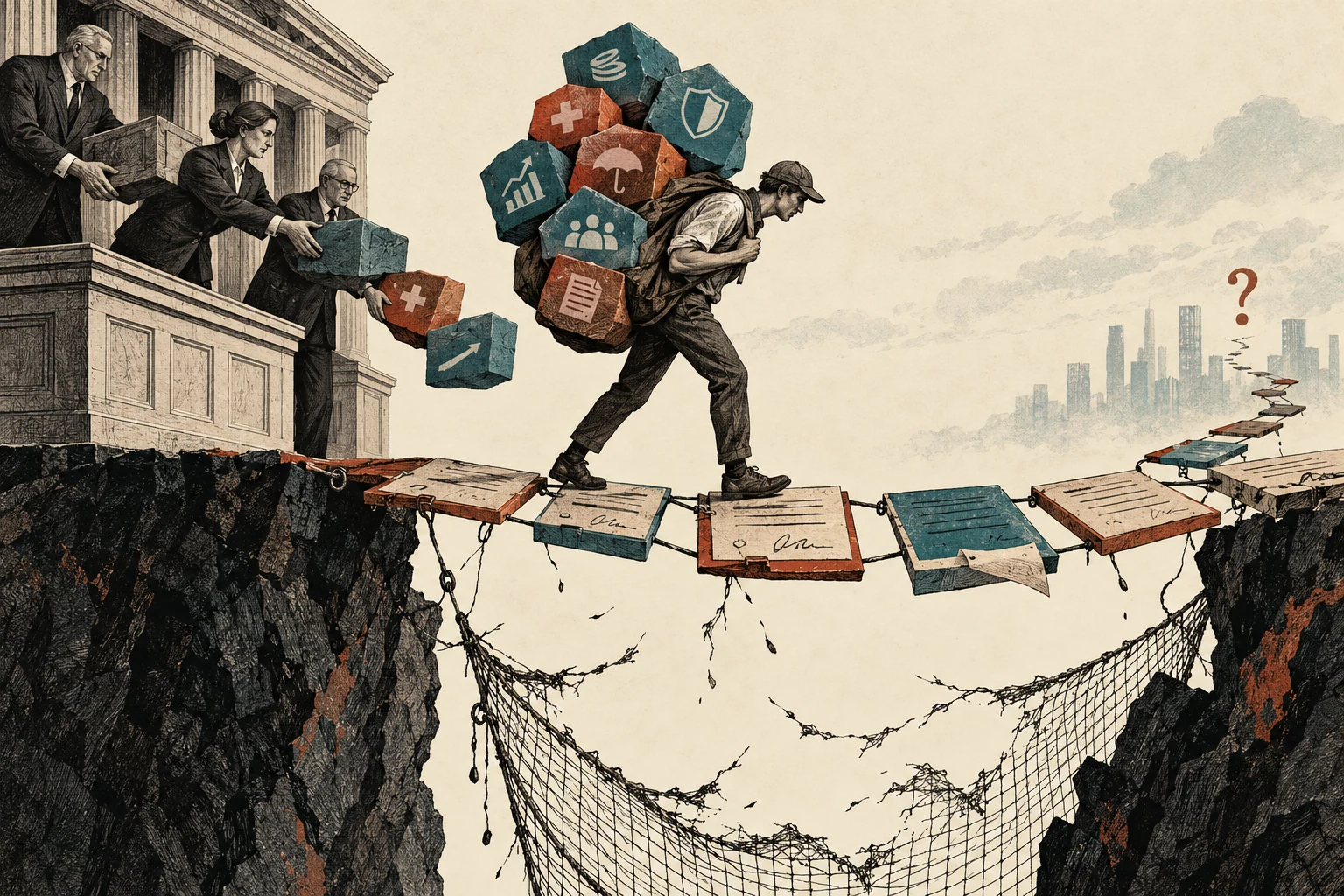
Short, uncertain stints of work replace a stable path, shifting more risk and responsibility for future security onto the worker.
AI-assisted illustration · conceptual metaphor View in visual quiz →Genesis and Global Lineage
The concept has two distinct genealogies that merged only in the 2000s. The older French lineage dates back to sociology and social-policy debates of the late 1970s and 1980s: in Les métamorphoses de la question sociale (1995), Robert Castel traced the historical construction and post-1970s erosion of the société salariale (“wage-earning society”), in which the standard employment contract served as the primary ticket to social citizenship. In a famous 1997 lecture collected in Contre-feux (1998), Pierre Bourdieu declared that la précarité est aujourd’hui partout (“insecurity is everywhere today”) and argued that it is not an accidental byproduct of market flexibility, but a deliberate political strategy(mode de domination): a worker who does not know whether they will have a job next month does not go on strike. In the early 2000s, Italian and French activist networks (the Milan MayDay Parade launched in 2001, expanding into EuroMayDay in 2004) carried the portmanteau precariato / précariat (fusing precario and proletariato) from seminar rooms into street politics. The second, Anglo-American lineage was crystallized by the British labor economist Guy Standing—formerly of the International Labour Organization—whose 2011 book The Precariat: The New Dangerous Class popularized the term worldwide, recast the precariat as a nascent social class distinct from the traditional working class, and linked its emancipation to a universal basic income. In that global popularization, a crucial nuance was partly flattened: whereas Bourdieu analyzed precarization as an active strategy of workplace domination, Standing often framed it as an inexorable structural consequence of globalization requiring a new welfare settlement.
Central European Lineage
We found no documented link between this concept and the intellectual history or historical experience of Central Europe.
We found no documented link between this concept and the intellectual history or historical experience of Central Europe (by our methodology, this means “none found,” not “none exists”; as of October 2026).
Why Now
Since 2018, precarization has moved from activist manifestos into the center of labor jurisprudence, macroeconomic statistics, and technology regulation. First, algorithmic platform work (Uber, Deliveroo, Glovo, Bolt, Amazon Mechanical Turk) made visible an industrial model in which a corporation sells a standardized service while claiming to employ no workers at all; high-profile legal battles over worker misclassification culminated in the UK Supreme Court’s Uber BV v Aslam ruling (February 2021), Spain’s Ley Rider (2021), and the European Union’s Platform Work Directive (adopted in 2024), which introduced a legal presumption of employment when digital platforms exercise algorithmic control. Second, the COVID-19 pandemic of 2020–2021 exposed the double edge of precarity: low-paid “essential” couriers and warehouse workers bore physical health risks without sick pay, while white-collar remote workers experienced a blurring of boundaries that turned insecurity into round-the-clock digital availability. Third, in Central Europe, the post-1989 proliferation of non-standard civil-law contracts—known colloquially in Poland since the early 2010s as umowy śmieciowe (“junk contracts,” such as specific-task contracts exempt from Labor Code protections, paid leave, and minimum-wage or social-security rules)—became a central axis of political conflict, prompting successive regulatory reforms and grassroots unionization drives led by unions like Inicjatywa Pracownicza. Finally, since 2023, the rapid deployment of generative AI in translation, copywriting, illustration, and software coding has triggered a fresh wave of precarization among cognitive freelancers, replacing salaried creative roles with piece-rate prompt editing and model training.
Explanatory Power
The concept shifts analytical attention from the binary question “does a person have a job?” to the structural question “what does that job actually anchor beyond today’s cash payout?”, rendering visible phenomena that headline unemployment rates conceal. First, it explains a major macroeconomic puzzle of the 2020s: why countries recording historically low official unemployment—including Poland, the Czech Republic, the United Kingdom, and the United States—simultaneously see rising numbers of working adults who cannot qualify for a mortgage, afford to fall ill, or plan starting a family; they are not unemployed, they are precarized. Second, it accounts for political realignments that traditional income-bracket sociology misses, such as why university-educated young adults with unstable project incomes simultaneously gravitate toward radical housing and social-protection demands on the left or anti-establishment populism on the right. Third, it demystifies the unit economics of the gig economy: the profitability of many on-demand platforms stems not from superior routing software, but from externalizing capital depreciation (vehicles, smartphones), insurance, and demand-trough idle time onto the individual worker—a cost shift that without the concept of precarization passes as benign “flexibility.”
Axes of Debate
A new social class versus a condition within the working class
Guy Standing argues that the precariat possesses distinctive relations of production (chronic insecurity and uncompensated work-for-labor), distinctive relations of distribution (reliance on volatile money wages stripped of enterprise or state non-wage benefits), and a distinctive relation to the state (eroded social rights), making it a separate “class-in-the-making” whose interests diverge from those of unionized, salaried “salariat” and core manual workers. Marxist and labor sociologists—including Erik Olin Wright, Jan Breman, and in Poland Jarosław Urbański—reply that job insecurity is a graduated condition internal to the working class rather than a class boundary, because a precarious courier and a permanent factory worker still share the same fundamental antagonism toward capital. Strongest counterargument: Defenders of Standing point out that if the precariat were seamlessly part of a single unified working class, traditional trade unions and social-democratic parties would not have spent three decades repeatedly sacrificing labor-market “outsiders” (accepting two-tier contracts and deregulated temporary agency work) in order to protect the pensions and job security of core “insiders.” Nature of the dispute: substantive — it determines whether political strategy should aim at forging a new autonomous movement around universal basic income or at rebuilding inclusive industrial unions across the entire wage-dependent population.
Global structural trend versus Eurocentric nostalgia
Global labor historians and scholars of the Global South, led by Jan Breman, argue that diagnosing a “loss” of employment security presupposes that standard, benefited full-time jobs were once the norm; across Asia, Africa, and Latin America—and historically for women and migrant workers even in the West—informal, precarious survival work has always been the rule, making the concept an expression of Northern European middle-class nostalgia for the brief postwar Fordist Golden Age (1945–1975). Strongest counterargument: Proponents of the concept reply that its analytical value lies precisely in provincializing the postwar welfare state: precarization names the political dismantling of the one historical arrangement that successfully de-commodified labor, showing how Northern labor markets are converging downward toward the informalized norms of the Global South rather than vice versa. Nature of the dispute: mixed — partly an empirical debate over global historical baselines, partly a debate over whose historical experience anchors sociological theory.
Inevitable technological adaptation versus deliberate strategy of domination
Mainstream labor-market economists and liberal policy analysts treat the rise of flexible, project-based, and platform-mediated contracts as an impersonal structural adaptation to post-industrial service economies, global supply chains, and digital matching technologies—a shift to be cushioned through portable benefits rather than reversed. Following Bourdieu, critical sociologists argue that insecurity is actively manufactured through legal deregulation and corporate subcontracting because a frightened, replaceable workforce is cheaper and more compliant. Strongest counterargument: The pure conspiracy or single-strategist view struggles to explain why public-sector institutions—universities, hospitals, ministries, and municipal cultural centers in welfare states—have become some of the heaviest users of rolling fixed-term and civil-law contracts, driven by grant cycles and fiscal austerity rules rather than private profit extraction. Nature of the dispute: substantive — both structural cost-shifting and disciplinary control are empirically observable, and the dispute turns on how institutional rules incentivize both private and public employers to shed long-term commitments.
Underappreciated Angle
The most corrosive effect of precarization is not strictly financial, but temporal and cognitive—what Pierre Bourdieu already identified in his Algerian ethnographies as the destruction of the subjective capacity to project oneself into the future. Someone who does not know whether they will have an income three months from now cannot rationally plan on a multi-year horizon, not out of impulsiveness or “poor financial literacy,” but because long-term planning under radical uncertainty is a losing bet. Precarization systematically compresses everyday decision-making horizons: long-term skill acquisition, preventative healthcare, civic participation, union organizing, and deep personal commitments lose their expected return. What looks from outside like a cultural pathology of short-termism is a rational adaptation to an environment where the institutional floor can vanish at a week’s notice. Precarization thus manufactures subjects forced to live in a perpetual present—who are then moralistically blamed for failing to plan for retirement or build stable communities. Serious social policy must therefore measure not only hourly wages, but the future horizon an institutional environment allows people to inhabit.
One-Sentence Takeaway
Precarization is not the loss of work, but the transformation of work into something on which a human life can no longer be durably built.
Related Concepts Network
How this concept reinforces, constrains, or complements other analytical frameworks in the corpus. View on graph →
-
Platformization reinforces
Labor platforms shift demand fluctuations, equipment costs, and idle waiting time onto the worker, institutionalizing precarization as a core business model.
-
Algorithmic management complements
Algorithmic task allocation and automated rating systems mean that income insecurity is no longer mediated by a human supervisor, but governed by an opaque mathematical metric.
-
Burnout reinforces
The absence of predictable employment enforces perpetual availability and self-exploitation, which burnout research identifies as chronic occupational stress stripped of recovery phases.
-
Loneliness epidemic complements
Fragmented gigs and the disappearance of stable workplace collectives erode a major source of everyday social ties that standard employment once provided.
-
Late capitalism complements
Precarization serves as one of the primary empirical indicators of what diagnoses of late capitalism describe as the dismantling of the postwar Fordist labor-capital compromise.
-
Surveillance capitalism in tension
Zuboff analyzes the extraction of behavioral surplus from consumers rather than labor from workers; digital platforms fuse both processes, yet their mechanisms and victims remain distinct.
Reading Canon & Translation Bridge
Foundational texts, introductions, and critical perspectives—with availability of English and Polish editions.
-
foundational text 2011 · English
Guy Standing, The Precariat: The New Dangerous Class
The book that made “the precariat” a global household term: defines seven forms of labor-related security that precarious workers lack, diagnoses a “class-in-the-making,” and advocates universal basic income.
In English: original text written in English
In Polish: Polish edition not verified
-
foundational text 1998 · French
Pierre Bourdieu, Contre-feux. Propos pour servir à la résistance contre l'invasion néo-libérale
Contains his famous 1997 Grenoble address "La précarité est aujourd'hui partout“ (”Job Insecurity Is Everywhere Now"), which theorizes precarization not as an economic side effect, but as a deliberate political mode of domination through insecurity.
In English: English edition not verified
In Polish: Polish edition not verified
-
foundational text 1995 · French
Robert Castel, Les métamorphoses de la question sociale. Une chronique du salariat
The monumental historical genealogy of the rise and crumbling of the “wage-earning society” (société salariale), indispensable for understanding the French sociological tradition of précarité.
In English: English edition not verified
In Polish: Polish edition not verified
-
critical perspective 2013 · English
Jan Breman, A Bogus Concept?
A sharp critique of Standing in “New Left Review” 84 (2013) charging the concept with Eurocentrism: across the Global South, informal and insecure labor was never an exception, but the historical norm.
In English: original text written in English
In Polish: Polish edition not verified
-
critical perspective 2016 · English
Erik Olin Wright, Is the Precariat a Class?
A rigorous analytical Marxist assessment in the “Global Labour Journal”: argues that the precariat does not constitute a distinct class because its material interests do not stand in fundamental antagonism to the rest of the working class.
In English: original text written in English
In Polish: Polish edition not verified
-
cross-disciplinary 2004 · English
Judith Butler, Precarious Life: The Powers of Mourning and Violence
A philosophical expansion of the concept: distinguishes universal bodily vulnerability (precariousness) from politically induced, unevenly distributed insecurity (precarity).
In English: original text written in English
In Polish: Polish edition not verified
-
introduction & synthesis 2014 · Polish
Jarosław Urbański, Prekariat i nowa walka klas. Przeobrażenia współczesnej klasy pracowniczej i jej form walki
A Polish reception of the concept from a grassroots syndicalist perspective that challenges Standing: insecurity does not forge a separate class, but restructures the working class as a whole.
In English: English edition not verified
In Polish: original text written in Polish