Skin in the game
original term: skin in the game (Eng.) · własna skóra w grze, na własne ryzyko, symetria ryzyka
Global-circulation concept — no documented lineage in Central Europe. jump to documentation ↓
Working Definition
Skin in the game is the institutional condition in which a decision-maker bears tangible, personal downside consequences if their decision fails, rather than merely sharing in the upside when it succeeds. In Nassim Nicholas Taleb’s technical formulation, it is a rule of symmetry under tail risk: anyone whose choices can inflict harm on others must be personally exposed to a meaningful share of that harm, because otherwise the system loses its evolutionary filter for removing bad decision-makers and silently accumulates catastrophic risk in the tail of the distribution. In casual business usage, the phrase is often watered down to “having a financial incentive or bonus,” which misses the entire point: upside participation without downside exposure is the exact pathology the concept attacks. As an analytical diagnostic, the rule is simple: do not ask who profits when things go right; ask who pays when they go wrong.
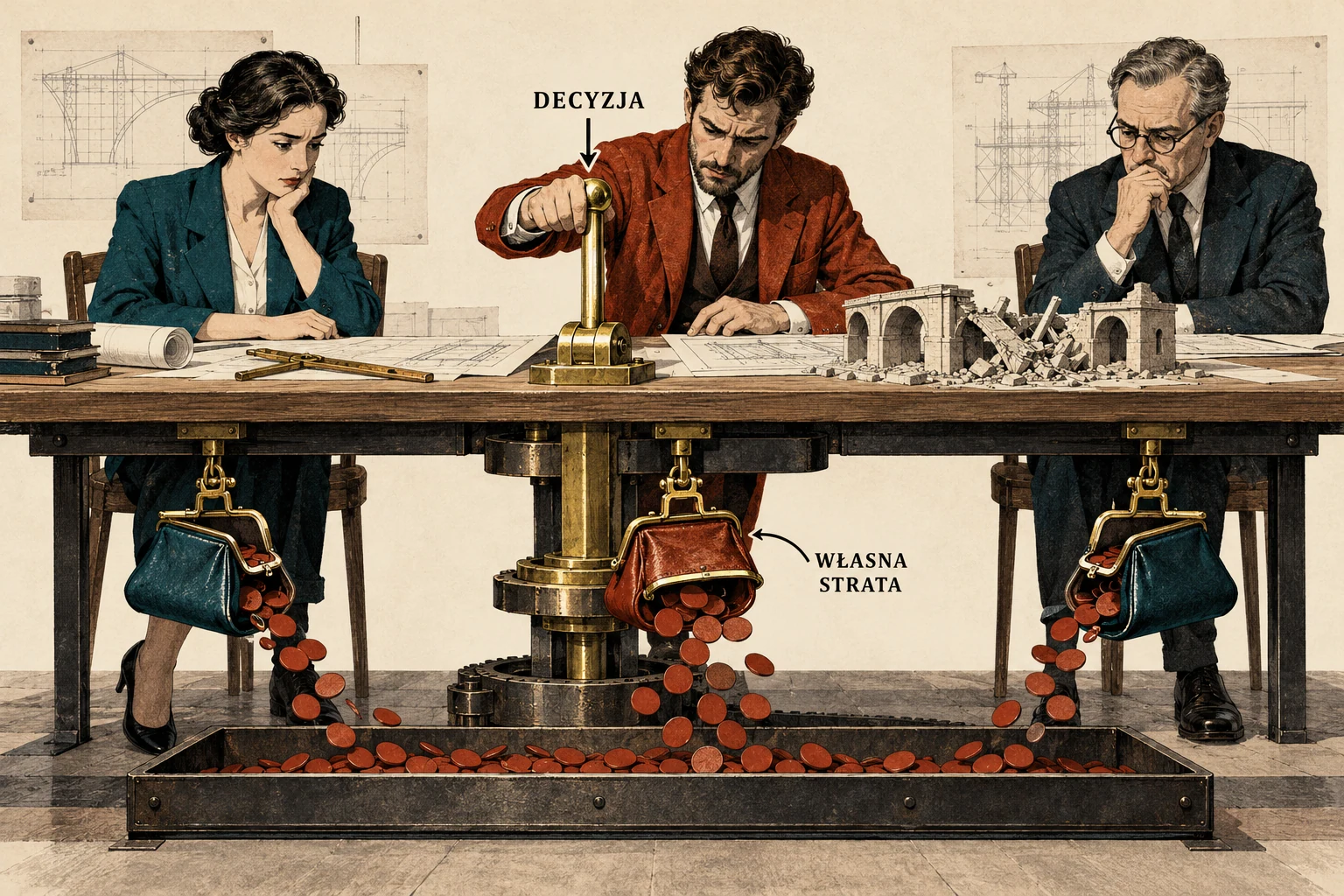
The person at the lever loses their own money alongside the other participants. The core point is personally bearing the cost of failure rather than merely sharing in gains, though losses need not be identical.
AI-assisted illustration · conceptual metaphor View in visual quiz →Genesis and Global Lineage
The idiom comes from American financial and sports slang (often associated with Warren Buffett’s remarks on managerial co-investment, though Buffett himself disclaimed coining the phrase); as a general concept of risk ethics and epistemology, it was codified by Nassim Nicholas Taleb, the Lebanese-American options trader and essayist educated in Paris and at Wharton whose career was built on pricing fat-tailed events. The argument first appeared in Book VII of Antifragile (2012), received a formal mathematical statement in a 2014 Review of Behavioral Economics paper co-authored with the philosopher Constantine Sandis, and was expanded into Skin in the Game: Hidden Asymmetries in Daily Life (2018), the fifth volume of Taleb’s Incerto series. Taleb anchors the idea in two traditions: the microeconomics of agency costs and moral hazard (Kenneth Arrow 1963; Michael Jensen and William Meckling 1976), which he argues is directionally right but blind to fat tails, and ancient legal and religious symmetry rules—from Hammurabi’s Code and Roman lex talionis to maritime law—interpreted as evolved risk-management technologies. Since 2018 the concept has circulated in two distinct registers: in venture capital and corporate governance as a demand for founder co-investment and clawbacks, and in populist anti-establishment polemics, where Taleb’s figure of the “Intellectual Yet Idiot” (first sketched in a 2016 Medium essay) is wielded as a bludgeon against credentialed experts of every stripe.
Central European Lineage
We found no documented link between this concept and the intellectual history or historical experience of Central Europe.
We found no documented link between this concept and the intellectual history or historical experience of Central Europe (by our methodology, this means “none found,” not “none exists”; as of October 2026).
Why Now
The years 2018 to 2026 supplied a textbook parade of asymmetric failures in which insiders pocketed years of compensation while losses were socialized or dumped onto retail customers. In March 2023 Silicon Valley Bank collapsed after its executives had cashed out stock options and bonuses tied to short-term return on equity, leaving public deposit-insurance backstops to rescue uninsured depositors; the same year saw the criminal trial of Sam Bankman-Fried following the implosion of FTX. In Central Europe, similar debates erupted around the 2018 collapse of the Polish debt-collection firm GetBack—whose toxic corporate bonds had been aggressively sold to retail savers by bank advisors earning upfront commissions—and the long wave of European Court of Justice rulings (from 2019 onward) invalidating Swiss-franc-indexed mortgages that had shifted unhedged currency tail risk onto households. Beginning in 2020, the COVID-19 pandemic turned “skin in the game” into a bitter political fault line over public-health expertise: critics asked whether salaried officials and tenured advisers recommending prolonged lockdowns bore the same economic downside as small business owners and hourly workers. Most recently, since 2022, the deployment of generative artificial intelligence has raised the same structural question for frontier AI laboratories: when a model hallucinates, infringes copyright, or enables large-scale fraud, who bears the liability—the developer selling API access or the downstream society absorbing the externality?
Explanatory Power
The concept allows us to evaluate the reliability of a claim or institution without having to master the technical details of the domain: we inspect the payoff symmetry of the speaker instead. First, it explains why financial crises recur despite ever-thicker rulebooks: the “Bob Rubin trade”—collect tens of millions in annual bonuses during the boom while holding a free put option on the taxpayer when the tail event hits—is completely rational for anyone granted that contract, so complex Basel capital rules merely invite regulatory arbitrage unless personal downside is restored through clawbacks or unlimited partnership liability. Second, it clarifies why the advice of practitioners systematically diverges from the advice of commentators: a surgeon, commercial pilot, or master plumber has their professional survival wired directly to visible failure, whereas a management consultant, foreign-policy pundit, or macroeconomic forecaster rarely pays a penalty when a recommendation wrecks a client five years later. Third, it reframes how we read inherited taboos and traditions: practices that have survived for centuries among people who paid with their own skin for mistakes encode non-verbalized statistical knowledge about tail risks that a cross-sectional academic study can easily miss.
Axes of Debate
Risk symmetry versus the division of labor and insurance
Mainstream economists, legal historians, and insurance theorists point out that modern civilization rests on decoupling action from full personal ruin: the limited-liability corporation, bankruptcy protection, health and casualty insurance, and professional specialization exist precisely so that individuals can take productive risks without betting their family’s survival on every outcome. Enforcing literal Hammurabi-style symmetry would freeze innovation and return the economy to small family workshops. Strongest counterargument: Taleb and Sandis reply that they are not calling for the abolition of insurance or limited liability in thin-tailed, diversifiable domains, but for eliminating moral hazard in the fat tails—where an agent can manufacture systemic ruin for others while walking away personally wealthy. Nature of the dispute: substantive — it turns on where to draw the boundary between diversifiable entrepreneurial risk (where limited liability boosts growth) and systemic tail risk (where limited liability subsidizes recklessness).
Epistemic filter versus anti-intellectual populism
Reviewers and political theorists (such as Zoe Williams in The Guardian and critics in The Economist) argue that Taleb’s tirades against the “Intellectual Yet Idiot” turn a sound agency-theory heuristic into an all-purpose ad hominem weapon used to dismiss epidemiologists, climate scientists, and civil servants whenever their findings are inconvenient—while never explaining how a public regulator or academic researcher is supposed to “put personal skin” into a planetary policy choice. Strongest counterargument: Defenders of the heuristic answer that in technical and policy forecasting, minimal skin in the game does not require physical danger; it requires an auditable public track record where blown predictions carry reputational and career costs rather than being memory-holed. Nature of the dispute: mixed — the institutional problem of expert accountability is substantive, whereas the blanket caricature of all non-traders as “bureaucrats” is polemical theater.
Individual liability versus distributed systemic harm
Sociologists of risk and legal scholars note that the gravest twenty-first-century hazards—climate change, antibiotic resistance, algorithmic polarization, cascading infrastructure failures—are emergent products of millions of fragmented decisions across global networks in which no single “builder” can be placed on trial when the house falls down. Strongest counterargument: Precisely because individual attribution fails in complex systems, Taleb argues for layered subsidiarity: forcing corporations, municipalities, and financial institutions to fail locally at their own owners’ expense before their errors can scale up to infect the macro-system. Nature of the dispute: substantive — it concerns whether ancient rules of personal accountability can be translated into governance rules for distributed socio-technical systems.
Underappreciated Angle
The deepest claim in Skin in the Game is not ethical (that offloading risk is unfair), but epistemological: for Taleb, exposure to real-world downside is the primary mechanism by which any system acquires genuine knowledge about a complex environment. In domains with fat tails and opaque causal chains, detached theoretical reasoning can stay wrong for decades because nothing physically stops it. By contrast, when actors have skin in the game, reality acts as a ruthless evolutionary filter: firms, traditions, and rules of thumb that harbor hidden tail vulnerabilities eventually go bankrupt or die out, leaving behind survivors whose practices work even if they cannot articulate why in a peer-reviewed journal. Seen from this angle, symmetry of risk is not a moral punishment meted out to greedy bankers; it is the scientific method applied to social institutions where controlled laboratory experiments are impossible. The corollary is sobering: when an institution insulates its decision-makers from the consequences of error—through permanent bailouts, tenure without accountability, or monopolistic lock-in—it does not merely become unjust; it goes epistemically blind, because it has severed the only feedback channel through which reality can correct its models.
One-Sentence Takeaway
Never ask an adviser how confident they are that their plan will work; ask what they personally stand to lose if it fails.
Related Concepts Network
How this concept reinforces, constrains, or complements other analytical frameworks in the corpus. View on graph →
-
Antifragility reinforces
Systems become antifragile only when errors are paid for by the agents who make them; without downside exposure, a fragile part offloads its tail costs onto the collective whole.
-
Black Swan complements
Payoff asymmetry is most lethal in the tails of a distribution, where a rare catastrophe wipes out other people’s capital long after the decision-maker has pocketed annual bonuses.
-
Goodhart’s law complements
When a metric replaces the underlying goal, an agent rewarded for the metric without bearing the real-world fallout will ruthlessly game the indicator at reality’s expense.
-
Lindy effect reinforces
Practices and institutions that have endured for centuries have passed the filter of consequences: their creators bore the cost of error, linking the two concepts in Taleb’s evolutionary theory of selection.
-
Chesterton’s fence in tension
Both concepts counsel respect for inherited rules, but Chesterton requires intellectual understanding before reform, whereas skin in the game allows action without full theoretical understanding so long as the actor bears the downside.
-
Legibility complements
A central planner insulated from personal loss flattens reality into legible administrative grids precisely because the cost of omitted local detail falls on someone else.
Reading Canon & Translation Bridge
Foundational texts, introductions, and critical perspectives—with availability of English and Polish editions.
-
foundational text 2018 · English
Nassim Nicholas Taleb, Skin in the Game: Hidden Asymmetries in Daily Life
The canonical, polemical exposition of the thesis that without symmetry of risk there can be neither social justice, nor reliable knowledge, nor evolutionary selection of competent decision-makers.
In English: original text written in English
In Polish: “Na własne ryzyko. Ukryte asymetrie w codziennym życiu”, Zysk i S-ka 2019, trans. Alicja Unterschuetz
-
foundational text 2014 · English
Nassim Nicholas Taleb, Constantine Sandis, The Skin In The Game Heuristic for Protection Against Tail Events
A concise paper in the “Review of Behavioral Economics” presenting the heuristic as a formal argument about moral hazard under fat-tailed distributions, stripped of the later book’s polemics.
In English: original text written in English
In Polish: no Polish edition
-
introduction & synthesis 2012 · English
Nassim Nicholas Taleb, Antifragile: Things That Gain from Disorder
Book VII on the ethics of fragility contains the first book-length statement of the idea and shows how the demand for risk symmetry grows directly out of Taleb’s systems theory.
In English: original text written in English
In Polish: “Antykruchość. Jak żyć w świecie, którego nie rozumiemy”, Zysk i S-ka 2020, trans. Olga Siara
-
cross-disciplinary 1976 · English
Michael C. Jensen, William H. Meckling, Theory of the Firm: Managerial Behavior, Agency Costs and Ownership Structure
The classic paper on agency costs in the “Journal of Financial Economics”—the orthodox microeconomic formulation of the problem that Taleb considers recognized in theory yet systematically underestimated in the tails.
In English: original text written in English
In Polish: Polish edition not verified
-
cross-disciplinary 1963 · English
Kenneth J. Arrow, Uncertainty and the Welfare Economics of Medical Care
The landmark “American Economic Review” article that brought moral hazard into mainstream economics, showing that asymmetric risk exposure was analyzed half a century before Taleb in the language of insurance.
In English: original text written in English
In Polish: Polish edition not verified
-
cross-disciplinary 1915 · English
L. W. King (przekład), The Code of Hammurabi (prawa 229–230)
The oldest historical rule invoked by Taleb as an archetype of risk symmetry: a builder answers with his life if a house collapses and kills its owner (best read alongside Law 230, which reveals the archaic, non-individualist logic of ancient talion).
In English: original text written in English
In Polish: Polish edition not verified
-
critical perspective 2018 · English
Zoe Williams, Skin in the Game by Nassim Nicholas Taleb review – how risk should be shared
A review in “The Guardian” acknowledging the author’s aphoristic force while showing how an abstract demand for personal risk exposure breaks down in the concrete institutional design of healthcare and social policy.
In English: original text written in English
In Polish: no Polish edition
Primary-Source Quotes
If a builder build a house for some one, and does not construct it properly, and the house which he built fall in and kill its owner, then that builder shall be put to death.