Algorithmic amplification
original term: algorithmic amplification (Eng.) · wzmacnianie algorytmiczne, amplifikacja algorytmiczna, wzmacnianie zasięgu przez rekomendacje
Global-circulation concept — no documented lineage in Central Europe. jump to documentation ↓
Working Definition
Algorithmic amplification is the measurable difference between the audience reach a piece of content achieves in a feed governed by a personalized recommender system and the reach it would have achieved against a non-personalized baseline—most commonly a reverse-chronological feed composed solely of accounts that the user has chosen to follow. In its technical sense, the concept is strictly relational and quantitative: it measures the surplus (or deficit) of exposure generated by ranking models, rather than whether the content itself is accurate, valuable, or organically popular. In everyday and political usage, the phrase simply means “the algorithm promotes X” without specifying any baseline, which means that most public disputes over amplification are in fact disguised arguments over what counts as a neutral state of distribution.
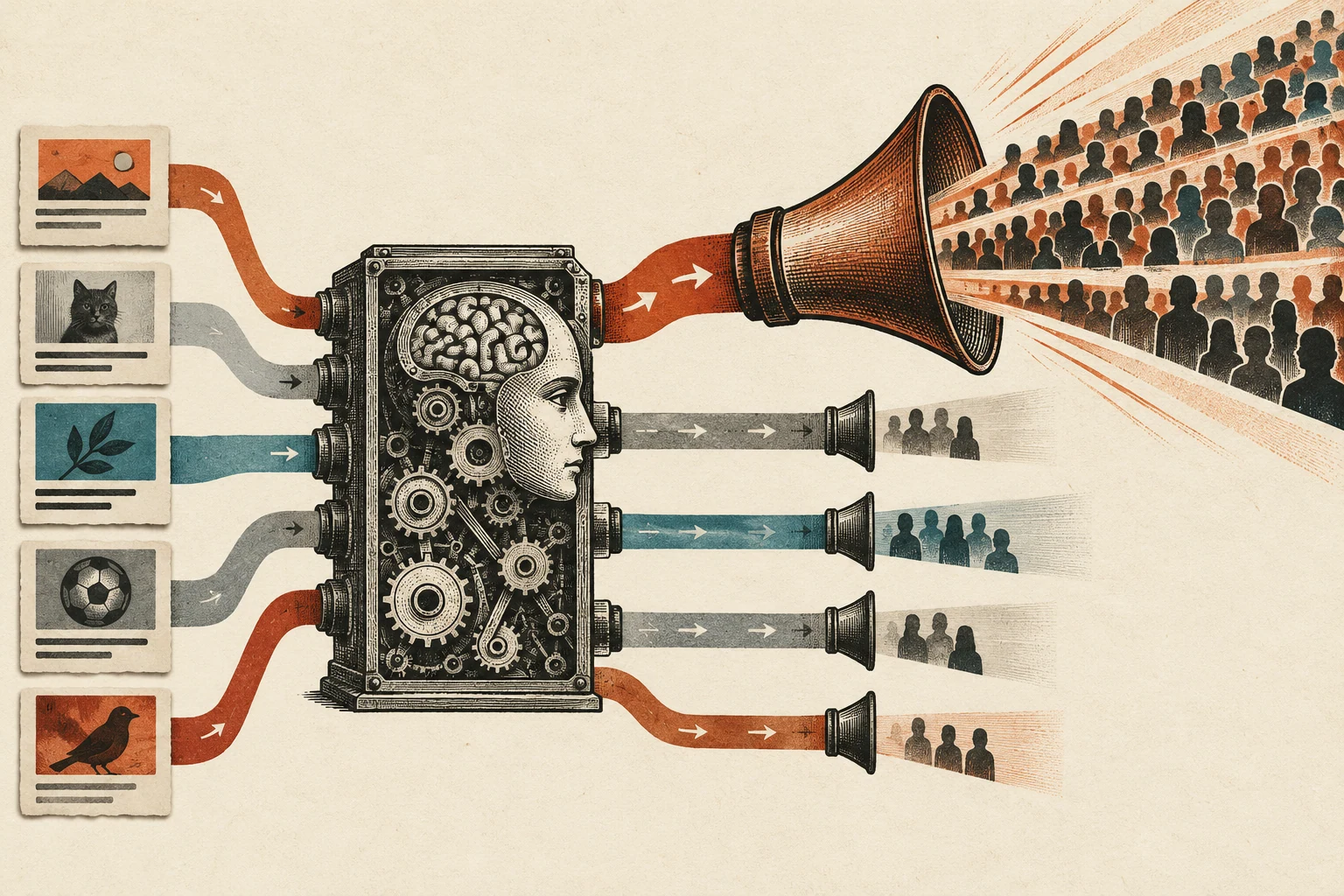
A recommendation engine gives a selected post vastly greater reach; amplified distribution by itself says nothing about quality or truth.
AI-assisted illustration · conceptual metaphor View in visual quiz →Genesis and Global Lineage
The term crystallized around 2021 at the intersection of two fields. The first was empirical research into recommender systems and the 2018–2020 debate over radicalization on YouTube, which borrowed “amplification” as a metaphor from electroacoustics: the platform as a signal amplifier. The second was platform law: following controversies over Section 230 of the U.S. Communications Decency Act and the 2020 presidential election, legal scholars and lawmakers began distinguishing liability for merely hosting user speech from liability for actively distributing it through ranking algorithms; Daphne Keller’s June 2021 essay for the Knight First Amendment Institute organized this debate and demonstrated that the term lacked a stable legal definition. Operational precision was supplied by Twitter’s META (ML Ethics, Transparency, and Accountability) team—Ferenc Huszár, Sofia Ira Ktena, Conor O’Brien, Luca Belli, and Andrew Schlaikjer—working with Moritz Hardt of UC Berkeley. In their landmark PNAS paper (accepted October 2021, published online December 21, 2021, issue of January 4, 2022), they defined amplification as the ratio of reach in the personalized timeline to reach in a long-running randomized control group of roughly two million users who saw only a reverse-chronological feed, applying this metric to legislators across seven countries and U.S. news outlets. From that moment, the concept moved from metaphor to an auditable quantity, and subsequently—through the European Union’s Digital Services Act—into a statutory regulatory category.
Central European Lineage
We found no documented link between this concept and the intellectual history or historical experience of Central Europe.
We found no documented link between this concept and the intellectual history or historical experience of Central Europe (by our methodology, this means “none found,” not “none exists”; as of October 2026).
Why Now
Between 2018 and 2026, three successive waves pushed algorithmic amplification to the center of technology policy. The first was the “Facebook Files” leaked by Frances Haugen and published by the Wall Street Journal in autumn 2021, which revealed that Meta’s 2018 ranking overhaul prioritizing “Meaningful Social Interactions” systematically rewarded outrage and divisive posts—and that internal researchers had documented the effect. The second wave was empirical: Huszár and colleagues (2022) showed that in six of seven countries studied, mainstream right-wing political parties enjoyed higher algorithmic amplification on Twitter than left-wing parties, while finding no evidence that far-left or far-right extremes were amplified more than the political center; meanwhile, large-scale 2020 election experiments on Facebook and Instagram published in Science in July 2023 (Guess et al.) showed that switching users to a reverse-chronological feed significantly altered their diet of political and untrustworthy news, yet over three months produced no measurable change in affective polarization or ideological attitudes. The third wave was legal and institutional: the EU Digital Services Act (Regulation 2022/2065) obliged very large online platforms to assess systemic risks stemming from their recommender systems and to offer users at least one feed option not based on profiling, while in the United States Gonzalez v. Google (2023) brought before the Supreme Court the question of whether algorithmic recommendations forfeit Section 230 immunity (a question the Court ultimately sidestepped). After Elon Musk acquired Twitter in October 2022, the internal randomized control group on which Huszár’s measurement relied was dismantled and the platform began openly re-weighting its ranking heuristics, turning amplification into an explicit instrument of owner policy.
Explanatory Power
The concept disentangles three phenomena that public debate routinely blends together: the organic popularity of content, the platform’s architectural intervention in its reach, and the psychological effect on the audience. First, it replaces conspiracy theories with an auditable counterfactual: only by comparing personalized delivery against a control baseline can researchers determine whether a given political camp receives an algorithmic boost, ruling out the simpler explanation that one side merely tweets more often or has more followers. Second, it renders visibility reduction (demotion, colloquially “shadowbanning”) legible as an independent instrument of power: a creator who never has a single post deleted can lose the bulk of their audience overnight without receiving any formal notice or right of appeal—what Arvind Narayanan calls “soft moderation.” Third, it explains why follower counts have ceased to function as stable capital: in feeds driven by engagement prediction (pioneered by TikTok’s “For You” page and copied across the industry), reach depends on item-level probability scores rather than a user’s curated social graph, making the distribution of attention radically skewed and unpredictable even for established publishers.
Axes of Debate
Does a neutral baseline even exist?
Platform legal scholars and media sociologists (Keller, Gillespie) point out that a reverse-chronological feed is itself a value-laden design choice: it rewards accounts that post incessantly, privileges early adopters who have already accumulated followers, and still sits atop content-moderation rules that filter the pool of eligible speech. Strongest counterargument: Huszár’s team replies from the pragmatics of measurement: scientific auditing does not require metaphysical neutrality, only a clearly specified counterfactual; a reverse-chronological feed is analytically useful precisely because it strips out the platform’s machine-learned predictions about individual user engagement, isolating the exact component under dispute. Nature of the dispute: substantive — both sides agree that any baseline is a convention, but disagree on whether such a convention is robust enough to ground legal liability or regulatory mandates.
Does amplification change minds, or only information diets?
Journalists, lawmakers, and researchers studying online radicalization (including Whittaker et al. on YouTube in 2021) treat algorithmic amplification as a primary causal driver of affective polarization and extremist recruitment. Strongest counterargument: The 2020 U.S. election field experiments published in Science (Guess et al., 2023) found that moving users to a chronological feed for three months changed what they saw on screen without changing their political beliefs or polarization levels, and Huszár et al. found no extra boost for extremist politicians over mainstream ones; critics of those studies counter that three months cannot undo years of cumulative exposure and note that the experiments were conducted in partnership with Meta. Nature of the dispute: mixed — the methodological debate over experimental time horizons is substantive, but both platform defenders and critics routinely extrapolate broader political absolutions or indictments than the data support.
Can the state regulate reach when it cannot regulate speech?
Under U.S. First Amendment doctrine (as analyzed by Keller), state-mandated demotion of lawful speech is treated with nearly the same constitutional suspicion as outright prohibition, and platforms argue that their ranking algorithms constitute protected editorial discretion; hence American reform proposals gravitate toward content-neutral friction, such as circuit breakers on viral velocity or mandatory chronological toggles. Strongest counterargument: The European Union’s Digital Services Act bypasses the U.S. constitutional deadlock by neither banning amplification nor judging individual posts, instead requiring platforms to audit and mitigate “systemic risks” to civic discourse and electoral processes—to which civil-liberties critics reply that risk mitigation quietly shifts speech-restrictive decisions from courts to corporate compliance officers and Brussels regulators. Nature of the dispute: substantive — the disagreement reflects a fundamental divergence between American and European constitutional architectures.
Underappreciated Angle
The least discussed truth about algorithmic amplification is institutional: rigorous measurement of the phenomenon was possible only because a single corporation happened to maintain a permanent 1% randomized reverse-chronological control group for its own engineering telemetry and briefly allowed its internal ethics researchers to publish findings from it. Once Twitter changed hands in 2022, the research team was dissolved and the control condition disappeared—taking with it the only empirical scale on which amplification could be measured across an entire population. External audits using sockpuppet bots or browser extensions donated by volunteers measure something fundamentally different: the localized trajectory of synthetic profiles or tiny self-selected samples, not the population-level causal effect of a ranking model. While the EU Digital Services Act legally compels platforms to grant vetted researchers access to data, no law currently compels a platform to maintain a permanent randomized unranked control group for millions of active users. As a measurable scientific quantity, algorithmic amplification remains a hostage to corporate infrastructure that neither academia nor regulators control.
One-Sentence Takeaway
Algorithmic amplification is defined not by what an algorithm promotes in the abstract, but by the baseline we agree to measure it against—and by who still holds the power to run that comparison.
Related Concepts Network
How this concept reinforces, constrains, or complements other analytical frameworks in the corpus. View on graph →
-
Attention economy reinforces
Algorithmic amplification is the operational mechanism through which a platform converts scarce user attention into expanded reach for certain items of content at the expense of others.
-
Content moderation complements
Reducing reach (demotion) is “soft” moderation: it does not delete a post, but strips away its algorithmic amplification, often invisibly to the author.
-
Epistemic bubbles vs. echo chambers in tension
Controlled experiments with reverse-chronological feeds show that algorithmic amplification does not always lock users inside a bubble; at times it even exposes them to more cross-cutting content than their self-selected social graph would.
-
Platformization reinforces
Control over what gets amplified is the core of a platform's structural power over the creators and news organizations that depend on it for distribution.
-
Algorithmic bias complements
Unequal amplification of political speech is a specific case of systemic bias, measured not at the point of classification accuracy but across aggregate audience reach.
-
Affective polarization in tension
The popular hypothesis that algorithmic amplification directly drives partisan polarization has weaker experimental support than public commentary suggests.
-
Disinformation complements
Policy debates over disinformation have shifted from asking whether a piece of content is false to asking whether—and by whom—it was algorithmically amplified.
Reading Canon & Translation Bridge
Foundational texts, introductions, and critical perspectives—with availability of English and Polish editions.
-
foundational text 2022 · English
Ferenc Huszár, Sofia Ira Ktena, Conor O'Brien, Luca Belli, Andrew Schlaikjer, Moritz Hardt, Algorithmic amplification of politics on Twitter
The PNAS article (vol. 119, no. 1, e2025334119) that gave the term an operational metric: comparing reach in the personalized home timeline against a reverse-chronological control group of nearly two million accounts across seven countries.
In English: original text written in English
In Polish: no Polish edition
-
foundational text 2021 · English
Daphne Keller, Amplification and Its Discontents: Why Regulating the Reach of Online Content Is Hard
A Knight First Amendment Institute essay (June 8, 2021) showing why amplification is notoriously difficult to define and why U.S. constitutional law treats restrictions on algorithmic reach much like restrictions on speech itself.
In English: original text written in English
In Polish: no Polish edition
-
introduction & synthesis 2023 · English
Arvind Narayanan, Understanding Social Media Recommendation Algorithms
The clearest concise explanation of how engagement optimization works and why it shifts decisions about audience reach from the user's follower graph to the platform's predictive models.
In English: original text written in English
In Polish: no Polish edition
-
critical perspective 2023 · English
Andrew M. Guess, Neil Malhotra, Jennifer Pan i in., How do social media feed algorithms affect attitudes and behavior in an election campaign?
A large-scale field experiment in “Science” (July 28, 2023) during the 2020 U.S. election: switching users to a reverse-chronological feed altered their information diet, but over three months did not change affective polarization or political attitudes, tempering simple causal claims about amplification.
In English: original text written in English
In Polish: no Polish edition
-
critical perspective 2021 · English
Joe Whittaker, Seán Looney, Alastair Reed, Fabio Votta, Recommender systems and the amplification of extremist content
An “Internet Policy Review” (10:2) study using sockpuppet accounts that found systematic amplification of extremist content on YouTube, though not on Reddit or Gab, and proposed co-regulatory frameworks for “lawful but awful” speech.
In English: original text written in English
In Polish: no Polish edition
-
cross-disciplinary 2018 · English
Tarleton Gillespie, Custodians of the Internet: Platforms, Content Moderation, and the Hidden Decisions That Shape Social Media
A media sociology study showing that platforms have always acted as curators rather than neutral pipes—providing the backdrop against which any “neutral baseline” for measuring amplification turns out to be a design convention.
In English: original text written in English
In Polish: Polish edition not verified
-
cross-disciplinary 2022 · English
Nick Seaver, Computing Taste: Algorithms and the Makers of Music Recommendation
An ethnography of recommendation engineers (University of Chicago Press) showing how practitioners themselves understand “captology” and attention traps, and how their vernacular differs from that of regulators.
In English: original text written in English
In Polish: Polish edition not verified
Primary-Source Quotes
Results unveil that the political right enjoys higher amplification compared to the political left.
Defining amplification is hard.