Culture & Power #152
Cancel culture
original term: cancel culture (Eng.) · kultura unieważniania, kultura anulowania, cyfrowy ostracyzm
Global-circulation concept — no documented lineage in Central Europe. jump to documentation ↓
Working Definition
Cancel culture is the collective, usually social-media-mediated withdrawal of support from a person or institution in response to a statement or action judged unacceptable, combined with pressure on third parties—employers, publishers, universities, sponsors—to sever ties with the target as well. In everyday political polemics the phrase is stretched to cover almost any sharp public criticism online; in analytical usage it is more usefully restricted to cases where the sanction is disproportionate to the offense, imposed without due process, and aimed at permanently excluding the target from their profession or public platform. Operationally, it helps to separate three layers: the social practice (boycott, deplatforming, viral shaming), the interpretive frame (the label “cancel culture” applied by observers), and the meta-dispute over whether that frame describes a genuine threat to open inquiry or serves mainly to delegitimize accountability from below.
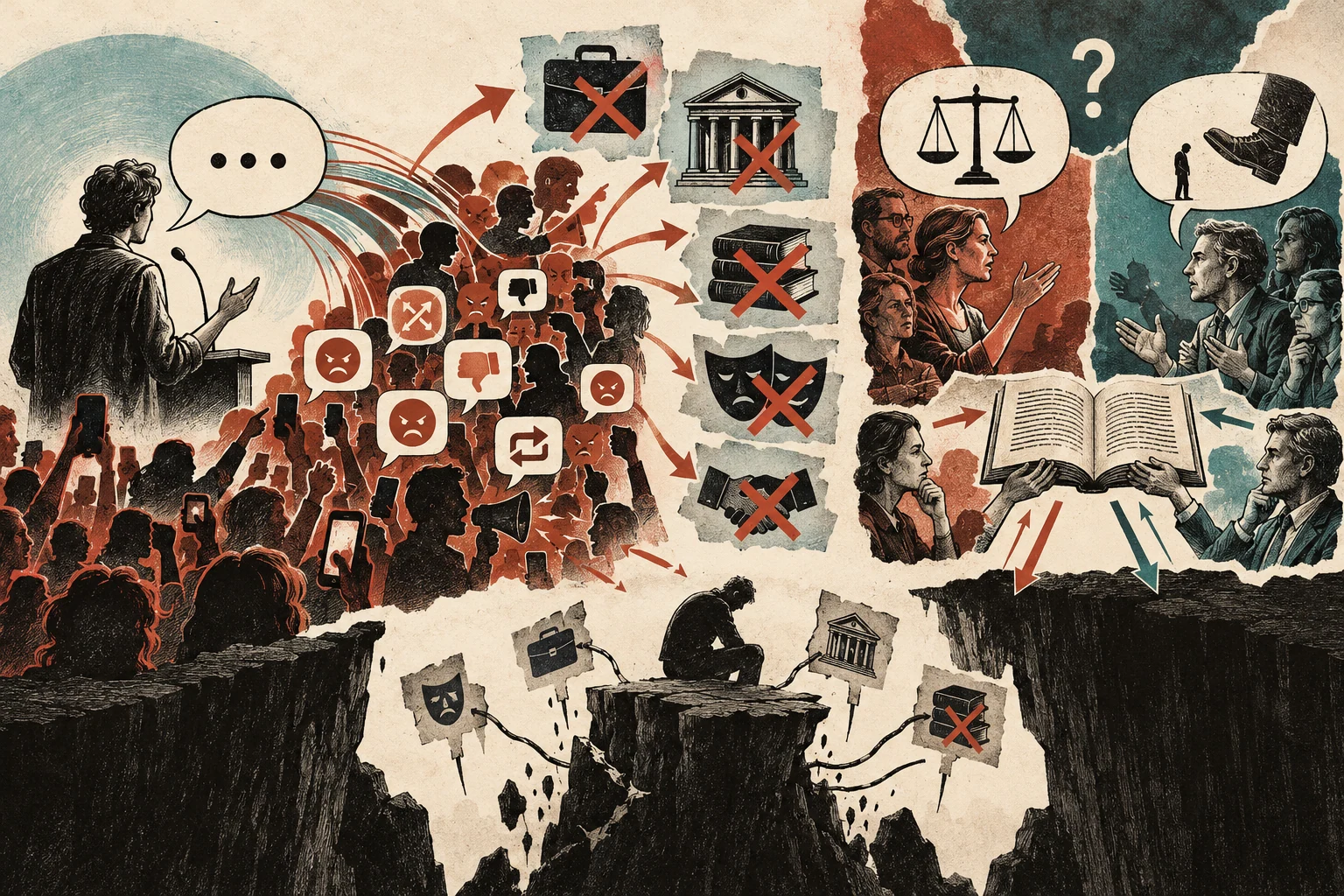
Public backlash leads to withdrawn support and platform access, sparking debate over accountability, proportionality, and room for context.
AI-assisted illustration · conceptual metaphor View in visual quiz →Genesis and Global Lineage
The transitive verb “to cancel” applied to a person comes from African American vernacular culture: its trajectory runs from the 1981 Chic song Your Love Is Cancelled and a line spoken by Wesley Snipes’s character in the 1991 film New Jack City (“Cancel that bitch. I’ll buy another one”), through a 2014 episode of the reality show Love & Hip Hop: New York, onto Black Twitter around 2015, where “canceling” meant a personal or collective decision to withdraw attention and financial support from a public figure. In her 2020 essay DRAG THEM, media scholar Meredith D. Clark traced this genealogy to Black discursive traditions of “reading” and boycott—a tool of groups excluded from institutional power—and showed how mainstream media elites captured the phrase and inverted it into an accusation against marginalized critics. As the name of a diagnosed social pathology, “cancel culture” crystallized in 2018–2019 (Merriam-Webster added a usage note in July 2019, and Barack Obama criticized “call-out culture” that autumn), receiving its canonical statement on July 7, 2020, when Harper’s Magazine published A Letter on Justice and Open Debate, signed by 153 writers and academics including Noam Chomsky, Margaret Atwood, and Salman Rushdie. Three days later, a counter-letter (A More Specific Letter on Justice and Open Debate) charged that prominent signatories were confusing public criticism by marginalized voices with censorship.
Central European Lineage
We found no documented link between this concept and the intellectual history or historical experience of Central Europe.
We found no documented link between this concept and the intellectual history or historical experience of Central Europe (by our methodology, this means “none found,” not “none exists”; as of October 2026).
Why Now
Three developments converged between 2017 and 2026 to keep the concept at the center of public conflict. First, the #MeToo movement (from October 2017) demonstrated that viral online disclosures could end powerful careers in days where legal and HR procedures had failed for decades, raising acute questions about the boundary between overdue accountability and extra-procedural trial by social media. Second, digital platforms became the primary arena of professional reputation: corporate communications departments and university administrators learned to treat a 48-hour Twitter storm as an existential brand crisis, frequently firing or suspending employees preemptively. Third, the phrase was weaponized in electoral politics: the 2020 US Republican National Convention made “cancel culture” a headline theme, and a Pew Research Center survey (fielded September 2020, published May 2021) found that while 49% of Americans familiar with the term defined it as “actions people take to hold others accountable,” conservative respondents overwhelmingly defined it as “censorship of speech or history.” Between 2022 and 2026 the roles visibly flipped: following disputes over the Gaza war on US and European campuses in 2023–2024 and the return of the Trump administration in 2025, actors who had spent years denouncing progressive “cancel culture” deployed donor boycotts, doxxing trucks, visa revocations, and state blacklists against students, academics, and civil servants.
Explanatory Power
The concept highlights how digital network architecture has transformed the scale, speed, and permanence of an otherwise ancient human practice—social ostracism. First, it exposes a radical asymmetry of costs: joining an online outrage cascade costs an individual participant a single click and yields immediate social-signaling rewards within their peer network, whereas the cumulative blow to the target is global and permanently indexed by search engines—explaining why the punishment routinely exceeds what any single participant intended (as Jon Ronson documented in So You’ve Been Publicly Shamed, 2015). Second, it clarifies the institutional transmission belt: viral campaigns rarely defeat their target directly; instead, they exploit the risk aversion of third-party institutions (employers, publishers, festival boards) that lack robust internal due-process standards and fire the target to make the PR headache go away—exemplified by theJune 2020 resignation of the New York Times opinion editor after staff backlash over a senator’s op-ed. Third, stripping the concept of partisan allegiance reveals the shared structural mechanics connecting episodes across the political spectrum: firing a progressive teacher over a social-media post about Gaza in 2023 and firing a conservative analyst over a tweet about Black Lives Matter protests in 2020 follow the exact same institutional script.
Axes of Debate
Moral panic and elite myth (Clark) versus measurable chilling effect (Norris)
Media scholars and progressive critics (Meredith Clark, Sarahagi, signatories of the 2020 counter-letter) argue that “cancel culture” is a moral panic manufactured by pundits who mistake losing a monopoly on public discourse for censorship, pointing out that many famously “canceled” celebrities retain lucrative platforms. Strongest counterargument: Drawing on Elisabeth Noelle-Neumann’s “spiral of silence” (1980) and a survey of nearly 2,500 political scientists across 100 countries, Pippa Norris (2021) demonstrates that scholars whose views diverge from the local majority in their department systematically report self-censorship and pressure to conform—Whether right-wing scholars in progressive Western universities or liberal scholars in socially conservative societies. The primary effect of cancel culture is not the tally of celebrity firings, but the quiet self-silencing of ordinary professionals who watch those firings. Nature of the dispute: mixed — the two sides measure different denominators: critics count high-profile comedians who bounce back, whereas defenders of the concept measure unseen self-censorship among rank-and-file employees and students.
Grassroots accountability versus punishment without due process
Digital-activism scholars and civil-rights advocates emphasize that boycotts and public naming have always been the weapon of the weak against powerful actors shielded by nondisclosure agreements, friendly HR departments, and expensive defamation lawyers. Strongest counterargument: Procedural liberals (the Harper’s signatories, Greg Lukianoff and Jonathan Haidt) reply that a sanctioning mechanism devoid of proportional sentencing, fact-checking, a statute of limitations (as when teenagers’ decade-old posts are unearthed), or any path to rehabilitation is not justice, but mob rule—and that extra-procedural weapons forged by the weak are inevitably captured and wielded on a larger scale by the powerful. Nature of the dispute: substantive — it reflects a genuine institutional dilemma between correcting impunity when formal procedures fail and preserving basic norms of due process and proportionality.
Peer ostracism in civil society versus state censorship from above
Right-wing politicians across North America and Europe (including Poland and Hungary, where “cancel culture” is invoked in English or calqued as kultura unieważniania) portray progressive universities, media, and NGOs as the primary censors of public life. Strongest counterargument: Free-speech monitors such as PEN America and the Foundation for Individual Rights and Expression (FIRE) document that since 2021 state legislatures and executive branches have enacted sweeping legal bans on school books, university courses, and institutional speech—demonstrating that coercive state censorship backed by law and funding cuts poses a qualitatively heavier threat than horizontal peer shaming on social media. Nature of the dispute: rhetorical — in partisan combat both camps apply “cancel culture” exclusively to their opponents’ boycotts while relabeling their own campaigns as “accountability” or “democratic oversight.”
Underappreciated Angle
Almost absent from public debate is the political economy of attention on the side of the shamers. An online outrage cascade is not a spontaneous eruption of puritanism; it is an engagement product optimized by platform ranking algorithms. Because righteous moral indignation generates higher click-through and sharing rates than nuanced disagreement, recommender systems systematically amplify posts that identify a villain to be denounced. For participants, piling on is virtually cost-free and pays immediate dividends in followers, in-group status, and moral solidarity. Viewed through this institutional lens, “cancel culture” is neither a left-wing nor a right-wing ideological invention, but an structural byproduct of an attention economy that monetizes moral outrage combined with cowardly institutions that have outsourced their internal judgment to social-media metrics. The practical lesson follows directly: wherever a university, newspaper, or company maintains clear procedural rules and simply waits seventy-two hours for the algorithmic wave to move on to its next target, almost nobody actually gets “canceled.” The decisive link in the chain is never the online crowd; it is the institution that panics and surrenders its own procedures to a trending topic.
One-Sentence Takeaway
An online crowd cannot fire anyone on its own; someone is “canceled” only when an employer or institution decides it is cheaper to sacrifice an individual than to defend its own due-process rules against a forty-eight-hour storm.
Related Concepts Network
How this concept reinforces, constrains, or complements other analytical frameworks in the corpus. View on graph →
-
Preference falsification reinforces
Fear of public shaming raises the personal cost of open dissent and widens the gap between privately held views and publicly expressed opinions.
-
Overton window complements
Online shaming campaigns are one of the mechanisms that shift or narrow the range of views treated as publicly acceptable.
-
Culture wars reinforces
The dispute over whether cancel culture even exists has become one of the central battlegrounds of the post-2019 culture wars.
-
Affective polarization reinforces
Collective denunciation of an offender builds in-group solidarity through shared hostility toward an out-group rather than substantive argument.
-
Epistemic bubbles vs. echo chambers complements
Outrage cascades spread fastest inside densely connected, ideologically homogeneous networks where moral signaling is rewarded with reach.
-
DEI in tension
Critics of institutional diversity policies view them as the bureaucratic enforcement arm of cancel culture, whereas defenders see the “cancel culture” label as an attempt to block accountability for discrimination.
Reading Canon & Translation Bridge
Foundational texts, introductions, and critical perspectives—with availability of English and Polish editions.
-
foundational text 2020 · English
Meredith D. Clark, DRAG THEM: A brief etymology of so-called „cancel culture”
A concise essay in Communication and the Public (vol. 5, nos. 3–4, pp. 88–92) tracing the practice from Black vernacular culture and Black Twitter to the capture of the term by media elites.
In English: original text written in English
In Polish: no Polish edition
-
foundational text 2020 · English
Sygnatariusze listu w „Harper’s Magazine” (153 osoby, m.in. Noam Chomsky, Margaret Atwood, Francis Fukuyama), A Letter on Justice and Open Debate
The open letter of July 7, 2020 that made the climate of “intolerance of opposing views” a mainstream debate topic and provoked the counter-letter “A More Specific Letter on Justice and Open Debate” (July 10, 2020).
In English: original text written in English
In Polish: Polish edition not verified
-
critical perspective 2021 · English
Pippa Norris, Cancel Culture: Myth or Reality?
An empirical study in Political Studies (vol. 71, no. 1, 2023, pp. 145–174; online 2021) based on a survey of nearly 2,500 political scientists across a hundred countries, showing that perceived chilly climate tracks the ideological gap between a scholar’s views and the dominant culture of their department.
In English: original text written in English
In Polish: no Polish edition
-
introduction & synthesis 2022 · English
Eve Ng, Cancel Culture: A Critical Analysis
A media-studies monograph (Palgrave Macmillan) mapping the phenomenon from fan practices and digital activism to its partisan weaponization.
In English: original text written in English
In Polish: Polish edition not verified
-
introduction & synthesis 2015 · English
Jon Ronson, So You’ve Been Publicly Shamed
Reportage on ordinary people devastated by viral online shaming campaigns, written before the phrase “cancel culture” caught on; captures the mechanics of an outrage cascade from the vantage point of its targets.
In English: original text written in English
In Polish: “#WstydźSię! O jednej z najbardziej niedocenianych sił rządzących światem”, Insignis Media 2017, trans. Katarzyna Dudzik, Olga Siara
-
critical perspective 2018 · English
Greg Lukianoff, Jonathan Haidt, The Coddling of the American Mind: How Good Intentions and Bad Ideas Are Setting Up a Generation for Failure
The most influential diagnosis of campus “safetyism” as the psychological breeding ground for deplatforming and public shaming; best read alongside Norris’s cross-national survey data.
In English: original text written in English
In Polish: “Rozpieszczony umysł. Jak dobre intencje i złe idee skazują pokolenia na porażkę”, Zysk i S-ka 2023, trans. Filip Filipowski
-
cross-disciplinary 1980 · German
Elisabeth Noelle-Neumann, Die Schweigespirale. Öffentliche Meinung – unsere soziale Haut
The classic theory of the fear of social isolation (English translation “The Spiral of Silence,” 1984) on which Norris directly draws; explains how self-censorship by a local minority reinforces the impression of unanimity without formal censorship.
In English: English edition not verified
In Polish: “Spirala milczenia. Opinia publiczna – nasza skóra społeczna”, Zysk i S-ka 2004, trans. Joanna Gilewicz