Culture & Power #138
Overton window
original term: Overton window (Eng.) · okno dyskursu, window of political possibility
Central European lineage: 1 thread (historical experience) · 2014 · jump to documentation ↓
Working Definition
The Overton window is the range of policy ideas and political positions that a mainstream politician can publicly endorse in a given society at a given moment without being dismissed as too extreme to win or hold office. The model describes what is politically sayable and enactable rather than what is true or right: a proposal inside the window can be debated and legislated, whereas one outside is political suicide for an office-seeker until the window shifts. In its original formulation at the Mackinac Center for Public Policy, the window moves slowly in response to cultural and social shifts, with elected politicians acting as cautious followers rather than prime movers. In its colloquial and conspiratorial mutations, however, “shifting the Overton window” refers to a deliberate rhetorical tactic—or a sinister top-down social-engineering plot—through which extremists, media elites, or foreign powers normalize ideas that were previously taboo.
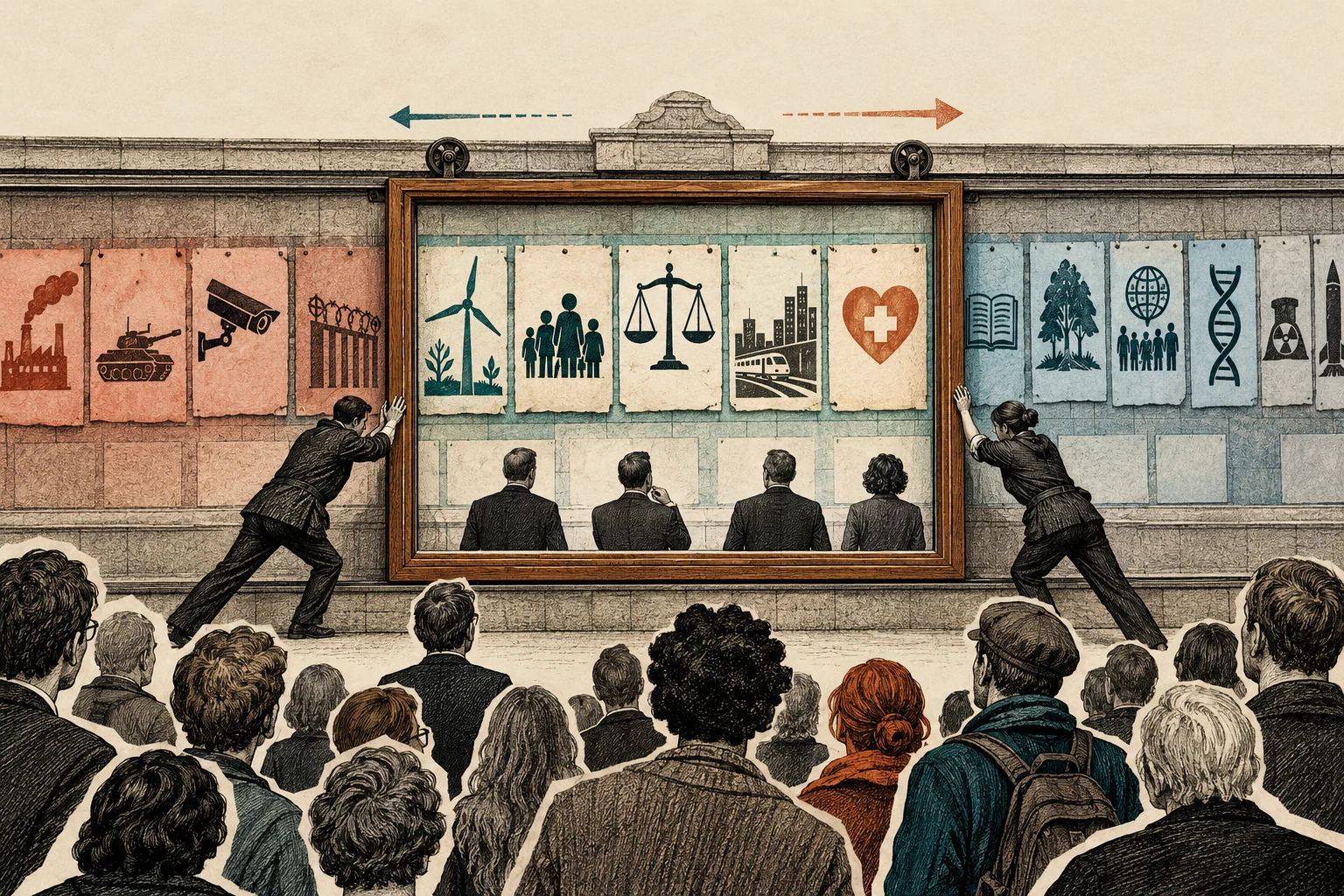
A shifting frame alters which proposals are treated as acceptable in public debate, though acceptability is not the same as truth or merit.
AI-assisted illustration · conceptual metaphor View in visual quiz →Genesis and Global Lineage
The concept was created in the mid-1990s by Joseph P. Overton (1960–2003), an engineer, lawyer, and vice president at the Mackinac Center for Public Policy in Midland, Michigan. Overton needed a visual aid to explain to donors why a think tank should research radical free-market proposals (like abolishing public schooling) that no sitting legislator would vote for. He designed a vertical axis from “more government control” to “less government control” fitted with a sliding cutout—the “window of political possibility.” Politicians stay inside the window to get re-elected, while think tanks, movements, and intellectuals do the outside work of shifting it until yesterday’s radical proposal becomes tomorrow’s common sense. After Overton died in a 2003 plane crash, colleague Joseph G. Lehman named the model the Overton Window. In 2006, Joshua Treviño popularized it online and added the six-rung ladder (Unthinkable, Radical, Acceptable, Sensible, Popular, Policy). Two texts then altered its trajectory: Glenn Beck’s 2010 thriller The Overton Window, recasting a donor diagram as a PR conspiracy, and Joe Carter’s 2011 First Things column How to Destroy a Culture in 5 Easy Steps, turning Treviño’s rungs into a satirical manual for normalizing taboos. After 2015–2016, the phrase exploded across journalism to explain how Donald Trump, Brexit, and Bernie Sanders shattered party orthodoxies.
Central European Lineage
While the concept has no Central European coiners, its most striking mutation occurred in Eastern Europe in early 2014 and radiated into the region’s vocabulary. On January 14, 2014—during the Euromaidan protests in Kyiv—Moscow blogger Yevgeny Gorzhaltsan (writing on LiveJournal as zuhel and affiliated with Sergey Kurginyan’s Essence of Time / Sut’ vremeni) published a viral post titled Technology of Destruction (Tekhnologiya unichtozheniya). Adapting Joe Carter’s 2011 five-step sequence without attribution, Gorzhaltsan illustrated the “Overton Window” with a parable explaining how Western elites could legalize cannibalism in five steps (beginning by renaming it “anthropophagy” and “anthropophilia”), arguing that Western support for LGBT rights and the Ukrainian Maidan was a psychological operation to destroy Slavic societies. Reprinted by Russian outlets (Komsomolskaya Pravda, Regnum) and read aloud by director Nikita Mikhalkov on state television (Besogon TV), this conspiratorial version became so pervasive that political scientist Ekaterina Shulman diagnosed it as “magical thinking”—the belief that complex social shifts are operated by a hidden director pulling five levers. Ironically, this Russian distortion crossed into Ukrainian and Central European conservative discourse: as documented in a 2019 Kyiv academic article by Oleksandr Karpenko, regional commentators cited “Overton’s technology of value destruction” at face value as a foreign brainwashing mechanism, unaware the parable had been invented on a Moscow blog.
Documented regional lineage · Link: 1. Compiled: October 2026.
-
historical experience 0 years — same text on both sides
Central European Source: Jewgienij Gorżałcan (blog „zuhel”), “Технология уничтожения (wpis na LiveJournal)”; Moscow, Russia, 2014
Global Circulation: the Overton window as a covert “technology” for step-by-step legalization of the unthinkable (the conspiratorial variant of the concept) — Jewgienij Gorżałcan, za schematem Joe Cartera (2011), 2014
historical experience
0 years — same text on both sidesJewgienij Gorżałcan (blog „zuhel”), “Технология уничтожения (wpis na LiveJournal)”
2014 · Moscow, Russia
the Overton window as a covert “technology” for step-by-step legalization of the unthinkable (the conspiratorial variant of the concept)
2014 · Jewgienij Gorżałcan, za schematem Joe Cartera (2011)
- Claim & Connection
- A conspiratorial mutation of the concept—recast as a deterministic five-step “technology of destruction” moving from the “unthinkable” to “statutory policy,” illustrated by the hypothetical legalization of cannibalism—spread across the post-Soviet and Eastern European information space from a Russian-language LiveJournal post published on January 14, 2014 by Yevgeny Gorzhaltsan, who adapted a 2011 column by American writer Joe Carter. Reprinted verbatim by major Russian newspapers and read aloud on state television by film director Nikita Mikhalkov, this version became a staple ideological tool for explaining the Ukrainian Euromaidan and the supposed “moral collapse of Europe.” By 2019, it had entered Ukrainian academic writing (Karpenko 2019) as an alleged manipulative technology threatening societal values, while Russian sociologists (Namyatova 2018; Shulman; Vakhshtayn) and political scientists (Parma 2024) documented how the Mackinac policy heuristic mutated into a full-blown conspiracy theory.
- Source Documentation
-
- primary source zuhel [Jewgienij Gorżałcan], „Технология уничтожения”, LiveJournal, 14 I 2014; headings of the five steps; the sentence “Возьмём для примера что-то совершенно невообразимое” (“Let us take as an example something completely unthinkable”). zuhel.livejournal.com ↗
- scholarly study Aleksandra Namiatowa, „«Окно Овертона» как инструмент конспирологических теорий. К истории использования понятия в российских реалиях”, Нож, 1 VIII 2018; paragraphs tracing the lineage from Carter (2011) to the January 14, 2014 blog post, state-media reprints, the 2014 spike in citations, and critiques by Ekaterina Shulman and Viktor Vakhshtayn. knife.media ↗
- scholarly study Oleksandr Karpenko, „«Вікно Овертона» як маніпулятивний механізм трансформації суспільних цінностей”, Вісник Національної академії керівних кадрів культури і мистецтв, 2019, nr 1, DOI 10.32461/2226–3209.1.2019.166531; abstract: warning against the application of the “Overton window” as a manipulative mechanism transforming societal values in Ukraine. journals.uran.ua ↗
- primary source Joe Carter, „How to Destroy a Culture in 5 Easy Steps”, First Things, 29 VI 2011; paragraph outlining the Unthinkable–Policy continuum and the five-step sequence. firstthings.com ↗
- scholarly study Roman Parma, „Расширение поля применения технологии «Окно политических возможностей»”, Власть, 2024, nr 5, DOI 10.24412/2071-5358-2024-5-43-51; passage on the migration of the model beyond policy consulting into conspiracy theories (via Glenn Beck’s novel and post-2014 reception). cyberleninka.ru ↗
- scholarly study „Окно Овертона”, Википедия (ru), wersja oldid=153394931; section on reception in Russia: reprints in Komsomolskaya Pravda, Regnum, and KPRF; Mikhalkov broadcast; Parma 2024. ru.wikipedia.org ↗
- Historical Context
- This link documents the distinct Eastern European and post-Soviet reception history of the concept (including verified uptake in Ukraine), where the “Overton window” circulates primarily as a sinister five-step brainwashing technology rather than Joseph Overton’s descriptive model of legislative constraints.
Why Now
Between 2016 and 2026, the Overton window became a pervasive lens for diagnosing rapid normative ruptures across Western and Central European politics. In the US and Western Europe, journalists used it in 2016 to explain the sudden viability of tariffs, border walls, and Brexit, and in 2019–2020 to describe how ideas like the Green New Deal or pandemic lockdowns leaped from fringes to cabinet policy within weeks. In Central and Eastern Europe, 2016–2026 offered a dramatic laboratory along two axes. First, in domestic politics (Poland under Law and Justice 2015–2023, Hungary under Fidesz, Slovakia after 2023), battles over courts, abortion law, migration, and LGBT rights showed how ruling parties use state media and legislative shock therapy to stretch what is sayable—while importing conspiratorial rhetoric of “defending society against Overton-window engineering.” Second, Russia’s full-scale invasion of Ukraine in February 2022 triggered the fastest geopolitical Overton-window shift in postwar European history: within seventy-two hours, decades of German Ostpolitik and bans on weapons exports, Finnish and Swedish neutrality, and EU defense financing moved from “unthinkable” margins directly into state policy.
Explanatory Power
The concept’s value lies in separating what people privately think from what the public sphere rewards or punishes a politician for saying out loud. First is the radical flank effect (Herbert Haines): an activist group staking out an uncompromising position outside the window shifts the perceived center of gravity so a previously “radical” proposal looks like a moderate compromise. Second, combining Overton’s window with Daniel Hallin’s 1986 model of journalistic spheres (Consensus, Legitimate Controversy, Deviance) explains media gatekeeping: journalists apply rules of neutral balance only to ideas inside the window, treating ideas below it as self-evident and ideas outside it as unworthy of airtime. Third, pairing the window with Timur Kuran’s preference falsification (1995)—inspired by the 1989 collapse of communist regimes across Central and Eastern Europe—explains why the window jumps abruptly: when millions privately reject an orthodoxy but stay silent out of fear (as in Communist Poland before Solidarność and the drugi obieg press), the visible window stays frozen for decades and then leaps across the spectrum in weeks once the fear threshold breaks.
Axes of Debate
Bottom-up social evolution versus top-down elite and media engineering
Joseph Lehman and the Mackinac Center insist on Overton’s premise: politicians are risk-averse followers ratifying shifts that have already occurred in society, and no PR campaign can force voters to accept an idea lacking cultural foundations. Critics counter that this modesty hides why Overton invented the diagram—to solicit donor millions for think tanks and media campaigns designed to manufacture a new “common sense” from the top down. Strongest counterargument: Both extremes fail empirically: well-funded astroturf campaigns flop when they collide with lived experience, yet acute crises (9/11, the 2008 crash, the 2022 invasion of Ukraine) allow executive elites to move the legislative window overnight before cultural evolution begins. Nature of the dispute: mixed — the interaction between elite framing and mass attitudes is a substantive question, while claiming the window only moves organically often masks organized lobbying.
Descriptive heuristic versus deterministic five-step conspiracy theory
Political scientists and sociologists (Ekaterina Shulman, Viktor Vakhshtayn, Aleksandra Namyatova) note that the original Overton window is a descriptive snapshot of legislative viability, whereas the “five steps from unthinkable to mandatory law” schema (the Carter–Gorzhaltsan cannibalism parable) is unfalsifiable pseudoscience. Cultural-war commentators reply that activist coalitions really do use linguistic incrementalism—replacing harsh terms with euphemisms—to soften resistance. Strongest counterargument: Strategic incrementalism is a real tactic, but the conspiratorial “five-step machine” erases every campaign that stalled, provoked backlash, or moved the window in the opposite direction (such as U.S. Prohibition or post-2020 abortion restrictions in the US and Poland), giving it zero predictive power. Nature of the dispute: substantive — marking the boundary between empirical sociology of norms and teleological conspiracy theory.
One shared national window versus fragmented partisan windows
Scholars of digital media and affective polarization argue that Overton’s 1990s model presupposed a broadcast public sphere where a country shared one window of “respectable opinion.” In an era of algorithmic feeds and partisan media, there are two or more non-overlapping party windows, where a statement that gets a politician expelled from one coalition is a loyalty test in the other. Strongest counterargument: Even in a polarized media environment, constitutional law and parliamentary arithmetic enforce a single legislative bottleneck: to pass a budget or form a coalition in a multiparty democracy, actors must converge on a shared zone of enactment. Nature of the dispute: substantive — turning on whether we measure the window at the level of rhetorical discourse (fractured) or enacted policy (where majority rules bind).
Underappreciated Angle
The irony of the Overton window is that the concept itself traveled through its own window—exposing a performative tell in everyone who invokes it. When a Michigan think-tank donor diagram turns into a Glenn Beck thriller, mutates on a Moscow blog in 2014 into a cannibalism parable, airs on Russian television to explain the Kyiv Maidan, and resurfaces in Central European speeches against “cultural engineering,” it becomes a weapon inside the struggle it describes. Almost nobody invokes the window to analyze a consensus they agree with; speakers invoke it to declare their fringe provocation a heroic act of “widening the window,” or to denounce an opponent’s reform as the first rung toward ruin. Moreover, Overton drew his original axis strictly along state economic intervention (zero government to total control), avoiding cultural taboos because they do not sit on a continuous tax scale. The twenty-first-century career of the window unfolded on the cultural battlefield for which its creator knew the ruler did not fit.
One-Sentence Takeaway
The Overton window measures not what is true or just, but what a politician can say out loud today without paying a career penalty—which is why invoking it almost always reveals that the speaker is trying to police or breach that boundary themselves.
Related Concepts Network
How this concept reinforces, constrains, or complements other analytical frameworks in the corpus. View on graph →
-
Preference falsification reinforces
Widespread public concealment of private views makes the Overton window appear much narrower than it actually is—explaining why the window can suddenly jump when a regime or taboo cracks, even though underlying private beliefs barely changed.
-
Hypernormalization complements
Under hypernormalization, the official window of permissible public speech remains tightly policed even after everyone inside the system knows that the permitted formulas no longer correspond to reality.
-
Cultural hegemony complements
Gramsci’s hegemony explains which class and institutional apparatus sets the boundaries of “common sense,” whereas Overton’s model simply maps where those boundaries sit on a single policy issue at a given moment.
-
Framing complements
Shifting an idea into the Overton window is accomplished far more often by reframing the problem and substituting new vocabulary than by altering the substance of the proposal.
-
Cancel culture in tension
Social and professional sanctions against speech outside the window are the everyday enforcement mechanism that keeps the window’s edges sharp; controversies over “cancel culture” are struggles over who holds that enforcement power.
-
Disinformation in tension
The post-2014 conspiratorial version of the “Overton window” (the cannibalism parable) is itself a textbook instrument of disinformation about how social norms and minority rights evolve.
-
Post-truth complements
When the window of politically rewarded speech shifts faster than fact-checking institutions can respond, performative boundary-breaking becomes a political asset in its own right regardless of factual accuracy.
Reading Canon & Translation Bridge
Foundational texts, introductions, and critical perspectives—with availability of English and Polish editions.
-
foundational text 2019 · English
Mackinac Center for Public Policy, A Brief Explanation of The Overton Window
The canonical institutional exposition by Overton’s own Michigan think tank (written by Joseph G. Lehman): stresses that the window is a descriptive constraint on politicians rather than a manipulation trick, and that politicians follow the window rather than move it.
In English: original text written in English
In Polish: no Polish edition
-
introduction & synthesis 2018 · English
Derek Robertson, How an Obscure Conservative Theory Became the Trump Era's Go-to Nerd Phrase
A “Politico Magazine” profile tracing how a fundraising brochure from a state-level free-market think tank became the ubiquitous cliché of post-2016 American political journalism, featuring interviews with Joseph Lehman on how commentators misuse the term.
In English: original text written in English
In Polish: no Polish edition
-
foundational text 2011 · English
Joe Carter, How to Destroy a Culture in 5 Easy Steps
The direct template for the conspiratorial mutation: a short conservative column in “First Things” that repurposed Overton’s six-rung policy ladder into a satirical five-step manual for normalizing cultural taboos.
In English: original text written in English
In Polish: no Polish edition
-
critical perspective 2018 · Russian
Aleksandra Namiatowa, «Окно Овертона» как инструмент конспирологических теорий. К истории использования понятия в российских реалиях
Reconstructs the exact textual transmission from Overton through Joshua Treviño and Joe Carter to the January 2014 Moscow blog post, summarizing critiques by Russian political scientist Ekaterina Shulman (“magical thinking”) and sociologist Viktor Vakhshtayn.
In English: no English edition
In Polish: no Polish edition
-
cross-disciplinary 1986 · English
Daniel C. Hallin, The „Uncensored War”: The Media and Vietnam
The rigorous media-studies counterpart formulated a decade before Overton: divides public discourse into three concentric spheres—the Sphere of Consensus, the Sphere of Legitimate Controversy, and the Sphere of Deviance—policed by journalistic norms of “objectivity.”
In English: original text written in English
In Polish: Polish edition not verified
-
cross-disciplinary 1980 · German
Elisabeth Noelle-Neumann, Die Schweigespirale. Öffentliche Meinung – unsere soziale Haut
Supplies the micro-psychological mechanism explaining why the Overton window holds: citizens constantly scan their social environment and fall silent when they sense their view is losing ground out of fear of social isolation.
In English: English edition not verified
In Polish: “Spirala milczenia. Opinia publiczna – nasza skóra społeczna”, Zysk i S-ka 2004, trans. Joanna Gilewicz
-
cross-disciplinary 1995 · English
Timur Kuran, Private Truths, Public Lies: The Social Consequences of Preference Falsification
Formalizes how public conformism sustains an illusory consensus—explaining why, as in Eastern Europe in 1989, the window of politically sayable truth can leap overnight once preference falsification collapses.
In English: original text written in English
In Polish: no Polish edition
-
introduction & synthesis 2010 · English
Glenn Beck, The Overton Window
The best-selling 2010 political thriller that catapulted the phrase into mass American pop culture while recasting a think-tank fundraising diagram as a shadowy public-relations plot.
In English: original text written in English
In Polish: Polish edition not verified
Primary-Source Quotes
The Overton Window is a model for understanding how ideas in society change over time and influence politics.
All issues fall somewhere along this policy continuum, which can be roughly outlined as: Unthinkable, Radical, Acceptable, Sensible, Popular, Policy.