Systems & Complexity #064
Information theory
original term: information theory (Eng.) · entropia informacyjna, matematyczna teoria komunikacji, entropia Shannona
Central European lineage: 4 threads (documented influence, anticipation, counterpoint) · 1872–1970 · jump to documentation ↓
Working Definition
Information theory is the mathematical theory of transmitting and storing messages, measuring information as the reduction of uncertainty: the amount of information in an event grows with its improbability, and the entropy of a source is the expected value of that quantity per symbol. From this single measure follow hard physical and mathematical bounds: how far data can be compressed without loss (source entropy), how much can be sent reliably through a noisy channel (channel capacity), and what price must be paid for lossy compression. In everyday speech, “information” means meaningful knowledge about the world; in the technical sense, it is a content-free quantity measured in bits, and keeping that distinction clear decides whether the concept explains anything or merely decorates prose.
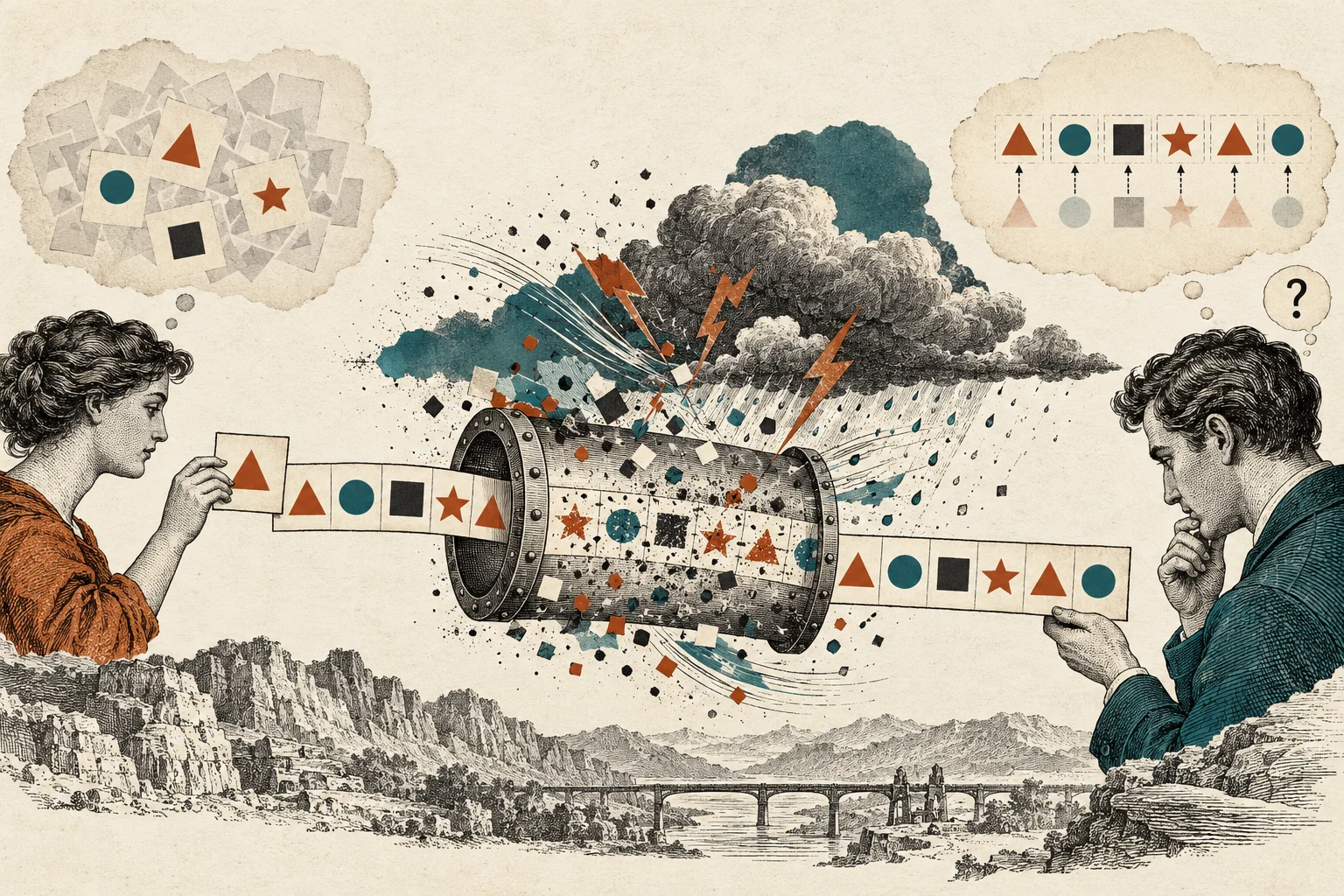
A message passes through a noisy channel; the diagram concerns signal transmission and recovery rather than the truth or meaning of its content.
AI-assisted illustration · conceptual metaphor View in visual quiz →Genesis and Global Lineage
Claude E. Shannon unveiled the theory in a two-part paper, A Mathematical Theory of Communication, in the Bell System Technical Journal (July and October 1948), solving a practical engineering problem at Bell Labs: how to measure how much a telegraph, telephone, or radio link can carry given a fixed bandwidth and noise floor. His immediate predecessors were Harry Nyquist (1924) and Ralph Hartley (1928), who already measured the “amount of information” logarithmically but without probability distributions; Shannon introduced a probabilistic source model, the entropy measure, and the fundamental coding theorems, drawing mathematically on statistical mechanics and Markov processes. In the same year, Norbert Wiener defined information in Cybernetics (1948) within the context of control and signal filtering. The 1949 book edition, featuring an introductory essay by Warren Weaver, stretched Shannon’s framework to questions of semantic meaning and communicative effectiveness—moves Shannon himself had carefully avoided—and from that moment the concept began a second life across linguistics, molecular biology, social science, and philosophy, often as a metaphor detached from any calculation. The technical lineage evolved differently: Andrey Kolmogorov (1965) shifted the focus from probability ensembles to the length of the shortest program that generates an individual object, while modern machine learning returned directly to Shannon via compression and cross-entropy loss.
Central European Lineage
The regional lineage here is formal and institutional rather than national. In §6 of Part I of his 1948 paper, Shannon remarks that the mathematical form of his function H = -\sum pi \log pi will be recognized by anyone familiar with statistical mechanics, pointing explicitly to “Boltzmann’s famous H theorem”—formulated by Ludwig Boltzmann, who studied and earned his doctorate at the University of Vienna (1866) and developed the H-theorem (1872) and the statistical definition of entropy (1877) between Graz and Vienna. Earlier, in 1929, Leó Szilárd—who began his engineering studies in Budapest before completing his doctorate in Berlin—analyzed Maxwell’s demon and demonstrated that acquiring one bit of information about a physical system carries an inescapable thermodynamic entropy cost, anticipating the link between information and entropy nineteen years before Shannon (though without documented influence on him). A well-known anecdote reported by Myron Tribus and Edward McIrvine (1971) holds that the very choice of the word “entropy” was suggested to Shannon at Princeton around 1940 by John von Neumann, educated at Budapest’s Lutheran Fasori Gymnasium and the University of Budapest, who joked that “nobody knows what entropy really is, so in a debate you will always have the advantage.” A later theoretical counterpoint came from Warsaw: Marian Mazur (1909–1983), an electrical engineer trained at the Warsaw University of Technology in interwar Poland and a leading figure of postwar Polish cybernetics, argued in Jakościowa teoria informacji (Qualitative Theory of Information, 1970) and Cybernetyka i charakter (1976) that Shannon had built a theory of signal quantity that says nothing about what information actually is, proposing instead a model of message transformations across a control loop.
Documented regional lineage · Links: 4. Compiled: October 2026.
-
documented influence 76 years
Central European Source: Ludwig Boltzmann, “Twierdzenie H (1872) i statystyczna definicja entropii (1877)”; Vienna, Austria-Hungary (now Austria); Graz, Austria, 1872
Global Circulation: information entropy H = −Σ p log p — Claude E. Shannon, 1948
-
anticipation 19 years
Central European Source: Leó Szilárd, “Über die Entropieverminderung in einem thermodynamischen System bei Eingriffen intelligenter Wesen”; Budapest, Hungary; Berlin, Germany, 1929
Global Circulation: information as a measurable quantity, the bit, and its link to entropy — Claude E. Shannon, 1948
-
documented influence 8 years
Central European Source: Rada, by Shannon nazwał swoją miarę „entropią” — John von Neumann; Budapest, Hungary; Princeton, USA, 1940
Global Circulation: the name “entropy” for the measure of uncertainty — Claude E. Shannon, 1948
-
counterpoint 22 years — regional source later than global formulation
Central European Source: Marian Mazur, “Jakościowa teoria informacji”; Warsaw, Poland, 1970
Global Circulation: quantitative information theory (entropy, amount of information) — Claude E. Shannon, 1948
documented influence
76 yearsLudwig Boltzmann, “Twierdzenie H (1872) i statystyczna definicja entropii (1877)”
1872 · Vienna, Austria-Hungary (now Austria); Graz, Austria
information entropy H = −Σ p log p
1948 · Claude E. Shannon
- Claim & Connection
- In Part I, §6 of “A Mathematical Theory of Communication,” Shannon notes that the form of his function H will be recognized as that of entropy in statistical mechanics, explicitly pointing out that H is the H of “Boltzmann’s famous H theorem.” Boltzmann studied and earned his doctorate in Vienna (1866) and formulated the H-theorem and the statistical definition of entropy in Graz and Vienna. The influence is indirect—mediated through statistical mechanics textbooks (Shannon cites Tolman)—but explicitly acknowledged by the author.
- Source Documentation
-
- primary source Claude E. Shannon, „A Mathematical Theory of Communication”, The Bell System Technical Journal, Vol. 27, July/October 1948, s. 379–423, 623–656 (przedruk z poprawkami); Part I, §6 “Choice, Uncertainty and Entropy,” paragraph following Theorem 2, footnote 8 (citing R. C. Tolman, Principles of Statistical Mechanics, 1938). people.math.harvard.edu ↗
- biographical record Ludwig Boltzmann, hasło w Wikipedii (en); Biography and Physics sections: studies and PhD in Vienna 1866, professorships in Graz 1869–1873 and 1876–1890, Vienna 1873–1876 and from 1894; H-theorem 1872, S = k log W 1877. en.wikipedia.org ↗
- Historical Context
- Dates: 1872 is the H-theorem, 1877 the statistical definition of entropy. The formula −Σ p log p was also popularized by J. Willard Gibbs (1878, outside the region); Shannon names only Boltzmann. Boltzmann’s Viennese formation is undisputed; the link concerns the mathematical formalism rather than the engineering concept of communication.
anticipation
19 yearsLeó Szilárd, “Über die Entropieverminderung in einem thermodynamischen System bei Eingriffen intelligenter Wesen”
1929 · Budapest, Hungary; Berlin, Germany
information as a measurable quantity, the bit, and its link to entropy
1948 · Claude E. Shannon
- Claim & Connection
- Analyzing Maxwell’s demon in 1929, Szilárd demonstrated that acquiring information about the state of a physical system carries an entropy cost of its own, writing down the first quantitative relation linking information and entropy—nineteen years before Shannon. Szilárd began his engineering studies at the Technical University of Budapest (1916), though he completed his doctorate and conducted this research in Berlin; no evidence has been found that Shannon drew on Szilárd’s paper.
- Source Documentation
-
- scholarly study Leo Szilard, hasło w Wikipedii (en); Early life and Berlin sections: studies in Budapest from 1916, Berlin from 1919; article details: Zeitschrift für Physik, Vol. 53, Nos. 11–12, 1929, pp. 840–856. en.wikipedia.org ↗
- scholarly study Entropy in thermodynamics and information theory, hasło w Wikipedii (en); paragraph on the 1929 thought experiment and citation to Szilárd. en.wikipedia.org ↗
- Historical Context
- Borderline regional formation: university studies begun in Budapest and completed in Berlin, where the paper was written. A reviewer should inspect the primary article (DOI 10.1007/BF01341281) and judge whether the formation rule is satisfied.
documented influence
8 yearsRada, by Shannon nazwał swoją miarę „entropią” — John von Neumann
1940 · Budapest, Hungary; Princeton, USA
the name “entropy” for the measure of uncertainty
1948 · Claude E. Shannon
- Claim & Connection
- According to an account reported by Tribus and McIrvine (1971), it was John von Neumann—an alumnus of Budapest’s Fasori Gymnasium and a mathematics PhD from the University of Budapest (1926)—who advised Shannon to call his uncertainty function “entropy,” partly because the function was already known in statistical mechanics and partly because “nobody knows what entropy really is, so in a debate you will always have the advantage.” This is a secondhand anecdote rather than a contemporaneous document; Wikipedia dates the conversation to 1939, though Shannon was at the Institute for Advanced Study in Princeton in 1940–1941, so the year field is approximate.
- Source Documentation
-
- scholarly study History of entropy, hasło w Wikipedii (en), sekcja Information theory, z odesłaniem do: M. Tribus, E. C. McIrvine, „Energy and Information”, Scientific American, September 1971; Information theory section. en.wikipedia.org ↗
- biographical record John von Neumann, hasło w Wikipedii (en); Education section: Fasori Evangélikus Gimnázium from 1914, PhD in mathematics in Budapest 1926, ETH Zurich 1926. en.wikipedia.org ↗
- Historical Context
- Secondhand transmission. A reviewer should check Tribus and McIrvine (Scientific American 225, no. 3, 1971) to verify whether the anecdote is reported there as a direct recollection from Shannon. Until then, the link remains labeled as an anecdote.
counterpoint
22 years — regional source later than global formulationMarian Mazur, “Jakościowa teoria informacji”
1970 · Warsaw, Poland
quantitative information theory (entropy, amount of information)
1948 · Claude E. Shannon
- Claim & Connection
- Mazur, an electrical engineer trained at the Warsaw University of Technology (1934) who worked at the State Telecommunications Institute and later the Polish Academy of Sciences, argued that Shannon’s “quantitative information theory,” centered on the “amount of information,” deliberately ignores message content; in response, Mazur built his own “qualitative theory of information,” defining information as a transformation between messages within a control loop. He laid it out in his 1970 book (WNT; Russian translation 1974, French 1976) and summarized it in the “Information” chapter of “Cybernetyka i charakter” (1976), where he directly contrasts his approach with Shannon’s.
- Source Documentation
-
- primary source Marian Mazur, „Cybernetyka i charakter”, PIW, Warszawa 1976, rozdz. 7 „Informacja” (wersja elektroniczna autonom.edu.pl); Ch. 7: Shannon as creator of the classical theory who “stipulated that his theory does not concern the content of messages”; “it is a quantitative theory of information, its fundamental concept is the ‘amount of information’”; footnote 2 cites “Jakościowa teoria informacji,” Warsaw 1970. autonom.edu.pl ↗
- bibliographic record Biblioteka Narodowa, rekord: Marian Mazur, „Jakościowa teoria informacji”, Wydawnictwa Naukowo-Techniczne, Warszawa 1970, 223 s.; przekład rosyjski „Kačestvennaâ teoriâ informacii”, Mir, Moskva 1974; author/title catalog search result. data.bn.org.pl ↗
- biographical record Marian Mazur (naukowiec), hasło w Wikipedii (pl); biography: Warsaw University of Technology 1934, PIT 1935–1939, Institute of Electrical Engineering 1948–1967, PAN 1967–1979; bibliography. pl.wikipedia.org ↗
- Historical Context
- The 1970 book is available online only as an unsearchable scan; the direct comparison with Shannon was verified in the 1976 chapter. Mazur also wrote the foreword to the Polish edition of John R. Pierce’s book (PWN 1967). Reception of Mazur’s theory outside Poland was minimal; it represents a local counterpoint rather than a revision adopted by the global discipline.
Why Now
Two developments between 2018 and 2026 brought Shannon’s apparatus back to center stage: large language models and the physics of computation. Since 2018 frontier language models have been trained by minimizing cross-entropy loss, with performance reported in bits per token (or perplexity); empirical scaling laws (Jared Kaplan et al., 2020; Jordan Hoffmann et al., 2022) are essentially curves plotting how closely a neural network approaches the intrinsic entropy of natural language as compute budgets grow. The thesis that “compression is intelligence,” going back to Ray Solomonoff, has returned as a live research program, and the debate over whether a model that predicts the next token with low entropy “understands” the world is a replay of Weaver versus Shannon in modern dress. At the same time, the surging energy footprint of data centers has turned Landauer’s principle (1961) from a theoretical curiosity into an engineering horizon, while laboratory experiments with single-bit information engines in the 2010s and early 2020s physically confirmed Szilárd’s 1929 thought experiment. Meanwhile, public debates over “information overload” and disinformation lean on the everyday sense of the word, even as attention-economy recommendation engines optimize measurable information-theoretic quantities.
Explanatory Power
The concept separates what can be transmitted from what is worth transmitting—and proves that the former obeys hard bounds independent of hardware. First, it explains linguistic redundancy: written English is roughly 50 percent redundant, which is why we can read text riddled with typos and why lossless ZIP compression works; Shannon estimated the entropy of English experimentally by asking human subjects to guess successive letters in a passage. Second, it explains why the genetic code, cellular networks, and hard drives all rely on error-correcting codes: the noisy-channel coding theorem proves that arbitrarily reliable transmission is achievable at any rate below channel capacity, and impossible above it, at the price of coding delay. Third, it provides a general measure of statistical dependence that assumes no linearity—mutual information—used everywhere from computational neuroscience to side-channel leak detection. Finally, it shows why “more data” does not mean “more information”: if incoming data are highly predictable, they carry almost zero bits of surprise, explaining why billions of repetitive social-media posts do not shift a well-calibrated observer’s beliefs.
Axes of Debate
Does information theory have anything to say about meaning
Warren Weaver (1949), Yehoshua Bar-Hillel and Rudolf Carnap (1952) with their semantic theory of information, and today Luciano Floridi and several philosophers of mind argue that Shannon’s syntactic measure is merely “Level A,” above which semantic and pragmatic theories must be erected; in Poland, Marian Mazur went further, treating the omission of content as a foundational design flaw. Strongest counterargument: Shannon explicitly stated that “semantic aspects of communication are irrelevant to the engineering problem,” and it is precisely this ruthless abstraction that gives the theory its mathematical theorems; any proposed “semantic” theory of information must first specify what invariant it measures before borrowing the prestige of Shannon’s word. Nature of the dispute: mixed — part is a substantive formal problem of how to model semantic content, part is a struggle over ownership of the word “information.”
Thermodynamic entropy versus information entropy: identity or formal analogy
Edwin T. Jaynes (1957) and the maximum-entropy school treat thermodynamic entropy as a direct application of Shannon’s measure—quantifying the observer’s ignorance of a system’s microstate—whereas “objectivist” statistical physicists regard this as a category mistake that confuses epistemology with physical reality. Strongest counterargument: Rolf Landauer and Charles Bennett demonstrated that erasing a single bit of information dissipates at least kB T \ln 2 of heat into the environment, proving the connection is physical rather than merely formal: Maxwell’s demon in Szilárd’s 1929 formulation pays a real thermodynamic price for its bit. Nature of the dispute: substantive — both camps agree on the equations, but they diverge over the physical interpretation of probability.
Is Shannon entropy the right measure for learning and cognition
Proponents of Kolmogorov complexity and minimum description length (Jorma Rissanen) point out that Shannon entropy requires a known probability distribution over an ensemble, which we rarely possess in practice, whereas science and cognition care about the internal structure of an individual object rather than an ensemble average. Strongest counterargument: Kolmogorov complexity is mathematically uncomputable, and in practice every empirical approximation falls back on real-world compression algorithms built directly on Shannon’s principles; for stationary ergodic sources, the two measures converge. Nature of the dispute: substantive — a productive methodological divide with well-understood boundaries on each side.
Underappreciated Angle
The least appreciated aspect of information theory is that its crowning achievements are impossibility theorems. Popular accounts remember the bit and entropy, forgetting that Shannon’s deepest results state what cannot be done: you cannot compress a source losslessly below its entropy, you cannot transmit reliably above channel capacity, and you cannot simultaneously achieve lower rate and lower distortion than the rate–distortion curve permits. That makes information theory one of the rare scientific frameworks that is socially useful primarily by saying “no”: every pitch for hundred-fold “lossless” video compression, zero-latency error-free wireless links, or an AI pipeline that extracts more signal from a dataset than the data contain can be dismissed without inspecting the code. Mazur was right that Shannon’s theory refuses to say what information means—yet it is precisely because of that refusal that it can state with mathematical certainty how much information is not there.
One-Sentence Takeaway
Information in Shannon’s sense says nothing about what a message means—it measures only how much uncertainty has been removed, and for that very reason it sets hard mathematical limits that no content can ever bypass.
Related Concepts Network
How this concept reinforces, constrains, or complements other analytical frameworks in the corpus. View on graph →
-
Free energy principle complements
Karl Friston transplants Shannon entropy and surprise from the communication channel to the living organism, which minimizes the surprise of its own sensory states.
-
Predictive processing complements
As a predictive coder, the brain passes upward only prediction errors—applying the very compression strategy Shannon described for redundant sources.
-
Applied Bayesianism reinforces
Entropy and Kullback–Leibler divergence measure how much an observation actually shifts a probability distribution, quantifying the information carried by evidence.
-
Scaling laws complements
Training loss in large language models is measured in bits per token; scaling curves track how closely a model approaches the intrinsic entropy of language as compute grows.
-
The map is not the territory in tension
Shannon deliberately excluded meaning from his theory, so “information” in bits is not the same as information in the sense of knowledge about the world—conflating the two is a pervasive error.
-
Complexity science complements
Complexity measures (Kolmogorov complexity, logical depth, mutual information) grow out of Shannon’s apparatus while trying to capture what pure entropy cannot distinguish: structure versus random noise.
-
Systems thinking reinforces
Information as a control signal inside a feedback loop forms the shared foundation of Wiener’s cybernetics and later system dynamics.
Reading Canon & Translation Bridge
Foundational texts, introductions, and critical perspectives—with availability of English and Polish editions.
-
foundational text 1948 · English
Claude E. Shannon, A Mathematical Theory of Communication
The foundational two-part paper in the “Bell System Technical Journal”: source entropy, channel capacity, and the coding theorems—accessible to anyone with a grasp of basic probability.
In English: original text written in English
In Polish: Polish edition not verified
-
foundational text 1949 · English
Claude E. Shannon, Warren Weaver, The Mathematical Theory of Communication
The 1949 book edition (University of Illinois Press) pairing Shannon’s paper with Warren Weaver’s introductory essay, which stretched the theory toward questions of meaning and effectiveness—the source of both its massive popularity and later misunderstandings.
In English: original text written in English
In Polish: Polish edition not verified
-
introduction & synthesis 1961 · English
John R. Pierce, Symbols, Signals and Noise: The Nature and Process of Communication
The finest non-technical introduction, written by a Bell Labs colleague of Shannon; the 1967 Polish edition in the “Biblioteka Problemów” series features a foreword by Marian Mazur.
In English: original text written in English
In Polish: “Symbole, sygnały i szumy. Wprowadzenie do teorii informacji”, Państwowe Wydawnictwo Naukowe 1967, trans. Jerzy Mieścicki, Roger Gomulicki
-
introduction & synthesis 2011 · English
James Gleick, The Information: A History, a Theory, a Flood
A sweeping intellectual history from African talking drums and Charles Babbage to Shannon and Kolmogorov; the best literary synthesis that refuses to reduce the mathematics to vague metaphor.
In English: original text written in English
In Polish: “Informacja. Bit, wszechświat, rewolucja”, Wydawnictwo Znak 2012, trans. Grzegorz Siwek
-
cross-disciplinary 1948 · English
Norbert Wiener, Cybernetics: Or Control and Communication in the Animal and the Machine
A parallel formulation of information as a statistical measure (with the opposite sign) in the context of control and feedback, launching the cybernetic tradition within which Mazur later wrote.
In English: original text written in English
In Polish: “Cybernetyka, czyli sterowanie i komunikacja w zwierzęciu i maszynie”, Państwowe Wydawnictwo Naukowe 1971, trans. Jerzy Mieścicki
-
critical perspective 1970 · Polish
Marian Mazur, Jakościowa teoria informacji
A Polish attempt to build a theory of information as message transformation rather than quantity; highlights what Shannon’s theory deliberately brackets out, even though Mazur’s own model gained little international traction.
In English: English edition not verified
In Polish: original text written in Polish
-
introduction & synthesis 1991 · English
Thomas M. Cover, Joy A. Thomas, Elements of Information Theory
The standard graduate textbook: from entropy and mutual information to Kolmogorov complexity and portfolio theory, for readers ready for formal proofs.
In English: original text written in English
In Polish: Polish edition not verified
Primary-Source Quotes
H is then, for example, the H in Boltzmann’s famous H theorem.