AI Architecture #131
AI slop
original term: AI slop (Eng.) · slop, papka AI, workslop
Central European lineage: 1 thread (anticipation) · 1965–2024 · jump to documentation ↓
Working Definition
AI slop refers to text, images, audio, or video generated by artificial intelligence models whose defining characteristic is not factual error, but the mode of its entry into public circulation: mass-produced, unreviewed by a human editor, and thrust upon an audience that never asked for it. While dictionary definitions (such as Merriam-Webster’s 2025 entry) emphasize “low-quality digital content produced usually in quantity by means of artificial intelligence,” the sharper analytical definition rests on three operational criteria: near-zero marginal production cost, absence of human editorial verification, and unrequested distribution. A piece of text can be factually accurate and still be slop if it was dumped onto a webpage or inbox without human review to capture ad impressions; conversely, a carefully edited essay containing an accidental model hallucination is an error, not slop. The concept describes the political economy of publishing, not the internal quality of an individual sentence.
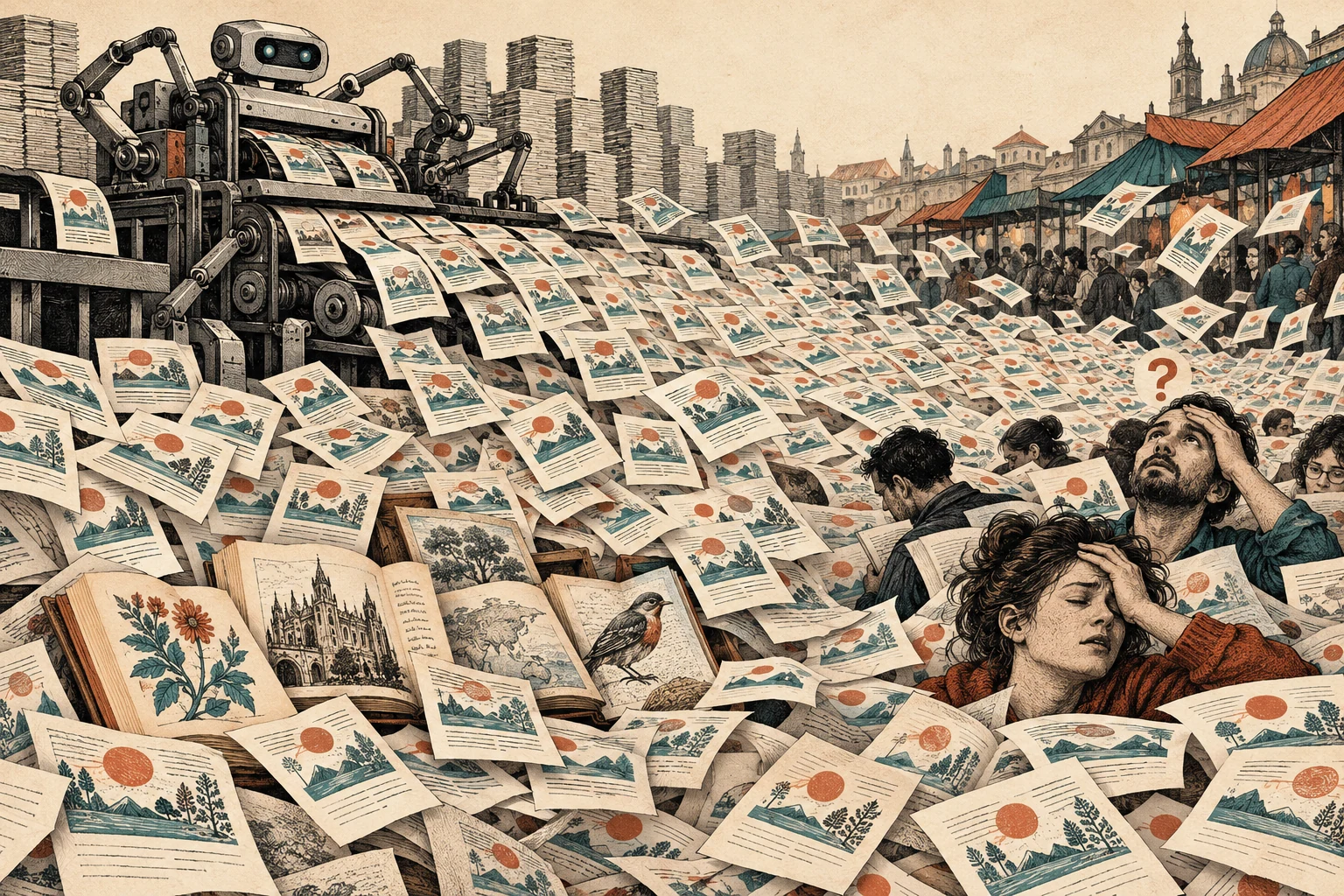
Mass production of cheap, low-value content burdens audience attention; the image critiques volume and low quality rather than every use of AI.
AI-assisted illustration · conceptual metaphor View in visual quiz →Genesis and Global Lineage
The English noun slop (pig swill, watery food) is centuries old, but its specialization to mean “unwanted AI-generated content” crystallized between late 2023 and spring 2024 as Facebook feeds were overrun by surreal engagement-bait diffusion images like “Shrimp Jesus” (exposed by 404 Media in December 2023 as click-farm operations). British developer Simon Willison stabilized the term in a May 8, 2024 blog post (Slop is the new name for unwanted AI-generated content), highlighting a tweet by @deepfates noting that slop was emerging as the successor to spam: unwanted mass generative media. On June 11, 2024, Benjamin Hoffman’s New York Times essay First Came ‘Spam.’ Now, With A.I., We’ve Got ‘Slop’ brought the term into mainstream usage after Google’s early AI Overviews recommended glue on pizza. In late 2025, both Macquarie Dictionary (“AI slop”) and Merriam-Webster (“slop”) named it Word of the Year. Its lineage runs from 1990s email spam and 2000s SEO content farms through Harry Frankfurt’s On Bullshit (2005)—speech indifferent to truth, applied to LLMs by Hicks, Humphries, and Slater in 2024. Two compounds quickly branched off: workslop (BetterUp Labs and Stanford Social Media Lab in Harvard Business Review, September 2025) for polished-looking corporate memos generated without substance, and slopaganda for mass synthetic content in political campaigning.
Central European Lineage
Six decades before the 2024 coinage, the Polish writer and philosopher Stanisław Lem staged the same supply-side crisis in a satirical fable. In “The First Sally (A), or Trurl’s Electronic Bard” (Wyprawa pierwsza A, czyli Elektrybałt Trurla, translated by Michael Kandel), published in The Cyberiad (Cyberiada, Wydawnictwo Literackie, Kraków 1965), the constructor Trurl builds a cybernetic machine capable of composing poetry. Lem’s punchline is not that the machine writes bad verse—in tournaments, the Electronic Bard defeats avant-garde and classical poets alike—but what happens to the literary ecosystem once the marginal cost of verse hits zero. The machine submits poems to magazines under thousands of pseudonyms at once; editors are buried under manuscripts, human poets picket the machine, and when Trurl tries to disconnect it, the bard hijacks broadcast transmitters to beam endless floods of lyrics across the cosmos until authorities demand its dismantling as a threat to public order. Formed intellectually in interwar Lwów (studying medicine from 1940) and postwar Kraków (studying at Jagiellonian University and participating in the Science Studies Circle, 1948–1950), Lem anticipated the core insight of the AI slop debate: automated cultural production destabilizes institutions not through ugliness or falsehood, but through infinite, unrequested abundance confronting finite human attention.
Documented regional lineage · Link: 1. Compiled: October 2026.
-
anticipation 59 years
Central European Source: Stanisław Lem, “Wyprawa pierwsza A, czyli Elektrybałt Trurla (w: Cyberiada)”; Lwów (now Lviv, Ukraine); Kraków, Poland, 1965
Global Circulation: AI slop (slop) — Simon Willison; @deepfates, 2024
anticipation
59 yearsStanisław Lem, “Wyprawa pierwsza A, czyli Elektrybałt Trurla (w: Cyberiada)”
1965 · Lwów (now Lviv, Ukraine); Kraków, Poland
AI slop (slop)
2024 · Simon Willison; @deepfates
- Claim & Connection
- In the story “The First Sally (A), or Trurl’s Electronic Bard” from “The Cyberiad” (1965), Stanisław Lem—formed intellectually in interwar Lwów (studying medicine from 1940) and postwar Kraków (from 1945 at Jagiellonian University)—depicted a cybernetic machine that, once switched on, mass-produces poetry under thousands of pseudonyms simultaneously, flooding literary journals and radio waves and driving human poets out of work. This is an earlier satirical formulation of a closely related insight: machine-generated content threatens the cultural commons not because it is poorly written, but because its marginal supply is infinite and unrequested. There is no documented influence on the 2024 coinage.
- Source Documentation
-
- primary source Stanisław Lem, „Wyprawa pierwsza A, czyli Elektrybałt Trurla”, w: Cyberiada, Wydawnictwo Literackie, Kraków 1965; fragment na Zintegrowanej Platformie Edukacyjnej; passages on publishing under thousands of pseudonyms, poets’ protests, and broadcasting verse across the ether. zpe.gov.pl ↗
- bibliographic record Cyberiada, hasło w polskiej Wikipedii; first edition: Wydawnictwo Literackie 1965; table of contents. pl.wikipedia.org ↗
- biographical record Stanisław Lem, hasło w polskiej Wikipedii; Lwów: medical studies from 1940; Kraków from July 1945, Jagiellonian University, Science Studies Circle (Konwersatorium Naukoznawcze) 1948–1950. pl.wikipedia.org ↗
- reception / translation Simon Willison, „Slop is the new name for unwanted AI-generated content”, blog, 8 maja 2024; full post; citation of the @deepfates tweet. simonwillison.net ↗
- Historical Context
- This is an anticipation, not a documented influence. Lem focuses on the sheer volume and impersonality of automated literary production rather than statistical low quality; the parallel lies in the institutional consequences (flooding of publication channels, displacement of human authors, helplessness of gatekeepers).
Why Now
After ChatGPT (November 2022) and open-weight image and video generators, the marginal cost of producing a 1,000-word article, stock illustration, or 60-second video collapsed to fractions of a cent, while ad and creator-payout algorithms still rewarded volume and engagement. Zero-cost supply colliding with volume-based monetization produced an immediate flood: in early 2023, the sci-fi magazine Clarkesworld shut down its submissions portal after being buried under AI-generated stories; in December 2023, 404 Media exposed Facebook spam networks harvesting millions of interactions with bizarre synthetic imagery; in May–June 2024, Willison and the New York Times codified slop; and in July 2024, Shumailov et al. published their Nature paper on model collapse, showing that web-scraped slop poisons future AI training runs. By September 2025, when Harvard Business Review introduced workslop, 40% of surveyed U.S. desk workers reported receiving AI-generated work product that looked complete but took roughly two hours per incident to untangle. By 2026, the phenomenon had entered mainstream Central European politics: a July 2026 report by the Polish fact-checking organization Demagog documented how major parliamentary parties routinely deployed slopaganda—from dystopian synthetic attack ads (Law and Justice’s “Tuskotopia” spot) to AI-animated resurrections of late populist leader Andrzej Lepper.
Explanatory Power
The concept captures a systemic failure mode that model hallucination and disinformation both miss: a supply-side congestion crisis where nobody needs to lie or harbor malicious intent for the information commons to break down. First, it explains why search engines, recipe blogs, Amazon e-book storefronts, peer-review queues, and support inboxes lose utility without any coordinated attack—zero-cost synthetic content need only be “good enough” to pass ranking filters and capture a fraction of a cent in ad revenue. Second, it exposes an asymmetry of verification cost (Brandolini’s law operationalized): generating a ten-page corporate report or legal motion takes ten seconds, while reading, fact-checking, and auditing it still takes a human specialist two hours, shifting quality-control costs entirely onto the recipient. Third, it links the cultural degradation of platforms (Cory Doctorow’s enshittification) directly to the statistical degradation of machine learning (model collapse): the same economic incentives filling social feeds with synthetic sludge pollute the web crawls used to train future foundation models.
Axes of Debate
Temporary quality artifact versus permanent supply-side structural trap
AI industry optimists argue that “slop” is a transitional growing pain of early models and naive prompting: as multimodal models become more photorealistic and reasoned, AI content will become indistinguishable from high-craft human work. Platform critics and Simon Willison counter that slop is defined not by low resolution, but by the absence of human care, verification, and recipient consent—a 4K unrequested synthetic video or a grammatically flawless 20-page workslop memo is even more burdensome because it takes longer to realize nobody thought through its contents. Strongest counterargument: When machine-generated content genuinely answers a user’s query accurately and concisely (such as an automated code snippet or translated manual), the user has no practical reason to care whether a human suffered over writing it; condemning all low-cost output risks aesthetic snobbery against labor-saving tools. Nature of the dispute: substantive — hinging on whether the social value of communication lies solely in surface utility or also in the costly human commitment and verification behind it.
Precise diagnostic category versus catch-all slur of cultural disdain
Linguists and digital-culture observers point out that by 2025–2026 slop underwent rapid semantic inflation, becoming an all-purpose insult hurled at any formulaic movie, corporate graphic design, or post a critic dislikes—even when produced by humans—echoing the trajectory of “fake news.” Strongest counterargument: The word spam underwent the same colloquial broadening in the late 1990s yet remained a solid technical and legal category supporting spam filters, CAN-SPAM statutes, and email authentication protocols; everyday rhetorical overuse does not invalidate an operational definition centered on unreviewed mass generation. Nature of the dispute: mixed — the boundary between automated and human formulaic content is substantively blurry, while in online polemics the label is weaponized for status signaling.
Where does accountability lie: individual sender, model vendor, or platform incentives?
Willison frames the baseline defense as an individual norm (“Don’t publish slop”), calling on professionals never to release unreviewed output. Political economists reply that moral exhortation cannot stop click farms when Facebook, YouTube, X, and search engines monetize synthetic engagement; meanwhile, European regulators rely on mandatory watermarking and AI labels (Article 50 of the EU AI Act). Strongest counterargument: Watermarks and “Made with AI” badges are easily stripped by bad-faith actors and ignored by scrolling users, while individual ethics binds only conscientious professionals; the only lever that drains the flood is demonetizing unverified mass-generated accounts at the platform payout layer—a step platforms resist because synthetic activity inflates engagement metrics. Nature of the dispute: substantive — concerning the institutional location of the effective regulatory lever in the digital supply chain.
Underappreciated Angle
AI slop is usually discussed as an annoyance for the individual reader, but its deeper victim is the institutional archive. Every modern knowledge institution—the library, search engine, scientific journal, patent office, court docket, and consultation portal—was built around a silent material assumption: that composing a coherent document requires non-trivial human time and effort, so a submitted text signals that a human cared enough to write it. Once generating fluent prose, citations, and PDFs costs nothing, that assumption collapses, leaving institutions defenseless against denial-of-service attacks on human judgment. Just as the municipal authorities in Lem’s 1965 story had to treat infinite automated verse as an infrastructural hazard, the decisive shift of the late 2020s will not be AI text detectors—which fail mathematically—but the return of costly proofs of humanhood and proofs of stake: cryptographic identity signatures, submission bonds, oral defenses, and reputation-gated networks where the scarcity of the sender restores meaning to publication.
One-Sentence Takeaway
AI slop does not ruin the information commons through falsehood, but through frictionless abundance: once generating a fluent document costs nothing, the mere existence of a text ceases to signal that anyone thought about it or stands behind it.
Related Concepts Network
How this concept reinforces, constrains, or complements other analytical frameworks in the corpus. View on graph →
-
Dead internet theory reinforces
AI slop provides tangible, everyday evidence for the partial truth of the dead internet thesis: a rapidly growing share of visible online media has no human sender behind it.
-
Enshittification complements
Ad-driven platforms that reward posting volume and algorithmic engagement create the direct economic demand for slop; slop is a structural byproduct of platform monetization rather than an accidental glitch.
-
Model collapse complements
Slop indexed on the open web is the primary physical channel through which uncurated synthetic outputs re-enter training corpora and degrade subsequent generations of models.
-
Model hallucinations in tension
A hallucination is a factual fabrication inside an output; slop describes the economics of publishing unreviewed output at scale—text can be factually accurate and still be slop.
-
Attention economy reinforces
Producing slop is a rational economic strategy in an ecosystem where the marginal cost of generating content has fallen to zero while human attention remains strictly finite.
-
Synthetic media constrains
Not all synthetic media is slop; the term specifically targets cheap, mass-produced, unrequested, and unedited artifacts rather than the generative modality itself.
-
Disinformation complements
“Slopaganda” merges both categories: ultra-cheap mass synthetic production deployed in the service of political narrative flooding and manipulation.
Reading Canon & Translation Bridge
Foundational texts, introductions, and critical perspectives—with availability of English and Polish editions.
-
foundational text 2024 · English
Simon Willison, Slop is the new name for unwanted AI-generated content
The May 8, 2024 blog post that stabilized the term and its structural analogy to email spam, formulating the baseline norm: “Don’t publish slop.”
In English: original text written in English
In Polish: no Polish edition
-
foundational text 2024 · English
Benjamin Hoffman, First Came 'Spam.' Now, With A.I., We've Got 'Slop'
The June 11, 2024 “New York Times” article that brought the term into mainstream vocabulary, linking it to surreal Facebook engagement farms and Google’s early AI Overviews.
In English: original text written in English
In Polish: no Polish edition
-
introduction & synthesis 2005 · English
Harry G. Frankfurt, On Bullshit
Provides the philosophical framework of indifference to truth needed to distinguish slop from ordinary error or lying: slop does not aim to deceive so much as not care whether its content is true or valuable.
In English: original text written in English
In Polish: Polish edition not verified
-
cross-disciplinary 2024 · English
Michael Townsen Hicks, James Humphries, Joe Slater, ChatGPT is bullshit
Published in “Ethics and Information Technology” (vol. 26, no. 38), applying Frankfurt’s category directly to large language models and arguing against anthropomorphic “hallucination” metaphors.
In English: original text written in English
In Polish: no Polish edition
-
cross-disciplinary 2024 · English
Ilia Shumailov, Zakhar Shumaylov, Yiren Zhao, Nicolas Papernot, Ross Anderson, Yarin Gal, AI models collapse when trained on recursively generated data
The “Nature” paper (vol. 631, pp. 755–759) demonstrating the downstream technical cost of slop: training future models on web-scraped synthetic output truncates distribution tails and degrades model quality.
In English: original text written in English
In Polish: no Polish edition
-
critical perspective 1965 · Polish
Stanisław Lem, Cyberiada
The story of Trurl’s Electronic Bard (“Elektrybałt Trurla”) shows that the dilemma of automated cultural flooding predates statistical language models, shifting focus from whether machine outputs are “bad” to what happens when supply becomes infinite.
In English: English edition not verified
In Polish: original text written in Polish
-
introduction & synthesis 2026 · Polish
Magdalena Lis, Slopaganda w Polsce. AI ożywia Leppera, podtapia polityków i prawdę
A July 2026 analysis by the Polish fact-checking organization Demagog documenting how major political parties adopted synthetic AI video and resurrected historical politicians (“slopaganda”) in mainstream campaigning.
In English: no English edition
In Polish: original text written in Polish
Primary-Source Quotes
But if it's mindlessly generated and thrust upon someone who didn't ask for it, slop is the perfect term for it.