Ontology #200
Umwelt and autopoiesis
original term: Umwelt & autopoiesis (Ger.) · Umwelt (self-centered world), autopoiesis (self-production), operational closure
Central European lineage: 3 threads (author from the region, anticipation, documented influence) · 1909–1998 · jump to documentation ↓
Working Definition
Umwelt and autopoiesis (literally “self-production”) are two pillars of the philosophy of biology and cognitive science that explain how a living system differs from a non-living automaton and how meaning arises for it. Autopoiesis defines the internal organization of life: an autopoietic system (such as a living cell) is a network of metabolic processes that continually produces and repairs the components of which it consists while building a physical boundary (such as a cell membrane) that distinguishes it from its background. Umwelt defines the external, phenomenological dimension of this process: the subjective “self-centered world” carved out of the indifferent physical surroundings (Umgebung), composed exclusively of those signals and objects that matter to a given organism as food, obstacle, mate, or threat. Together, they show that cognition is not a passive copying of the world, but the active maintenance of one's own existence that establishes the boundary between what is significant and what is invisible.
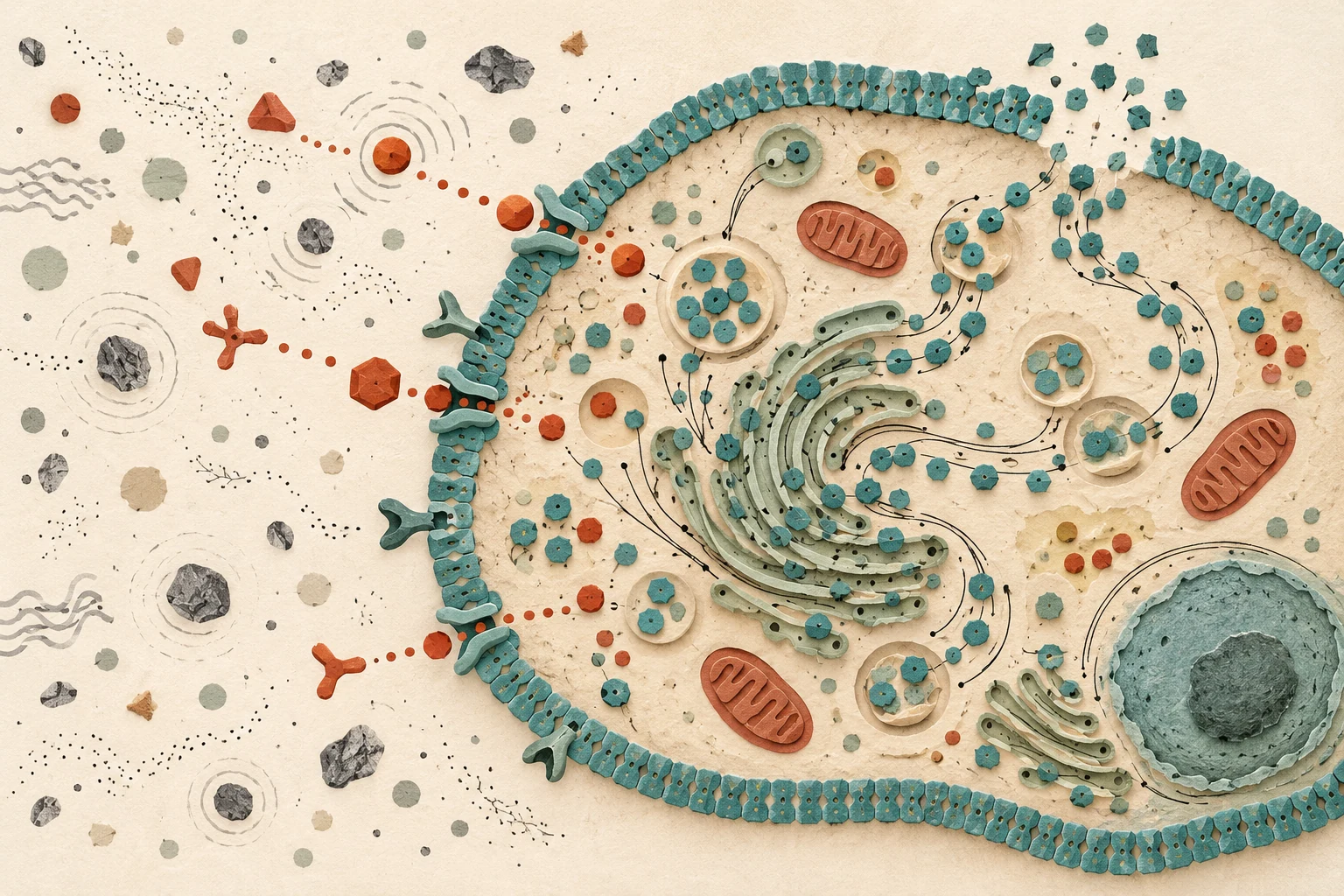
An internal loop replenishes the boundary that mediates exchange with the environment, while only cues relevant to this organism stand out from the background.
AI-assisted illustration · conceptual metaphor View in visual quiz →Genesis and Global Lineage
Baltic German biologist Jakob von Uexküll introduced the technical concept of Umwelt in his 1909 book Umwelt und Innenwelt der Tiere (and expanded it in A Foray into the Worlds of Animals and Humans, 1934). Rejecting mechanistic models that treated animals as mere reflex machines responding to physical stimuli, Uexküll described the “functional circle” (Funktionskreis) linking an animal's receptor and effector organs: every species inhabits its own perceptual bubble filled with species-specific carriers of meaning (for a tick, the world consists of three signals: the smell of mammalian butyric acid, a warmth of 37 degrees Celsius, and the texture of skin). Six decades later, in 1971–1972 in Santiago, Chile, neurobiologist Humberto Maturana and his student Francisco Varela coined the term autopoiesis (from Greek auto, “self,” and poiesis, “production”), published in De máquinas y seres vivos (1973; English ed. Autopoiesis and Cognition, 1980). In the late twentieth century, Evan Thompson, Ezequiel Di Paolo, and biosemioticians united the two traditions: because an autopoietic system must continually exchange energy with its surroundings to avoid disintegration, indifferent physical differences (such as a glucose gradient for a bacterium) are transformed into value-laden signs—that is, into an Umwelt.
Central European Lineage
The history of both concepts is deeply intertwined with two scientific centers of the region: Dorpat (present-day Tartu in Estonia) and Vienna. Jakob von Uexküll was born on the Keblas estate in Estonia and received his scientific formation at the Imperial University of Dorpat, where he studied zoology from 1884 to 1889. Dorpat was then the foremost bastion of European biological anti-mechanism, founded by the embryologist Karl Ernst von Baer; it was directly from Baer's concept of species-specific “subjective time” that Uexküll derived his theory of Umwelt. In the 1990s, this legacy was revived at the University of Tartu by the Tartu school of biosemiotics led by Kalevi Kull, who synthesized Uexküll's Dorpat tradition with the concept of the “semiosphere” (1984) developed in the same university town by semiotician Juri Lotman, making Tartu a world center of contemporary biosemiotics. Meanwhile, the direct precursor of autopoiesis in Central Europe was Viennese biologist Ludwig von Bertalanffy (who earned his doctorate at the University of Vienna in 1926). In his Theoretische Biologie (1932) and his 1940s papers on “flowing equilibrium” (Fließgleichgewicht), Bertalanffy defined the living organism as an open system that preserves the constancy of its form solely through the continual breakdown and self-regeneration of its constituent parts.
Documented regional lineage · Links: 3. Compiled: October 2026.
-
author from the region 0 years — same text on both sides
Central European Source: Jakob von Uexküll, “Umwelt und Innenwelt der Tiere”; Dorpat, Russian Empire (now Tartu, Estonia), 1909
Global Circulation: Umwelt (the organism's subjective world of meaning) — Jakob von Uexküll, 1909
-
anticipation 40 years
Central European Source: Ludwig von Bertalanffy, “Theoretische Biologie (t. I, 1932; t. II, 1942)”; Vienna, Austria, 1932
Global Circulation: autopoiesis (self-production and self-maintenance of living organization) — Humberto R. Maturana and Francisco J. Varela, 1972
-
documented influence 14 years
Central European Source: Jurij Łotman i Kalevi Kull (tartuska szkoła semiotyki i biosemiotyki), “O semiosferie (1984) oraz On Semiosis, Umwelt, and Semiosphere (1998)”; Tartu, Estonian SSR (now Estonia), 1984
Global Circulation: contemporary biosemiotics integrating Umwelt theory, semiosphere, and autopoiesis — Kalevi Kull, Jesper Hoffmeyer, Evan Thompson, 1998
author from the region
0 years — same text on both sidesJakob von Uexküll, “Umwelt und Innenwelt der Tiere”
1909 · Dorpat, Russian Empire (now Tartu, Estonia)
Umwelt (the organism's subjective world of meaning)
1909 · Jakob von Uexküll
- Claim & Connection
- Baltic German biologist Jakob von Uexküll, who coined the concept of Umwelt, received his scientific formation in Estonia, studying zoology at the University of Dorpat (now Tartu) from 1884 to 1889 within the anti-mechanistic biological tradition of Karl Ernst von Baer. In his 1909 book Umwelt und Innenwelt der Tiere, he introduced the distinction between the objective physical surroundings (Umgebung) and the species-specific world of meaning filtered through an organism's sensory and effector organs (Umwelt).
- Source Documentation
-
- primary source Jakob von Uexküll, „Umwelt und Innenwelt der Tiere”, Verlag von Julius Springer, Berlin 1909; Introduction: distinction between Umwelt and Umgebung. archive.org ↗
- biographical record Kalevi Kull, „Jakob von Uexküll: An introduction”, Semiotica, Vol. 134, No. 1/4, 2001, s. 1–59; studies in Dorpat/Tartu (1884–1889) and the influence of von Baer's Dorpat school of biology. doi.org ↗
anticipation
40 yearsLudwig von Bertalanffy, “Theoretische Biologie (t. I, 1932; t. II, 1942)”
1932 · Vienna, Austria
autopoiesis (self-production and self-maintenance of living organization)
1972 · Humberto R. Maturana and Francisco J. Varela
- Claim & Connection
- Viennese biologist and founder of general systems theory Ludwig von Bertalanffy—who earned his doctorate (1926) and habilitation (1934) at the University of Vienna—defined the living organism in Theoretische Biologie (1932/1942) as an open system maintaining a constant organization in “flowing equilibrium” (Fließgleichgewicht) through the continual breakdown and regeneration of its own components. This conception anticipated Maturana and Varela's formulation of autopoiesis (1972) by four decades.
- Source Documentation
-
- primary source Ludwig von Bertalanffy, „Theoretische Biologie”, t. I: Gebrüder Borntraeger, Berlin 1932; „Der Organismus als physikalisches System betrachtet”, Die Naturwissenschaften 28 (1940), s. 521–531; the organism as a self-maintaining system in flowing equilibrium (Fließgleichgewicht). doi.org ↗
- Historical Context
- Maturana and Varela added to Bertalanffy's thermodynamic account the topological and cognitive condition of “operational closure,” whereby the network produces its own physical boundary (membrane).
documented influence
14 yearsJurij Łotman i Kalevi Kull (tartuska szkoła semiotyki i biosemiotyki), “O semiosferie (1984) oraz On Semiosis, Umwelt, and Semiosphere (1998)”
1984 · Tartu, Estonian SSR (now Estonia)
contemporary biosemiotics integrating Umwelt theory, semiosphere, and autopoiesis
1998 · Kalevi Kull, Jesper Hoffmeyer, Evan Thompson
- Claim & Connection
- At the University of Tartu, Kalevi Kull and researchers at the Jakob von Uexküll Centre combined Uexküll's Dorpat theory of Umwelt with Juri Lotman's Tartu concept of the “semiosphere” (1984) and Maturana and Varela's theory of autopoiesis, bringing these concepts into the mainstream of contemporary biosemiotics and enactivism.
- Source Documentation
-
- reception / translation Kalevi Kull, „On Semiosis, Umwelt, and Semiosphere”, Semiotica, Vol. 120, No. 3/4, 1998, s. 299–310; synthesis of Uexküll's Umwelt and Lotman's semiosphere in Tartu biosemiotics. doi.org ↗
Why Now
Between 2018 and 2026, Umwelt and autopoiesis experienced a major resurgence across three fields. First, in debates over whether large language models “understand” language (from Emily Bender and Alexander Koller's 2020 “octopus test” paper to the AI agency debates of 2023–2026), autopoiesis became the primary argument against attributing genuine agency or meaning to AI models. As enactivists (Evan Thompson, Tom Froese) point out, a language model is an allopoietic system: its weights do not decay when the power is switched off and the system does not struggle to maintain its own metabolic boundary, so the tokens it generates do not form a genuine Umwelt in which anything is existentially at stake for the system itself. Second, in ecology (popularized by Ed Yong's Pulitzer Prize-winning 2022 book An Immense World), researchers demonstrated that anthropogenic “sensory pollution”—artificial light at night, ocean noise, and electromagnetic smog—devastates wildlife populations not by poisoning their bodies, but by blinding their species-specific Umwelten. Third, in theoretical neurobiology, Karl Friston mathematically formalized the boundary of an autopoietic system using the “Markov blanket” and the free energy principle.
Explanatory Power
Pairing Umwelt and autopoiesis resolves the classic philosophical impasse between naive realism (“the senses copy the world as it is”) and relativism (“everything is a subjective projection”). In the same meadow, an oak tree is a different object in the Umwelt of a forester (measuring timber volume), an owl (seeking a nesting cavity), a bark beetle (boring galleries beneath the bark), and an ant. None of these worlds is a hallucination—each is an objective cross-section through the real properties of the oak, selected for the autopoietic survival of a given species. Transferred by Niklas Luhmann into sociology, the pairing also explains why the subsystems of modern society—law, the economy, science, politics—are so deaf to mutual moral appeals. Each operates like an operationally closed autopoietic system that registers its environment exclusively through the binary code of its own Umwelt: the economy registers an ecological catastrophe only when it is translated into prices and payments, and the legal system only when it takes the form of the distinction between lawful and unlawful.
Axes of Debate
Biological constructivism and operational closure vs. ecological realism (Gibson)
Proponents of James J. Gibson's ecological psychology and epistemological realists charge Uexküll and Maturana with locking the organism inside the “soap bubble” of an Umwelt and a closed nervous system, cutting the subject off from direct contact with reality and lapsing into species-level solipsism. Strongest counterargument: Enactivists (Varela, Thompson, Di Paolo) reply that operational closure does not mean isolation, but “structural coupling”: an Umwelt and Gibsonian affordances are not mental pictures inside a head, but relational properties emerging at the interface between an organism's body and the resistance of the environment. Nature of the dispute: substantive — concerns whether information exists in the environment ready-made prior to an observer, or is co-constituted by the organism's activity.
Sociological autopoiesis of systems (Luhmann) vs. human agency (Maturana, Habermas)
Humberto Maturana himself (and from a different angle Jürgen Habermas) objected to Niklas Luhmann's transfer of autopoiesis to social systems; Maturana argued that making impersonal “communication” the autopoietic unit, for which living human beings are merely an external environment, erases the biological and ethical agency of individuals. Strongest counterargument: Defenders of Luhmann's systems theory point out that treating financial markets, bureaucracies, and legal systems as self-reproducing communication machines is not an apology for them, but a precise diagnosis explaining why institutions reproduce their own procedures even against the will of the people who staff them. Nature of the dispute: mixed — combines a dispute over the limits of conceptual transfer from biology to sociology with a normative dispute over the place of the human subject in social theory.
Life–mind continuity vs. computational functionalism in AI
Functionalists in the philosophy of mind and AI researchers maintain that cognition and possessing a “world model” are substrate-independent: a silicon agent processing data streams in a robot or simulator has its own functional Umwelt, even without cellular metabolism. Strongest counterargument: Biosemioticians and strong enactivists argue that without autopoiesis—that is, without a precarious, self-producing body whose existence depends at every second on its own activity—a computational system has no intrinsic normativity, and its “goals” exist only in the eye of its human designer. Nature of the dispute: substantive — marks the primary dividing line in cognitive science between the computational paradigm and the embodied, autopoietic paradigm.
Underappreciated Angle
Although Umwelt theory is associated today with empathetic ecology, its twentieth-century political history is far more ambivalent. In the 1920s and 1930s, Uexküll's writings exerted a profound influence on Martin Heidegger (who in his 1929–1930 lectures contrasted the animal as “poor in world” with the human as “world-forming”), as well as on Ernst Cassirer, Maurice Merleau-Ponty, and Gilles Deleuze. At the same time, in his book Staatsbiologie (1920/1933), Uexküll himself attempted to apply organismic biology to the theory of the state as a living organism threatened by “parasites” and “pathogens,” even while rejecting Darwinian competition and Nazi genetic racial determinism. This duality offers an important warning: concepts that describe an organism as an operationally closed whole brilliantly illuminate the biology of cells and senses, but when used as a literal blueprint for a political community, they easily turn into an instrument for excluding whatever does not fit the group's "natural Umwelt."
One-Sentence Takeaway
A living organism does not inhabit a ready-made world like furniture in a room—by keeping itself alive, at every second it carves out of the noise of the universe the exact world it can sustain through its senses and action.
Related Concepts Network
How this concept reinforces, constrains, or complements other analytical frameworks in the corpus. View on graph →
-
Enactivism reinforces
Francisco Varela and Evan Thompson's enactivism is a direct extension of both concepts: through its action, an autopoietic organism co-creates (enacts) its own meaningful Umwelt.
-
Free energy principle complements
Karl Friston's concept of the Markov blanket provides a contemporary probabilistic formalization of the boundary separating a self-maintaining autopoietic system from its environment.
-
Ontological turn complements
The concept of Umwelt supplies a biological foundation for the ontological turn's thesis that different species and collectives do not merely hold different “views” on the same world, but inhabit differently carved perceptual worlds.
-
Systems thinking complements
Autopoiesis introduces into systems theory the distinction between allopoietic systems (such as a factory producing cars) and autopoietic systems, whose sole product is themselves.
-
Digital semiotics complements
Extending Uexküll's biosemiotics to algorithmic environments makes it possible to examine how sensors, tokenizers, and objective functions define the artificial “Umwelt” of computational models.
-
Posthumanism reinforces
Both concepts dethrone anthropocentrism by showing that the human sensory world is only one of millions of co-existing perceptual bubbles in the biosphere, and that agency begins at the level of the single cell.
-
Metamodernism complements
Efforts to move beyond the sterile impasse between naive realism and radical constructivism find support in biosemiotics, where the subjective world (Umwelt) is simultaneously relationally constructed and biologically grounded.
Reading Canon & Translation Bridge
Foundational texts, introductions, and critical perspectives—with availability of English and Polish editions.
-
foundational text 1934 · German
Jakob von Uexküll, Streifzüge durch die Umwelten von Tieren und Menschen: Ein Bilderbuch unsichtbarer Welten
The most famous, richly illustrated exposition of Umwelt theory, opening with the classic analysis of the tick's world reduced to three sensory signals: the smell of butyric acid, a temperature of 37 degrees Celsius, and the texture of skin.
In English: “A Foray into the Worlds of Animals and Humans: with A Theory of Meaning”, University of Minnesota Press 2010, trans. Joseph D. O'Neil
In Polish: “Przechadzki po światach zwierząt i ludzi. Książka z obrazkami z niewidzialnych światów (w: „Koncepcja Umweltu Jakoba von Uexkülla”)”, Wydawnictwo Uniwersytetu Jagiellońskiego 2023, trans. Małgorzata Łukasiewicz
-
foundational text 1973 · Spanish
Humberto R. Maturana, Francisco J. Varela, De máquinas y seres vivos. Autopoiesis: la organización de lo vivo
The foundational text defining living organisms as autopoietic machines in which the processes of life and the processes of cognition are identical.
In English: “Autopoiesis and Cognition: The Realization of the Living”, D. Reidel Publishing Company 1980, trans. Humberto R. Maturana, Francisco J. Varela
In Polish: no Polish edition
-
introduction & synthesis 1984 · Spanish
Humberto R. Maturana, Francisco J. Varela, El árbol del conocimiento: Las bases biológicas del entendimiento humano
An accessible exposition of autopoiesis, structural coupling, and the biological roots of language written for a broad readership.
In English: “The Tree of Knowledge: The Biological Roots of Human Understanding”, Shambhala Publications 1987, trans. Robert Paolucci
In Polish: no Polish edition
-
introduction & synthesis 2022 · English
Ed Yong, An Immense World: How Animal Senses Reveal the Hidden Realms Around Us
A superb contemporary introduction to the concept of Umwelt grounded in recent discoveries in neuroethology—from echolocation and ultraviolet vision to magnetoreception and electroreception.
In English: original text written in English
In Polish: “Niezwykłe zmysły. Jak zwierzęta postrzegają świat”, Wydawnictwo Czarne 2023, trans. Magdalena Rabsztyn-Anioł
-
cross-disciplinary 1984 · German
Niklas Luhmann, Soziale Systeme. Grundriß einer allgemeinen Theorie
A monumental transfer of autopoiesis from biology to sociology: for Luhmann, law, the economy, and science are operationally closed autopoietic systems composed not of human beings, but of self-reproducing communications.
In English: “Social Systems”, Stanford University Press 1995, trans. John Bednarz Jr., Dirk Baecker
In Polish: “Systemy społeczne. Zarys ogólnej teorii”, Zakład Wydawniczy Nomos 2007, trans. Michał Kaczmarczyk
-
critical perspective 1990 · English
Danilo Zolo, The Epistemological Status of the Theory of Autopoiesis
An incisive epistemological critique demonstrating that Maturana's extreme thesis of nervous-system closure and the absence of an objective external reality collapses into biological solipsism and self-contradiction.
In English: original text written in English
In Polish: no Polish edition
Primary-Source Quotes
Jedes Subjekt spinnt seine Beziehungen wie die Fäden einer Spinne zu bestimmten Eigenschaften der Dinge und verwebt sie zu einem festen Netz, das sein Dasein trägt.
Every subject spins out, like the spider's threads, its relations to certain qualities of things and weaves them into a solid web, which carries its existence. (trans.: Joseph D. O'Neil (2010 English edition))