Culture & Power #140
Metamodernism
original term: metamodernism (Eng.) · wrażliwość metamodernistyczna, oscylacja metamodernistyczna, nowa szczerość
Central European lineage: 1 thread (anticipation) · 2007–2010 · jump to documentation ↓
Working Definition
Metamodernism names a contemporary cultural sensibility and artistic mode that refuses to choose between modern faith in grand narratives, progress, and sincerity on one hand, and postmodern irony, deconstruction, and detachment on the other—instead oscillating between both poles: committing earnestly while aware the commitment may be naive, and deploying irony without surrendering ethical hope. In the canonical formulation of Dutch scholars Timotheus Vermeulen and Robin van den Akker (2010), it is a “structure of feeling” that emerged after the 2008 financial crisis and climate anxiety, characterized by “informed naivety,” “pragmatic idealism,” and a Kantian “as-if” (als ob) attitude. In popular criticism, the term blurs into David Foster Wallace’s New Sincerity to mean warm-hearted art after cynicism, while in online political subcultures (following “Hanzi Freinacht”) it has been co-opted as a developmental ideology. Keeping these registers distinct is essential: the academic concept is a diagnostic description of cultural tension, whereas its offshoots are normative manifestos.
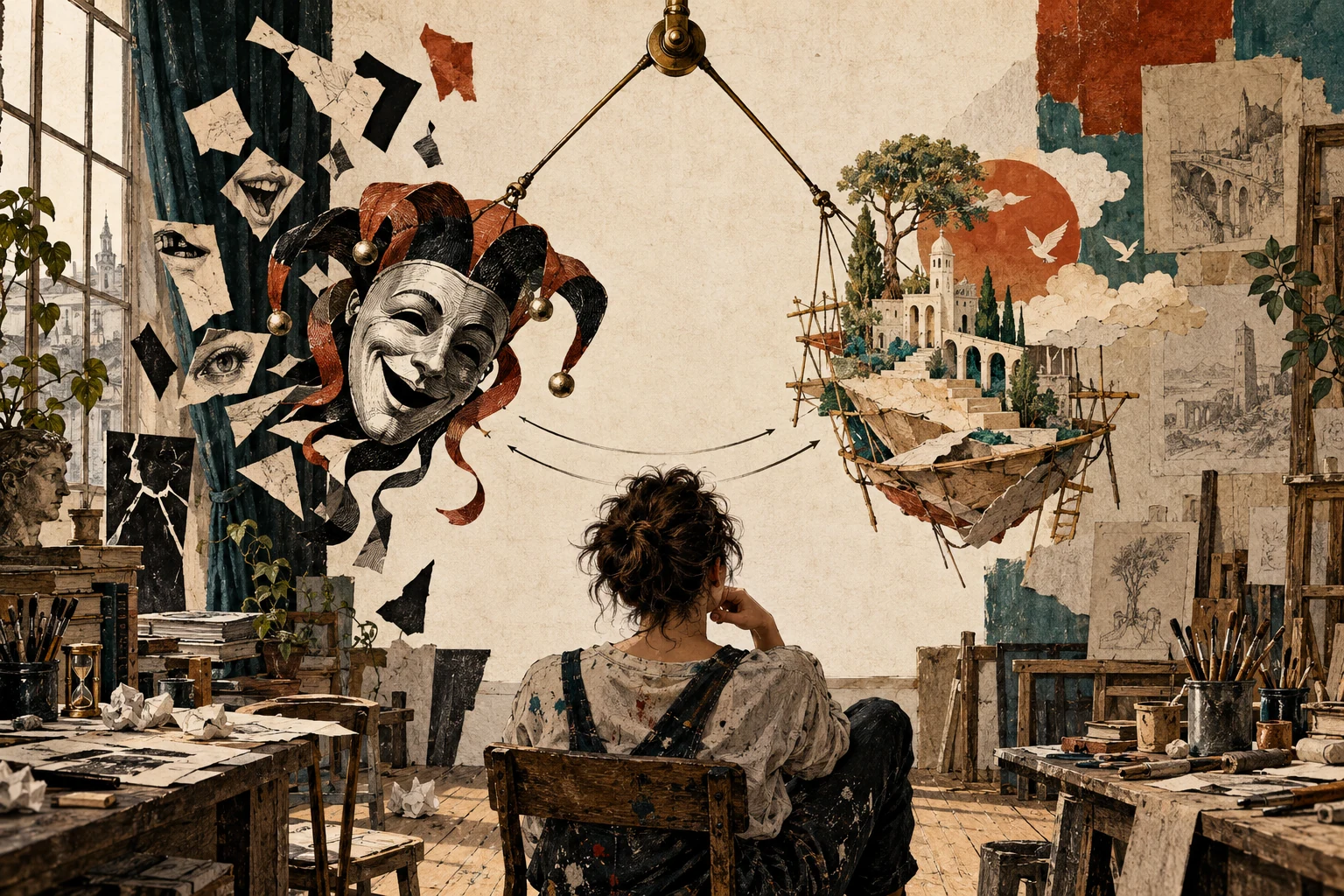
The pendulum swings between self-aware detachment and earnest commitment, keeping both stances in play without a final resolution.
AI-assisted illustration · conceptual metaphor View in visual quiz →Genesis and Global Lineage
The word metamodern surfaced sporadically across twentieth-century humanities—in Mas’ud Zavarzadeh (1975), Moyo Okediji (1999), and Andre Furlani (2002)—without forming a school. Its contemporary meaning was forged in 2010 by Dutch theorists Timotheus Vermeulen (Radboud University) and Robin van den Akker (Erasmus University) in Notes on metamodernism (Journal of Aesthetics & Culture). After competing post-postmodern labels failed to stick (altermodern, performatism, hypermodernity, digimodernism), Vermeulen and van den Akker anchored their diagnosis in the 2008 financial crash, climate anxiety, and a neo-romantic turn in art and cinema (Herzog & de Meuron, Bas Jan Ader, Wes Anderson, Miranda July). Drawing on Plato’s metaxy—movement “with,” “between,” and “beyond”—they defined metamodernism as a pendulum swinging between modern enthusiasm and postmodern irony. In 2017, with Alison Gibbons, they edited Metamodernism: Historicity, Affect and Depth after Postmodernism, overturning Fredric Jameson’s hallmarks of postmodernism (waning of affect, loss of historicity, depthlessness). Meanwhile, the term split into three tracks: Luke Turner’s performative Metamodernist Manifesto (2011, with Shia LaBeouf); the Nordic duo “Hanzi Freinacht” (The Listening Society, 2017), turning metamodernism into a stage theory adopted by Game B and metacrisis thinkers; and Jason Ānanda Josephson Storm’s Metamodernism: The Future of Theory (2021), proposing a post-deconstructive methodology for the humanities.
Central European Lineage
Years before Vermeulen and van den Akker’s 2010 essay, an independent conception of metamodernism was developed in Transylvania by Romanian literary scholar Alexandra Dumitrescu (now Alexandra Balm). Born in Cluj (Cluj-Napoca) in 1974 and educated at Babeș-Bolyai University (BA in English, MA in American Studies), Dumitrescu circulated research proposals on metamodernism in 2001 and published early essays in Cluj (Foretelling Metamodernity, Napoca Star, 2006; Caietele Echinox, 2009) and in Double Dialogues (Interconnections in Blakean and Metamodern Space, 2007) before completing her PhD at the University of Otago (2014). Whereas the Dutch school built its concept around pendulum oscillation, Dumitrescu’s Cluj-formed model defined metamodernism around integration, interconnectedness, and ethical self-revision—healing the fragmentation of both communist totalitarianism and postmodern relativism. Vermeulen and van den Akker cited Dumitrescu in their 2010/2012 note on prior usages while clarifying their model was independent. Recent comparative scholarship from Romania, Poland, and Ukraine—Arina-Mihaela Bărboiu (Caietele Echinox, Cluj 2024) and Mariia Varlygina (Przegląd Kulturoznawczy, Kraków 2024, alongside Jacek Kubera in Teksty Drugie, 2013, and the 2025 Polish translation in Kultura Współczesna)—shows how the region reads “sincerity after irony” through a distinct timeline: under state socialism before 1989, irony was an anti-totalitarian survival weapon against official state pathos, while in Ukraine after 2014 and 2022, existential sincerity was forged by war rather than the 2008 financial crash.
Documented regional lineage · Link: 1. Compiled: October 2026.
-
anticipation 3 years
Central European Source: Alexandra Dumitrescu, “Interconnections in Blakean and Metamodern Space”; Cluj (now Cluj-Napoca, Romania), 2007
Global Circulation: metamodernism as an oscillation between modern enthusiasm and postmodern irony (Notes on metamodernism) — Timotheus Vermeulen, Robin van den Akker, 2010
anticipation
3 yearsAlexandra Dumitrescu, “Interconnections in Blakean and Metamodern Space”
2007 · Cluj (now Cluj-Napoca, Romania)
metamodernism as an oscillation between modern enthusiasm and postmodern irony (Notes on metamodernism)
2010 · Timotheus Vermeulen, Robin van den Akker
- Claim & Connection
- Born in Cluj (Cluj-Napoca, Romania) in 1974 and educated at Babeș-Bolyai University in Cluj (earning her BA in English and MA in American Studies there), literary scholar Alexandra Dumitrescu began circulating research proposals on “metamodernism” as the cultural paradigm succeeding postmodernism in 2001, publishing “Foretelling Metamodernity” in Cluj (Napoca Star, 2006) and “Interconnections in Blakean and Metamodern Space” in the Australian journal “Double Dialogues” (2007), where she defined metamodernism around ethical integration, interconnectedness, and self-revision in place of postmodern fragmentation. This is an independent, earlier formulation of the term from a Central European starting point: Timotheus Vermeulen and Robin van den Akker explicitly cited her work in their July 2010/October 2012 note on prior usages while stating that their oscillation-based conception was not derived from hers.
- Source Documentation
-
- primary source Alexandra E. Dumitrescu, „What is Metamodernism and Why Bother? Meditations on Metamodernism as a Period Term and as a Mode”, electronic book review, 4 XII 2016; paragraph on her first 2001 research proposals; author’s bibliography citing Napoca Star (Cluj 2006), Double Dialogues 7 (2007), Caietele Echinox 17 (Cluj 2009), and her 2014 University of Otago doctoral thesis. electronicbookreview.com ↗
- biographical record New Zealand Society of Authors, biogram „Alexandra Balm” (Dumitrescu); paragraph 1: born 1974 in Cluj; BA English (Hons.) and MA American Studies, University of Cluj; PhD Otago 2014 (“Towards A Metamodern Literature”). authors.org.nz ↗
- reception / translation „Previous uses of the term metamodernism”, Notes on Metamodernism (metamodernism.com), 17 VII 2010 (akt. 17 X 2012); paragraph on literary studies citing “Alexandra Dimitrescu” [sic] and stating: “our conception of metamodernism is by no means aligned to these notions, nor is it derived from them”. metamodernism.com ↗
- scholarly study Arina-Mihaela Bărboiu, „Mapping Metamodernism from East to West”, Caietele Echinox, vol. 47, 2024, s. 323–332, DOI 10.24193/cechinox.2024.47.20; abstract and section “Early/Pre-2010 Uses”; systematic comparison of Dumitrescu’s integrative model with Vermeulen and van den Akker’s oscillation model; analysis of Romanian post-communist cultural space. caieteleechinox.lett.ubbcluj.ro ↗
- Historical Context
- Dumitrescu’s formative education and earliest publications (“Foretelling Metamodernity”, Napoca Star, Cluj 2006; “Caietele Echinox”, Cluj 2009) took place in Cluj-Napoca before she completed her PhD at the University of Otago (2014). The link is an acknowledged pre-2010 anticipation offering a competing theoretical architecture (integration versus pendulum oscillation).
Why Now
Between 2018 and 2026, metamodernism moved from cultural-studies seminars into mass cinema, internet culture, and politics. First, the aesthetic mainstream caught up with the 2010 diagnosis: when Daniel Kwan and Daniel Scheinert’s Everything Everywhere All at Once swept the 2023 Academy Awards—using hyper-ironic multiverse slapstick (hot-dog fingers, an everything bagel) as the vehicle for an unironic plea for kindness—critics recognized it as the quintessential metamodern blockbuster, alongside series like BoJack Horseman, Fleabag, and Succession or fiction by Sally Rooney and George Saunders. Second, online youth culture evolved into layered post-irony, where memes, hyperpop, and “cringe” aesthetics fuse self-mockery with confession so tightly that outsiders cannot tell where the joke ends and the diary begins. Third, as Game B podcasts popularized Hanzi Freinacht’s developmental politics and Jason Josephson Storm’s 2021 book sparked methodology debates across university departments, cultural scholars (including a 2025 wave of Polish essays in Teksty Drugie and Kultura Współczesna) returned to Vermeulen and van den Akker’s text to ask whether metamodernism is a passing 2010s mood or the durable logic of crisis capitalism.
Explanatory Power
The concept decodes cultural artifacts and behaviors that baffle critics armed only with the binary of “naive earnestness” versus “cynical irony.” First, in literature, film, and music, it explains why a contemporary work deploys metafictional tricks of high postmodernism—breaking the fourth wall, exposing artifice, winking at genre clichés—not to undermine emotional investment, but to earn permission from a media-savvy, distrustful audience to deliver a sincere moral statement without sounding preachy. Second, in visual art and architecture, it clarifies why returning to craft, ornament, and romantic landscapes is neither nineteenth-century academicism nor camp parody, but a conscious as-if reconstruction undertaken in awareness of ecological fragility. Third, in digital politics and marketing, oscillation names a pervasive posture: the politician, influencer, or brand account posting a provocation suspended between earnest commitment and “just a joke” meme—explaining why public discourse feels simultaneously hyper-moralized and unserious.
Axes of Debate
Descriptive cultural diagnosis versus normative artistic or political manifesto
Vermeulen, van den Akker, and Gibbons insist that metamodernism is strictly a descriptive heuristic mapping a historical “structure of feeling,” not a normative movement or political program. By contrast, artist Luke Turner (Metamodernist Manifesto, 2011) and the Nordic developmental-politics movement around “Hanzi Freinacht” treat it as a prescriptive philosophy and a higher psychological stage for individuals and welfare states. Strongest counterargument: Even in academic form, announcing that postmodernism is dead and selecting a canon of hopeful artworks is a performative act of periodization that rewards certain artistic postures and shapes curatorial markets. Nature of the dispute: mixed — a substantive split between unrelated schools sharing a word, reinforced by boundary-policing over academic authority.
Genuine historical rupture after 2008 versus continuity within postmodernism
Literary critics like Martin Paul Eve (2012) and defenders of Linda Hutcheon’s Poetics of Postmodernism (1988) argue that metamodernists rely on a straw-man caricature of postmodernism as cold, nihilistic wordplay: canonical postmodernists from Thomas Pynchon and Kurt Vonnegut to Toni Morrison always combined ironic metafiction with deep ethical passion, and David Foster Wallace’s call for “New Sincerity” dates to 1993. Strongest counterargument: Proponents reply that while Pynchon or Wallace anticipated the tension, what changed after the late 2000s is the cultural dominant: under high postmodernism, earnestness hid defensively inside ironic deconstruction, whereas under metamodernism, irony is subordinated as a tactical instrument serving affective reconstruction. Nature of the dispute: substantive — turning on corpus-wide comparison and how cultural theory defines a shift in dominant sensibility.
Restless pendulum oscillation (Vermeulen & van den Akker) versus ethical integration (Dumitrescu)
Alexandra Dumitrescu (2007, 2016; analyzed by Bărboiu, 2024) argues that Vermeulen and van den Akker’s pendulum swinging endlessly between fanaticism and apathy remains trapped in indecisive dualism; her Cluj-originated model defines metamodernism as moving toward synthesis, interconnectedness, and an ethical dominant of care. Strongest counterargument: The Dutch theorists counter that in a crisis-ridden world, any claim to stable synthesis quickly hardens into dogma; refusing to let the pendulum rest keeps metamodern art honest about its limits. Nature of the dispute: substantive — pitting Hegelian-style integrative synthesis against irreconcilable Platonic metaxy.
Universal Western timeline versus post-communist and wartime chronologies in Central and Eastern Europe
Theorists from Romania, Poland, and Ukraine (Bărboiu and Varlygina, 2024) challenge Vermeulen and van den Akker’s Western chronology of 1990s consumerist boredom shattered in 2008: in Central and Eastern Europe, the 1990s were turbulent post-communist transformation, pre-1989 irony was a dissident weapon against compulsory state-socialist “sincerity,” and in Ukraine after 2014 and 2022, unironic civic pathos was forged by military invasion. Strongest counterargument: A “structure of feeling” need not share identical calendar dates everywhere: the metamodern framework diagnoses how post-communist and wartime cultures navigate between suspicion of grand slogans and an existential need for solidarity. Nature of the dispute: substantive — forcing Western aesthetic theory to confront uneven historical development and regional genealogies of irony.
Underappreciated Angle
Discussions of metamodernism celebrate oscillation between irony and sincerity as emotional nuance—rarely asking whom perpetual undecidability serves as a structure of power. When an actor oscillates between earnestness and irony, they occupy an impregnable bunker: if criticized as naive or dogmatic, they point to the ironic wink (“it was parody”); if criticized as cynical or cruel, they point to the earnest pole (“I spoke from the heart”). What looks in an indie film like delicate poetic metaxy functions in platform politics, corporate branding, and meme warfare as structural plausible deniability—an alibi absolving the speaker of accountability. The hardest question facing metamodernism is how to distinguish ethical “informed naivety” from the strategic ambiguity of a culture wanting the emotional high of conviction without the cost of standing behind its words.
One-Sentence Takeaway
Metamodernism does not mean simple sincerity triumphed over postmodern irony, but that contemporary culture oscillates so rapidly between earnestness and self-mockery that the two cannot be pried apart—leaving open whether that fusion is emotional honesty or the ultimate alibi against accountability.
Related Concepts Network
How this concept reinforces, constrains, or complements other analytical frameworks in the corpus. View on graph →
-
Hypernormalization in tension
Hypernormalization describes a society that cynically performs a hollow official script nobody believes in anymore; metamodernism describes the inverse movement: consciously choosing to act “as if” meaning and progress were possible despite knowing how easily earnestness can fail.
-
Late capitalism complements
Vermeulen and van den Akker explicitly situate the birth of the metamodern sensibility in the 2008 financial crash and the exhaustion of Fredric Jameson’s postmodern consumer capitalism.
-
Post-truth in tension
Both concepts diagnose the post-2008 cultural landscape, but whereas “post-truth” sees the collapse of shared factual standards, metamodernism tracks the aesthetic attempt to recover emotional and ethical commitment without surrendering ironic self-awareness.
-
Hyperreality constrains
Metamodernism responds directly to Baudrillard’s diagnosis of simulacra: it wagers that an “informed naivety” can pierce through hyperreal detachment, though critics ask whether that sincerity is merely one more curated simulation.
-
Culture wars complements
The figure of constant oscillation between earnest moral crusade and ironic meme detachment captures the native rhetorical mode of post-millennial culture-war participants.
-
Metacrisis reinforces
In the developmental-political writings of “Hanzi Freinacht” and Nordic metamodern circles, metamodernism was repurposed as the cultural-psychological operating system needed to navigate the planetary metacrisis—far removed from Vermeulen and van den Akker’s descriptive aesthetics.
-
Game B reinforces
Online Game B and developmental-politics communities adopted the label “metamodernism” (in Freinacht’s stage-theory sense) as the ideological banner for their civilizational redesign project.
Reading Canon & Translation Bridge
Foundational texts, introductions, and critical perspectives—with availability of English and Polish editions.
-
foundational text 2010 · English
Timotheus Vermeulen, Robin van den Akker, Notes on metamodernism
The canonical foundational essay ("Journal of Aesthetics & Culture“, vol. 2): diagnoses a new post-postmodern ”structure of feeling" that oscillates like a pendulum between modern enthusiasm and postmodern irony, illustrated through contemporary architecture, visual art, and independent cinema.
In English: original text written in English
In Polish: “Szkic o metamodernizmie”, Narodowe Centrum Kultury („Kultura Współczesna” 3(133)/2025, s. 15–32) 2025, trans. Łukasz Kępiński
-
introduction & synthesis 2017 · English
Robin van den Akker, Alison Gibbons, Timotheus Vermeulen (red.), Metamodernism: Historicity, Affect and Depth after Postmodernism
The flagship edited volume (Rowman & Littlefield International) structuring the academic program around three explicit revisions of Fredric Jameson’s postmodernism (historicity, affect, and depth) across literature, film, art, and politics.
In English: original text written in English
In Polish: Polish edition not verified
-
critical perspective 2016 · English
Alexandra E. Dumitrescu, What is Metamodernism and Why Bother? Meditations on Metamodernism as a Period Term and as a Mode
Articulates the competing pre-2010 model developed by the Cluj-educated scholar: argues for ethical integration and synthesis rather than endless pendulum oscillation, and distinguishes metamodernism as a historical period from metamodernism as a transhistorical artistic mode.
In English: original text written in English
In Polish: Polish edition not verified
-
critical perspective 2012 · English
Martin Paul Eve, Thomas Pynchon, David Foster Wallace and the Problems of „Metamodernism”: Post-Millennial Post-Postmodernism?
An early literary-critical rebuttal (“C21 Literature”): demonstrates that the simultaneous interplay of irony and earnest ethical concern was already central to high postmodernists like Thomas Pynchon, questioning whether “metamodernism” relies on a caricature of postmodernism.
In English: original text written in English
In Polish: Polish edition not verified
-
cross-disciplinary 2021 · English
Jason Ānanda Josephson Storm, Metamodernism: The Future of Theory
Uses the exact same term independently in the philosophy of the humanities and social sciences (University of Chicago Press): proposes a rigorous post-deconstructive methodology (“process social ontology”, “humble knowledge”) to move academic theory beyond both positivism and postmodern skepticism.
In English: original text written in English
In Polish: Polish edition not verified
-
introduction & synthesis 2013 · Polish
Jacek Kubera, Metamodernistyczna oscylacja lub podmiot i tożsamość po postmodernizmie
An early Polish academic reception in the literary-theory journal “Teksty Drugie” (no. 1–2/2013), applying the figure of metamodern oscillation to sociological theories of subjectivity and identity.
In English: English edition not verified
In Polish: original text written in Polish
-
introduction & synthesis 2024 · Polish
Mariia Varlygina, Oscylowanie między ironią a autentycznością: metamodernizm w polskiej i ukraińskiej refleksji akademickiej
A comparative survey in “Przegląd Kulturoznawczy” (no. 4(62)/2024, pp. 623–645) examining how post-1989 post-communist transformation and the post-2014/2022 war in Ukraine reshape the meaning of “returning to sincerity” in Polish and Ukrainian scholarship.
In English: English edition not verified
In Polish: original text written in Polish
-
cross-disciplinary 1993 · English
David Foster Wallace, E Unibus Pluram: Television and U.S. Fiction
The famous 1993 essay diagnosing pervasive television irony as a cultural cage and prophesying a future generation of “anti-rebels” brave enough to risk single-entendre sincerity—the primary fountainhead of the American “New Sincerity” movement.
In English: original text written in English
In Polish: Polish edition not verified
Primary-Source Quotes
Ontologically, metamodernism oscillates between the modern and the postmodern. It oscillates between a modern enthusiasm and a postmodern irony, between hope and melancholy, between naïveté and knowingness, empathy and apathy, unity and plurality, totality and fragmentation, purity and ambiguity.