Digital semiotics
original term: digital semiotics (Eng.) · semiotyka mediów cyfrowych, semiotyka komputerowa, maszyny semiotyczne
Central European lineage: 2 threads (author from the region, documented influence) · 1984–2021 · jump to documentation ↓
Working Definition
Digital semiotics is the study of how meaning is produced, circulated, transformed, and interpreted in networked computational environments where signs are generated, filtered, and read not only by human beings, but also by machines—graphical interfaces, recommendation algorithms, and generative AI models. What sets it apart from classical linguistic or visual semiotics is its premise that the computer is not a passive physical conduit (like paper or radio waves), but a semiotic machine: an apparatus that executes formal operations on tokens while presenting humans with interactive signs on a screen. Whereas popular commentary often reduces the field to internet memes, emojis, and TikTok formats, in rigorous scholarship digital semiotics spans three layers: the semiotics of the interface (how buttons, icons, and layouts communicate affordances to users), the semiotics of computation (how binary data structures and algorithmic weights represent the world internally), and the semiotics of the digital semiosphere (how societies negotiate meaning across global platforms).
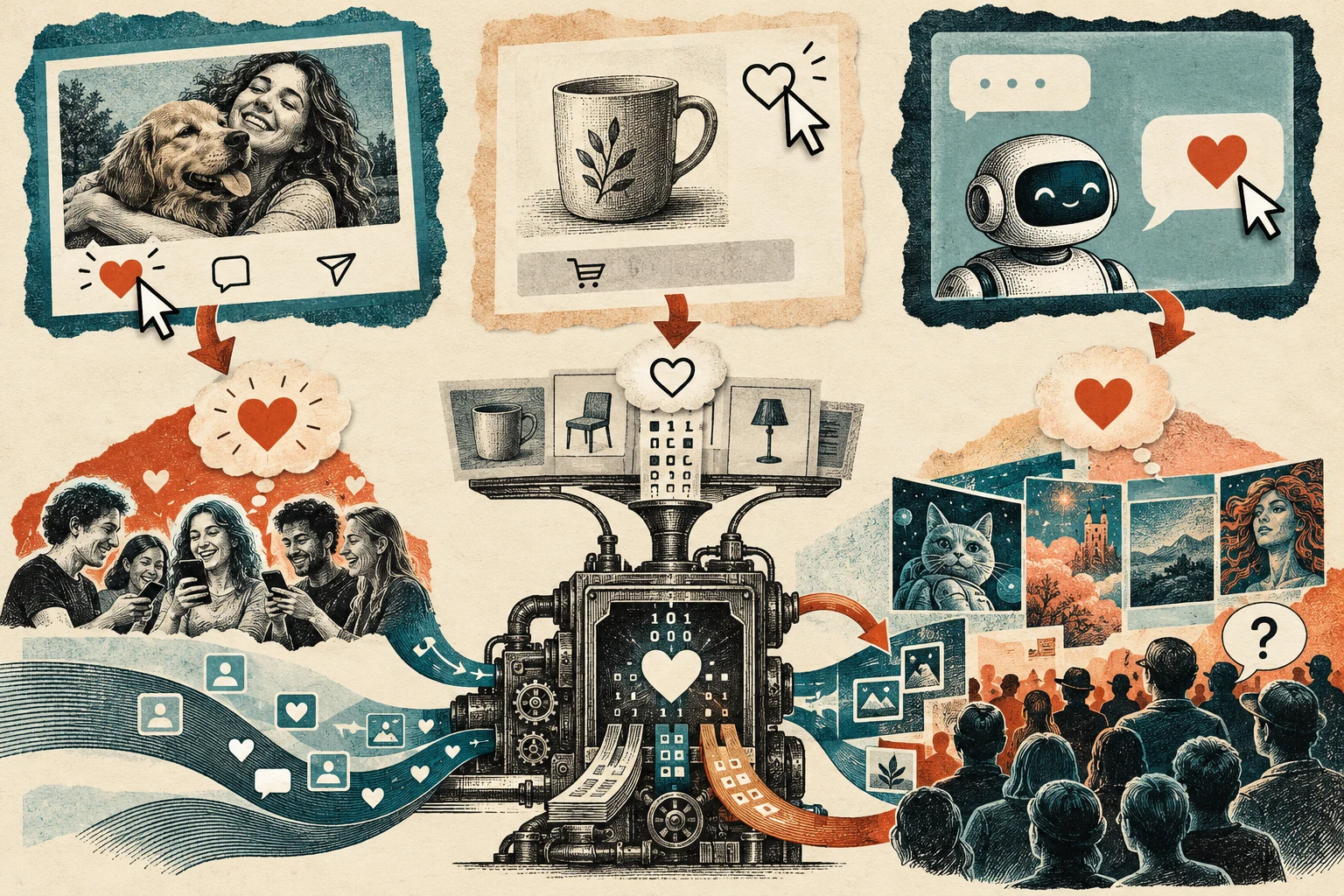
A symbol's meaning depends on digital context, interpretation, and available action, so a similar sign can trigger different practices.
AI-assisted illustration · conceptual metaphor View in visual quiz →Genesis and Global Lineage
Digital semiotics grew out of three traditions that converged in the twenty-first century. The first is computer semiotics, which emerged around 1990 as graphical user interfaces replaced command-line terminals: in 1988, Mihai Nadin published Interface design: A semiotic paradigm in Semiotica, applying Charles Sanders Peirce's sign theory to screen design, followed in 1990 by Peter Bøgh Andersen's A Theory of Computer Semiotics, grounded in Louis Hjelmslev's structural linguistics, and in 2005 by Clarisse Sieckenius de Souza's Semiotic Engineering, analyzing interfaces as “metacommunication” from designer to user. The second root is social semiotics and multimodality, pioneered by Michael Halliday and adapted by Gunther Kress and Theo van Leeuwen (Reading Images, 1996; Kress, Multimodality, 2010), examining how users assemble meaning across image, typography, sound, and layout. The third root draws on cultural semiotics: in On the Digital Semiosphere (2021), John Hartley, Indrek Ibrus, and Maarja Ojamaa extended Juri Lotman's semiosphere to planetary networks, analyzing how platforms mediate cultural translation.
Central European Lineage
Two of the three foundational pillars of digital semiotics have direct intellectual roots in Central and Eastern Europe: Bucharest and Tartu. First, the pioneer of interface semiotics, Mihai Nadin, was born in Brașov, Romania, in 1938 and formed intellectually in Bucharest, where he earned dual degrees in electrical engineering and computer science at the Polytechnic Institute of Bucharest and in philosophy and aesthetics at the University of Bucharest (working under Grigore Moisil and Tudor Vianu) before emigrating via Germany to the United States. That rare Eastern European combination of formal cybernetics and continental aesthetics enabled Nadin to formulate in 1988 the thesis that the computer is a "semiotic machine par excellence" at a moment when American human-computer interaction was dominated by narrow cognitive psychology. Second, the contemporary macro-theory of the digital semiosphere stems directly from the University of Tartu in Estonia, where Juri Lotman founded the Tartu–Moscow Semiotic School in the 1960s and established Sign Systems Studies (Trudy po znakovym sistemam). In his landmark 1984 Tartu essay On the Semiosphere (O semiosfere), Lotman argued that no individual sign or code functions in isolation, but only within a bounded, heterogeneous semiotic space where new meaning is generated through asymmetric translation across boundaries. In 2021, Estonian scholars Indrek Ibrus and Maarja Ojamaa joined John Hartley to publish On the Digital Semiosphere, demonstrating how Lotman's boundary-translation mechanics explain viral dynamics and algorithmic filtering on the internet.
Documented regional lineage · Links: 2. Compiled: October 2026.
-
documented influence 37 years
Central European Source: Jurij Łotman, “О семиосфере (O semiosfere)”; Tartu, Estonian SSR (now Estonia), 1984
Global Circulation: the digital semiosphere — John Hartley, Indrek Ibrus, Maarja Ojamaa, 2021
-
author from the region 0 years — same text on both sides
Central European Source: Mihai Nadin, “Interface design: A semiotic paradigm”; Brașov and Bucharest, Romania, 1988
Global Circulation: the computer as a “semiotic machine”; semiotics of the user interface — Mihai Nadin, 1988
author from the region
0 years — same text on both sidesMihai Nadin, “Interface design: A semiotic paradigm”
1988 · Brașov and Bucharest, Romania
the computer as a “semiotic machine”; semiotics of the user interface
1988 · Mihai Nadin
- Claim & Connection
- Mihai Nadin—born in Brașov and educated in Bucharest (electrical engineering and computer science at the Polytechnic Institute of Bucharest, philosophy and aesthetics at the University of Bucharest)—published in “Semiotica” in 1988 one of the earliest programmatic papers treating the computer user interface as a rigorous object of semiotic design and analysis. His characterization of the computer as a “semiotic machine par excellence” became a foundational reference point in computer and digital semiotics.
- Source Documentation
-
- primary source Mihai Nadin, „Interface design: A semiotic paradigm”, Semiotica 69–3/4, Mouton de Gruyter, Amsterdam 1988, s. 269–302; author's archive page with full bibliographic metadata and PDF text. nadin.ws ↗
- biographical record Hasło „Mihai Nadin”, Wikipedia (en), z odesłaniem do: Frieder Nake, Susanne Grabowski, „Human–computer interaction viewed as pseudo-communication”, Knowledge-Based Systems 14(8), 2001, s. 441–447; sections on education (Polytechnic Institute and University of Bucharest) and the computer as a “semiotic machine par excellence”. en.wikipedia.org ↗
- Historical Context
- Article metadata and text are confirmed on the author's website; biographical details on his Bucharest academic formation rely on the encyclopedic entry and should be cross-checked against an institutional biography (e.g., University of Texas at Dallas faculty record). The citation in Nake and Grabowski (2001) on the “semiotic machine” was not opened directly.
documented influence
37 yearsJurij Łotman, “О семиосфере (O semiosfere)”
1984 · Tartu, Estonian SSR (now Estonia)
the digital semiosphere
2021 · John Hartley, Indrek Ibrus, Maarja Ojamaa
- Claim & Connection
- Juri Lotman, working from 1950 onward at the University of Tartu as the leading figure of the Tartu–Moscow Semiotic School, introduced in 1984 the concept of the “semiosphere” as the relational space outside which semiosis cannot occur. In their 2021 monograph “On the Digital Semiosphere” (and a companion 2021 journal article), John Hartley, Indrek Ibrus, and Maarja Ojamaa explicitly extend Lotman's model of the semiosphere to networked digital media, making Tartu cultural semiotics the theoretical core of one of the principal contemporary schools of digital semiotics.
- Source Documentation
-
- reception / translation John Hartley, Indrek Ibrus, Maarja Ojamaa, „Emergent self-mediating classes in the digital semiosphere: Covid-19 conspiracies and the climate justice movement”, Nordic Journal of Media Studies 3(1), 2021, s. 118–140; abstract: the authors explicitly "extend Juri Lotman's model of the semiosphere to the ‘digital semiosphere’". doi.org ↗
- bibliographic record John Hartley, Indrek Ibrus, Maarja Ojamaa, On the Digital Semiosphere: Culture, Media and Science for the Anthropocene, Bloomsbury Academic, 2021; Crossref record, DOI 10.5040/9781501369209, ISBN 9781501369216. api.crossref.org ↗
- biographical record Hasło „Juri Lotman”, Wikipedia (en); studies in Leningrad (1939–1950), move to Estonia in 1950, faculty career at the University of Tartu from 1954, coinage of “semiosphere” in 1984. en.wikipedia.org ↗
- Historical Context
- Although Lotman was educated in Leningrad, he qualifies for the regional lineage through his four decades of institution-building at the University of Tartu, where cultural semiotics and the journal “Sign Systems Studies” (Trudy po znakovym sistemam, where “O semiosfere” first appeared in vol. 17, 1984) were created. Moreover, two of the three co-authors of “On the Digital Semiosphere” (Indrek Ibrus and Maarja Ojamaa) are Estonian scholars working directly in the Tartu tradition.
Why Now
Three developments between 2018 and 2026 moved digital semiotics to the forefront of debates over AI, law, and platform governance. First, the eruption of generative AI models after 2022—Midjourney, Stable Diffusion, ChatGPT, and synthetic voice/video generators—created a historic anomaly: billions of fluent texts, photorealistic images, and expressive voices that possess every syntactic and semantic feature of human signs except an intentional human sender. Second, new regulatory regimes—the EU Digital Services Act (2022) and AI Act (2024), mandating machine-readable watermarks and disclosures for deepfakes, alongside rules against dark patterns—forced courts and engineers to grapple with semiotic questions: what makes a sign an “authentic trace,” how does visual framing manipulate consent, and when does an algorithmic label lose meaning? Third, platform research showed that recommendation algorithms on TikTok, Instagram, and YouTube act as normative semiotic teachers, training creators to adopt facial expressions, vocal cadences (“algospeak”), and thumbnail compositions that engagement models reward.
Explanatory Power
Digital semiotics provides a precise vocabulary for dissecting digital phenomena where general talk of “algorithms” or “content” remains blurry. First, it reveals that user interfaces are ideological codebooks that standardize affect: when Facebook expanded its “Like” thumb in 2016 into six “Reactions” (Love, Haha, Wow, Sad, Angry), it compressed human emotion into six machine-countable tokens optimized for ad targeting. Second, Charles Sanders Peirce's triad of icon (sign by resemblance, like a portrait), index (sign by physical cause and effect, like a footprint or chemical photograph), and symbol (sign by convention, like a word) clarifies the epistemic crisis triggered by generative AI: a diffusion-model image of a war zone is a pure icon synthesized from statistical probabilities that masquerades visually as an indexical photograph—severing the bond between photographic realism and physical existence. Third, Lotman's Tartu concept of the semiotic boundary illuminates APIs, moderation filters, and search rankings: platform interfaces operate as active translation membranes where subcultural languages are ingested, stripped of context, translated into commercial metadata, and fed back into mainstream circulation.
Axes of Debate
Micro-semiotics of the interface versus macro-semiotics of the digital semiosphere
Semiotic engineers (Clarisse de Souza, Peter Bøgh Andersen) and UX researchers treat digital semiotics as an applied design discipline focused on the screen in front of the individual user: how icons, menus, and error messages convey the designer's model of the system. Cultural semioticians (Hartley, Ibrus, Ojamaa) argue that focusing on single user-screen interactions misses the forest for the trees, because meaning is generated at the population scale through collective remixing, platform governance, and cross-border clashes across the global digital semiosphere. Strongest counterargument: Without micro-analysis of interface grammar and software constraints, macro-theories of the “digital semiosphere” risk floating into generalizations that cannot explain how a change in TikTok's duet button or X's reply ranking mechanically alters the signs a culture produces. Nature of the dispute: substantive — a division of analytical scale between human-computer interaction and cultural media studies, where both levels are necessary.
Can a machine be a genuine “interpretant,” or does semiosis require a living mind?
Classical Peircean semioticians, biosemioticians (Kalevi Kull, Jesper Hoffmeyer), and Mihai Nadin insist that while computers manipulate syntactic tokens (signals) at lightning speed, genuine semiosis—where a sign stands for an object to an interpretant that cares about its survival and meaning—requires a living organism; a language model processes statistical vectors, not meanings. Posthumanist and computational semioticians counter that when neural networks classify images, translate languages, and generate multimodal signs that shape culture, restricting “interpretation” to biological consciousness leaves us blind to machine-to-machine semiosis. Strongest counterargument: Even if an AI model lacks conscious experience, its latent space functions operationally as an externalized cultural interpretant: trained on billions of human texts and images, its outputs enact a statistical synthesis of collective human habits of interpretation with real causal power. Nature of the dispute: mixed — a philosophical dispute over syntax versus semantics, complicated by disciplinary stakes between humanities scholars and AI engineers.
Semiotic sign analysis versus Lev Manovich's “software studies” and procedurality
Software-studies theorists led by Lev Manovich (The Language of New Media, 2001) and Ian Bogost (“procedural rhetoric”) argue that importing literary and visual semiotics into digital media is a category mistake: beneath screen icons, digital objects are numerical matrices, databases, and executable algorithms, meaning critics should analyze what software does rather than what screen images signify. Strongest counterargument: Defenders of digital semiotics reply that software operations and databases become new semiotic genres—users actively read and interpret the behavior of an algorithmic feed, search autocomplete, or chatbot refusal as meaningful communicative acts, making procedurality a new mode of semiosis. Nature of the dispute: substantive — it concerns whether executable code can be theorized within an expanded theory of signs or requires a post-semiotic ontology of operations.
Underappreciated Angle
While public anxiety over digital signs fixates on machines imitating humans (deepfakes, voice clones, synthetic text), the most profound transformation uncovered by digital semiotics runs in the opposite direction: reverse semiosis, in which humans reshape their own language, gestures, and culture to be legible to machine “interpretants.” Millions of people no longer write, speak, or film primarily for another human mind; they compose signs first to pass through an algorithmic parser. Journalists craft headlines for Google Discover's token weights; job applicants rewrite their resumés to trigger keyword matches in applicant-tracking systems; YouTubers pull wide-eyed “algorithmic face” grimaces on thumbnails because neural networks score those pixel patterns for higher click-through rates; TikTok users invent euphemisms (“unalive,” “seggs”) to evade automated speech-to-text moderation; and corporations format websites for clean ingestion by retrieval-augmented generation (RAG) pipelines and AI shopping agents. Classical semiotics assumed that cultural codes evolve through negotiation within a community of human interpreters. In the digital semiosphere, the primary addressee of human expression is increasingly a statistical black box, and humans learn its grammar by watching which signs the machine rewards with visibility.
One-Sentence Takeaway
In the digital environment, a sign no longer waits passively for a human reader; it is formatted for, parsed by, and rewarded or buried by a machine long before another human mind ever gets the chance to ask what it means.
Related Concepts Network
How this concept reinforces, constrains, or complements other analytical frameworks in the corpus. View on graph →
-
Multimodality reinforces
Gunther Kress's social semiotics of multimodality supplies digital semiotics with its primary descriptive apparatus for analyzing how meaning is orchestrated simultaneously across image, text, sound, gesture, and screen layout.
-
Memetics in tension
Memetics models the spread of online content as the quasi-biological replication of discrete units, whereas digital semiotics analyzes how signs are continuously reinterpreted and translated across cultural boundaries by users and algorithms.
-
Platformization complements
Digital platforms dictate which signs can be produced and circulated (character limits, aspect ratios, reaction buttons, algorithmic visibility), acting as the infrastructural grammar that digital semiotics studies.
-
Hyperreality complements
Jean Baudrillard's thesis of simulacra without originals is the sweeping philosophical precursor to the concrete operational question posed by digital semiotics: what is the indexical status of a machine-generated sign?
-
Synthetic media reinforces
Text, images, and audio generated by foundation models are signs produced without an intentional human author; digital semiotics provides the precision tools to separate statistical sign generation from human interpretation.
-
Attention economy complements
Semiotically engineered interface cues (notification badges, color contrast, infinite feeds) channel human gaze; the attention economy explains why that semiotic steering is commercially monetized.
-
Deepfake reinforces
In Charles Sanders Peirce's classification of signs, a deepfake is a boundary crisis of the index: a synthetic icon engineered to counterfeit the causal physical trace of a photograph or voice recording.
Reading Canon & Translation Bridge
Foundational texts, introductions, and critical perspectives—with availability of English and Polish editions.
-
foundational text 1988 · English
Mihai Nadin, Interface design: A semiotic paradigm
The pioneering paper in Semiotica (vol. 69, pp. 269–302) treating the graphical user interface not as a mere visual display, but as an active system of Peircean signs—the starting point of computer semiotics.
In English: original text written in English
In Polish: no Polish edition
-
foundational text 1990 · English
Peter Bøgh Andersen, A Theory of Computer Semiotics: Semiotic Approaches to Construction and Assessment of Computer Systems
The first systematic book-length theory of the computer as a sign medium, grounded in Louis Hjelmslev's structural glossematics and empirical workplace studies in Denmark (Cambridge University Press).
In English: original text written in English
In Polish: no Polish edition
-
introduction & synthesis 2010 · English
Gunther Kress, Multimodality: A Social Semiotic Approach to Contemporary Communication
The most influential introduction to social semiotics, demonstrating how digital screens displace the dominance of the printed page and require analyzing meaning across multiple semiotic modes at once.
In English: original text written in English
In Polish: Polish edition not verified
-
introduction & synthesis 2021 · English
John Hartley, Indrek Ibrus, Maarja Ojamaa, On the Digital Semiosphere: Culture, Media and Science for the Anthropocene
Builds a macro-theory of global digital culture directly on Juri Lotman's Tartu concept of the semiosphere, bridging cultural semiotics, evolutionary economics, and cultural data analytics.
In English: original text written in English
In Polish: Polish edition not verified
-
cross-disciplinary 1990 · Russian
Jurij Łotman, Universe of the Mind: A Semiotic Theory of Culture
The definitive synthesis of Lotman's concepts of the semiosphere, cultural boundaries, and creative translation across asymmetric codes—first published in English translation in 1990.
In English: “Universe of the Mind: A Semiotic Theory of Culture”, I.B. Tauris 1990, trans. Ann Shukman
In Polish: “Uniwersum umysłu. Semiotyczna teoria kultury”, Wydawnictwo Uniwersytetu Gdańskiego 2008, trans. Bogusław Żyłko
-
critical perspective 2001 · English
Lev Manovich, The Language of New Media
A foundational critique arguing that classical literary and film semiotics cannot capture what is specific to software: databases, modularity, automation, and algorithmic transcoding are executable operations rather than static signs.
In English: original text written in English
In Polish: “Język nowych mediów”, Wydawnictwa Akademickie i Profesjonalne 2006, trans. Piotr Cypryański
-
critical perspective 2005 · English
Clarisse Sieckenius de Souza, The Semiotic Engineering of Human-Computer Interaction
Develops “semiotic engineering” (MIT Press), treating the user interface as a one-shot “metacommunication” message sent from the system designer to the user through the medium of executable code.
In English: original text written in English
In Polish: Polish edition not verified