Cognitive Science #031
Free energy principle
original term: free energy principle (Eng.) · zasada swobodnej energii, FEP, wnioskowanie aktywne
Central European lineage: 2 threads (documented influence, counterpoint) · 1944–2020 · jump to documentation ↓
Working Definition
The free energy principle (FEP) states that any self-organizing system that maintains its structural integrity over time against a changing environment must behave as if it is minimizing an information-theoretic quantity called variational free energy—a tractable upper bound on surprisal (the negative log-probability of its sensory states given an implicit generative model of its world). A system can minimize this quantity in two complementary ways: by updating its internal states to better match incoming sensory signals (perception), or by acting on the external world so that future sensory inputs match its predictions (action)—together known as active inference. In popular science, the principle is often boiled down to the slogan “the brain hates surprise”; in its strict mathematical form, it is a statement about random dynamical systems possessing a statistical boundary (Markov blanket), of which the human brain is only one elaborate case.
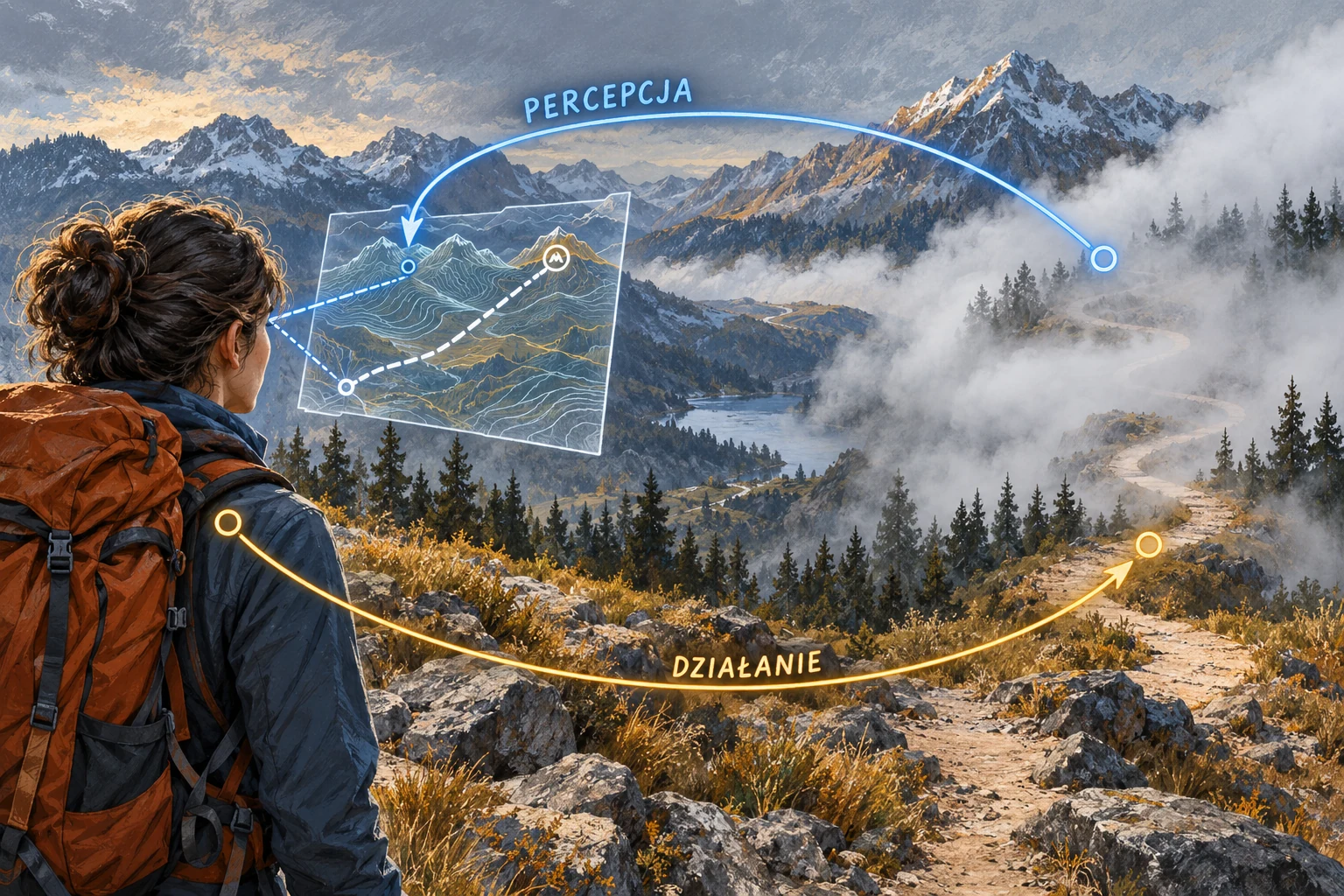
Perception updates the model of the environment while action alters incoming signals. The image depicts the active inference aspect of the free energy principle; predictive processing is a close reading, and the illustration does not define the full formalism.
AI-assisted illustration · conceptual metaphor View in visual quiz →Genesis and Global Lineage
The principle was formulated by Karl Friston, a theoretical neurobiologist at University College London, across papers between 2005 and 2010, culminating in his 2010 Nature Reviews Neuroscience synthesis The free-energy principle: a unified brain theory? Its conceptual pedigree braids together three traditions. First, from statistical physics and machine learning comes Richard Feynman's variational free energy, adapted by Geoffrey Hinton and Peter Dayan in the 1995 “Helmholtz machine” to turn intractable Bayesian integration into an optimization problem. Second, from visual neurophysiology comes Hermann von Helmholtz's nineteenth-century idea of perception as “unconscious inference” and Rajesh Rao and Dana Ballard's 1999 predictive-coding model of the visual cortex. Third, from mid-twentieth-century cybernetics comes W. Ross Ashby's homeostasis and the 1970 Conant–Ashby Good Regulator Theorem, which proved that any effective regulator of a system must contain a model of that system. From 2013 onward (Life as we know it), Friston expanded the principle beyond neuroscience into a general “physics of sentient systems”: any system separated from its environment by a Markov blanket (partitioning states into internal, external, sensory, and active) that persists at non-equilibrium steady state can be mathematically read as performing active inference. Since then, the FEP has led a double life—as a computational modeling toolkit in psychiatry and robotics, and as a sweeping “theory of everything” for living matter.
Central European Lineage
When Friston expanded the free energy principle from cortical hierarchies to a general physics of living systems in his 2013 paper Life as we know it, he anchored the argument directly in the question posed by the Vienna-educated physicist Erwin Schrödinger. Educated and formed scientifically at the University of Vienna between 1906 and 1914 under Franz Exner and Friedrich Hasenöhrl (inheriting Ludwig Boltzmann's Vienna statistical-mechanics tradition before his exile in Dublin), Schrödinger had asked in his 1944 monograph What is Life?: “How can the events in space and time which take place within the spatial boundary of a living organism be accounted for by physics and chemistry?” Friston places that exact sentence as the epigraph of his 2013 paper and presents the Markov-blanket formalism of variational free energy as the statistical-mechanical answer to Schrödinger's puzzle of how organisms resist entropic dispersion. A second, contrasting Central European link comes from contemporary Warsaw philosophy of cognitive science: in 2020, Piotr Litwin (University of Warsaw) and Marcin Miłkowski (Institute of Philosophy and Sociology of the Polish Academy of Sciences, IFiS PAN) published Unification by Fiat: Arrested Development of Predictive Processing in Cognitive Science, delivering a sharp methodological critique of the Fristonian unification program and questioning whether the free energy principle provides genuine explanatory unification or an unfalsifiable umbrella for local models.
Documented regional lineage · Links: 2. Compiled: October 2026.
-
documented influence 69 years
Central European Source: Erwin Schrödinger, “What is Life? The Physical Aspect of the Living Cell”; Vienna, Austria-Hungary (now Austria); Dublin, Ireland, 1944
Global Circulation: the free energy principle as a physics of self-organizing systems (“Life as we know it”) — Karl Friston, 2013
-
counterpoint 10 years — regional source later than global formulation
Central European Source: Piotr Litwin i Marcin Miłkowski, “Unification by Fiat: Arrested Development of Predictive Processing”; Warsaw, Poland, 2020
Global Circulation: predictive processing and the free energy principle as a unified theory of cognition — Karl Friston, 2010
documented influence
69 yearsErwin Schrödinger, “What is Life? The Physical Aspect of the Living Cell”
1944 · Vienna, Austria-Hungary (now Austria); Dublin, Ireland
the free energy principle as a physics of self-organizing systems (“Life as we know it”)
2013 · Karl Friston
- Claim & Connection
- In his 2013 paper “Life as we know it,” which extends the free energy principle from the brain to any physical system possessing a boundary (a Markov blanket), Friston opens with an epigraph from Schrödinger (asking how the events in space and time taking place within the spatial boundary of a living organism can be accounted for by physics and chemistry) and frames his formal derivation as an answer to that question. Schrödinger was educated and formed scientifically in Vienna (studying and earning his doctorate and habilitation at the University of Vienna, 1906–1914) before delivering the 1943 lectures in exile in Dublin.
- Source Documentation
-
- reception / translation Karl Friston, „Life as we know it”, Journal of the Royal Society Interface, Vol. 10, No. 86, 2013, 20130475; epigraph to §1 (Schrödinger [1, p. 2]); references to [1] in the introduction and conclusion (§4); reference [1] in the bibliography. pmc.ncbi.nlm.nih.gov ↗
- biographical record Erwin Schrödinger — hasło w angielskiej Wikipedii; sections on education (University of Vienna from 1906, doctorate 1910, habilitation 1914 as assistant to Franz Exner) and Dublin (from October 1939; book published 1944). en.wikipedia.org ↗
- Historical Context
- Place: Vienna marks the author's scientific formation, Dublin the place where the lectures were delivered. We do not claim that Schrödinger anticipated variational free energy; the documented link is that Friston explicitly frames the generalized principle as an answer to Schrödinger's question about the physics of living boundaries.
counterpoint
10 years — regional source later than global formulationPiotr Litwin i Marcin Miłkowski, “Unification by Fiat: Arrested Development of Predictive Processing”
2020 · Warsaw, Poland
predictive processing and the free energy principle as a unified theory of cognition
2010 · Karl Friston
- Claim & Connection
- Working in Warsaw, Litwin (Faculty of Psychology, University of Warsaw; IFiS PAN) and Miłkowski (Institute of Philosophy and Sociology of the Polish Academy of Sciences, IFiS PAN; educated at the University of Warsaw) argue that predictive processing—including its Fristonian core—fails to deliver general, simple, homogeneous, and systematic explanations, remains loosely coupled to its mathematical and biological foundations, and mistakes model proliferation for theoretical progress. In §5 they explicitly examine whether this methodological critique extends to the free energy principle itself.
- Source Documentation
-
- primary source Piotr Litwin, Marcin Miłkowski, „Unification by Fiat: Arrested Development of Predictive Processing”, Cognitive Science, Vol. 44, No. 7, 2020, e12867; abstract (“As a unifying theory, PP fails to deliver general, simple, homogeneous, and systematic explanations”); §5 Possible objections (relationship between PP and FEP). pmc.ncbi.nlm.nih.gov ↗
- biographical record Marcin Miłkowski — hasło w polskiej Wikipedii; philosophical studies at the University of Warsaw (until 2000), doctorate at UW 2005, IFiS PAN. pl.wikipedia.org ↗
- Historical Context
- Both authors' Warsaw affiliations appear in the published paper header. This is a methodological critique of the research program rather than a mathematical refutation of the variational inequality.
Why Now
Between 2018 and 2026, the free energy principle moved from computational neuroimaging to the center of three controversies. First, in artificial intelligence, while Large Language Models trained on next-token prediction popularized the intuition that “prediction drives intelligence,” AI researchers (and Friston, as Chief Scientist at VERSES AI after 2022) pitched active inference as an alternative paradigm for embodied robotics—arguing that genuine agency requires an action-oriented Markov blanket that actively samples the world rather than passively ingesting static text corpora. Second, the textbook Active Inference by Thomas Parr, Giovanni Pezzulo, and Karl Friston (MIT Press, 2022) gave the field a standardized mathematical canon, allowing critics and engineers to test concrete process models. Third, a wave of philosophy-of-science critiques between 2020 and 2023 (Litwin & Miłkowski 2020; Mel Andrews 2021; Matteo Colombo & Cory Wright) forced a crucial clarification: separating the principle (an unfalsifiable mathematical formalism, like Hamilton's principle of least action) from specific process theories (falsifiable empirical hypotheses about how cortical microcircuits actually compute).
Explanatory Power
The principle's chief explanatory virtue is showing how perception, motor control, attention, and epistemic curiosity—traditionally studied as separate faculties—can be written as variations on a single optimization equation. First, attention ceases to be a homuncular “spotlight” and becomes precision-weighting: the nervous system estimates the reliability (inverse variance) of prediction-error channels, turning up synaptic gain on high-precision signals and muting noisy ones—giving computational psychiatry a framework for modeling hallucinations in schizophrenia or sensory overload in autism as disorders of aberrant precision. Second, perception and action become mathematical duals: faced with a discrepancy between predicted body temperature and cold skin sensations, an organism can either update its perceptual belief (“I am cold”) or engage motor reflexes to shiver and put on a coat, changing sensory inputs to fit its homeostatic prior. Third, curiosity and exploration no longer require bolting an ad-hoc “novelty drive” onto a reward-maximizing agent: minimizing expected free energy over future actions naturally decomposes into a pragmatic value term (seeking preferred homeostatic outcomes) and an epistemic value term (performing actions that resolve uncertainty about hidden states).
Axes of Debate
Empirical law of nature versus unfalsifiable mathematical tautology
Philosophers of science (Mel Andrews in The math is not the territory, 2021; Matteo Colombo & Cory Wright) point out that “every system that exists minimizes variational free energy” is a mathematical identity derived from defining a non-equilibrium steady-state system with a Markov blanket; because no existing object could violate it, it is empirically unfalsifiable. Strongest counterargument: Friston replies that the FEP has the same status as Hamilton's principle of least action in physics: principles are not falsifiable hypotheses, but formal grammatical frameworks within which specific, falsifiable process theories (such as predictive coding in cortical layers) are tested against data. Nature of the dispute: substantive — whether the prestige of the mathematical framework is earned by empirical tests or transferred to ad-hoc models.
Genuine theoretical unification versus “unification by fiat”
Cognitive methodologists Piotr Litwin and Marcin Miłkowski (2020) argue that the purported unification of psychology under predictive processing and the FEP is “unification by fiat”: different modelers redefine priors, likelihoods, and precision parameters incompatibly across tasks, rarely pit models against non-predictive competitors, and mistake Bayesian jargon for causal discovery. Strongest counterargument: Proponents counter that every young unifying paradigm went through a pluralistic phase, and active-inference models in oculomotor control, dopamine signaling, and psychiatry already generate novel quantitative predictions. Nature of the dispute: mixed — the audit of model inconsistency is substantive, while disagreements over promissory credit are programmatic.
Internalist “brain in a vat” (Hohwy) versus enactive ecological coupling (Bruineberg, Clark)
Jakob Hohwy (The Predictive Mind, 2013) interprets the Markov blanket along neo-Kantian lines: because internal states interact with the world only across sensory and active states, the mind is locked inside a self-evidencing skull. Enactivists (Jelle Bruineberg, Erik Rietveld, Ezequiel Di Paolo) object that treating a statistical partition as a literal wall smuggles representationalism back into embodied cognition. Strongest counterargument: Friston, Andy Clark, and Thomas Parr reply that in active inference the “generative model” is not a picture stored in neurons, but is entailed by the entire embodied morphology and action-perception coupling of the organism in its niche. Nature of the dispute: rhetorical — both camps accept the same stochastic differential equations while battling over whether the vocabulary of “inference” illuminates or obscures what a Markov blanket does.
Underappreciated Angle
The most unsettling implication of the free energy principle lies in what it says about the divorce between survival and objective truth. In Friston's framework, a living system's generative model is never calibrated against a God's-eye view of reality; its sole evolutionary imperative is to keep the organism within viable homeostatic states so its Markov blanket does not dissolve into death. Consequently, an organism's “priors” are simultaneously beliefs about what is likely and preferences about what must be maintained for survival. Applied to human minds, social groups, and institutions, this yields a dark theorem: a community, bureaucracy, or ideology that maintains its boundary by minimizing internal surprise does not need an accurate map of the outside world—it only needs a loop of actions and perceptual filters that keeps its Markov blanket intact. Delusions, echo chambers, and rigid institutional dogmas are not failures of free-energy minimization; they are local optima in which a system preserves its identity by refusing to let disconfirming reality breach its boundary. Conversely, a disembodied language model that minimizes prediction error over text without a fragile body to keep alive has surprisal in the Shannon sense, but no existential stake in what its predictions mean.
One-Sentence Takeaway
The free energy principle is less a theory of how brains think than a statistical definition of what it takes for anything to stay alive as a distinct entity: to keep existing, a system must continually act and perceive so that the world never surprises it beyond the narrow bounds of its survival.
Related Concepts Network
How this concept reinforces, constrains, or complements other analytical frameworks in the corpus. View on graph →
-
Predictive processing reinforces
Predictive processing is the most influential neurobiological realization of the principle: a cortical hierarchy minimizing prediction error is a concrete process-theory implementation of free-energy minimization.
-
Applied Bayesianism complements
Variational free energy is an upper bound on statistical surprise, turning its minimization into tractable approximate Bayesian inference for a system that cannot compute exact posterior probabilities.
-
Enactivism in tension
Classic enactivists view the principle's “generative model” as a return to internal representationalism, whereas Friston and his collaborators argue that active inference formalizes autopoietic self-maintenance.
-
Systems thinking complements
The principle translates into probability theory the classic cybernetic insights of W. Ross Ashby's homeostasis and the Conant–Ashby Good Regulator Theorem (that every good regulator of a system must be a model of that system).
-
Emergence complements
The Markov blanket formalism shows how a statistical boundary between an “inside” and an “outside” emerges from local couplings—the precondition for anything to individuate as an organism.
-
Information theory reinforces
Because “surprisal” in the principle is negative log-probability (Shannon self-information), minimizing free energy is mathematically continuous with data compression and minimum description length.
-
Complexity science complements
The principle aspires to a statistical physics of non-equilibrium self-organizing systems that maintain themselves within a restricted set of viable states.
Reading Canon & Translation Bridge
Foundational texts, introductions, and critical perspectives—with availability of English and Polish editions.
-
foundational text 2010 · English
Karl Friston, The free-energy principle: a unified brain theory?
The landmark review article in “Nature Reviews Neuroscience” (11:2, pp. 127–138) that synthesized Friston's 2005–2009 papers and showed how perception, action, attention, and learning can be cast as optimizing a single quantity.
In English: original text written in English
In Polish: no Polish edition
-
foundational text 2013 · English
Karl Friston, Life as we know it
Extends the principle from the brain to any random dynamical system possessing a Markov blanket, advancing the famous claim that any system that exists will appear to minimize free energy.
In English: original text written in English
In Polish: no Polish edition
-
introduction & synthesis 2022 · English
Thomas Parr, Giovanni Pezzulo, Karl Friston, Active Inference: The Free Energy Principle in Mind, Brain, and Behavior
The definitive MIT Press textbook exposition of active inference, split into conceptual chapters and formal mathematical derivations; the closest thing to a canonical user manual.
In English: original text written in English
In Polish: Polish edition not verified
-
introduction & synthesis 2013 · English
Andy Clark, Whatever next? Predictive brains, situated agents, and the future of cognitive science
The target article in “Behavioral and Brain Sciences” (36:3, pp. 181–204) that brought Friston's framework into mainstream philosophy of mind and cognitive science alongside dozens of peer commentaries.
In English: original text written in English
In Polish: no Polish edition
-
introduction & synthesis 2013 · English
Jakob Hohwy, The Predictive Mind
The first book-length philosophical treatment of the predictive brain, written from an internalist stance close to Friston's early formulations; ideal for seeing the ontological commitments of the Markov blanket.
In English: original text written in English
In Polish: no Polish edition
-
critical perspective 2020 · English
Piotr Litwin, Marcin Miłkowski, Unification by Fiat: Arrested Development of Predictive Processing
A rigorous methodological critique of the program's unifying claims: charges of conceptual equivocation, untested task-specific models, and unification “by decree.”
In English: original text written in English
In Polish: no Polish edition
-
critical perspective 2021 · English
Mel Andrews, The math is not the territory: navigating the free energy principle
A paper in "Biology & Philosophy" separating the free energy principle as an unfalsifiable mathematical modeling framework from empirical hypotheses about biological brains.
In English: original text written in English
In Polish: Polish edition not verified
-
cross-disciplinary 1944 · English
Erwin Schrödinger, What is Life? The Physical Aspect of the Living Cell
Poses the foundational question of how a living organism maintains local order (“feeding on negative entropy”) against the second law of thermodynamics—the puzzle Friston reformulates seventy years later in informational terms.
In English: original text written in English
In Polish: “Czym jest życie? Fizyczne aspekty żywej komórki; Umysł i materia; Szkice autobiograficzne”, Prószyński i S-ka 1998, trans. Stefan Amsterdamski
Primary-Source Quotes
any system that exists will appear to minimize free energy and therefore engage in active inference.