Culture & Power #144
Thucydides’s Trap
original term: Thucydides's Trap (Eng.) · pułapka Tukidydesa, Thucydides Trap, teoria przejścia potęgi
Global-circulation concept — no documented lineage in Central Europe. jump to documentation ↓
Working Definition
Thucydides’s Trap is the thesis that when a rising power threatens to displace a ruling power, the resulting structural stress between them—ambition on one side, fear on the other—carries a high probability of ending in war, even when neither side wants conflict. In Graham Allison’s technical version, it is a historical-statistical hypothesis: out of sixteen major power transitions over the past five hundred years, twelve ended in war and four did not. In the popular version circulating in media and policy briefings, it becomes a deterministic law of history applied almost exclusively to a single dyad: the United States and China. The distinction matters because an empirical hypothesis can be tested and qualified, whereas a law of history can only be accepted or fatalistically enacted.
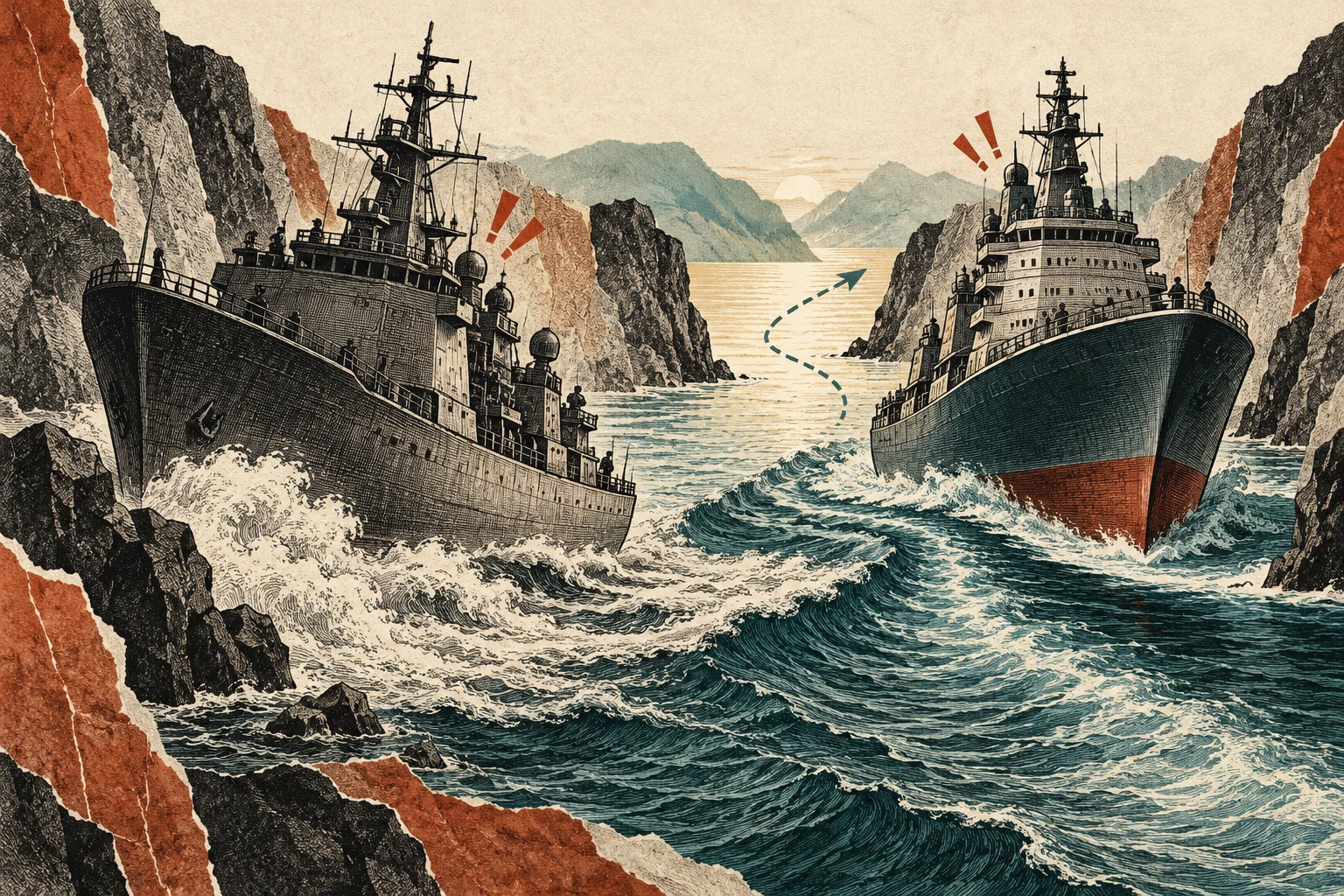
Growing strength on one side triggers fear on the other and reciprocal moves heighten tension, while an open negotiating path recalls that war is not inevitable.
AI-assisted illustration · conceptual metaphor View in visual quiz →Genesis and Global Lineage
The name comes from a single sentence in Book I of the History of the Peloponnesian War, in which Thucydides distinguishes the immediate grievances behind the war from its “truest cause”: the growth of Athenian power and the fear this inspired in Sparta. As early as 1980 the novelist Herman Wouk compared the Cold War to the rivalry between Athens and Sparta in a lecture at the US Naval War College and spoke of a “Thucydidean trap,” but the term acquired its contemporary meaning from Graham Allison, a Harvard political scientist, former student of Henry Kissinger, and author of the classic Cuban Missile Crisis study Essence of Decision (1971). Allison coined the phrase in a Financial Times op-ed in 2012, expanded it in The Atlantic in 2015—referencing the Harvard Belfer Center’s “Case File” of sixteen historical rivalries running from late fifteenth-century Portugal and Spain to united Germany’s position vis-à-vis Britain and France since the 1990s—and published Destined for War in 2017. Intellectually, the concept descends directly from A. F. K. Organski’s power-transition theory (1958) and Robert Gilpin’s theory of hegemonic war; Allison added a memorable classical label, a sixteen-case scoreboard, and a direct policy addressee. Political uptake was immediate: Xi Jinping spoke of the need to avoid the trap as early as 2014, and Chinese state media adopted the phrase as a convenient description of irrational American fear in the face of China’s peaceful rise.
Central European Lineage
We found no documented link between this concept and the intellectual history or historical experience of Central Europe.
We found no documented link between this concept and the intellectual history or historical experience of Central Europe (by our methodology, this means “none found,” not “none exists”; as of October 2026).
Why Now
Since 2018 the concept has moved from academic seminars into state practice. The tariff war initiated by the first Trump administration, export controls targeting Huawei and advanced semiconductor manufacturers, and the subsequent “de-risking” strategies adopted in Washington and Brussels were all framed and justified in the vocabulary of hegemon-versus-challenger rivalry. The COVID-19 pandemic, Russia’s full-scale war against Ukraine since 2022, and military tensions around Taiwan supplied concrete scenarios in which the “accidental spark” described in Allison’s book ceased to be an abstraction. The phrase itself became an active instrument of summit diplomacy: in October 2023 Xi Jinping assured US Senate Majority Leader Chuck Schumer that Thucydides’s Trap “is not inevitable,” and according to press reports from May 2026 he opened a Beijing summit by asking Donald Trump whether the two powers could manage to avoid it. At the same time, scholarly pushback has matured: Steve Chan’s 2020 monograph, the 2021 philological critique by Platias and Trigkas, and Hal Brands and Michael Beckley’s 2021 essay on the “peaking power trap” shifted the debate from “is war inevitable?” to “are we even diagnosing the mechanism correctly?”
Explanatory Power
The concept brings three dynamics into focus that routine diplomatic commentary tends to obscure. First, conflict between great powers does not require malice or aggressive intent: it suffices that each side rationally hedges against the other, and those defensive hedges are read by the rival as offensive preparations. This explains why US semiconductor export controls and China’s naval buildup mutually reinforce each other without either capital making a formal decision to escalate. Second, the greatest risk resides in allies and peripheral flashpoints rather than in the metropoles themselves: just as Berlin followed Vienna into war over Serbia in 1914, an incident over Taiwan or in the South China Sea could trigger alliance commitments that neither Washington nor Beijing can easily walk back. Third, history contains genuine escapes: the transition of hegemony from London to Washington at the turn of the twentieth century occurred peacefully because British statesmen consciously accommodated American primacy in the Western Hemisphere. The framework thus forces analysts to ask not “who is right?” but “what is the incumbent power prepared to concede?”
Axes of Debate
Are the sixteen cases hard data or curated anecdotes?
Historians and quantitative international-relations scholars (Steve Chan, Jack Levy, Lawrence Freedman) point out that the Belfer Center’s sixteen cases are selected and coded arbitrarily: the Crimean War and the Russo-Japanese War fit the hegemonic-transition template poorly, while the First World War began as a clash between Austria-Hungary and Serbia rather than a bilateral race between London and Berlin. Strongest counterargument: Allison never claimed to be running a randomized statistical regression; his case file was designed as an illustrative warning and comparative heuristic, and noting selection bias does not refute the core insight that power transitions are periods of elevated systemic risk. Nature of the dispute: substantive — it concerns whether a small, heterogeneous set of historical episodes can support probabilistic claims about the future.
Inadvertent escalation or war of choice?
Classicists and international-relations theorists (Platias and Trigkas, Jonathan Kirshner, Arthur Waldron) argue that Thucydides depicted the Peloponnesian War as the product of deliberate strategic choices by Athens and Sparta rather than a fatalistic structural mechanism; Sparta sought compromise for years, and the English word “inevitable” in popular translations is much stronger than the Greek original (anankē). Strongest counterargument: Even if ancient and modern leaders make conscious choices, they make them inside a strategic structure that penalizes restraint; that is precisely what a trap means—not the absence of agency, but choice under structural pressure that the actors themselves experience as compulsion. Nature of the dispute: mixed — the philological debate over Thucydides’s Greek is substantive, but both sides use it to contest the rhetorical authority of the classical name.
Is a rising power or a peaking power more dangerous?
Hal Brands and Michael Beckley argue that the gravest danger comes not from a relentlessly rising China, but from a China whose demographic and economic growth is decelerating, because leaders who see a closing window of opportunity are far more prone to gamble—like Imperial Germany before 1914 or Imperial Japan before 1941. Strongest counterargument: From the standpoint of the incumbent hegemon, this distinction changes less than it appears: whether the challenger is surging or peaking, Washington faces the same dilemma between accommodation and deterrence, and both trajectories generate acute structural stress. Nature of the dispute: substantive — different diagnoses prescribe opposite policies: strategic patience toward a rising power versus immediate deterrence toward a peaking one.
Underappreciated Angle
The least examined aspect of Thucydides’s Trap is the political work performed by the label itself. Invoking an ancient Greek historian accomplishes something that a dry social-science hypothesis about “elevated conflict risk during power transitions” never could: it cloaks policy choices in the aura of classical tragedy and absolves decision-makers of agency, since in a tragedy the culprit is fate or structure rather than human judgment. Beijing embraced the phrase because it frames American containment as irrational Spartan paranoia and China’s rise as a natural law of history; Washington invokes it to justify the immense fiscal and economic costs of military deterrence and technological decoupling. Both capitals thus cite the exact same classical maxim for opposite purposes, and every citation reinforces the shared expectation that confrontation is the normal course of events. If strategic expectations shape state behavior, the concept is not merely a description of a trap, but one of the mechanisms that springs it.
One-Sentence Takeaway
Thucydides’s Trap tells us less about what great powers are fated to do than about how decision-makers on both sides prefer to view their own choices—as the compulsion of history rather than political responsibility.
Related Concepts Network
How this concept reinforces, constrains, or complements other analytical frameworks in the corpus. View on graph →
-
Dark forest theory reinforces
Both frameworks derive conflict from structural distrust between actors who cannot credibly signal peaceful intentions.
-
Geoeconomic fragmentation complements
The fracturing of the global economy into rival blocs is today the primary channel through which competition between a ruling hegemon and a rising challenger spills into trade and technology.
-
De-risking complements
Policies aimed at reducing strategic dependence on China are directly justified by anticipating conflict within a power-transition logic.
-
Non-zero-sum games constrains
The trap model treats great-power rivalry as a zero-sum game, even though deep economic interdependence creates vast areas of mutual gain.
-
Hyperstition in tension
Critics argue that the narrative of inevitable war increases its likelihood by shaping the expectations of decision-makers on both sides.
-
Path dependence in tension
The claim that past power transitions predetermine today’s assumes a continuity of mechanism that historians do not find across the sixteen cases.
-
Framing complements
The name itself, built on the authority of an ancient historian, is a framing device that lends a statistical hypothesis the weight of a law of history.
Reading Canon & Translation Bridge
Foundational texts, introductions, and critical perspectives—with availability of English and Polish editions.
-
foundational text 2017 · English
Graham Allison, Destined for War: Can America and China Escape Thucydides's Trap?
The book that gave the concept its current shape: sixteen historical cases across five centuries—twelve ending in war and four “escapes”—presented as a policy lesson for Washington and Beijing.
In English: original text written in English
In Polish: “Skazani na wojnę? Czy Ameryka i Chiny unikną pułapki Tukidydesa?”, Wydawnictwo Pascal 2018, trans. Regina Mościcka, Maciej Wacław, Marta Żbikowska
-
foundational text 1953 · Greek
Tukidydes, Historiai (Wojna peloponeska)
A work from the late fifth century BCE (the year field reflects Kumaniecki’s Polish translation because the schema does not accept ancient dates). Source of the single sentence (Book I, 23) on which the entire edifice rests; reading Book I in full shows how many decisions, alliances, and contingencies Thucydides packs into the word “cause.”
In English: English edition not verified
In Polish: “Wojna peloponeska”, Czytelnik 1953, trans. Kazimierz Kumaniecki
-
introduction & synthesis 2017 · English
Graham Allison, The Thucydides Trap
A concise essay in Foreign Policy (June 9, 2017) summarizing the book’s thesis; sufficient to grasp the argument in the author’s own formulation.
In English: original text written in English
In Polish: no Polish edition
-
critical perspective 2020 · English
Steve Chan, Thucydides's Trap? Historical Interpretation, Logic of Inquiry, and the Future of Sino-American Relations
The most comprehensive book-length critique: dissects the case selection, logic of inference, and relationship to power-transition theory, before examining histories of peaceful accommodation.
In English: original text written in English
In Polish: Polish edition not verified
-
critical perspective 2021 · English
Athanassios Platias, Vasilis Trigkas, Unravelling the Thucydides' Trap: Inadvertent Escalation or War of Choice?
An article in the Chinese Journal of International Politics (vol. 14, no. 2) demonstrating that in Thucydides the war resulted from deliberate strategic choices rather than inadvertent escalation.
In English: original text written in English
In Polish: no Polish edition
-
critical perspective 2019 · English
Jonathan Kirshner, Handle Him with Care: The Importance of Getting Thucydides Right
An essay in Security Studies (vol. 28, no. 1) on how political scientists wrench Thucydides out of context; useful for separating the ancient historian from the policy slogan.
In English: original text written in English
In Polish: no Polish edition
-
cross-disciplinary 2021 · English
Hal Brands, Michael Beckley, China Is a Declining Power—and That's the Problem
An essay in Foreign Policy (September 24, 2021) shifting the emphasis from a rising power to a peaking power that fears a closing window of opportunity.
In English: original text written in English
In Polish: no Polish edition
-
cross-disciplinary 1958 · English
A. F. K. Organski, World Politics
The textbook that first laid out power-transition theory, showing that Allison is retelling a classic political-science hypothesis in new dress.
In English: original text written in English
In Polish: Polish edition not verified
Primary-Source Quotes
It was the rise of Athens and the fear that this instilled in Sparta that made war inevitable.