Culture & Power #157
Dark forest theory
original term: 黑暗森林法则 (dark forest theory) (Chin.) · hipoteza ciemnego lasu, dark forest hypothesis, dark forest theory
Central European lineage: 1 thread (anticipation) · 1986–2008 · jump to documentation ↓
Working Definition
Dark forest theory is a strategic model of interaction among actors who cannot verify one another’s intentions and for whom the cost of a single mistaken trust decision is existential annihilation. From two explicit axioms of “cosmic sociology”—that survival is the primary need of any civilization, and that civilizations continuously expand while total resources in the universe remain finite—combined with two auxiliary mechanisms, the “chain of suspicion” and the “technological explosion,” the model deduces that any actor who reveals its location becomes an intolerable threat, and that the cheapest rational response to detection is a preemptive strike. The operational corollary is stark: a rational actor remains silent and hidden, because visibility is itself a mortal hazard. In everyday usage the phrase means simply “keep your head down in a predatory environment”; in its technical game-theoretic sense, it describes a grim equilibrium in a game without credible communication or enforceable commitments.
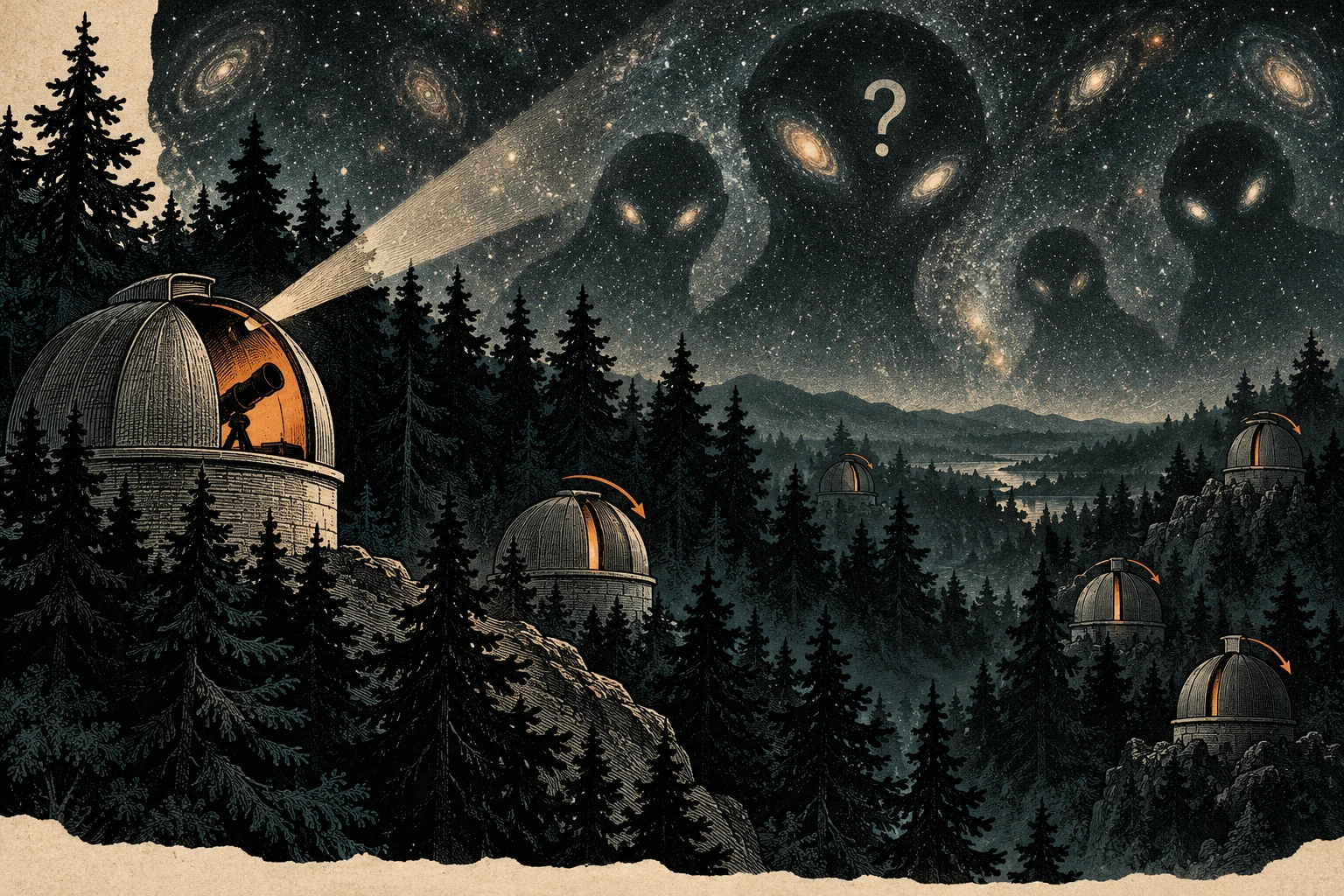
Uncertainty about others' intentions incentivizes hiding one's signals; the image depicts a speculative scenario rather than evidence of hostile civilizations.
AI-assisted illustration · conceptual metaphor View in visual quiz →Genesis and Global Lineage
The term comes from the Chinese science-fiction writer Liu Cixin’s 2008 novel The Dark Forest (黑暗森林, Hēi’àn sēnlín), the second volume of his Remembrance of Earth’s Past trilogy. In the novel, the protagonist Luo Ji develops “cosmic sociology” from axioms suggested to him by the astrophysicist Ye Wenjie, arriving at the image of the universe as a dark forest in which every civilization is an armed hunter stalking silently through the trees: if he spots another life-form, there is only one thing he can do—open fire. The underlying idea had precursors in Western astrobiology and science fiction: Fred Saberhagen’s Berserker stories (from 1963), David Brin’s 1983 survey of “deadly probes” in the Quarterly Journal of the Royal Astronomical Society, and Greg Bear’s The Forge of God (1987), which compared humanity broadcasting radio signals to a lost baby crying in a forest full of wolves. Liu gave this family of intuitions a quasi-axiomatic Hobbesian form and an unforgettable name; following Joel Martinsen’s 2015 English translation and the 2024 Netflix adaptation 3 Body Problem, the concept broke out of science fiction into three distinct arenas: astrobiological debates over SETI, international-relations and AI-safety theory, and digital media studies following Kickstarter co-founder Yancey Strickler’s May 2019 essay The Dark Forest Theory of the Internet.
Central European Lineage
Two decades before Liu Cixin’s novel, Stanisław Lem—formed intellectually in interwar Lwów (where he began medical studies in 1940–1941, now Lviv, Ukraine) and postwar Kraków—depicted the exact escalatory spiral that Liu later called the “chain of suspicion” in his final novel Fiasko (Fiasco, first published in German in 1986 and in Polish in Kraków in 1987). In Fiasco, the civilization of the planet Quinta is locked in an automated orbital arms race and resists external contact by every means; a terrestrial expedition determined to achieve first contact interprets Quinta’s silence and defensive actions as hostility, escalates through increasingly destructive demonstrations of force, and ends by obliterating the planet. Exposing oneself and insisting on communication triggers a lethal spiral that technological superiority only accelerates. While there is no evidence that Liu knew Fiasco, Lem’s novel functions as both an independent anticipation and a deep philosophical counterpoint. In Liu’s dark forest, annihilation follows from the cold, transparent game-theoretic calculation of hunters who understand the rules of the game identically; in Lem’s Fiasco (building on his earlier analysis of SETI in Chapter 3 of Summa technologiae, 1964), catastrophe springs from impenetrable cognitive alienness and the coercive “benevolence” of the stronger party demanding an answer.
Documented regional lineage · Link: 1. Compiled: October 2026.
-
anticipation 22 years
Central European Source: Stanisław Lem, “Fiasko”; Kraków, Poland, 1986
Global Circulation: dark forest theory — Liu Cixin, 2008
anticipation
22 yearsStanisław Lem, “Fiasko”
1986 · Kraków, Poland
dark forest theory
2008 · Liu Cixin
- Claim & Connection
- In “Fiasko” (“Fiasco,” German first edition 1986, Polish edition 1987), Stanisław Lem—intellectually formed in Lwów and Kraków—depicted a first-contact mission that ends in planetary annihilation: the civilization of Quinta resists contact by every means, and the terrestrial expedition, frustrated by its silence and suspecting a trap, escalates demonstrations of force until it destroys the planet. Two decades before Liu Cixin, Lem showed how the very act of revealing oneself and forcing contact triggers a spiral of suspicion that no technological superiority can halt. There is no evidence that Liu Cixin knew “Fiasco”; the parallel is recorded as an independent anticipation rather than a direct influence.
- Source Documentation
-
- primary source Stanisław Lem, „Fiasko”, Wydawnictwo Literackie, Kraków 1987 (pierwodruk: „Fiasko”, S. Fischer Verlag, Frankfurt am Main 1986; przekł. ang. Michael Kandel, Harcourt Brace Jovanovich 1987); chapters in orbit around Quinta: refusal of contact, destruction of the “Hermes” replica, bombardment of the ice ring, destruction of the planet. en.wikipedia.org ↗
- scholarly study Solaris.lem.pl, hasło „Fiasko”; paragraph on the Quintans resisting contact “by all means” and impenetrable alienness. solaris.lem.pl ↗
- biographical record Solaris.lem.pl, „Biografia”; born 1921 in Lwów; medical studies in Lwów 1940–1941 and after 1944; from 1946 in Kraków, studies at Jagiellonian University. solaris.lem.pl ↗
- Historical Context
- The parallel is both substantive and polemical: in Liu Cixin, annihilation follows from the cold game-theoretic calculation of a hunter; in Lem, from impenetrable cognitive alienness and the coercive “good intentions” of the side demanding contact. Hence the main text discusses Lem as both an anticipation and a philosophical counterpoint. The year 1986 refers to the German first edition (S. Fischer, Frankfurt am Main); the Polish edition appeared in 1987 in Kraków (Wydawnictwo Literackie).
Why Now
Between 2018 and 2026 the concept moved into mainstream strategic and cultural vocabulary for three reasons. First, the debate over METI (Messaging Extraterrestrial Intelligence)—actively transmitting high-powered signals toward exoplanets—became a concrete policy dispute after the launch of the Breakthrough Initiatives (2015), with “dark forest” serving as shorthand for the precautionary position against broadcasting Earth’s coordinates. Second, Yancey Strickler’s 2019 essay and Maggie Appleton’s 2023 sequel (The Expanding Dark Forest and Generative AI, written after the release of ChatGPT) turned the metaphor into a diagnosis of the contemporary internet: as the open web fills with ad-tech surveillance, outrage mobs, and synthetic AI-generated slop, humans retreat into unindexed “cozy web” spaces—private Discord servers, WhatsApp groups, and newsletters—where proving one’s humanity becomes the price of admission. Third, in geopolitics, blockchain MEV (maximal extractable value, where pending public transactions are front-run by predatory bots), and frontier AI labs since 2023, the dark forest frames capability-hiding and preemptive competition under uncertainty.
Explanatory Power
The model demonstrates that silence in a communication system need not indicate absence; it can be an equilibrium signal about the cost of visibility. Where naive intuition looks at an empty space and concludes “nobody is there,” dark forest theory asks: “what penalty on visibility makes everyone hide?” First, in astrobiology: it resolves the Fermi paradox without assuming that intelligent life is biologically rare—it need only be strategically cautious. Second, in digital platform design: it explains why expanding public reach and searchability often reduces candid human expression; anyone with a reputation to lose migrates to encrypted or ephemeral channels, leaving the public square to bots, spammers, and combatants with nothing to lose. Third, in international security and AI race dynamics: it formalizes how two defensive actors can lock themselves into preemptive aggression without either harboring malice—because a reassurance signal is indistinguishable from a feint, and the “technological explosion” means that a rival’s harmlessness today offers zero guarantee of its harmlessness five years from now.
Axes of Debate
Derived theorem or smuggled offensive-realist premise? (Ćirković)
Astrobiologists and philosophers of science such as Milan M. Ćirković (The Great Silence, 2018) and Stephen Webb point out that Liu’s “axioms” are not laws of nature, but the assumptions of John Mearsheimer’s offensive realism projected onto the galaxy: if you stipulate finite resources, exponential expansion, zero communication, and costless first strikes from the outset, preemptive war is baked into the premises rather than discovered as a theorem. Strongest counterargument: Game theorists reply that a dark forest equilibrium does not require every civilization to be a paranoid predator; in a setting where a single defector can sterilize a planet at relativistic speeds, even a tiny fraction of aggressive actors forces peaceful civilizations to remain silent and treat any noisy newcomer as a mortal threat. Nature of the dispute: substantive — it turns on how sensitive the hiding/striking equilibrium is to relaxing the assumptions of zero communication and guaranteed first-strike success.
The physics and economics of a first strike
Physicists and military strategists note that launching a relativistic strike across light-years is neither cheap nor invisible: firing a weapon reveals the attacker’s own existence and predisposition to third-party observers, while a target civilization that has already spread across multiple star systems or asteroid belts acquires second-strike retaliatory capacity (mutually assured destruction), breaking the dark forest logic. Strongest counterargument: Within Liu’s model, the “technological explosion” bridges the gap: because technological breakthroughs are non-linear and unpredictable, waiting to see whether a detected civilization will develop second-strike capability is far riskier than striking while it is still confined to a single cradle planet. Nature of the dispute: mixed — part of the argument concerns astrophysical constraints on detection and retaliation, while part projects Cold War nuclear-deterrence anxieties onto interstellar scales.
The “dark forest of the internet”: sharp diagnosis or elitist retreat?
Media sociologists acknowledge that Strickler’s metaphor captures the migration from public social feeds to private group chats, but warn that calling the public internet a “dark forest” romanticizes the retreat of affluent professionals into gated digital clubs while abandoning the public sphere to disinformation. Strongest counterargument: Strickler and Appleton are diagnosing an architectural incentive rather than preaching elitism: when public platforms monetize outrage and scrape every public sentence into AI training sets without consent, retreating off the public index is a rational act of self-defense by ordinary users and creators. Nature of the dispute: rhetorical — both sides agree on the empirical migration toward private channels while debating whether the predator-and-prey metaphor overdramatizes platform segmentation.
Underappreciated Angle
Reception of the concept is almost universally hypnotized by the image of the ruthless hunter, overlooking the fact that the entire dark forest rests on a single fragile bottleneck: the complete absence of institutions that make commitments credible. The dark forest is not a theory of cosmic malice; it is a theory of an institutionless state of nature. In Liu’s universe there is no third-party arbiter, no shared reputation ledger, no repeated-game iteration (because the first interaction is fatal), and no costly signaling mechanism that cannot be faked. That makes the concept less a prophecy about aliens than a negative mirror showing what sustains cooperation in human societies: repeated interactions, verifiable audits, shared legal frameworks, and communication channels where lying carries a price. And as Stanisław Lem showed in Fiasco, even without predatory calculation, a dark forest can erupt whenever actors lack a shared hermeneutic framework to distinguish defensive silence from hostile preparation. For technology and platform governance, the practical lesson is the inverse of the survivalist slogan: instead of asking how to build thicker camouflage inside the forest, the task is to design the verification and reputation institutions that make stepping into the clearing safe.
One-Sentence Takeaway
Dark forest theory does not claim that others are inherently malicious; it shows that where no institutions exist to make intentions verifiable, visibility itself is priced as an existential threat—in the open internet and frontier AI races no less than in the cosmos.
Related Concepts Network
How this concept reinforces, constrains, or complements other analytical frameworks in the corpus. View on graph →
-
Fermi paradox reinforces
The dark forest is one of the sharpest proposed answers to why we see no evidence of extraterrestrial civilizations: they remain silent because silence is the dominant survival strategy.
-
Non-zero-sum games in tension
The theory assumes that civilizations with unverifiable intentions cannot establish a positive-sum game because the cost of a single mistake is existential; critics reply that this is a built-in premise rather than a derived conclusion.
-
Moloch and coordination failure reinforces
Every actor would prefer a peaceful universe without preemptive strikes, yet none can trust others to hold their fire first—a textbook coordination trap without communication.
-
Information asymmetry complements
Liu’s “chain of suspicion” pushes information asymmetry to an infinite regress: actors do not know not only the other’s intentions, but also how the other assesses their own intentions.
-
Existential risk complements
Debates over active messaging to extraterrestrial intelligence (METI) and over capability disclosure in the frontier AI race treat visibility itself as an existential risk factor.
-
Surveillance capitalism complements
The “dark forest of the internet” describes users retreating into unindexed private spaces in response to an open web dominated by tracking, ad extraction, and automated harassment.
-
Black Swan complements
Liu’s “technological explosion” captures the insight that a neighbor’s weakness today tells you nothing about its lethal capability tomorrow, giving threat distributions a fat tail.
Reading Canon & Translation Bridge
Foundational texts, introductions, and critical perspectives—with availability of English and Polish editions.
-
foundational text 2008 · Chinese
Liu Cixin, 黑暗森林 (Hēi'àn sēnlín)
The source of the concept: Luo Ji’s conversation with Ye Wenjie laying out the axioms of “cosmic sociology” and his climactic exposition of the universe as a dark forest filled with armed hunters.
In English: “The Dark Forest”, Tor Books 2015, trans. Joel Martinsen
In Polish: “Ciemny las”, Dom Wydawniczy Rebis 2017, trans. Andrzej Jankowski
-
introduction & synthesis 1983 · English
David Brin, The ‘Great Silence’: the Controversy Concerning Extraterrestrial Intelligent Life
A landmark survey in the Quarterly Journal of the Royal Astronomical Society (vol. 24, pp. 283–309) that systematized hypotheses for the Great Silence—including “deadly probes” and cautious hiding—a quarter century before Liu’s novel.
In English: original text written in English
In Polish: no Polish edition
-
critical perspective 1987 · Polish
Stanisław Lem, Fiasko
A novel about a contact mission that ends in planetary destruction not through cold hunter calculation, but through the inability to comprehend radical alienness—the sharpest literary counterpoint to Liu’s rationalist geometry.
In English: “Fiasco”, Harcourt Brace Jovanovich 1987, trans. Michael Kandel
In Polish: original text written in Polish
-
cross-disciplinary 1964 · Polish
Stanisław Lem, Summa technologiae
The chapter on “Cosmic Civilizations” shows how 1960s thinkers analyzed the longevity, distribution, and limits of SETI listening programs—the backdrop against which the dark forest emerges as a late, pessimistic answer.
In English: “Summa Technologiae”, University of Minnesota Press 2013, trans. Joanna Zylinska
In Polish: original text written in Polish
-
critical perspective 2018 · English
Milan M. Ćirković, The Great Silence: Science and Philosophy of Fermi's Paradox
A systematic astrobiological and philosophical classification of solutions to the Fermi paradox, situating the dark forest among “sociological” hypotheses and exposing how many hidden assumptions it requires.
In English: original text written in English
In Polish: Polish edition not verified
-
introduction & synthesis 2015 · English
Stephen Webb, If the Universe Is Teeming with Aliens... Where Is Everybody? Seventy-Five Solutions to the Fermi Paradox and the Problem of Extraterrestrial Life
An accessible catalog of seventy-five proposed solutions (2nd ed., Springer 2015; 1st ed. 2002), demonstrating how small a fraction of the theoretical space relies on cosmic hostility.
In English: original text written in English
In Polish: Polish edition not verified
-
cross-disciplinary 2019 · English
Yancey Strickler, The Dark Forest Theory of the Internet
The May 2019 essay that transferred Liu’s metaphor to digital culture: users retreat from the open web into private newsletters, podcasts, and group chats because public visibility invites ad tracking, shaming cascades, and bots.
In English: original text written in English
In Polish: no Polish edition
-
cross-disciplinary 2023 · English
Maggie Appleton, The Expanding Dark Forest and Generative AI
Extends Strickler’s thesis after the launch of ChatGPT: the flood of synthetic LLM text forces humans into closed spaces and turns proving one’s humanity into a new tax on online visibility.
In English: original text written in English
In Polish: no Polish edition
Primary-Source Quotes
This is also what the internet is becoming: a dark forest.