Culture & Power #156
Hyperstition
original term: hyperstition (Eng.) · fikcja, która się urzeczywistnia, hiperstycyjność
Global-circulation concept — no documented lineage in Central Europe. jump to documentation ↓
Working Definition
Hyperstition is a fiction that makes itself real: an idea, forecast, myth, or narrative which, by circulating through culture, triggers behaviors and investments that bring about the very state of affairs it describes. Three features distinguish it from an ordinary sociological self-fulfilling prophecy: the feedback loop is deliberately engineered or consciously exploited; its fictional status is not an epistemic flaw, but its active propulsion mechanism; and it produces not a single isolated event, but a durable technological or institutional reality that retroactively appears to have been inevitable all along. In the technical vocabulary of Nick Land and the Cybernetic Culture Research Unit (CCRU), hyperstition is a positive-feedback circuit with culture as a component; in loose online and marketing parlance, it means “manifesting” or “memeing” a future into existence. Operationally, it shifts the analytical question from “is this claim true?” to “what does this claim do once enough people and capital start acting as if it were true?”
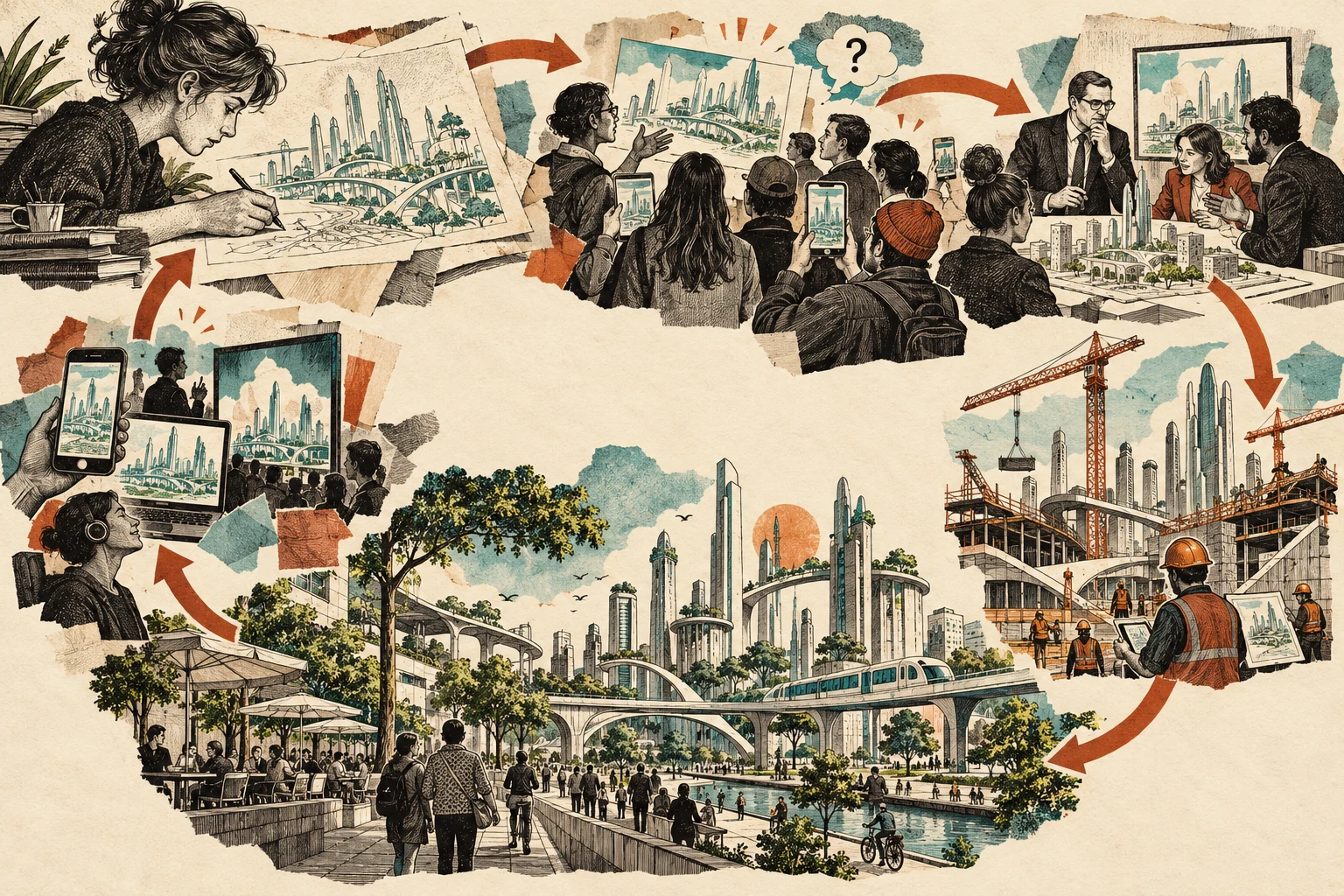
An imagined blueprint mobilizes expectations and actions that help bring it into being—a social feedback loop of fiction rather than supernatural prophecy.
AI-assisted illustration · conceptual metaphor View in visual quiz →Genesis and Global Lineage
The portmanteau word was coined around 1995 by Nick Land, then a lecturer in continental philosophy at the University of Warwick (1987–1998), fusing hyper- and superstition: a superstition that, instead of remaining a false belief about the world, re-engineers the world to match itself. The concept incubated inside the Cybernetic Culture Research Unit (CCRU), the rogue interdisciplinary collective founded at Warwick in the mid-1990s by Sadie Plant and Land alongside Kodwo Eshun, Iain Hamilton Grant, and later Mark Fisher, Ray Brassier, and Reza Negarestani. Drawing on Gilles Deleuze and Félix Guattari, second-order cybernetics, H. P. Lovecraft’s fictional Necronomicon, 1990s jungle music, and the early web, the CCRU did not write dry treatises defining hyperstition; it practiced it through fictional academic personae, Lemurian pseudomythology, and occult numerology—texts collected posthumously in Ccru: Writings 1997–2003 (2015). After the group dissolved, the concept branched along three paths: Negarestani’s Cyclonopedia (2008) turned it into the genre of “theory-fiction”; Mark Fisher’s Capitalist Realism (2009) inverted it to diagnose neoliberalism as a negative hyperstition that paralyzes alternatives; and Land himself, after relocating to Shanghai, tied it to unconditional accelerationism and the neo-reactionary “Dark Enlightenment.”
Central European Lineage
We found no documented link between this concept and the intellectual history or historical experience of Central Europe.
We found no documented link between this concept and the intellectual history or historical experience of Central Europe (by our methodology, this means “none found,” not “none exists”; as of October 2026).
Why Now
The years between 2018 and 2026 supplied a live planetary laboratory for the concept. First, Bitcoin and cryptocurrency markets offered a textbook economic hyperstition: tokens without intrinsic use value whose market capitalization is a direct function of a collective narrative about their future adoption, where every bull-market bubble and crash demonstrates that belief is the underlying mechanism rather than mere ornament. Second, QAnon (from 2017 onward) demonstrated political hyperstition: anonymous fictional “drops” on imageboards generated a mass movement, physical violence, and elected members of the US Congress. Third, the post-2022 artificial-intelligence boom operates hyperstitionally on both its utopian and apocalyptic flanks: grand announcements that Artificial General Intelligence (AGI) is imminent mobilize hundreds of billions of dollars in data centers, chip fabs, and talent that actively accelerate the capability curve, while “Roko’s Basilisk”—originally a 2010 thought experiment on the rationalist forum LessWrong about a future superintelligence punishing those who failed to help build it—circulates as a literal parable of a self-actualizing idea. Hyperstition has become analytically indispensable wherever traditional tools of ideology critique (fact-checking, debunking) fail—because a hyperstition does not pretend to be an already established fact; it openly works to become one.
Explanatory Power
The concept makes causal agency visible where standard epistemology sees only error or hype. First, it explains the performative power of classic technological fictions: William Gibson coined “cyberspace” in a 1982 short story and Neuromancer (1984) as a literary invention, yet that image guided a generation of engineers and venture capitalists who built the commercial internet in its likeness; by contrast, the 2021 corporate rebranding around the “Metaverse” failed not as an empirical forecast, but as an aborted hyperstition that failed to recruit enough belief to close the feedback loop. Second, it clarifies why political movements and revolutionary vanguards invest so heavily in the rhetoric of historical inevitability (“history is on our side,” “the future is already here”): proclaiming inevitability is a coordination device designed to make opponents capitulate in advance. Third, it names the core genres of Silicon Valley’s future-production economy: the vaporware product demo, the crypto protocol whitepaper without users, and the startup founder manifesto are hyperstitional artifacts whose success is measured not by their present correspondence to reality, but by their capacity to attract the capital and engineers required to make them true.
Axes of Debate
Genuine theoretical novelty (Land, CCRU) versus gothic repackaging of Merton and Soros
Sociologists and economists point out that W. I. Thomas’s theorem (1928: “If men define situations as real, they are real in their consequences”), Robert K. Merton’s “self-fulfilling prophecy” (1948), and George Soros’s theory of financial market reflexivity (1987) have analyzed positive feedback loops between belief and social reality for nearly a century, arguing that the CCRU merely dressed a standard sociological mechanism in cyberpunk and Lovecraftian occultism. Strongest counterargument: Merton analyzed the self-fulfilling prophecy as an unintended cognitive pathology (such as a panicked bank run or racial prejudice) that enlightened policy should dissolve by restoring objective truth; hyperstition analyzes a deliberate design technique in which actors consciously deploy fictions—which nobody even needs to believe literally—to bootstrap a new technological or social order. That is the difference between diagnosing an error and writing an operating manual. Nature of the dispute: mixed — the underlying feedback mechanism is genuinely older, but shifting from a sociology of error to an engineering of self-realizing fictions changes how the phenomenon is used and studied.
Analytical theory of performativity versus irresponsible rhetorical posture (Noys)
Marxist critics such as Benjamin Noys (Malign Velocities, 2014) charge that “hyperstition” functions as an intellectual alibi: it allows theorists and online provocateurs to disavow responsibility for reactionary claims (“it’s just theory-fiction, an experiment”) while simultaneously celebrating their real-world causal impact whenever those claims catch on. Strongest counterargument: Strategic ambiguity between fiction and program is precisely how contemporary media ecosystems, financial markets, and extremist networks operate; refusing to theorize that mechanism on moral grounds leaves critics disarmed before actors—from central bankers managing inflation expectations to meme-warfare campaigns—who use performative fictions every day. Nature of the dispute: rhetorical — both sides agree on how the feedback loop works, clashing over whether theorists should adopt an ironic, complicit style when describing it.
Politically neutral tool (left accelerationism) versus structural bias toward capital and algorithms
Left accelerationists and cultural theorists following the late Mark Fisher argue that hyperstition is a neutral weapon of collective imagination: emancipatory movements—from the nineteenth-century labor movement’s myth of the General Strike (Georges Sorel) to feminist manifestos—have always relied on Counter-hyperstitions to break the spell of “capitalist realism.” Strongest counterargument: Critics reply that the concept was forged to describe impersonal, decentralized markets and algorithmic networks rather than democratic deliberation; in an attention economy driven by venture capital and viral outrage, hyperstitional loops systematically favor capital-backed hype and conspiratorial panic over slow, democratic institution-building. Nature of the dispute: substantive — it concerns whether the medium of viral positive feedback structurally privileges certain political and economic actors over others.
Underappreciated Angle
The most insidious property of a hyperstition is not that fictions can become real, but that a successful hyperstition erases its own fictional origin. Once the positive-feedback loop closes and hardens into physical infrastructure, law, or market convention, the realized future looks retroactively like a natural necessity, and the speculative myth that bootstrapped it is forgotten as a quaint historical anecdote. “Cyberspace,” fiat central-bank money, and Moore’s Law (originally an empirical observation by Gordon Moore in 1965 that semiconductor manufacturers turned into a coordinated industry roadmap so as not to fall behind competitors) no longer feel like fictions anyone had to believe in; they simply feel like the world. Hyperstition is therefore also a theory of historical amnesia: it explains why societies so quickly forget that their most rigid institutions, currencies, and technological trajectories began as someone’s contested speculation. For analysts, the practical corollary is clear: the hyperstitions that matter most are not the noisy, half-baked memes currently trending on X, but the quiet, completed ones that have already succeeded so thoroughly that we now mistake them for laws of nature.
One-Sentence Takeaway
When evaluating a bold narrative about the future, do not ask only whether it is currently true; ask how much capital, talent, and institutional coordination it is capable of recruiting until its initial falsity ceases to matter.
Related Concepts Network
How this concept reinforces, constrains, or complements other analytical frameworks in the corpus. View on graph →
-
Accelerationism reinforces
Hyperstition is the operational mechanism of accelerationism: announcing a future is meant to hasten its arrival, and accelerationism itself functions as a hyperstition of its own trajectory.
-
Memetics complements
Memetics describes how ideas replicate; hyperstition asks when a replicating idea begins to bring about the material state of affairs it describes.
-
Speculative realism complements
Both currents grew out of the same milieu (Warwick, Urbanomic, Negarestani, Brassier), yet speculative realism defends a reality independent of thought whereas hyperstition investigates reality manufactured by thought.
-
Hypernormalization in tension
Hypernormalization is a fiction in which nobody believes yet everyone performs; hyperstition is a fiction that works precisely because actors invest belief and capital in it.
-
Post-truth in tension
The post-truth diagnosis assumes that falsehood displaces an existing fact; hyperstition holds that a fiction can manufacture a new fact, unsettling any simple binary between truth and lie.
-
Overton window reinforces
The Overton window shifts when an implausible proposal is treated as inevitable until it becomes policy—a local political case of a hyperstitional loop.
-
Goodhart’s law complements
Once a forecast becomes a target, it starts shaping the very reality it was supposed to measure; Goodhart’s law is hyperstition seen from the angle of indicators.
Reading Canon & Translation Bridge
Foundational texts, introductions, and critical perspectives—with availability of English and Polish editions.
-
foundational text 2015 · English
Ccru (Cybernetic Culture Research Unit), Ccru: Writings 1997–2003
Collected texts of the Warwick collective (Time Spiral Press 2015; Urbanomic 2017), in which hyperstition appears not as an academic definition, but as an enacted practice: fictional personae, numerology, Lemurian pseudomythology, and a conceptual glossary.
In English: original text written in English
In Polish: Polish edition not verified
-
foundational text 2011 · English
Nick Land, Fanged Noumena: Collected Writings 1987–2007
Selected writings of Nick Land from 1987–2007 (Urbanomic/Sequence Press, ed. Robin Mackay and Ray Brassier), laying out the philosophical backdrop of the concept: Deleuze and Guattari, cybernetics, critique of Kant, and capital as an autonomous process.
In English: original text written in English
In Polish: Polish edition not verified
-
introduction & synthesis 2009 · English
Delphi Carstens, Nick Land, Hyperstition: An Introduction (wywiad)
The clearest exposition of the concept in Land’s own words: a positive-feedback circuit with culture as a component, illustrated through monetary confidence and cyberspace (Orphan Drift Archive: https://www.orphandriftarchive.com/articles/hyperstition-an-introduction/).
In English: original text written in English
In Polish: Polish edition not verified
-
introduction & synthesis 2008 · English
Reza Negarestani, Cyclonopedia: Complicity with Anonymous Materials
A work of “theory-fiction” (re.press) in which petroleum, Middle Eastern demonology, and the War on Terror form a hyperstitional system; the most widely cited demonstration of the concept in action.
In English: original text written in English
In Polish: Polish edition not verified
-
critical perspective 2014 · English
Benjamin Noys, Malign Velocities: Accelerationism and Capitalism
A Marxist critique of accelerationism that dissects the CCRU’s hyperstitional rhetoric as a fantasy of fusion with capital and asks whose interests are served by proclaiming a future as inevitable.
In English: original text written in English
In Polish: Polish edition not verified
-
cross-disciplinary 2009 · English
Mark Fisher, Capitalist Realism: Is There No Alternative?
A former CCRU member inverts the concept: shows how neoliberal capitalism operates as a negative hyperstition—the fiction that “there is no alternative,” which makes itself true by paralyzing political imagination.
In English: original text written in English
In Polish: “Realizm kapitalistyczny. Czy nie ma alternatywy?”, Instytut Wydawniczy Książka i Prasa 2020, trans. Andrzej Karalus
-
cross-disciplinary 1948 · English
Robert K. Merton, The Self-Fulfilling Prophecy
The classic Antioch Review article (vol. 8, no. 2) against which hyperstition defines itself: analyzes the sociological mechanism of a self-fulfilling prophecy (such as a bank run), but treats it as an institutional error to be corrected rather than a deliberately engineered design tool.
In English: original text written in English
In Polish: Polish edition not verified
-
introduction & synthesis 2019 · Polish
Gabriela Korwin-Piotrowska, Hiperstycyjne anty-praxis. Od #cavetwittera do Ccru
A master’s thesis at Jagiellonian University in Kraków (supervised by Andrzej Juszczyk, available in the Jagiellonian University Repository); one of the few Polish scholarly studies reconstructing the history of the CCRU and tracing hyperstition into online #cavetwitter subcultures.
In English: no English edition
In Polish: original text written in Polish
Primary-Source Quotes
the experimental (techno-)science of self-fulfilling prophecies
a positive feedback circuit including culture as a component