AI Architecture #118
RAG (Retrieval-Augmented Generation)
original term: retrieval-augmented generation (Eng.) · generowanie wspomagane wyszukiwaniem, generacja z wyszukiwaniem
Global-circulation concept — no documented lineage in Central Europe. jump to documentation ↓
Working Definition
Retrieval-Augmented Generation (RAG) is a hybrid software architecture in which a language model does not answer a user’s query solely from the implicit knowledge compressed into its neural weights (parametric memory), but first queries an external document index (non-parametric memory), injects the most relevant retrieved passages into its active context window, and generates its response conditioned on those explicit texts. Functionally, it decouples two things that a standalone language model fuses together: linguistic and reasoning fluency on the one hand, and an updatable, auditable store of factual records on the other. In its original academic formulation (Lewis et al., May 2020), RAG denoted a specific end-to-end differentiable model that jointly trained a dense vector retriever (DPR) and a sequence-to-sequence generator (BART) over a Wikipedia index. In industry usage since 2023, the acronym has broadened to cover any pipeline that runs “retrieve chunks from a search index or database, paste them into an LLM prompt, and generate an answer with citations”—a distinction worth keeping in mind because most enterprise deployments use the modular stitched pipeline while borrowing the scientific authority of the original end-to-end research.
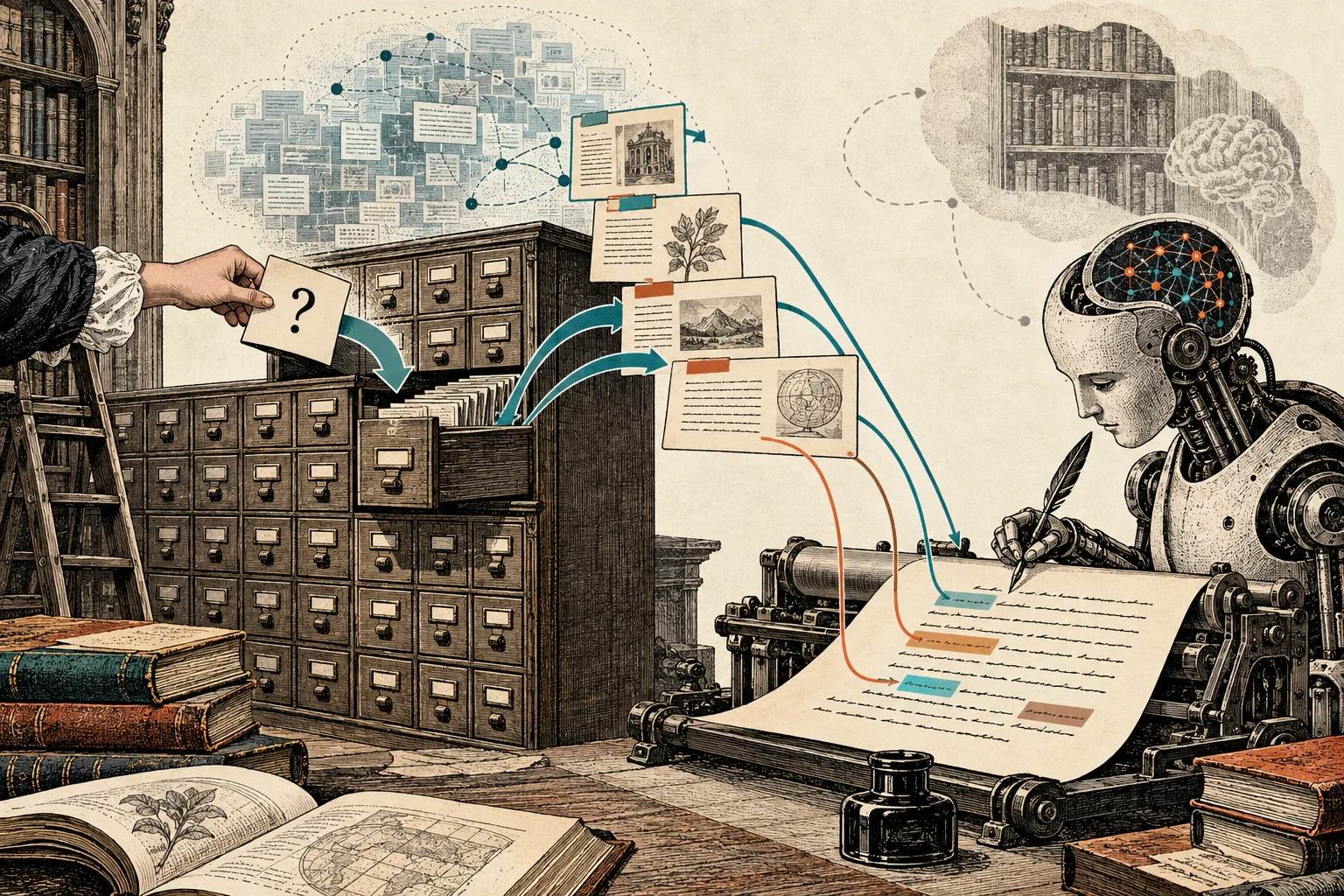
Retrieving external documents precedes drafting the response; source links aid verification but do not guarantee that retrieved passages are pertinent or true.
AI-assisted illustration · conceptual metaphor View in visual quiz →Genesis and Global Lineage
The term was coined in May 2020 by a team from Facebook AI Research (FAIR) and University College London—led by Patrick Lewis, Ethan Perez, Aleksandra Piktus, Fabio Petroni, and Douwe Kiela—in their NeurIPS 2020 paper Retrieval-Augmented Generation for Knowledge-Intensive NLP Tasks. It answered a fundamental problem diagnosed a year earlier by the same lab in Language Models as Knowledge Bases? (Petroni et al., 2019): while pretrained Transformers like BERT store surprising amounts of relational trivia in their weights, that parametric memory cannot be easily expanded, edited when facts change, or audited for provenance without expensive retraining. Two parallel research streams converged in early 2020 to solve this: open-domain question answering using dense dual-encoder vector search (Dense Passage Retrieval, Karpukhin et al., April 2020) and Google Research’s REALM (Guu et al., February 2020) and ORQA (Lee et al., 2019), which backpropagated through a document retriever during language-model pretraining. Lewis and colleagues united these threads into a clean, general-purpose recipe pairing a parametric generator with a non-parametric FAISS vector index, followed in December 2021 by DeepMind’s RETRO (Borgeaud et al.), which showed that a 25-times smaller model retrieving from a two-trillion-token database could match GPT-3. After the launch of ChatGPT in late 2022, open-source orchestration libraries (LangChain, LlamaIndex) and vector-database startups (Pinecone, Weaviate, Qdrant, Milvus) turned “RAG” into the default architectural pattern of enterprise AI.
Central European Lineage
We found no documented link between this concept and the intellectual history or historical experience of Central Europe.
We found no documented link between this concept and the intellectual history or historical experience of Central Europe (by our methodology, this means “none found,” not “none exists”; as of October 2026).
Why Now
Between 2022 and 2026, three practical pressures turned an academic NLP technique into the backbone of commercial AI deployment. First, ChatGPT’s consumer adoption in late 2022 made hallucinations a high-visibility professional liability—dramatized in May 2023 when New York attorneys in Mata v. Avianca were sanctioned for submitting a ChatGPT-written brief full of fabricated judicial opinions; workflows in law, medicine, and public administration demanded verifiable citations to real statutes and case files (such as Poland’s Dziennik Ustaw or corporate compliance manuals). Second, enterprises realized that fine-tuning weights on confidential internal documents was slow, expensive, prone to catastrophic forgetting, and incapable of enforcing row-level access permissions—whereas a RAG index checks user permissions at retrieval time and reflects updated documents within seconds. Third, every major AI search product launched between 2023 and 2026 (Copilot, Perplexity, Google AI Overviews, ChatGPT Search) is at its core a web-scale RAG system. Simultaneously, million-token context windows in 2024–2025 sparked a fierce engineering debate over whether “Long Context” will replace RAG for medium-sized collections, while studies like Lost in the Middle (Liu et al., 2023) proved that neither context stuffing nor naive vector chunking is foolproof.
Explanatory Power
The concept forces analysts to disentangle three failure modes that public talk of “AI accuracy” lumps together: whether the model reasons coherently, whether it has access to the right documents, and whether it privileges provided documents over its pretraining priors. First, in debugging: when a medical or legal AI assistant errs, RAG separates retrieval failure (the search engine failed to surface the relevant clause among the top-k chunks) from generation failure (the clause was in the prompt, but the LLM misread a negation or hallucinated an unsupported synthesis)—two distinct engineering problems requiring different fixes. Second, in governance: RAG turns knowledge updates from a machine-learning problem into a document-curation problem; revoking an outdated hospital protocol or tax rule takes effect the instant the document leaves the index, offering an operational answer to the GDPR’s “right to rectification” and “right to erasure” without un-training a neural network. Third, it exposes the limits of pure vector similarity: dense embeddings compress a 500-word passage into a single vector, frequently missing exact statute numbers, SKUs, or rare names—explaining why production systems combine dense vectors with classic lexical search (BM25) and cross-encoder re-rankers.
Axes of Debate
RAG versus Million-Token Long Context (“Is RAG dead?”)
Architects of frontier models with 1M–2M token context windows (at Google DeepMind and Anthropic from 2024 onward) argue that for corpora up to several thousand pages—like a policy handbook or medium codebase—chopping documents into 500-token chunks destroys cross-document structure, whereas placing the whole corpus into a cached long-context prompt lets self-attention reason holistically across the text. Strongest counterargument: Systems engineers note that enterprise archives hold millions of documents no context window can fit, processing a million tokens per query remains costly in compute and latency, and as Nelson Liu et al. proved in Lost in the Middle (2023), attention fidelity degrades when relevant facts are buried amidst hundreds of thousands of distracting tokens—making retrieval and long context partners rather than substitutes. Nature of the dispute: substantive — an empirical systems trade-off governed by corpus scale, latency budgets, prefix-caching economics, and access-control granularity.
Does RAG cure hallucinations, or manufacture more dangerous ones?
Enterprise AI vendors routinely market RAG as a “hallucination-free” architecture because the model is instructed to answer strictly from retrieved passages and attach clickable footnotes. Strongest counterargument: Empirical evaluations—including Kurt Shuster et al. (2021) and a 2024 Stanford audit of commercial legal-research RAG tools (Magesh et al.), which found specialized legal RAG systems still hallucinated or misrepresented holdings in 17% to 33% of queries—show that generators conflate adjacent chunks, miss statutory exceptions truncated at chunk boundaries, or attach real citation badges to fabricated inferences, producing citation-laundered hallucinations that lull human reviewers. Nature of the dispute: mixed — the measurable reduction in baseline fabrication is substantive, while vendor claims of “guaranteed factual grounding” are commercial rhetoric.
End-to-end differentiable training versus modular “Lego” pipelines (Naive, Advanced, and Agentic RAG)
Academic ML researchers (Lewis et al., Guu et al., Borgeaud et al., and creators of Self-RAG, 2023, and GraphRAG, 2024) argue that naive “chunk-embed-paste” pipelines fail on multi-hop questions because retriever and generator are not trained jointly. Industry practitioners favor decoupled, off-the-shelf components—pairing a commercial embedding API, hybrid search index, re-ranker, and an agentic tool-calling loop where the LLM iteratively rewrites search queries. Strongest counterargument: Decoupled modular pipelines won in industry because enterprises swap foundation models every six months and audit document indexes independently without re-indexing embeddings; moreover, giving an LLM an iterative search tool (Agentic RAG) achieves multi-hop retrieval at inference time without joint gradient training. Nature of the dispute: substantive — an engineering division of labor between coupled academic optimization and maintainable industrial modularity.
Underappreciated Angle
The most overlooked consequence of RAG is that it quietly shifts epistemic power away from the neural network and back onto the oldest, most politically charged machinery in computer science: indexing, chunking, and search ranking. When a user receives a fluent RAG answer with three neat footnotes, the interface creates an illusion of objective completeness—hiding the 999,995 fragments the similarity threshold discarded before the LLM woke up. Every mundane parameter in a RAG pipeline is an invisible editorial policy: how documents are chunked (which can sever a rule from its exception on the next page), which embedding model defines “similarity,” whether recency outweighs authority, and which folders entered the index. From a security perspective, RAG also opens the door to corpus poisoning and indirect prompt injection: an attacker who slips a poisoned document into a corporate wiki or web index can craft it to score high on vector similarity and hijack generator outputs for every user asking about that topic. While AI governance fixates on model weights, in institutions using RAG, truth is decided upstream—by whoever holds the keys to the index.
One-Sentence Takeaway
RAG does not teach a language model what is true; it shifts the burden of truth from the model’s weights onto the search index—and onto whoever decided how that index was chunked, ranked, and curated.
Related Concepts Network
How this concept reinforces, constrains, or complements other analytical frameworks in the corpus. View on graph →
-
Large language models (LLMs) complements
RAG attaches an external non-parametric memory to a language model that the base network lacks on its own: up-to-date, hot-swappable, and inspectable down to the source paragraph.
-
Model hallucinations constrains
Grounding generation in retrieved documents substantially reduces fabricated facts, but does not eliminate them: the generator can still misread a passage, conflate two chunks, or ignore the retrieved text in favor of its parametric priors.
-
Transformer reinforces
Both halves of a standard RAG pipeline—the dense query/passage encoder and the autoregressive generator—are Transformers; RAG is a modular systems architecture rather than a rival neural block.
-
Foundation models complements
RAG is the dominant enterprise pattern for adapting a frozen general-purpose foundation model to proprietary institutional data without the cost or risk of updating model weights.
-
Network epistemology in tension
An AI answer adorned with numbered source citations looks like transparent epistemic justification, yet the selection of which five passages the model saw was decided silently by an upstream retrieval ranking metric.
-
Model collapse constrains
If the external document index or web search corpus becomes flooded with machine-generated slop, the non-parametric memory loses its status as an independent anchor in human reality.
Reading Canon & Translation Bridge
Foundational texts, introductions, and critical perspectives—with availability of English and Polish editions.
-
foundational text 2020 · English
Patrick Lewis, Ethan Perez, Aleksandra Piktus, Fabio Petroni, Vladimir Karpukhin, Naman Goyal, Heinrich Küttler, Mike Lewis, Wen-tau Yih, Tim Rocktäschel, Sebastian Riedel, Douwe Kiela, Retrieval-Augmented Generation for Knowledge-Intensive NLP Tasks
The NeurIPS 2020 paper (posted to arXiv May 22, 2020) from Facebook AI Research and UCL that coined the name RAG: combines a pretrained seq2seq generator (“parametric memory”) with a dense vector index of Wikipedia (“non-parametric memory”) trained end-to-end.
In English: original text written in English
In Polish: no Polish edition
-
foundational text 2020 · English
Kelvin Guu, Kenton Lee, Zora Tung, Panupong Pasupat, Ming-Wei Chang, REALM: Retrieval-Augmented Language Model Pre-Training
A parallel February 2020 paper from Google Research that integrated a differentiable neural document retriever directly into masked language-model pretraining, showing that the “model plus external index” paradigm emerged simultaneously across multiple labs.
In English: original text written in English
In Polish: no Polish edition
-
foundational text 2020 · English
Vladimir Karpukhin, Barlas Oğuz, Sewon Min, Patrick Lewis, Ledell Wu, Sergey Edunov, Danqi Chen, Wen-tau Yih, Dense Passage Retrieval for Open-Domain Question Answering
The retrieval engine (DPR) that made the original RAG work: showed that dense dual-encoder BERT embeddings indexed in FAISS decisively beat classic BM25 keyword matching on open-domain question answering.
In English: original text written in English
In Polish: no Polish edition
-
introduction & synthesis 2023 · English
Yunfan Gao, Yun Xiong, Xinyu Gao, Kangxiang Jia, Jinliu Pan, Yuxi Bi, Yi Dai, Jiawei Sun, Meng Wang, Haofen Wang, Retrieval-Augmented Generation for Large Language Models: A Survey
The most widely cited technical survey of modern LLM-era RAG (December 2023): codifies the evolution from Naive RAG to Advanced RAG (query rewriting, re-ranking) and Modular/Agentic RAG.
In English: original text written in English
In Polish: no Polish edition
-
introduction & synthesis 2021 · English
Kurt Shuster, Spencer Poff, Moya Chen, Douwe Kiela, Jason Weston, Retrieval Augmentation Reduces Hallucination in Conversation
The April 2021 empirical study establishing that conditioning dialogue models on retrieved knowledge significantly lowers—though does not zero out—extrinsic hallucination rates.
In English: original text written in English
In Polish: no Polish edition
-
critical perspective 2023 · English
Nelson F. Liu, Kevin Lin, John Hewitt, Ashwin Paranjape, Michele Bevilacqua, Fabio Petroni, Percy Liang, Lost in the Middle: How Language Models Use Long Contexts
Demonstrates a U-shaped attention bias in which language models reliably use information placed at the very beginning or very end of a prompt while missing relevant facts buried in the middle of retrieved passages.
In English: original text written in English
In Polish: no Polish edition
-
cross-disciplinary 1945 · English
Vannevar Bush, As We May Think
The classic 1945 “Atlantic Monthly” essay proposing the Memex—an associative external memory desk linking trails of documents—reminding us that the dream of coupling active reasoning to rapid associative retrieval predates neural networks by decades.
In English: original text written in English
In Polish: Polish edition not verified