AI Architecture #112
Large language models (LLMs)
original term: large language model (Eng.) · wielkoskalowy model językowy, duży model językowy, LLM
Central European lineage: 1 thread (documented influence) · 2010–2020 · jump to documentation ↓
Working Definition
A large language model (LLM) is a deep neural network—almost always built on the Transformer architecture—trained across hundreds of billions or trillions of text tokens on the self-supervised objective of predicting the next token in a sequence, with parameter counts ranging from billions to trillions. Its defining property is not hardcoded domain knowledge, but the fact that scaling a single universal next-token prediction objective across vast corpora induces general-purpose capabilities that were never explicitly programmed: machine translation, summarization, code synthesis, and solving novel tasks specified solely through natural-language instructions in the prompt. In everyday usage, “LLM” refers to a complete conversational product (such as ChatGPT, Claude, or Gemini)—that is, a pretrained base model after instruction tuning, alignment, and tool integration; in its strict technical sense, it denotes the underlying statistical sequence predictor itself. Clear analysis of what LLMs can and cannot do requires keeping these two layers distinct.
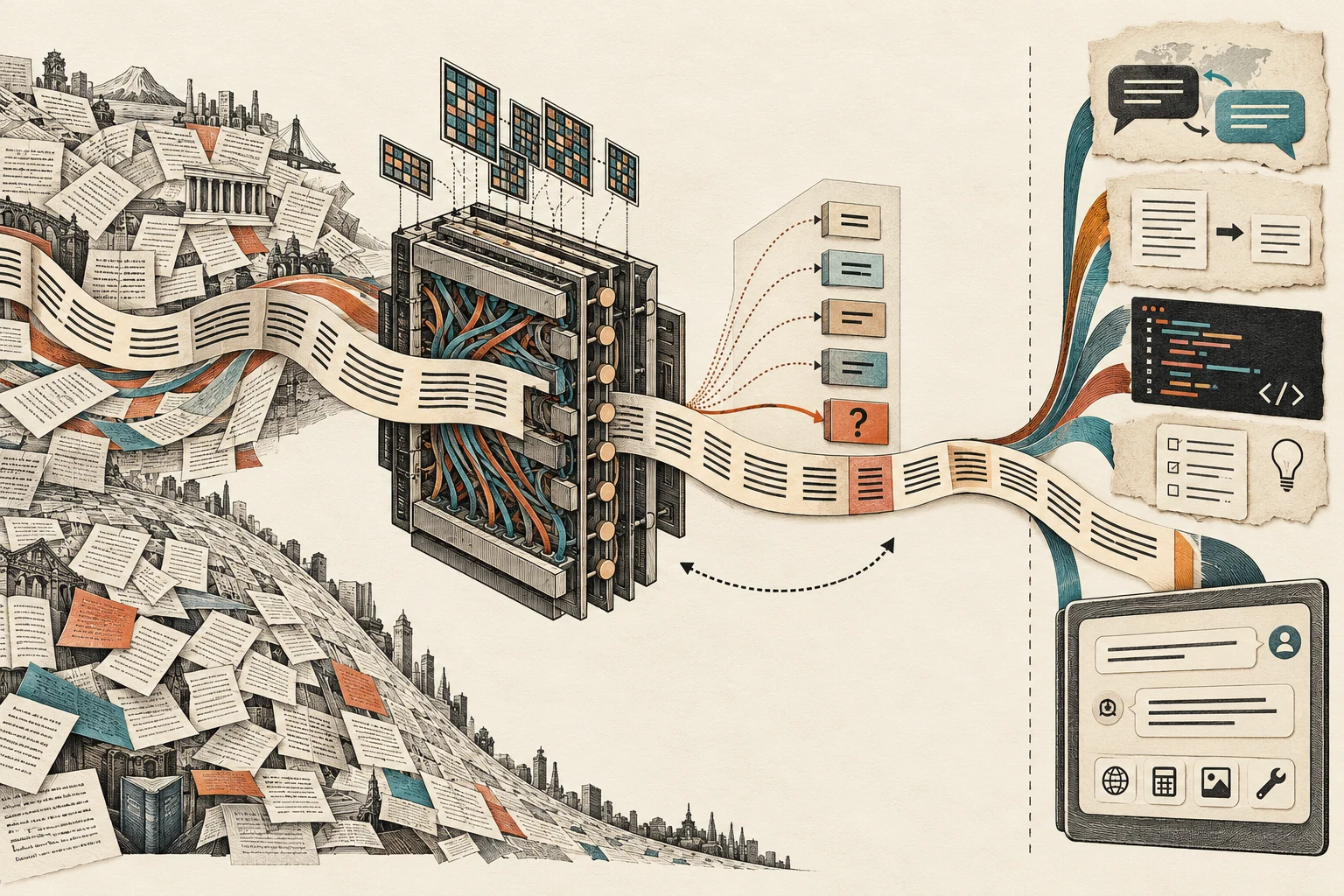
The model extends a sequence by predicting subsequent tokens from context, though fluent output does not guarantee factual accuracy.
AI-assisted illustration · conceptual metaphor View in visual quiz →Genesis and Global Lineage
The intellectual lineage of the large language model is statistical rather than rule-based. In 1948, Claude Shannon showed how English prose could be approximated by sampling from n-gram letter and word transition probabilities, and statistical n-gram models served for decades as the backbone of speech recognition and machine translation. Neural networks entered language modeling in stages: Yoshua Bengio’s feedforward neural probabilistic language model (2003), recurrent neural network language models (RNN LMs, 2010), and dense word embeddings (word2vec, 2013). The decisive architectural breakthrough arrived with the Transformer (Vaswani et al., 2017), replacing sequential recurrence with parallelizable self-attention. Between 2018 and 2020, OpenAI’s GPT-1, GPT-2, and GPT-3 combined the decoder-only Transformer with a scaling hypothesis: steadily increasing parameters, data, and compute yields predictable power-law gains. Tom B. Brown and colleagues’ May 2020 paper Language Models are Few-Shot Learners (the 175-billion-parameter GPT-3) established the modern concept: a language model large enough to perform new tasks from a few examples inside the context window without weight updates. After November 2022, “LLM” swept into public policy and mass culture as a metonym for all contemporary AI.
Central European Lineage
The transition from classic n-gram tables to modern neural language modeling has a direct, documented root in Central Europe—at the Brno University of Technology (Vysoké učení technické v Brně, VUT) in Czechia. In 2010, Tomáš Mikolov, then a doctoral researcher in Jan Černocký’s Speech@FIT group at VUT Brno, published Recurrent neural network based language model at Interspeech 2010. That four-page paper showed that a recurrent neural network with a continuous hidden state could decisively beat smoothed n-gram baselines in perplexity and speech-recognition word-error rate; Mikolov expanded this work in his 2012 Brno PhD thesis, Statistical Language Models Based on Neural Networks. Moving to Google in California, he led the creation of word2vec (2013). When the GPT-3 authors (Brown et al., 2020) reconstruct their technical lineage in the opening paragraph of their introduction, they trace modern pretrained language models directly back to learned word vectors and cite Mikolov et al. (2013). In addition, the 2017 Transformer architecture on which all modern LLMs run was co-authored by Wrocław-educated computer scientist Łukasz Kaiser and Kharkiv-educated engineer Illia Polosukhin, building on the 2014 neural attention mechanism introduced by Minsk-educated researcher Dzmitry Bahdanau.
Documented regional lineage · Link: 1. Compiled: October 2026.
-
documented influence 10 years
Central European Source: Tomáš Mikolov, “Doktorat „Statistical Language Models Based on Neural Networks” (VUT Brno, 2012) i artykuł „Recurrent neural network based language model” (Interspeech 2010)”; Brno, Czechoslovakia (now Czechia), 2010
Global Circulation: large language models (Language Models are Few-Shot Learners, GPT-3) — Tom B. Brown i in., 2020
documented influence
10 yearsTomáš Mikolov, “Doktorat „Statistical Language Models Based on Neural Networks” (VUT Brno, 2012) i artykuł „Recurrent neural network based language model” (Interspeech 2010)”
2010 · Brno, Czechoslovakia (now Czechia)
large language models (Language Models are Few-Shot Learners, GPT-3)
2020 · Tom B. Brown i in.
- Claim & Connection
- The landmark GPT-3 paper opens its technical genealogy with learned word vectors and explicitly cites Mikolov, Chen, Corrado, and Dean (2013, word2vec) as its starting point. Mikolov received his academic formation at the Brno University of Technology (VUT), where he published the recurrent neural network language model in 2010 and defended his PhD dissertation on neural statistical language models in 2012 under Jan Černocký before developing word2vec at Google.
- Source Documentation
-
- reception / translation Tom B. Brown i in., „Language Models are Few-Shot Learners”, arXiv:2005.14165, 2020; Section 1 “Introduction”, paragraph 1 (citation [MCCD13]); bibliography entry [MCCD13]. arxiv.org ↗
- primary source Tomáš Mikolov, Martin Karafiát, Lukáš Burget, Jan Černocký, Sanjeev Khudanpur, „Recurrent neural network based language model”, Interspeech 2010, s. 1045–1048; abstract. isca-archive.org ↗
- primary source Tomáš Mikolov, „Statistical Language Models Based on Neural Networks”, rozprawa doktorska, Vysoké učení technické v Brně, Fakulta informačních technologií, Brno 2012 (promotor Jan Černocký); title page and abstract. fit.vut.cz ↗
- biographical record Wikipedia (en), hasło „Tomáš Mikolov”; sections on education and career. en.wikipedia.org ↗
- Historical Context
- Brown et al. (2020) directly cite word2vec (2013, completed at Google) rather than the 2010 Brno paper; the regional link rests on Mikolov's doctoral formation at VUT Brno, where his research program on neural language modeling began.
Why Now
The concept moved from computational-linguistics conferences to the center of global economics in three steps: GPT-3 (2020) proved scale unlocked few-shot adaptability; Stanford’s 2021 “foundation models” report named the industrial concentration; and ChatGPT (November 2022) turned an instruction-tuned LLM into the fastest-adopted consumer app in history. Since 2023, rapid frontier releases (GPT-4, Claude 3.5, Gemini, Meta’s open-weight Llama series, and Chinese models like Qwen and DeepSeek) have collided with structural conflicts over copyright lawsuits, data-center energy and water footprints, and statutory regulation (the EU AI Act of 2024). Simultaneously, a scientific controversy has erupted over evaluation: because massive web scrapes ingest standard tests (benchmark contamination), researchers struggle to separate genuine generalization from memorized training patterns.
Explanatory Power
Understanding an LLM through its training objective separates what the system literally computes from anthropomorphic illusions. First, it explains why “hallucinations” are an intrinsic property rather than a bug: because the base model maximizes the conditional probability of the next token given preceding tokens, a fluent, genre-appropriate falsehood is mathematically indistinguishable from a fact whenever the training distribution fails to penalize it. Second, it accounts for the jagged capability profile of LLMs—why a model passes bar-exam essays yet fails at counting letters or multiplying multi-digit numbers: performance tracks the density of analogous token patterns in the corpus and single-pass forward computation limits, not human cognitive difficulty. Third, it illuminates AI’s political economy: because capability scales with compute clusters, proprietary data partnerships, and post-training pipelines, capital-intensive labs in the US and China capture upstream infrastructure while smaller countries and firms become downstream API tenants or local fine-tuners.
Axes of Debate
“Stochastic parrots” versus emergent world models
Computational linguists and AI ethicists—Emily M. Bender, Timnit Gebru, Angelina McMillan-Major, and Margaret Mitchell in On the Dangers of Stochastic Parrots (2021)—argue that an LLM trained strictly on linguistic form has no grounding in communicative intent or the world, stitching together plausible sequences while humans project meaning. Conversely, interpretability and cognitive researchers (Kenneth Li et al. on Othello-GPT, 2023; Geoffrey Hinton) argue that accurate next-token prediction at scale forces a network to compress an internal causal model of the processes generating the text. Strongest counterargument: As Melanie Mitchell and David Krakauer show in their 2023 PNAS review, both camps use competing definitions of “understanding”: linear probes prove internal activations encode structured geometric representations beyond surface n-grams, yet models still fail brittlely under counterfactual perturbations that any human with a stable world model handles effortlessly. Nature of the dispute: mixed — experiments probing internal representations are substantive, whereas battles over using the word “understanding” are philosophical and rhetorical.
Pretraining scale is all you need versus the “data wall” and reasoning limits
Frontier labs maintain that expanding model size, multimodal corpora, and inference compute will overcome reliability bottlenecks. Critics—including Gary Marcus, Yann LeCun (who argues autoregressive prediction compounds errors and lacks persistent world memory), and Epoch AI researchers—contend that high-quality public web text will be exhausted between 2026 and 2032, and next-token prediction cannot replace explicit planning. Strongest counterargument: The late-2024/2025 shift (OpenAI’s o1/o3, DeepSeek-R1) toward reinforcement learning over extended chain-of-thought “test-time compute” showed that when pretraining saturates, shifting compute to inference-time search unlocks major gains in math and coding—albeit at higher per-query energy and latency costs. Nature of the dispute: substantive — an empirical contest over whether synthetic data and inference-time RL can bypass the exhaustion of human text.
Open-weight models versus closed API control
Open-weight proponents (Meta’s Llama team, Mistral, Hugging Face, academics, sovereign-AI initiatives) argue that publishing weights is essential for scientific reproducibility, auditing, privacy, and preventing a handful of US firms from monopolizing cognitive infrastructure. Closed-lab executives and security hawks counter that once weights are public, safety guardrails can be stripped via cheap fine-tuning, creating irreversible proliferation risks. Strongest counterargument: Empirical studies of real-world abuse show bad actors overwhelmingly rely on cheap older tools, and marginal biosecurity uplift over standard web search remains small—suggesting that lobbying against open weights often serves as regulatory capture to protect API monopolies. Nature of the dispute: mixed — genuine technical questions about weight proliferation are intertwined with commercial competition over market structure.
Underappreciated Angle
The least examined structural property of an LLM is that it is a lossy compression of a specific historical and linguistic archive. Well over half of pretraining text in major LLMs consists of English web pages from 2010–2024; Central and Eastern European languages spoken by tens of millions—Polish, Czech, Hungarian, Romanian, Ukrainian—account for tiny single-digit or fractional-percent slices, and their pre-digital print heritage remains largely uningested. Because frontier models speak fluent Polish or Czech at the surface while drawing conceptual associations from an Anglo-American core, they act as invisible cultural translators: answering questions about law, history, or social norms using American institutional defaults dressed in Central European syntax. Moreover, because English-centric tokenizers split morphologically rich Slavic and Finno-Ugric words into more fragments, users in Central Europe literally pay more compute, latency, and API fees per sentence to process their own native languages—introducing a quiet new form of epistemic homogenization.
One-Sentence Takeaway
A large language model is not a machine that knows facts, but a machine that predicts how humans write so accurately that factual knowledge emerges as a statistical byproduct—which is precisely why it can never tell on its own where knowledge ends and plausible fabrication begins.
Related Concepts Network
How this concept reinforces, constrains, or complements other analytical frameworks in the corpus. View on graph →
-
Transformer reinforces
The 2017 self-attention architecture provides the parallelizable computational backbone of virtually all contemporary large language models.
-
Scaling laws reinforces
Empirical power-law relationships linking test loss to parameter count, dataset size, and training compute provide the epistemic and financial justification for making language models “large.”
-
Foundation models complements
The Stanford term describes the exact same class of artifacts from the perspective of their downstream ecosystem role rather than their linguistic training objective.
-
RLHF complements
Post-training with Reinforcement Learning from Human Feedback turns a raw next-token predictor into an instruction-following conversational assistant.
-
Model hallucinations constrains
Fluent but fabricated statements flow directly from the pretraining objective: the model optimizes sequence plausibility rather than factual truth.
-
Emergence in tension
Researchers remain divided over whether capabilities that appear abruptly in large models represent genuine phase transitions or artifacts of discontinuous evaluation metrics.
-
Generative AI complements
The commercial umbrella term groups large language models alongside image, audio, and video generators, often blurring the distinctive properties of text prediction.
Reading Canon & Translation Bridge
Foundational texts, introductions, and critical perspectives—with availability of English and Polish editions.
-
foundational text 2020 · English
Tom B. Brown i in., Language Models are Few-Shot Learners
The 75-page GPT-3 paper (175 billion parameters) that cemented the modern meaning of “large language model” and demonstrated that scaling unlocks in-context learning from a handful of prompt examples without gradient updates.
In English: original text written in English
In Polish: no Polish edition
-
foundational text 2017 · English
Ashish Vaswani i in., Attention Is All You Need
Introduced the Transformer architecture: dispensing with recurrence in favor of multi-head self-attention made it possible to train language models across thousands of GPUs in parallel.
In English: original text written in English
In Polish: no Polish edition
-
foundational text 2010 · English
Tomáš Mikolov, Martin Karafiát, Lukáš Burget, Jan Černocký, Sanjeev Khudanpur, Recurrent neural network based language model
The four-page Interspeech paper from Brno University of Technology in which a recurrent neural network decisively outperformed classic n-gram language models, inaugurating the modern wave of neural language modeling.
In English: original text written in English
In Polish: no Polish edition
-
critical perspective 2021 · English
Emily M. Bender, Timnit Gebru, Angelina McMillan-Major, Shmargaret Shmitchell, On the Dangers of Stochastic Parrots: Can Language Models Be Too Big?
The most influential critical assessment of LLMs: examines environmental costs, uncurated web corpora, and the thesis that models stitch together linguistic forms without access to communicative meaning.
In English: original text written in English
In Polish: Polish edition not verified
-
critical perspective 2023 · English
Melanie Mitchell, David C. Krakauer, The Debate Over Understanding in AI's Large Language Models
A lucid PNAS survey mapping the scientific deadlock over whether LLMs “understand” and showing how opposing camps rely on incompatible definitions of cognition.
In English: original text written in English
In Polish: Polish edition not verified
-
introduction & synthesis 2022 · English
Murray Shanahan, Talking About Large Language Models
An exercise in philosophical hygiene: separates what a model literally does (predicting probability distributions over next tokens) from the intentional metaphors we project when saying it “knows” or “believes.”
In English: original text written in English
In Polish: Polish edition not verified
-
cross-disciplinary 1948 · English
Claude E. Shannon, A Mathematical Theory of Communication
The founding paper of information theory, whose opening sections construct successive statistical approximations to English text based on letter and word transition frequencies—the direct conceptual ancestor of language modeling.
In English: original text written in English
In Polish: Polish edition not verified
Primary-Source Quotes
Contrary to how it may seem when we observe its output, an LM is a system for haphazardly stitching together sequences of linguistic forms it has observed in its vast training data, according to probabilistic information about how they combine, but without any reference to meaning: a stochastic parrot.
A new recurrent neural network based language model (RNN LM) with applications to speech recognition is presented.