Nudge and behavioral economics
original term: nudge (Eng.) · impuls, architektura wyboru, libertariański paternalizm
Central European lineage: 1 thread (anticipation) · 1976–2008 · jump to documentation ↓
Working Definition
A nudge is any deliberate arrangement of the choice architecture—the social, physical, or digital context in which people make decisions—that predictably alters behavior without forbidding any option or significantly changing economic incentives: automatic pension enrollment with an easy opt-out, placing healthier food at eye level, or sending a timely text reminder before a tax deadline. Behavioral economics is the broader research program from which nudging grew: modeling economic decisions with realistic psychological assumptions—bounded attention, loss aversion, present bias, framing, and status-quo inertia—rather than the frictionless optimization of homo economicus. In casual speech, “nudge” means any gentle persuasion; in Richard Thaler and Cass Sunstein’s definition, an intervention qualifies only if it is cheap and easy to avoid, non-coercive, and designed to make choosers better off as judged by themselves.
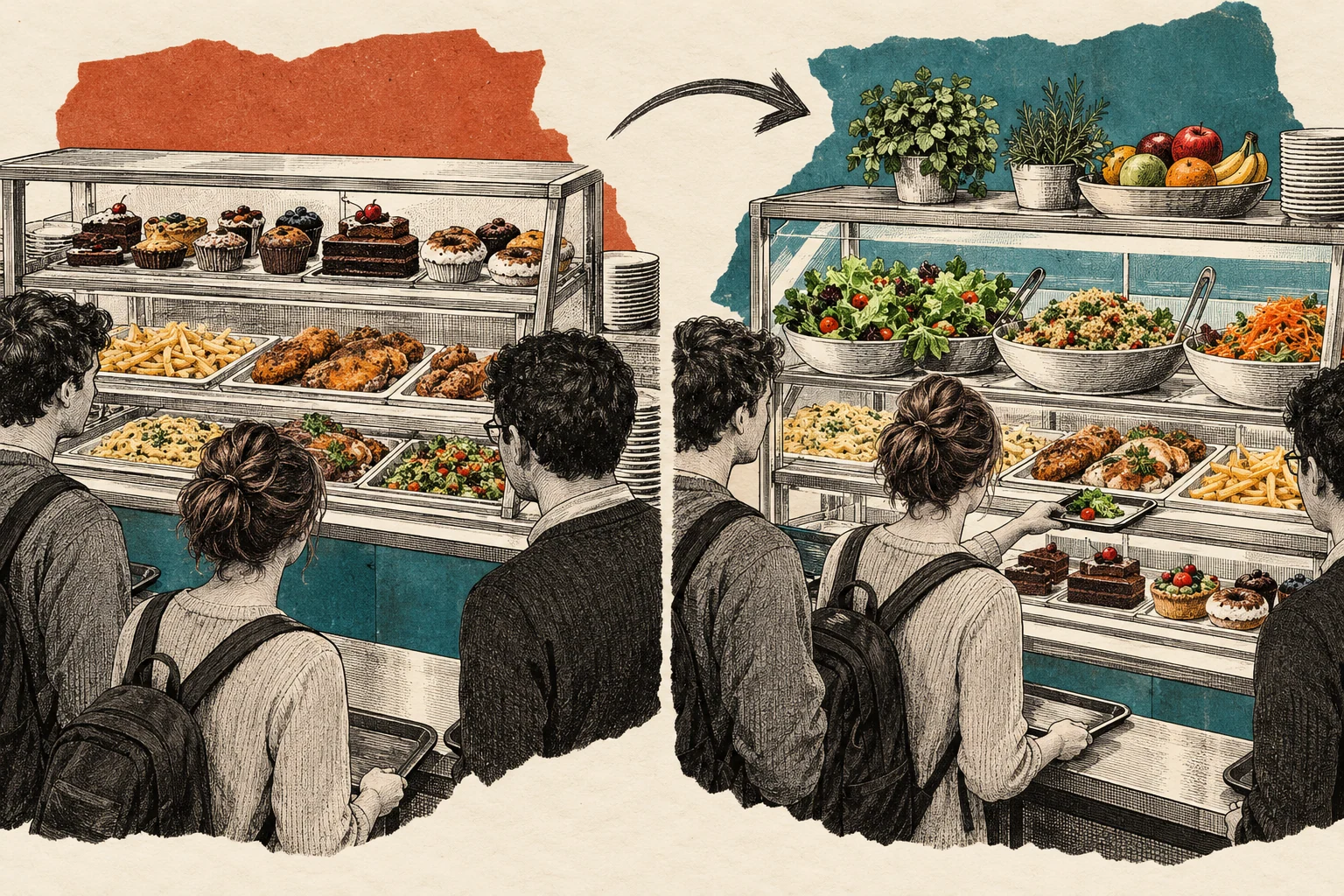
Rearranging the available dishes changes how easy each option is to pick; alternatives remain open, but choice architecture guides attention and action.
AI-assisted illustration · conceptual metaphor View in visual quiz →Genesis and Global Lineage
The foundations were laid in the 1970s and 1980s by psychologists Daniel Kahneman and Amos Tversky—whose heuristics-and-biases program and prospect theory (1979) mapped systematic departures from expected-utility axioms—and economist Richard Thaler, who cataloged consumer anomalies violating standard price theory. “Libertarian paternalism” and choice architecture were introduced by Thaler and legal scholar Cass Sunstein in a five-page 2003 American Economic Review paper and popularized in their 2008 bestseller Nudge: Improving Decisions About Health, Wealth, and Happiness. Their founding argument is straightforward: choice architecture is unavoidable because some option must always be the default, so institutions should set defaults consciously rather than by accident. Few academic ideas have entered government faster: in 2010 the UK Cabinet Office created the Behavioural Insights Team (“Nudge Unit”), Sunstein headed the White House Office of Information and Regulatory Affairs (OIRA) under Obama, behavioral teams spread across the OECD and international bodies, and Thaler won the 2017 Nobel Prize in Economics. Simultaneously, the same toolkit was industrialized by tech platforms to maximize screen time and subscription retention—prompting Thaler and Sunstein in their 2021 Final Edition of Nudge to coin sludge for deliberate friction designed to thwart a user’s interest.
Central European Lineage
An early anticipation of the behavioral critique of neoclassical consumer theory was formulated by Tibor Scitovsky (1910–2002), born and educated in interwar Budapest, who earned his law degree at Pázmány Péter University (today Eötvös Loránd University) before studying at Cambridge and the LSE and pursuing an academic career in the United States. In his landmark 1976 book The Joyless Economy: An Inquiry into Human Satisfaction and Consumer Dissatisfaction, Scitovsky drew directly on experimental psychology (notably Daniel Berlyne’s arousal theory) to argue that standard economics lacked a realistic theory of human motivation: by equating welfare with revealed market choices, economists missed the psychological distinction between passive comfort (pain avoidance, which quickly habituates) and active stimulation (novelty and challenge). While Scitovsky was diagnosing the limits of consumer sovereignty rather than proposing default rules—and we found no evidence that Thaler and Sunstein drew directly on his book—his insistence that empirical psychology must revise the microfoundations of consumer choice anticipated the behavioral turn that followed.
Documented regional lineage · Link: 1. Compiled: October 2026.
-
anticipation 32 years
Central European Source: Tibor Scitovsky, “The Joyless Economy: An Inquiry into Human Satisfaction and Consumer Dissatisfaction”; Budapest, Hungary, 1976
Global Circulation: behavioral economics and choice architecture (nudge) — Richard H. Thaler, Cass R. Sunstein, 2008
anticipation
32 yearsTibor Scitovsky, “The Joyless Economy: An Inquiry into Human Satisfaction and Consumer Dissatisfaction”
1976 · Budapest, Hungary
behavioral economics and choice architecture (nudge)
2008 · Richard H. Thaler, Cass R. Sunstein
- Claim & Connection
- Educated in law at Pázmány Péter University in Budapest before studying economics in Cambridge and London, Scitovsky argued in “The Joyless Economy” (1976) that consumer theory must incorporate empirical psychology because actual human choices and post-choice satisfaction systematically diverge from the neoclassical model of rational utility maximization. No evidence has been found that Thaler or Sunstein drew directly on Scitovsky’s book; the anticipation concerns the broader research program of behavioral economics rather than the specific administrative technique of the nudge.
- Source Documentation
-
- biographical record Wikipedia (en), hasło „Tibor Scitovsky”; lead and biography section: b. Budapest 1910, law degree at Pázmány Péter University, later Cambridge and LSE; “The Joyless Economy” 1976. en.wikipedia.org ↗
- scholarly study Ezra J. Mishan, „The Joyless Economy by Tibor Scitovsky”, Challenge 1976 (recenzja); Tommaso Reggiani, „Book Review to Tibor Scitovsky – The Joyless Economy (1976)”, MPRA 2008; OpenAlex records confirming the book’s title and publication year. api.openalex.org ↗
- Historical Context
- Borderline regional formation: university law studies in Budapest, followed by economics training at Cambridge and the LSE and an academic career in the United States. A reviewer should check the text of “The Joyless Economy” (chapters on comfort versus stimulation) and Thaler’s “Misbehaving” (2015) to verify whether Scitovsky is cited.
Why Now
The years 2018 to 2026 brought a sobering methodological reckoning for nudging. In January 2022 a meta-analysis by Stephanie Mertens and colleagues in PNAS reported a moderate positive effect of choice-architecture interventions; seven months later in PNAS, Maximilian Maier, Czech methodologist František Bartoš, Eric-Jan Wagenmakers, and colleagues demonstrated that once severe publication bias is corrected for, statistical evidence for an average effect disappears. That same year, Stefano DellaVigna and Elizabeth Linos published an Econometrica study of the complete, uncurated archive of 126 randomized trials covering 23 million people across two US government nudge units: while academic journals reported an average effect of 8.7 percentage points, real-world administrative nudges achieved just 1.4 percentage points. Simultaneously, popular behavioral science was shaken by data-fabrication scandals involving two prominent figures—a retracted 2012 honesty study co-authored by Dan Ariely (exposed in 2021) and fabricated datasets in multiple papers by Harvard Business School professor Francesca Gino (2023). Yet even as inflated claims were deflated, auto-enrollment defaults (such as Poland’s 2019 Pracownicze Plany Kapitałowe pension scheme) and regulatory crackdowns on commercial sludge and dark patterns became permanent fixtures of consumer law.
Explanatory Power
The concept makes visible that in any institutional setting, there is no such thing as a neutral form or screen: every interface embeds a default policy whether its creator realizes it or not. Three examples demonstrate its reach. First, the dramatic gap in organ-donor registration rates between countries with explicit opt-in rules and neighboring countries with presumed-consent (opt-out) defaults—famously documented by Eric Johnson and Daniel Goldstein (2003)—is vastly larger than any difference in underlying cultural attitudes toward organ donation, proving that administrative defaults actively manufacture what looks like public preference. Second, automatic enrollment in 401(k) and workplace pension plans (Save More Tomorrow, designed by Thaler and Shlomo Benartzi) raised participation rates among new hires from roughly 60 percent to over 90 percent without changing a single dollar of tax subsidies, revealing how much apparent “under-saving” was sheer paperwork inertia rather than a considered intertemporal choice. Third, the symmetric concept of sludge explains why subscribing to a digital service takes one tap while canceling requires navigating six confusing confirmation screens: friction is an invisible tax that redistributes wealth from boundedly attentive consumers to firms.
Axes of Debate
Does “easy to opt out” mean “non-manipulative”
Political philosophers and legal theorists (Daniel Hausman and Brynn Welch, 2010; Jeremy Waldron) argue that even when a nudge preserves formal legal freedom to opt out, it disrespects individual autonomy because it works covertly—exploiting System 1 cognitive blind spots, inertia, and framing rather than engaging the citizen’s reflective System 2 reasoning. Strongest counterargument: Sunstein replies that in most cases (cafeteria layout, default pension contribution rate, order of items on a ballot) some choice architecture is physically unavoidable, so refusing to design it consciously does not restore pure autonomy—it merely hands the steering wheel to random chance or self-interested commercial marketers; moreover, transparent public nudges are overwhelmingly endorsed by citizens once explained. Nature of the dispute: substantive — it turns on competing philosophical definitions of personal autonomy (absence of coercion versus deliberative self-direction) that no empirical trial can settle.
Who knows the chooser’s “true” preferences
Economists from the subjectivist and Austrian traditions (most comprehensively Mario Rizzo and Glen Whitman in Escaping Paternalism, 2020) point out a fatal epistemic contradiction in libertarian paternalism: if human beings have inconsistent, context-dependent preferences, how can a government choice architect possibly know which of a citizen’s conflicting selves (the impulsive Friday-night self or the regretful Monday-morning self) represents their “true” welfare as judged by themselves? Strongest counterargument: Defenders of nudging reply that in domains like retirement saving or avoiding predatory payday rollover traps, millions of people explicitly state their long-term goal and actively welcome self-binding defaults that help them overcome present bias; the architect is not inventing an alien goal, but lowering the friction of achieving the citizen’s own declared intention. Nature of the dispute: mixed — the Hayekian knowledge problem facing paternalist planners is substantive, though it is sometimes deployed rhetorically to defend predatory commercial defaults as “free choice.”
Micro-nudges versus structural policy (i-frame versus s-frame)
Behavioral scientists Nick Chater and George Loewenstein published a celebrated 2022 Behavioral and Brain Sciences critique arguing that for decades behavioral public policy has focused on the i-frame (individual-level nudges like carbon-footprint labels on flights or calorie counts on menus), which yield tiny 1 percent effects while distracting governments from s-frame systemic reforms (carbon taxes, sugar taxes, hard industrial regulation) that corporate lobbies desperately want to avoid. Strongest counterargument: Thaler, Sunstein, and practitioners in government nudge units reply that nudges were never meant to replace taxes or mandates, that a 1.4 percentage-point improvement achieved by rewriting a letter at near-zero marginal cost is still extraordinarily cost-effective, and that behavioral science is increasingly used to strip away administrative sludge inside welfare programs. Nature of the dispute: substantive — a pivotal debate over the political economy of policy attention and whether cheap behavioral tweaks crowd out harder structural legislation.
Underappreciated Angle
The most important asymmetry in the world of choice architecture is not between System 1 and System 2 inside the human brain, but the institutional asymmetry in learning speed between the state and commercial platforms. A government behavioral unit typically takes twelve to eighteen months to obtain ethical clearance, partner with a ministry, run a single randomized trial on a paper letter or web portal, and publish a report. A major e-commerce, social-media, or gaming platform runs tens of thousands of automated, real-time A/B tests and reinforcement-learning loops every single day, optimizing button colors, notification timing, and cancellation sludge against live behavioral telemetry. In an arms race of choice architecture, the public regulator is structurally outgunned by several orders of magnitude. Consequently, the most durable public contribution of behavioral economics in the coming decade is unlikely to be government-designed nudges; it is using the science of choice architecture diagnostically as an antitrust and consumer-protection radar—identifying and outlawing commercial sludge, dark patterns, and algorithmic manipulation traps at the structural level rather than trying to out-nudge trillion-dollar platforms one postcard at a time.
One-Sentence Takeaway
Because no form, menu, or default screen is ever neutral, the real question is never whether our choices are being architected, but by whom, in whose interest, and whether the friction is working for us or against us.
Related Concepts Network
How this concept reinforces, constrains, or complements other analytical frameworks in the corpus. View on graph →
-
Incentives complements
A nudge alters behavior without changing material payoffs or legal prohibitions, positioning itself as a third policy instrument alongside mandates and financial incentives.
-
Framing reinforces
Most tools of choice architecture are applied framing and default effects drawn directly from Kahneman and Tversky’s psychology of judgment.
-
Dark patterns in tension
The very same psychological mechanisms that a government calls a benevolent nudge toward citizen welfare are called conversion optimization when deployed by a commercial platform; the difference lies in the beneficiary, not the technique.
-
Mechanism design complements
Mechanism design assumes strategically rational players with private information, whereas nudging assumes boundedly attentive humans with inertia—both engineer the rules of the choice environment.
-
Falsifiability and the replication crisis constrains
Major meta-analyses and re-analyses published in 2022 showed that after correcting for publication bias, the average effect size of published nudges shrinks sharply and in some domains approaches zero.
-
State capacity complements
Behavioral insights teams have frequently served as a cheap substitute for structural reform where governments lack the political or administrative capacity to change hard rules.
-
Goodhart’s law in tension
A nudge optimized around a single visible metric—such as initial enrollment rate—can easily ignore whether the induced choice actually improved the chooser’s long-term welfare.
Reading Canon & Translation Bridge
Foundational texts, introductions, and critical perspectives—with availability of English and Polish editions.
-
foundational text 2008 · English
Richard H. Thaler, Cass R. Sunstein, Nudge: Improving Decisions About Health, Wealth, and Happiness
The book that named the movement; the extensively revised 2021 edition (“The Final Edition”) adds chapters on “sludge” and updates the policy record.
In English: original text written in English
In Polish: Polish edition not verified
-
foundational text 2003 · English
Richard H. Thaler, Cass R. Sunstein, Libertarian Paternalism
A five-page paper in the “American Economic Review” (93/2, pp. 175–179) stating the core premise: because some default option is unavoidable, choice architecture is inevitable and should be designed deliberately.
In English: original text written in English
In Polish: no Polish edition
-
introduction & synthesis 2011 · English
Daniel Kahneman, Thinking, Fast and Slow
The psychological foundation of nudging: heuristics and biases, System 1 versus System 2 cognition, and loss aversion, synthesized by the co-creator of prospect theory.
In English: original text written in English
In Polish: Polish edition not verified
-
critical perspective 2020 · English
Mario J. Rizzo, Glen Whitman, Escaping Paternalism: Rationality, Behavioral Economics, and Public Policy
The most thorough critique from the subjectivist and Austrian tradition: argues that the benchmark of rationality to which nudges purport to “restore” people is arbitrary, and that choice architects lack the knowledge to know what choosers truly prefer.
In English: original text written in English
In Polish: Polish edition not verified
-
critical perspective 2010 · English
Daniel M. Hausman, Brynn Welch, Debate: To Nudge or Not to Nudge
A philosophical analysis in the “Journal of Political Philosophy”: argues that even when a nudge preserves formal freedom of choice, it can compromise personal autonomy by exploiting cognitive blind spots rather than engaging rational deliberation.
In English: original text written in English
In Polish: Polish edition not verified
-
critical perspective 2022 · English
Maximilian Maier, František Bartoš, T. D. Stanley, David R. Shanks, Adam J. L. Harris, Eric-Jan Wagenmakers, No evidence for nudging after adjusting for publication bias
A Bayesian re-analysis of the Mertens et al. meta-analysis in “PNAS” (119/31): demonstrates that once severe publication bias is corrected for, there is no statistical evidence for a positive average nudge effect across the literature.
In English: original text written in English
In Polish: no Polish edition
-
cross-disciplinary 2022 · English
Stephanie Mertens, Mario Herberz, Ulf J. J. Hahnel, Tobias Brosch, The effectiveness of nudging: A meta-analysis of choice architecture interventions across behavioral domains
The environmental-psychology meta-analysis in “PNAS” (119/1) that reported a moderate positive effect of nudging and triggered the 2022 methodological debate over publication bias.
In English: original text written in English
In Polish: no Polish edition
-
cross-disciplinary 2022 · English
Stefano DellaVigna, Elizabeth Linos, RCTs to Scale: Comprehensive Evidence From Two Nudge Units
Public-policy econometrics (“Econometrica” 90/1): analyzing the complete, uncurated registry of 126 randomized trials covering 23 million citizens across two US nudge units, showing an average real-world effect of 1.4 percentage points—roughly one-sixth the size reported in academic journals.
In English: original text written in English
In Polish: no Polish edition