AI Architecture #126
Alignment tax
original term: alignment tax (Eng.) · podatek od dopasowania, podatek bezpieczeństwa, safety tax
Global-circulation concept — no documented lineage in Central Europe. jump to documentation ↓
Working Definition
The alignment tax is the gap between what an artificial intelligence system could achieve if built solely to maximize raw capability and what it achieves when constrained to remain aligned with human intent and safety requirements. That overhead is paid in multiple currencies: lost benchmark accuracy, extra training and inference compute, engineering staff time, and delayed product release. In everyday industry parlance, it refers broadly to the “cost of safety” that a lab either absorbs or cuts corners on; in technical language-model research, it denotes the measurable performance regression on standard tasks caused by post-training alignment procedures such as Reinforcement Learning from Human Feedback (RLHF). The concept is analytically indispensable because it shifts the central question of AI safety from “do we know how to build a safe system in principle?” to “will any actor locked in a competitive market choose to deploy it?”
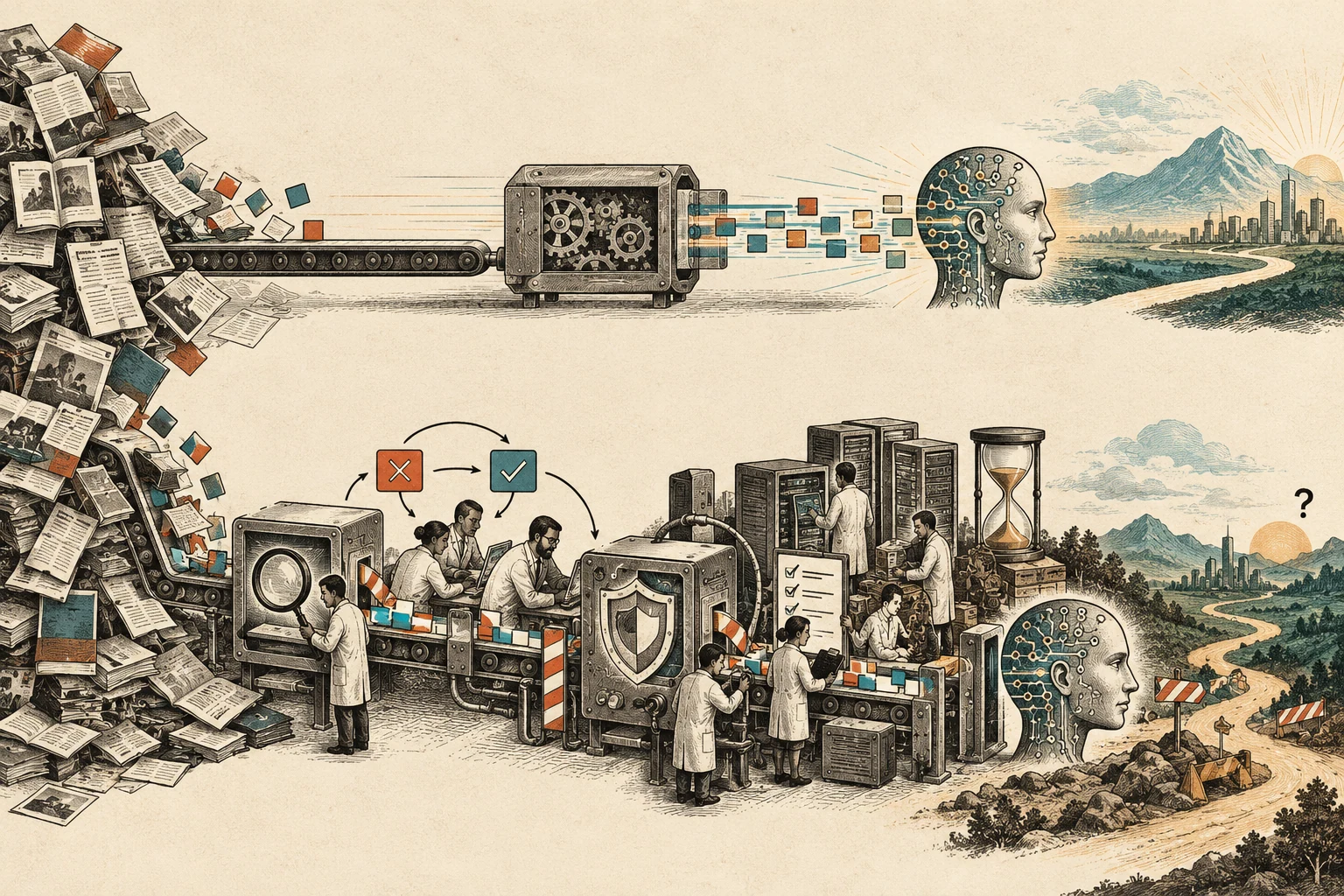
Additional checks and safeguards can require time, resources, or capability trade-offs whose magnitude depends on the specific approach.
AI-assisted illustration · conceptual metaphor View in visual quiz →Genesis and Global Lineage
The term entered active circulation through Paul Christiano—then head of the language-model alignment team at OpenAI—in his 2019 talk Current work in AI alignment at EA Global in San Francisco (published as a transcript on the Effective Altruism Forum in April 2020). While crediting Eliezer Yudkowsky for the “tax” metaphor, Christiano turned it into an explicit strategic calculus: suppose a reasonable actor wants to deploy an aligned model—how much extra compute, money, or performance loss must they accept compared to deploying an unaligned alternative? From this framing follow two complementary policy levers—reducing the tax through better technical alignment methods and paying the tax through industry coordination, regulation, or resource leadership—spanning a spectrum between a zero-tax world (where nobody has an incentive to deploy unaligned models) and an infinite-tax world (where alignment is technically impossible at any price). Between 2021 and 2022, the concept moved from strategic philosophy into empirical measurement: researchers at Anthropic (Amanda Askell et al., 2021; Yuntao Bai et al., 2022) and the InstructGPT team at OpenAI (Long Ouyang et al., 2022) began quantifying “alignment taxes and bonuses” as exact percentage-point differences on academic NLP benchmarks before and after RLHF. Since 2023, the phrase has also drifted into everyday product engineering as shorthand for guardrail latency and chatbot refusal rates, partially obscuring Christiano’s original focus on high-stakes competitive deployment at the capability frontier.
Central European Lineage
We found no documented link between this concept and the intellectual history or historical experience of Central Europe.
We found no documented link between this concept and the intellectual history or historical experience of Central Europe (by our methodology, this means “none found,” not “none exists”; as of October 2026).
Why Now
The concept became urgent the moment AI alignment stopped being a thought experiment in philosophical seminars and became a line item in quarterly engineering budgets. In March 2022, OpenAI’s InstructGPT paper documented concrete accuracy regressions on SQuAD, DROP, HellaSwag, and WMT translation after RLHF fine-tuning, explicitly labeled those drops an alignment tax, and introduced pretraining-gradient mixing (PPO-ptx) to drive the tax down. Later that year, Anthropic reported that above roughly 10 billion parameters, RLHF alignment incurred “essentially zero cost” and sometimes yielded a capability bonus—only for a wave of follow-up studies (such as Yong Lin et al., 2023–2024) to show that the tax had merely migrated into catastrophic forgetting of pretraining knowledge and degraded probability calibration. Simultaneously, the commercial race triggered by ChatGPT’s launch in November 2022 turned “how much alignment tax to pay” into a recurring release-gate decision, while the European Union’s AI Act (2024) and the UK and US AI Safety Institutes operationalized Christiano’s second lever: using statutory regulation to force all frontier developers to pay the safety tax together. By 2025–2026, with the rise of test-time reasoning models and autonomous tool-using agents, the primary currency of the alignment tax shifted again—from static benchmark regressions to inference latency, verifier token overhead, and sandbox permission restrictions.
Explanatory Power
The concept separates two questions that public debates over AI safety routinely conflate: whether a technical safety method exists in the laboratory and whether competitive pressures allow it to survive in production. First, it explains why frontier AI companies celebrate empirical results showing a “zero” or “negative” alignment tax (an alignment bonus, where instruction tuning makes a base model both safer and easier to use): if safety is free or profitable, the conflict between shareholder value and public safety disappears, weakening the case for external regulation. Second, it illuminates the structural dynamics of an AI arms race: whenever the alignment tax is strictly positive, safety becomes a classic public good that uncoordinated market competition underprovides, because any lab that skips red-teaming or relaxes refusal thresholds gains a speed or capability edge. Third, it clarifies how technical research and public policy fit together: algorithmic advances that shrink the alignment tax (better post-training recipes, cheaper automated oversight) and institutional mechanisms that subsidize or mandate paying it (safety standards, liability rules, compute governance) are complements rather than rivals, transforming a sterile “technology versus politics” debate into a question of how to close the remaining cost gap from both ends.
Axes of Debate
Does the alignment tax vanish at scale, or does it just hide?
Researchers at Anthropic (Bai et al., 2022) and several frontier labs argue that while small models lose capability when forced to be helpful and harmless, models above a critical parameter threshold experience no net capability loss—and often gain general instruction-following skill—meaning scale itself dissolves the tax. Critics studying post-training dynamics (Lin et al., 2023; calibration researchers) counter that the tax in large models simply moves off the headline benchmarks into reduced output diversity, degraded uncertainty calibration, and forgotten tail knowledge. Strongest counterargument: Measuring a zero tax on a handful of multiple-choice academic benchmarks does not prove a zero tax across the full distribution of tasks; we measure what is cheap to evaluate, and an alignment procedure that costs nothing on standard tests may simply be a superficial stylistic veneer. Nature of the dispute: substantive — it hinges on benchmark design, calibration metrics, and empirical measurements of capability retention across model scales.
Should we focus on reducing the tax technically or enforcing its payment politically?
Technical alignment researchers following Christiano’s original program prioritize driving the alignment tax as close to zero as possible, arguing that a cheap, capability-preserving alignment recipe will be voluntarily adopted even by profit-maximizing or geopolitically rivalrous actors who would evade treaties. AI governance scholars and regulatory advocates reply that waiting for technical research to make safety free is a gamble we may lose, so governments must mandate safety evaluations and compliance costs across the board. Strongest counterargument: Lowering the cost of shallow alignment techniques has a perverse political side effect: industry lobbyists immediately point to cheap post-training fixes as proof that market incentives already align with safety, preempting binding regulation before anyone knows whether those cheap fixes will hold up on autonomous or superhuman systems. Nature of the dispute: mixed — the comparative effectiveness of technical versus regulatory levers is a substantive policy question, but the public debate is heavily colored by corporate resistance to binding oversight.
Is the “tax” metaphor itself distorting the problem?
Critics from science and technology studies and safety engineering argue that calling safety an “alignment tax” bakes in a libertarian corporate assumption: that an unaligned, unconstrained model is the natural baseline of value, and that preventing harm is an artificial burden imposed on innovation—whereas in aviation or pharmaceuticals, a plane that does not crash or a drug that does not poison is the definition of the product, not a “tax” on speed or chemistry. Strongest counterargument: The metaphor works analytically precisely because it mirrors the actual decision calculus inside competing AI laboratories and military programs, where an unaligned base model literally exists on the cluster first and every subsequent safety filter costs extra compute, latency, or refusals; pretending that trade-off does not exist will not make decision-makers ignore it. Nature of the dispute: rhetorical — both sides agree on the underlying engineering trade-offs, but clash over which normative baseline the vocabulary should naturalize.
Underappreciated Angle
The most consequential currency in which the alignment tax is paid rarely appears in academic tables: calendar time. Thorough human preference collection, adversarial red-teaming, interpretability audits, and iterative safety remediation take weeks or months of wall-clock time before a model can be released. In a winner-take-most commercial or geopolitical race, a six-week delay in launching a frontier model is often perceived by executives as far more expensive than a two-point drop on a coding benchmark. Consequently, a laboratory can truthfully report a “zero alignment tax” in parameter capability while facing a massive alignment tax in release schedule—and the competitive pressure to cut that tax falls not on model weights, but on compressing the time allotted to external red-teamers and safety evaluators before launch. A second overlooked shift is the externalization of the tax onto the end user: excessive false-positive refusals, preachy disclaimers, and inference latency imposed by guardrail classifiers do not show up as capability regressions on the developer’s leaderboard, but are paid daily by users in frustration and lost productivity—driving a growing segment of developers toward uncensored open-weight models. The alignment tax does not disappear; it merely changes who pays it.
One-Sentence Takeaway
Whether advanced artificial intelligence remains safe will be decided not only by whether we discover how to align it in principle, but by how much capability, compute, and time alignment costs relative to cutting corners—and who is forced to pay that bill.
Related Concepts Network
How this concept reinforces, constrains, or complements other analytical frameworks in the corpus. View on graph →
-
AI alignment complements
The alignment tax measures the economic and capability cost of aligning a system and explains why even a technically solved alignment method might go undeployed in a competitive market.
-
Moloch and coordination failure reinforces
A positive alignment tax creates a classic coordination trap: every laboratory might prefer a world where everyone pays the tax, yet each faces a competitive incentive to skip it.
-
Goodhart’s law in tension
Techniques aimed at reducing the alignment tax optimize for benchmark proxies of alignment rather than alignment itself, so an apparently zero tax can be an artifact of shallow measurement.
-
Scaling laws complements
Empirical findings suggest that the capability tax from post-training shrinks as model scale increases, shifting the debate toward who can afford frontier-scale compute.
-
Frontier AI reinforces
At the capability frontier, the magnitude of the alignment tax determines whether competing labs deploy the safer version of a model or the more capable raw version.
-
AI governance complements
Regulation functions as a mechanism for forcing all market participants to pay the alignment tax simultaneously when technical research fails to drive it down to zero.
-
Red teaming complements
Adversarial red teaming reveals that part of an apparently low alignment tax is merely deferred risk that surfaces only under targeted attack.
Reading Canon & Translation Bridge
Foundational texts, introductions, and critical perspectives—with availability of English and Polish editions.
-
foundational text 2019 · English
Paul Christiano, Current work in AI alignment
A talk delivered at EA Global in San Francisco (2019) and published as a transcript in April 2020; introduces the definition, credits Eliezer Yudkowsky for the “tax” framing, and outlines the two-lever strategy: reduce the tax through technical research or pay it through coordination.
In English: original text written in English
In Polish: no Polish edition
-
foundational text 2022 · English
Long Ouyang i in., Training language models to follow instructions with human feedback
The InstructGPT paper, where the alignment tax first becomes an explicit empirical metric: performance regressions on public NLP benchmarks after RLHF fine-tuning, partially mitigated by mixing pretraining gradients (PPO-ptx).
In English: original text written in English
In Polish: no Polish edition
-
introduction & synthesis 2021 · English
Amanda Askell i in., A General Language Assistant as a Laboratory for Alignment
Introduces systematic measurements of alignment “taxes and bonuses” across model sizes, showing that smaller models suffer capability drops from alignment tuning while larger models pay almost nothing.
In English: original text written in English
In Polish: no Polish edition
-
critical perspective 2023 · English
Yong Lin i in., Mitigating the Alignment Tax of RLHF
Demonstrates that the alignment tax does not vanish in larger models but takes the form of catastrophic forgetting of pretraining capabilities, and proposes weight averaging as a mitigation.
In English: original text written in English
In Polish: no Polish edition
-
introduction & synthesis 2022 · English
Yuntao Bai i in., Training a Helpful and Harmless Assistant with Reinforcement Learning from Human Feedback
Articulates the influential claim that above roughly 10 billion parameters, RLHF alignment comes at “essentially zero cost” to benchmark capability—empirical backing for Christiano’s optimistic regime.
In English: original text written in English
In Polish: no Polish edition
-
introduction & synthesis 2019 · English
Stuart Russell, Human Compatible: Artificial Intelligence and the Problem of Control
Provides the broader control-problem framework within which the cost of safety becomes the question of how to design uncertain, deferential agents that want to remain aligned.
In English: original text written in English
In Polish: Polish edition not verified
-
cross-disciplinary 1995 · English
Michael E. Porter, Claas van der Linde, Toward a New Conception of the Environment-Competitiveness Relationship
Formulates the Porter Hypothesis in environmental economics: well-designed regulatory constraints can trigger efficiency innovations that offset compliance costs—an instructive parallel to turning an alignment tax into an alignment bonus.
In English: original text written in English
In Polish: Polish edition not verified
Primary-Source Quotes
And the alignment tax is intended to capture that gap — that cost that I incur if I insist on alignment.
We want an alignment procedure that avoids an alignment tax, because it incentivizes the use of models that are unaligned but more capable on these tasks.