Epistemology #010
Hanlon’s razor
original term: Hanlon's razor (Eng.) · brzytwa Heinleina, głupota przed złośliwością
Central European lineage: 2 threads (anticipation, counterpoint) · 1937–1980 · jump to documentation ↓
Working Definition
Hanlon's razor is a heuristic for interpreting other people's actions: never attribute to malice that which is adequately explained by stupidity, incompetence, ignorance, fatigue, or oversight. It does not claim that malice never happens; rather, it states a rule of prior probabilities and evidential economy: coordinated bad faith is rarer and structurally “more expensive” than error, so an intentional explanation must clear a higher bar of proof than a blunder. In everyday life it counsels interpersonal patience; in analytical work it serves as a baseline frequency rule against paranoid over-interpretation. Crucially, the razor is a tool for explanation, not exoneration—it asks what caused a bad outcome, not whether the person responsible should be excused from accountability.
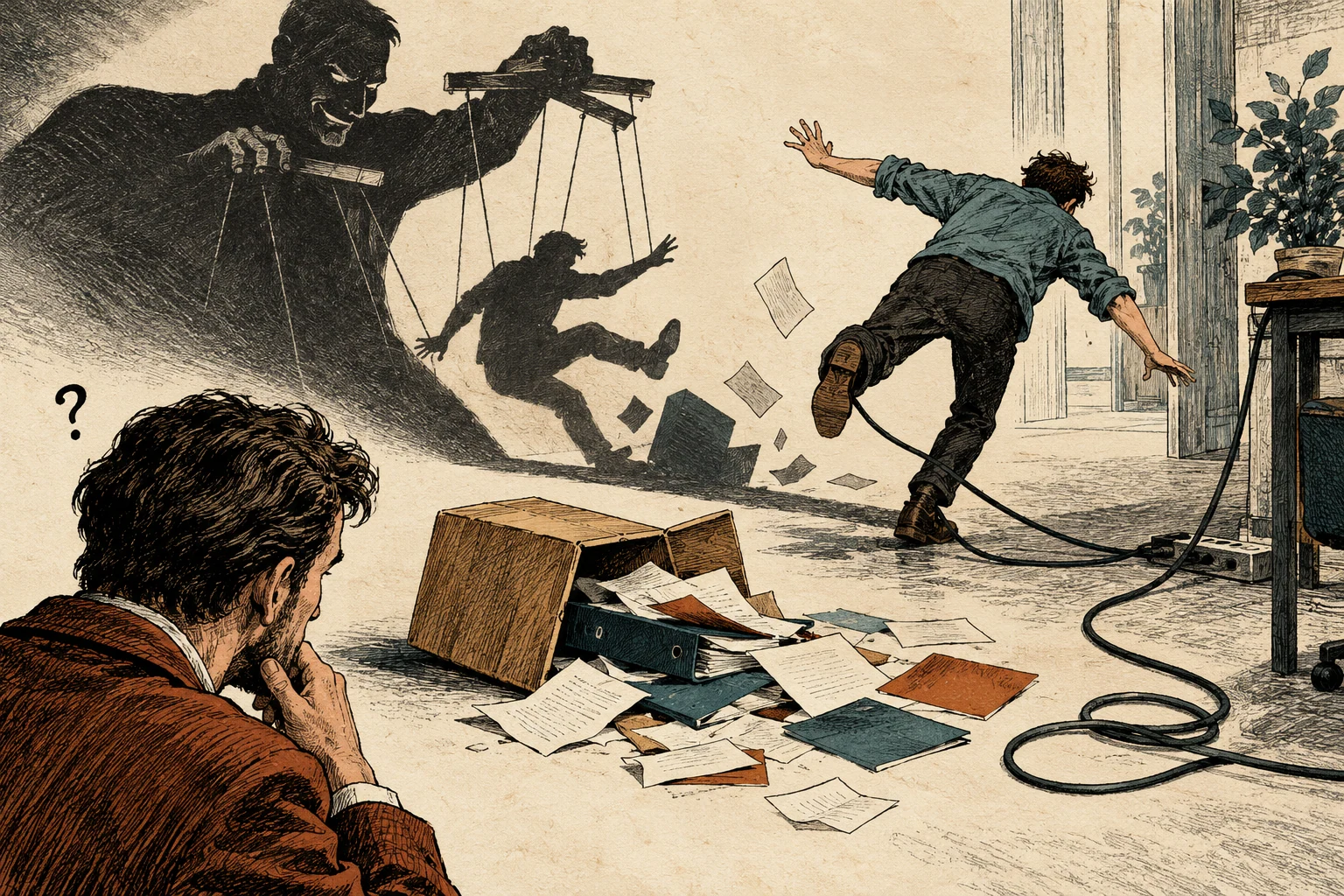
An apparently sinister outcome may have an ordinary explanation. Checking for error precedes attributing malice, though it does not rule out deliberate harm.
AI-assisted illustration · conceptual metaphor View in visual quiz →Genesis and Global Lineage
The canonical wording—“Never attribute to malice that which is adequately explained by stupidity”—first appeared in print in 1980 under the heading “Hanlon's Razor” in Arthur Bloch's humor anthology Murphy's Law Book Two: More Reasons Why Things Go Wrong! (p. 52). As traced by Quote Investigator and confirmed in 2001 by letters from Joseph E. Bigler published by computer scientist Quentin Stafford-Fraser, the contributor was Robert J. Hanlon, a programmer from Scranton, Pennsylvania, who submitted the line after Bloch invited readers of the first volume to send in their own laws. Modeled by analogy on Occam's razor, the maxim was canonized in 1990 by the Jargon File, the lexicon of hacker culture, whose 1996 edition noted that it might be a phonetic corruption of “Heinlein's razor”: in Robert A. Heinlein's March 1941 science-fiction novella Logic of Empire, a character remarks, “You have attributed conditions to villainy that simply result from stupidity,” contrasting the “devil theory” of sociology with the “stupidity theory.” The underlying insight is older still: in The Sorrows of Young Werther (1774), Goethe wrote that misunderstandings and lethargy produce more disorder in the world than cunning and malice (whereas popular attributions of the quote to Napoleon Bonaparte first surfaced in Usenet threads around 1997–1998 without historical support). From hacker folklore the razor branched into two contemporary circuits: self-help literature, where it is taught as an antidote to anger, and risk-management theory, where Douglas W. Hubbard (2009) added an essential institutional amendment—never attribute to malice or stupidity what can be explained by moderately rational people responding to incentives in a complex system.
Central European Lineage
Two Viennese texts flank Hanlon's razor from opposite sides: one elevates it into a philosophy of the social sciences, while the other exposes the moral danger of its key word. Karl R. Popper—educated at the University of Vienna (studies from 1918, doctorate 1928) before emigrating to New Zealand in 1937—coined and dismantled the “conspiracy theory of society” in two 1948 lectures (Towards a Rational Theory of Tradition in Oxford and Prediction and Prophecy in the Social Sciences in Amsterdam, collected in Conjectures and Refutations, 1963). The conspiracy theorist assumes that whatever goes wrong in society—war, unemployment, poverty—must be the result of direct design by powerful individuals or groups. Conspiracies do happen, Popper noted, but they rarely succeed because in social life almost nothing ever comes off exactly as intended; the primary task of social science is therefore to trace the unintended repercussions of intentional human actions. Eleven years earlier, however, the Austrian novelist and essayist Robert Musil—trained in engineering at the German Technical University in Brno before working in Vienna—delivered his famous lecture Über die Dummheit (On Stupidity, 11 and 17 March 1937) to the Austrian Werkbund in Vienna, just one year before the Nazi Anschluss. Musil challenged the comforting assumption that stupidity is merely a harmless lack of intellect: alongside “honest, simple-minded” stupidity stands a “higher, pretentious stupidity” that is a defect of feeling and moral proportion, “the true disease of education” and “the most life-threatening disease of the spirit.” Read together, Popper and Musil define both the power and the limit of Hanlon's razor.
Documented regional lineage · Links: 2. Compiled: October 2026.
-
counterpoint 43 years
Central European Source: Robert Musil, “Über die Dummheit. Vortrag auf Einladung des Österreichischen Werkbunds”; Vienna, Austria, 1937
Global Circulation: Hanlon's razor — Robert J. Hanlon (w zbiorze Arthura Blocha), 1980
-
anticipation 32 years
Central European Source: Karl R. Popper, “„Towards a Rational Theory of Tradition” (wykład, Oksford, 26 VII 1948) i „Prediction and Prophecy in the Social Sciences” (X Międzynarodowy Kongres Filozoficzny, Amsterdam 1948), w: Conjectures and Refutations (1963)”; Vienna, Austria (formation); Christchurch, New Zealand (Canterbury University College), 1948
Global Circulation: Hanlon's razor — Robert J. Hanlon (w zbiorze Arthura Blocha), 1980
anticipation
32 yearsKarl R. Popper, “„Towards a Rational Theory of Tradition” (wykład, Oksford, 26 VII 1948) i „Prediction and Prophecy in the Social Sciences” (X Międzynarodowy Kongres Filozoficzny, Amsterdam 1948), w: Conjectures and Refutations (1963)”
1948 · Vienna, Austria (formation); Christchurch, New Zealand (Canterbury University College)
Hanlon's razor
1980 · Robert J. Hanlon (w zbiorze Arthura Blocha)
- Claim & Connection
- Popper—educated at the University of Vienna (studies from 1918, doctorate 1928, teaching credentials 1929; in New Zealand from 1937)—named and rejected the “conspiracy theory of society” in two 1948 lectures: the view that war, unemployment, or poverty are the direct result of designs by powerful individuals or groups. Conspiracies occur, he argued, but rarely succeed because social life almost never turns out as intended; the primary task of the social sciences is to trace the unintended social repercussions of intentional human actions. This is an earlier, macro-sociological formulation of the heuristic that Hanlon's razor states at the level of individual conduct; no evidence was found that Hanlon or Bloch knew Popper's lectures.
- Source Documentation
-
- primary source Karl R. Popper, Conjectures and Refutations: The Growth of Scientific Knowledge, Routledge & Kegan Paul, London 1963 (skan z OCR na archive.org); Ch. 4, pp. 123–125 (“conspiracy theory of society”, “nothing ever comes off exactly as intended”); Ch. 16, pp. 341–342 (“conspiracies are very rarely successful”, “to trace the unintended social repercussions of intentional human actions”); lecture dates in footnotes on pp. 120 and 336. archive.org ↗
- primary source Karl R. Popper, The Open Society and Its Enemies, vol. II: The High Tide of Prophecy, Routledge, London 1945 (skan wydania z 1947 r.); Ch. 14–15, pp. 92–94: “unintended social repercussions of our actions”; social misery “not the result of a cunning conspiracy” (idea credited to Marx, before the phrase “conspiracy theory of society” was coined). archive.org ↗
- biographical record Stephen Thornton, „Karl Popper”, Stanford Encyclopedia of Philosophy; Section 1 (Life): Vienna 1902, University of Vienna 1918–1928, doctorate 1928, teaching diploma 1925 and qualification 1929, New Zealand 1937. plato.stanford.edu ↗
- Historical Context
- The phrase “conspiracy theory of society” appears in the 1948 lectures, building on a passage in Vol. II of The Open Society (1945). The parallel concerns the structure of the heuristic (do not attribute to a coordinated plan what is explained by unintended consequences and error), though Popper speaks of grand designs and Hanlon of personal malice.
counterpoint
43 yearsRobert Musil, “Über die Dummheit. Vortrag auf Einladung des Österreichischen Werkbunds”
1937 · Vienna, Austria
Hanlon's razor
1980 · Robert J. Hanlon (w zbiorze Arthura Blocha)
- Claim & Connection
- In his lecture delivered in Vienna on 11 and 17 March 1937, Musil undermines the silent premise on which Hanlon's razor rests: that stupidity is an innocent, harmless alternative to malice. Stupidity for Musil is not “merely or primarily a lack of intellect,” but also a “defect of feeling”; citing J. E. Erdmann, he notes that brutality is “the practice of stupidity,” and he diagnoses a “higher, intelligent stupidity” as “the true disease of education” and “the most life-threatening disease of the spirit.” If so, the diagnosis "it's only stupidity" settles nothing, either cognitively or morally.
- Source Documentation
-
- primary source Robert Musil, „Über die Dummheit. Vortrag auf Einladung des österreichischen Werkbunds, gehalten in Wien am 11. März und wiederholt am 17. März 1937”, tekst w Projekt Gutenberg-DE; title page (date and place); paragraph on Erdmann (“die Praxis der Dummheit”, “Gefühlsfehler”); paragraph “das Urteil zu lockern, daß die Dummheit bloß oder vornehmlich ein Mangel an Verstand sei”; paragraphs on “ehrliche” and “intelligente Dummheit”, “Diese höhere Dummheit ist die eigentliche Bildungskrankheit”, “die lebensgefährlichste […] Krankheit des Geistes”. projekt-gutenberg.org ↗
- biographical record „Robert Musil”, Wikipedia (en); Klagenfurt 1880; schools in Eisenstadt and Hranice, military academy in Vienna 1897, German Technical University in Brno, doctorate in Berlin (1908/1909); Vienna 1933–1938; lecture 11 March 1937 at the invitation of the Werkbund; emigration to Switzerland 1938. en.wikipedia.org ↗
- Historical Context
- A philosophical counterpoint: Musil was writing in 1937 Vienna one year before the Anschluss, and his distinction between “honest” and “higher, intelligent” stupidity exposes the moral and analytical limits of invoking stupidity as an exculpatory explanation.
Why Now
Between 2018 and 2026 a series of institutional disasters forced courts, regulators, and the public to adjudicate the boundary between incompetence and malice. Following the two fatal Boeing 737 MAX crashes (2018 and 2019), initial explanations focused on engineering blunders inside the MCAS system; by January 2021, however, Boeing entered a deferred-prosecution agreement with the US Department of Justice over charges of concealing technical information from safety regulators, shifting the case from blunder to deception. The British Post Office Horizon IT scandal illustrated the razor failing in both directions: for over a decade executives violated Hanlon's razor by prosecuting hundreds of sub-postmasters for theft when shortfalls were caused by bugs in Fujitsu's software; yet once the Court of Appeal quashed 39 convictions in 2021 and the public inquiry published its first report in July 2025, the question became when ignorance crossed into deliberate cover-up. Conversely, when a faulty configuration update from CrowdStrike crashed roughly 8.5 million Windows machines worldwide on 19 July 2024—halting airlines, hospitals, and banks—the razor proved its immediate value against early social-media speculation of a cyberattack.
Explanatory Power
Hanlon's razor sharpens analysis in three ways. First, it counteracts a well-documented cluster of cognitive biases: the fundamental attribution error and hostile attribution bias lead observers to explain others' harmful actions by character and intent while excusing their own by circumstances, and safety scientist Sidney Dekker shows how the “bad apple theory” derails accident investigations by hunting for a villain instead of fixing error-prone conditions. Second, it highlights the asymmetric social cost of the two errors: falsely accusing a colleague of malice destroys trust and triggers retaliation, whereas provisionally assuming a mistake keeps communication open while facts are checked. Third, it matches the empirical base rate of large technical and bureaucratic systems, where configuration typos, dropped emails, and unaligned databases outnumber plots by orders of magnitude. In practice, the razor means checking the spam folder before accusing a department of hiding a report and verifying whether a chaotic rule was drafted at 3 a.m. before reading it as a master plan.
Axes of Debate
Default charity versus adversarial environments
Cybersecurity engineers, intelligence analysts, and disinformation researchers treat Hanlon's razor as sensible advice for civilian life but a vulnerability inside their own domains: an intelligent adversary who knows that defenders default to “it's probably a glitch” will disguise sabotage, data exfiltration, or influence operations as mundane technical errors (plausible deniability). Strongest counterargument: Even inside security operations centers, the base rate of genuine misconfigurations and user mistakes vastly exceeds sophisticated attacks; treating every anomaly as malice causes alert fatigue and false positives, and the razor does not forbid investigation—it merely assigns the initial burden of proof. Nature of the dispute: substantive — it turns on empirical base rates and the relative cost of Type I versus Type II errors in a specific environment.
Individual stupidity versus systemic incentives
Risk analyst Douglas Hubbard (2009), safety theorist Sidney Dekker (2006), and sociologists in Popper's tradition argue that “stupidity” is almost as lazy an explanation as “malice”: inside organizations, harmful outcomes usually emerge because reasonably competent people respond rationally to local metrics, time pressure, and fragmented information. Strongest counterargument: Appealing purely to “the system” and “incentives” can become unfalsifiable and dissolve personal accountability; in both the Boeing 737 MAX and UK Post Office scandals, systemic pressures were real, but at identifiable moments specific individuals chose to withhold known error reports from courts and regulators. Nature of the dispute: substantive — it concerns the appropriate level of causal explanation needed to prevent recurrence.
Causal explanation versus moral exoneration
Moral philosophers and political theorists drawing on Robert Musil (1937) and Hannah Arendt's Eichmann in Jerusalem (1963) warn that Hanlon's razor is routinely abused to sedate moral judgment: since thoughtlessness, conformity, and “higher stupidity” can administer industrial-scale harm, saying “they didn't mean any harm” does not close the moral file—it opens it. Strongest counterargument: Hanlon's razor is an epistemic heuristic about causal diagnosis, not a legal or ethical doctrine of immunity; recognizing that a disaster stemmed from negligence rather than malice is why legal systems maintain graded categories of culpability (negligence, gross negligence, reckless disregard) rather than a binary choice between murder and innocence. Nature of the dispute: mixed — partly a substantive debate over culpable ignorance, partly a rhetorical struggle over who gets to say “mistakes were made” to escape liability.
Underappreciated Angle
Hanlon's razor is reflexive: it behaves differently once strategic actors know that observers rely on it. When “never attribute to malice what can be explained by incompetence” becomes the default norm of journalists, regulators, and courts, feigned incompetence acquires strategic value—the cheapest camouflage for bad faith is to look disorganized (weaponized incompetence in interpersonal life, plausible deniability in statecraft and corporate litigation). A second blind spot is temporal: Hanlon's razor is a rule for the first occurrence of harm, not the tenth. Incompetence that persists after its harmful effects have been documented and brought to the decision-maker's attention ceases to be mere incompetence and becomes a conscious choice to tolerate harm—captured in folklore by “Grey's Law” (any sufficiently advanced incompetence is indistinguishable from malice) and in law by the shift from negligence to dolus eventualis (reckless acceptance of foreseeable harm). To use Hanlon's razor rigorously, always attach a timestamp: when did they find out?
One-Sentence Takeaway
Hanlon's razor does not say people are benevolent, only that blunders are cheap and coordinated malice is expensive—so anyone invoking the pricier explanation owes the evidence, and anyone claiming a blunder loses that defense the moment they are told and refuse to fix it.
Related Concepts Network
How this concept reinforces, constrains, or complements other analytical frameworks in the corpus. View on graph →
-
Steelmanning complements
Both practices enforce charitable interpretation: Hanlon's razor applies charity to an interlocutor's intentions, steelmanning to their arguments.
-
Incentives constrains
Douglas Hubbard's correction replaces both terms of the razor with a third: organizational harm is usually explained by moderately rational people following local incentives, not by malice or stupidity.
-
Principal–agent problem complements
What looks from the outside like an agent's incompetence or sabotage is frequently the rational pursuit of their own misaligned incentives.
-
Systems thinking constrains
Complex systems routinely generate disastrous outcomes without anyone acting stupidly or maliciously, so Hanlon's razor stops the causal inquiry one level too early.
-
Motivated reasoning reinforces
Our spontaneous tendency to attribute enemies' blunders to malice and our own to circumstances is the exact cognitive bias the razor is designed to counteract.
-
Disinformation in tension
An adversary who knows Hanlon's razor designs covert operations to look like accidents, while the disinformation frame is conversely overused to attribute grand design to ordinary chaos.
-
Red teaming in tension
Red-teaming assumes an intelligent, malicious adversary by definition, so in cybersecurity and intelligence domains Hanlon's razor cannot serve as the default hypothesis.
Reading Canon & Translation Bridge
Foundational texts, introductions, and critical perspectives—with availability of English and Polish editions.
-
foundational text 1980 · English
Arthur Bloch (red.), Murphy's Law Book Two: More Reasons Why Things Go Wrong!
The first printing of the maxim under the heading "Hanlon's Razor" (p. 52) in a collection of humorous laws, showing that the concept entered circulation as a joke before becoming an analytical heuristic.
In English: original text written in English
In Polish: Polish edition not verified
-
foundational text 1941 · English
Robert A. Heinlein, Logic of Empire
A novella in Astounding Science-Fiction (March 1941) containing the line “You have attributed conditions to villainy that simply result from stupidity,” contrasting the “devil theory” of sociology with the “stupidity theory”; the closest direct predecessor of Hanlon's razor.
In English: original text written in English
In Polish: Polish edition not verified
-
introduction & synthesis 2019 · English
Shane Parrish, Rhiannon Beaubien, The Great Mental Models, Volume 1: General Thinking Concepts
A popular introduction placing Hanlon's razor alongside Occam's razor as a filter against overcomplicated explanations of other people's motives.
In English: original text written in English
In Polish: Polish edition not verified
-
cross-disciplinary 1963 · English
Karl R. Popper, Conjectures and Refutations: The Growth of Scientific Knowledge
Chapters 4 and 16 reprint Popper's 1948 lectures on the “conspiracy theory of society” and the unintended consequences of human actions—Hanlon's razor elevated to the philosophy of history and social science.
In English: original text written in English
In Polish: “Droga do wiedzy. Domysły i refutacje”, Wydawnictwo Naukowe PWN 1999, trans. Stefan Amsterdamski
-
critical perspective 2009 · English
Douglas W. Hubbard, The Failure of Risk Management: Why It's Broken and How to Fix It
Contains Hubbard's institutional correction to the razor: never attribute to malice or stupidity that which can be explained by moderately rational individuals following incentives in a complex system.
In English: original text written in English
In Polish: Polish edition not verified
-
critical perspective 1963 · English
Hannah Arendt, Eichmann in Jerusalem: A Report on the Banality of Evil
The sharpest reminder that the absence of satanic malice is not innocence: sheer thoughtlessness and bureaucratic conformism can administer industrial mass murder, so the razor explains without exonerating.
In English: original text written in English
In Polish: “Eichmann w Jerozolimie. Rzecz o banalności zła”, Znak 1987, trans. Adam Szostkiewicz
-
critical perspective 1937 · German
Robert Musil, Über die Dummheit
The 1937 Vienna lecture dissecting stupidity into an “honest, simple-minded” form and a “higher, pretentious” form; demonstrates that the “stupidity” pole of the razor is neither innocent nor simple.
In English: English edition not verified
In Polish: Polish edition not verified
-
cross-disciplinary 2006 · English
Sidney Dekker, The Field Guide to Understanding Human Error
Safety science in action: replaces the “bad apple theory” of accidents with an investigation of the systemic conditions under which reasonable operators made mistakes.
In English: original text written in English
In Polish: Polish edition not verified
Primary-Source Quotes
Never attribute to malice that which is adequately explained by stupidity.
The conspiracy theory of society is very widespread, and has very little truth in it. Only when conspiracy theoreticians come into power does it become something like a theory which accounts for things which actually happen (a case of what I have called the ‘Oedipus Effect’).