Epistemology #012
Sensemaking
original term: sensemaking (Eng.) · tworzenie sensu, nadawanie sensu, sense-making
Central European lineage: 1 thread (documented influence) · 1932–1995 · jump to documentation ↓
Working Definition
Sensemaking is the ongoing process through which people—usually acting together and looking backward—turn an ambiguous, unexpected stream of experience into an intelligible situation that they can name and use as a springboard for action. In organizational theorist Karl E. Weick's formulation, it has seven defining properties: it is grounded in identity construction, retrospective, enactive of sensible environments (by acting, we help create the environment we then decipher), social, ongoing, focused on extracted cues, and driven by plausibility rather than accuracy. Since around 2018, a broader usage has spread through public-intellectual culture (Daniel Schmachtenberger, John Vervaeke), where sensemaking denotes a society's collective epistemic capacity to separate signal from noise and coordinate on shared problems. Both usages share a core premise: the bottleneck in a crisis is rarely a shortage of raw data, but the lack of a working frame in which those data mean something.
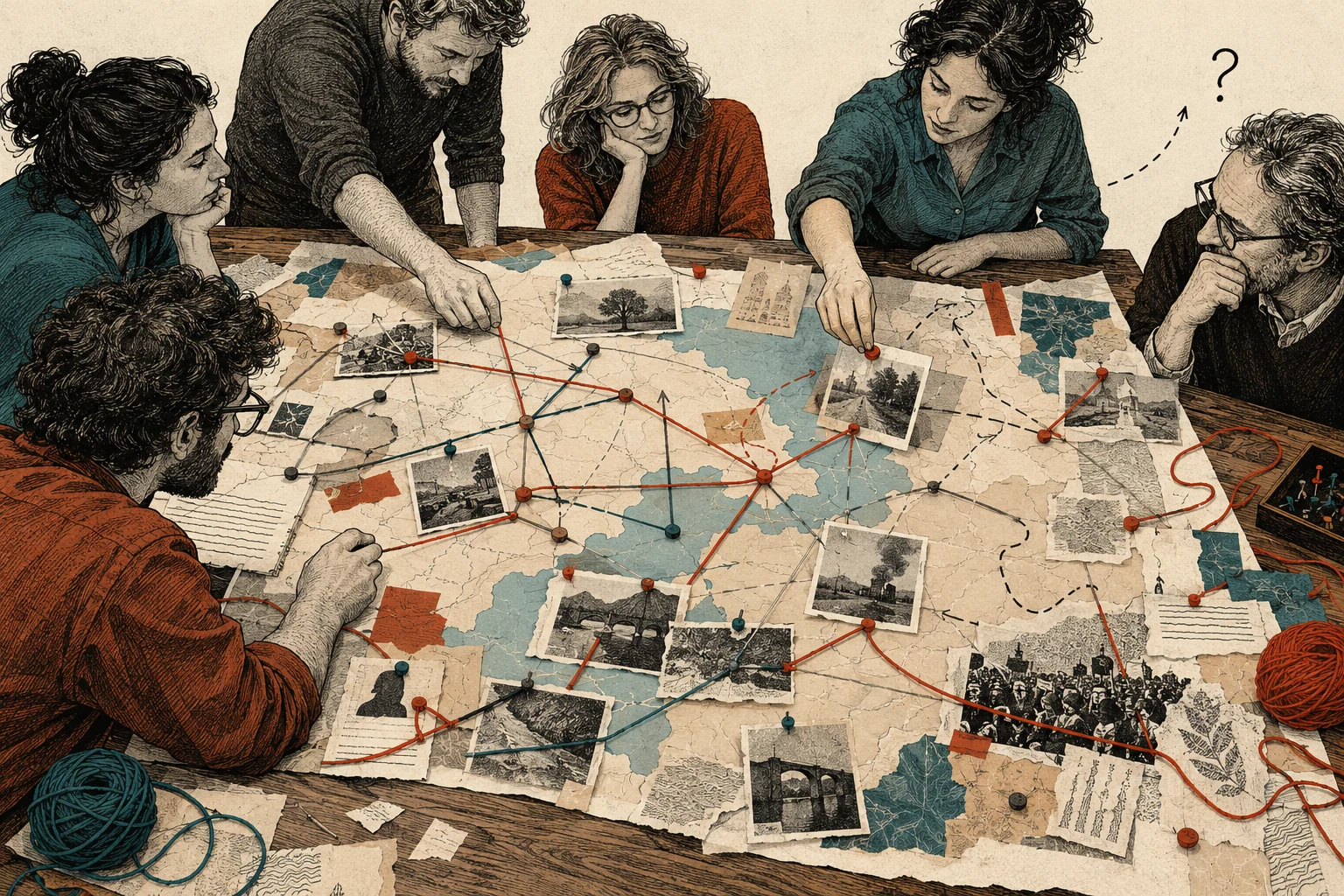
Arranging observations together creates a working picture of the situation. New information can alter the connections and the meaning of the whole account.
AI-assisted illustration · conceptual metaphor View in visual quiz →Genesis and Global Lineage
The concept was brought into organization studies by American social psychologist Karl E. Weick, first in The Social Psychology of Organizing (1969; 2nd ed. 1979), which urged scholars to replace the static noun “organization” with the active verb “organizing” and introduced the concept of enactment. Weick developed sensemaking in full across three landmark texts: his 1988 analysis of the Bhopal chemical disaster, his 1993 study of the 1949 Mann Gulch wildfire in Montana where thirteen smokejumpers perished (“The Collapse of Sensemaking in Organizations”), and his 1995 monograph Sensemaking in Organizations (later updated with Kathleen Sutcliffe and David Obstfeld in 2005). Weick synthesized American pragmatism (William James, John Dewey), symbolic interactionism, Harold Garfinkel's ethnomethodology, and Viennese social phenomenology. In parallel, three other fields built independent traditions under the same name: communication scholar Brenda Dervin developed her user-centered Sense-Making methodology (with a hyphen) from the 1970s onward; human–computer interaction researchers Daniel Russell, Mark Stefik, Peter Pirolli, and Stuart Card analyzed the “cost structure of sensemaking” in intelligence and information foraging (1993); and cognitive psychologist Gary Klein formulated the “data–frame” theory of expert sensemaking under time pressure (2006). After 2017 the term migrated into management consulting (Christian Madsbjerg's Sensemaking, 2017) and civilizational critique, where Schmachtenberger (“The War on Sensemaking,” 2019) and cognitive scientist John Vervaeke (Awakening from the Meaning Crisis, 2019) recast it as the collective faculty threatened by algorithmic media and the “metacrisis.”
Central European Lineage
The philosophical cornerstone of Weick's second property—that sensemaking is retrospective, because we can know what we are doing only after we have done it—comes directly from interwar Vienna. In Sensemaking in Organizations (1995, pp. 24–25), Weick derives retrospectivity from the Austrian philosopher and sociologist Alfred Schütz (1899–1959) and his treatise Der sinnhafte Aufbau der sozialen Welt (The Phenomenology of the Social World, published in Vienna by Julius Springer in 1932; English translation 1967). Educated at the University of Vienna under legal theorist Hans Kelsen and economist Ludwig von Mises while working by day as a banking executive in Vienna until fleeing the Nazi Anschluss for New York in 1939, Schütz combined Edmund Husserl's phenomenology of internal time-consciousness with Max Weber's interpretive sociology. While we are immersed in the ongoing flow of action (durée), Schütz argued, our experience has no discrete boundaries; it acquires determinate meaning only when we step out of the stream and cast a reflective glance backward upon an act as already completed (in the future perfect tense, modo futuri exacti). A second Viennese-rooted channel reached Weick through Schütz's students at the New School for Social Research, Vienna-born Peter L. Berger and Vienna-educated Thomas Luckmann, whose The Social Construction of Reality (1966) translated Schütz's phenomenology of the everyday lifeworld into the sociology of institutions—and later back into Central Europe when Warsaw-trained organization theorist Barbara Czarniawska translated Weick's monograph into Polish (Tworzenie sensu w organizacjach, Kraków, 2016).
Documented regional lineage · Link: 1. Compiled: October 2026.
-
documented influence 63 years
Central European Source: Alfred Schütz, “Der sinnhafte Aufbau der sozialen Welt. Eine Einleitung in die verstehende Soziologie”; Vienna, Austria, 1932
Global Circulation: sensemaking — retrospectivity and the social construction of meaning — Karl E. Weick, 1995
documented influence
63 yearsAlfred Schütz, “Der sinnhafte Aufbau der sozialen Welt. Eine Einleitung in die verstehende Soziologie”
1932 · Vienna, Austria
sensemaking — retrospectivity and the social construction of meaning
1995 · Karl E. Weick
- Claim & Connection
- In Sensemaking in Organizations (1995), Karl Weick derives the retrospective character of sensemaking—the second of his seven defining properties—directly from Alfred Schütz's analysis of “meaningful lived experience” (via the 1967 English translation, The Phenomenology of the Social World), and among his constructionist sources he cites Peter Berger and Thomas Luckmann's The Social Construction of Reality (1966), written by Schütz's students at the New School. Schütz studied law and social sciences at the University of Vienna under Hans Kelsen and Ludwig von Mises, worked in Viennese banking while writing his 1932 monograph in Vienna, and emigrated to the United States in 1939.
- Source Documentation
-
- biographical record Michael Barber, „Alfred Schutz”, Stanford Encyclopedia of Philosophy; §1: studies in Vienna under Kelsen and Mises, emigration 14 July 1939; bibliography: Der sinnhafte Aufbau der sozialen Welt, Vienna: Springer 1932; English trans. G. Walsh and F. Lehnert, Northwestern University Press 1967. plato.stanford.edu ↗
- reception / translation Karl E. Weick, Sensemaking in Organizations, Sage, Thousand Oaks 1995; Ch. 2, property “retrospective”, pp. 24–25 (reference to Schutz 1967); name index: Berger pp. 67, 196. books.google.pl ↗
- scholarly study Suzan Langenberg, Hans Wesseling, „Making Sense of Weick's Organising. A Philosophical Exploration”, Philosophy of Management 2016, doi:10.1007/s40926-016-0040-z; note 11: Berger and Luckmann (1966) as precursors of sensemaking theory. d-nb.info ↗
- biographical record Wikipedia (en), hasła „Thomas Luckmann” i „Peter L. Berger”; Luckmann: studies in Vienna (1947) and Innsbruck (1948), from 1950 New School, student of Schütz; Berger and Luckmann highlight Schütz's central role in The Social Construction of Reality. en.wikipedia.org ↗
- Historical Context
- Schütz's Viennese formation and the 1932 publication in Vienna are confirmed by the Stanford Encyclopedia of Philosophy; Weick drew on the 1967 English translation (The Phenomenology of the Social World) to ground the thesis that we know what we have done only after we have done it.
Why Now
Between 2018 and 2026 sensemaking experienced a second career outside business schools. In 2019 the platform Rebel Wisdom released “The War on Sensemaking” featuring Daniel Schmachtenberger, and cognitive scientist John Vervaeke launched his fifty-part lecture series Awakening from the Meaning Crisis; together they popularized the diagnosis that liberal democracies were losing the shared epistemic infrastructure needed to agree on basic problems. Months later, the COVID-19 pandemic provided a global stress test: in February 2020 the WHO declared an “infodemic,” while hospital administrators, supply-chain managers, and citizens faced textbook Weickian “cosmology episodes” as inherited playbooks failed overnight. Then, from late 2022 onward, the mass adoption of large language models industrialized the exact trade-off Weick had identified thirty years earlier as the seventh property of sensemaking: driven by plausibility rather than accuracy. Generative AI systems are statistical engines of plausible coherence—capable of helping teams synthesize messy notes into a working frame, or seducing organizations with smooth, hallucinated narratives that mask anomalies.
Explanatory Power
Sensemaking explains why organizations and communities rarely collapse from making a wrong calculation inside a stable decision tree; they collapse when the shared frame that makes calculation possible shatters. In Weick's analysis of the 1949 Mann Gulch disaster, an elite crew of smokejumpers parachuted into what they labeled a routine “10:00 fire” (extinguishable by 10 a.m. the next morning). When the wind shifted and a wall of flame raced up the canyon, they clung to the “10:00 fire” frame too long; and when foreman Wag Dodge ordered them to drop their heavy tools and run, several crew members kept carrying their axes and shovels until overtaken by the fire—because, as Weick showed, a firefighter stripped of his tools and command chain no longer knew who he was. Identity and role structure collapsed alongside their map of the terrain. The same mechanism illuminates public deadlocks where piling up fact-checks changes nothing because opposing camps operate inside incompatible frames that dictate what counts as a cue. And in corporate life, it explains why strategic plans and post-mortems read like linear deductions: because sense is made retrospectively, organizations act first by improvising and write their “strategy” afterward to explain where their feet took them.
Axes of Debate
Retrospective glance versus prospective imagination
Organization scholars such as Dennis Gioia, Jörgen Sandberg, and Haridimos Tsoukas (2015) criticize Weick's reliance on Schütz's retrospectivity, arguing that treating all sensemaking as backward-looking ignores how entrepreneurs and leaders actively project visions of the future (prospective sensemaking). Strongest counterargument: Following Schütz, Weick replies that even when we plan for the future, we do so in the future perfect tense—by imagining a future act as already accomplished (“once we have entered the market, we will have…”) and looking back from that imagined point to trace the steps that led there; foresight is simulated hindsight. Nature of the dispute: substantive — it concerns the temporal structure of human planning and how organizations coordinate around unbuilt futures.
Episodic cognitive repair versus continuous embodied dwelling
Phenomenological critics (Sandberg and Tsoukas, 2015; Robin Holt and Joep Cornelissen, 2014) argue that Weick restricts sensemaking to deliberate, language-mediated episodes triggered when routine breaks down, overlooking the continuous, pre-reflective, bodily ways skilled practitioners make sense of their work before any crisis occurs. Strongest counterargument: Weick's core concept of enactment—and his parable of lost soldiers who find their way out of the Alps using a map of the Pyrenees because the map calms them enough to start walking and noticing terrain cues—already places bodily action ahead of detached mental representation. Nature of the dispute: mixed — substantive regarding pre-verbal affect and bodily skill, partly rhetorical where critics caricature Weick as a Cartesian cognitivist.
Organizational micro-process versus civilizational “war on sensemaking”
Researchers in management and HCI object that the post-2018 “metacrisis” movement (Schmachtenberger, Vervaeke) stretches sensemaking into a synonym for “public epistemology” or “finding truth,” inverting Weick's thesis that sensemaking is driven by pragmatic plausibility rather than objective truth. Defenders of the macro usage reply that in a networked society, the breakdown of sensemaking has scaled from the firefighting crew to the body politic. Strongest counterargument: Weick himself opened the door to macro-analysis with his concept of a cosmology episode—when “both the sense of what is occurring and the means to rebuild that sense collapse together”; civilizational theorists argue that digital media ecosystems induce chronic cosmology episodes at societal scale. Nature of the dispute: mixed — part disciplinary boundary-policing, part a philosophical tension between pragmatic plausibility and epistemic truth.
Underappreciated Angle
The least absorbed lesson of Weick's Mann Gulch study is that meaning and social structure stand or fall together. When the smokejumpers scattered, they did not lack raw sensory data—they could see and hear the flames. What disintegrated first was their interpersonal role system: the line of march broke, orders stopped being relayed, and each man felt utterly alone. Once the social network dissolved, their individual capacity to interpret the fire dissolved with it. Weick identified four sources of resilience against such collapse: improvisation and bricolage, virtual role systems (carrying a mental model of the whole team's roles), the attitude of wisdom, and respectful interaction (trusting others' reports and reporting honestly). That contrasts sharply with standard remedies for “information disorder,” which operate almost exclusively on propositional data as if cleaning up false claims would repair collective sense. Weick's sociology teaches the opposite order: facts regain traction only after rebuilding a high-trust social role structure in which people can revise working hypotheses together without losing face or identity.
One-Sentence Takeaway
Organizations and societies rarely perish from a shortage of data—they perish in “cosmology episodes” when both their shared frame for what is happening and the social trust needed to rebuild that frame collapse at the same time.
Related Concepts Network
How this concept reinforces, constrains, or complements other analytical frameworks in the corpus. View on graph →
-
The map is not the territory complements
Weick's famous parable of Hungarian soldiers lost in the Alps who find their way out using a map of the Pyrenees shows that in action even a wrong map initiates coordinated movement that generates new cues.
-
Predictive processing complements
Predictive processing describes the neurocognitive loop of expectations guiding perception; sensemaking describes the same cycle at the social, linguistic, and retrospective level.
-
Wicked problems reinforces
In wicked problems the very definition of the problem is contested, so tackling them begins with collective sensemaking rather than optimizing a given objective function.
-
Information disorder complements
The “information disorder” framework classifies polluted messages, whereas the “war on sensemaking” asks about a society's collective capacity to process them; the two diagnoses need each other.
-
Metacrisis reinforces
In metacrisis discourse, the breakdown of collective sensemaking is treated as the shared bottleneck underlying ecological, technological, and institutional crises.
-
Black Swan in tension
Taleb treats retrospective narrative-building as a cognitive fallacy to be eradicated, whereas Weick views retrospective framing as the inescapable condition of all human meaning and coordinated action.
-
Framing complements
In Gary Klein's data–frame model, a frame is the working engine of sensemaking: it determines what counts as a cue versus noise, while anomalous cues eventually force a reframing.
Reading Canon & Translation Bridge
Foundational texts, introductions, and critical perspectives—with availability of English and Polish editions.
-
foundational text 1995 · English
Karl E. Weick, Sensemaking in Organizations
The canonical exposition of the seven properties of sensemaking and its philosophical roots in pragmatism, phenomenology, and symbolic interactionism.
In English: original text written in English
In Polish: “Tworzenie sensu w organizacjach”, Wydawnictwo Uniwersytetu Jagiellońskiego 2016, trans. Barbara Czarniawska
-
foundational text 1993 · English
Karl E. Weick, The Collapse of Sensemaking in Organizations: The Mann Gulch Disaster
The classic reanalysis of the 1949 Mann Gulch wildfire in Administrative Science Quarterly 38(4), pp. 628–652: introduces “cosmology episodes,” the mutual collapse of role structure and meaning, and four sources of organizational resilience.
In English: original text written in English
In Polish: no Polish edition
-
introduction & synthesis 2005 · English
Karl E. Weick, Kathleen M. Sutcliffe, David Obstfeld, Organizing and the Process of Sensemaking
A concise synthesis in Organization Science 16(4), pp. 409–421, updating the framework to give greater weight to emotion, power, and future-oriented action.
In English: original text written in English
In Polish: no Polish edition
-
introduction & synthesis 2014 · English
Sally Maitlis, Marlys Christianson, Sensemaking in Organizations: Taking Stock and Moving Forward
A comprehensive literature review in Academy of Management Annals 8(1), pp. 57–125: maps triggers, intersubjective processes, and organizational outcomes of sensemaking.
In English: original text written in English
In Polish: no Polish edition
-
critical perspective 2015 · English
Jörgen Sandberg, Haridimos Tsoukas, Making Sense of the Sensemaking Perspective: Its Constituents, Limitations, and Opportunities for Further Development
A critical reconstruction in Journal of Organizational Behavior 36(S1), pp. S6–S32: faults Weick's framework for overemphasizing episodic breakdown and retrospective cognition at the expense of prospective and embodied sensemaking.
In English: original text written in English
In Polish: no Polish edition
-
cross-disciplinary 2006 · English
Gary Klein, Brian Moon, Robert R. Hoffman, Making Sense of Sensemaking 1: Alternative Perspectives
A view from naturalistic decision-making and human–computer interaction (IEEE Intelligent Systems 21(4), pp. 70–73), introducing the data–frame theory of how experts make sense of anomalies under time pressure.
In English: original text written in English
In Polish: no Polish edition
-
cross-disciplinary 1932 · German
Alfred Schütz, Der sinnhafte Aufbau der sozialen Welt. Eine Einleitung in die verstehende Soziologie
The Viennese phenomenological source of Weick's retrospectivity thesis: lived experience acquires discrete meaning only when grasped in a reflective glance backward.
In English: “The Phenomenology of the Social World”, Northwestern University Press 1967, trans. George Walsh, Frederick Lehnert
In Polish: no Polish edition
-
cross-disciplinary 2012 · English
John Vervaeke, Timothy P. Lillicrap, Blake A. Richards, Relevance Realization and the Emerging Framework in Cognitive Science
The cognitive-science foundation behind the post-2018 “meaning crisis” and “civilizational sensemaking” literature (Journal of Logic and Computation 22(1), pp. 79–99): how an agent zeroes in on what is relevant before formal inference even begins.
In English: original text written in English
In Polish: no Polish edition
Primary-Source Quotes
A cosmology episode occurs when people suddenly and deeply feel that the universe is no longer a rational, orderly system. What makes such an episode so shattering is that both the sense of what is occurring and the means to rebuild that sense collapse together.
The basic idea of sensemaking is that reality is an ongoing accomplishment that emerges from efforts to create order and make retrospective sense of what occurs.