Epistemology #017
Preference falsification
original term: preference falsification (Eng.) · private truths, public lies, skrywanie preferencji, fałszowanie preferencji
Central European lineage: 4 threads (anticipation, documented influence, historical experience) · 1951–1991 · jump to documentation ↓
Working Definition
Preference falsification is the act of publicly expressing views, desires, or evaluations that contradict one’s privately held convictions in response to perceived social, political, or institutional pressure. The concept distinguishes genuine persuasion through argument from strategic impression management, in which an individual minimizes reputational costs at the expense of expressive autonomy. In everyday commentary it is often conflated with simple lying or personal hypocrisy; in Timur Kuran’s technical formulation, it is a microeconomic mechanism that at the macro level manufactures a false consensus, entrenches dysfunctional norms or regimes, and makes sudden political upheavals structurally unpredictable.
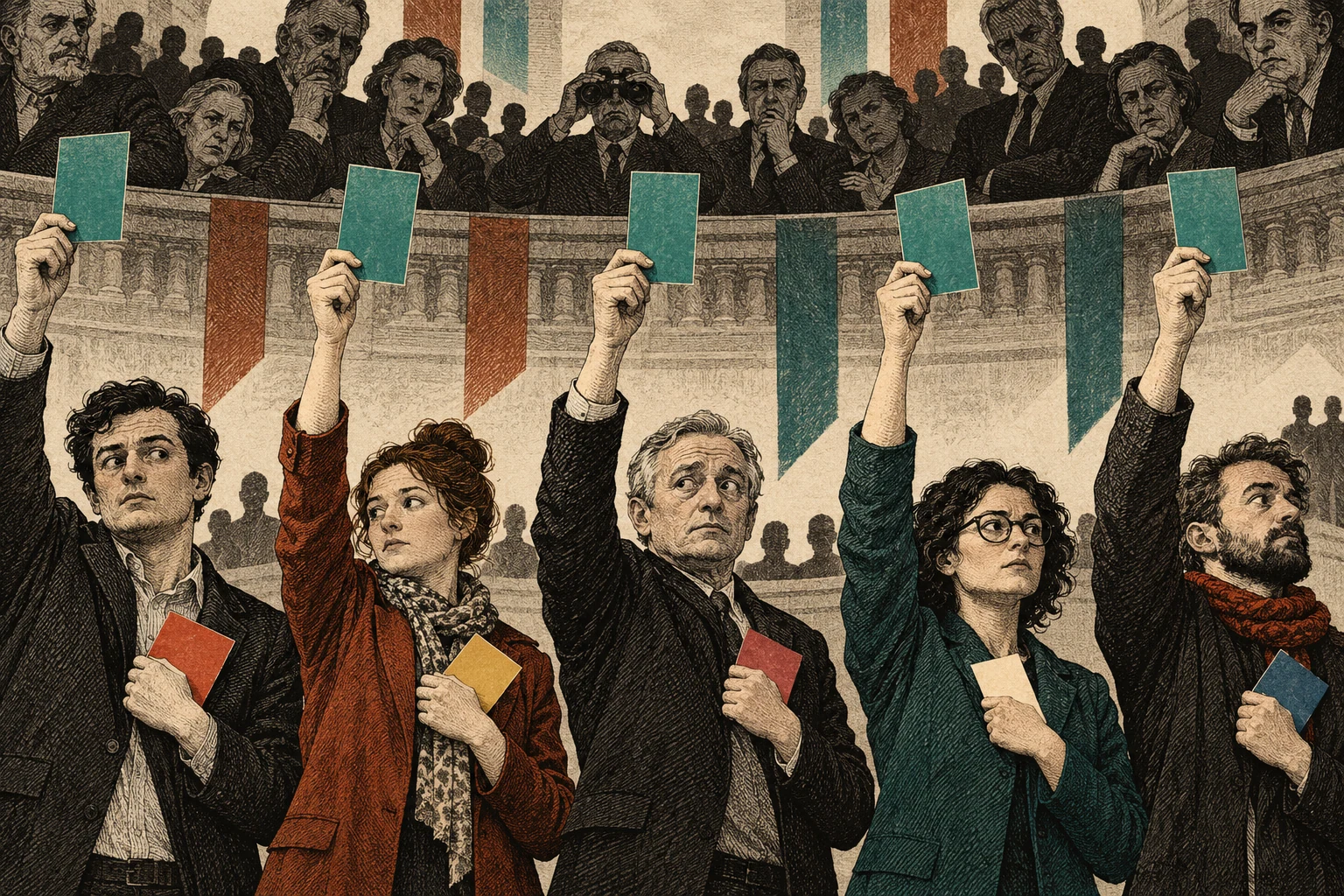
Publicly displayed stances differ from private ones. Social pressure makes visible unanimity potentially deceptive.
AI-assisted illustration · conceptual metaphor View in visual quiz →Genesis and Global Lineage
The term was coined by the Turkish-American economist and political scientist Timur Kuran in a series of late-1980s papers (beginning with his 1987 article in The Economic Journal) and received its full theoretical statement in his 1991 essay Now Out of Never and his 1995 monograph Private Truths, Public Lies. Building on Mark Granovetter’s threshold models of collective behavior (1978) and Albert O. Hirschman’s theory of exit, voice, and loyalty (1970), Kuran decomposed the payoff of any public declaration into three distinct components: intrinsic utility (derived from the substantive outcome a person genuinely favors), reputational utility (determined by the rewards and sanctions meted out by one’s audience), and expressive utility (the psychological satisfaction of speaking one’s mind and preserving personal integrity). In the twenty-first century, the concept has frequently been co-opted in culture-war punditry as an all-purpose invocation of a “silent majority,” a popular usage that often blurs Kuran’s crucial analytical distinction between durable private preferences and malleable social knowledge — which after decades of self-censorship can itself atrophy as counterarguments vanish from public circulation.
Central European Lineage
Czesław Miłosz anticipated the core mechanism decades before its formalization in public-choice economics, while dissident essays by Václav Havel and Piotr Wierzbicki were directly incorporated by Kuran into his 1991 analysis of the fall of Communism. In his essay “Ketman,” published in 1951 in Jerzy Giedroyc’s Paris-based Polish émigré monthly Kultura and included in 1953 as Chapter III of The Captive Mind, Miłosz — formed before World War II in Wilno and Warsaw — borrowed Arthur de Gobineau’s nineteenth-century account of Persian Shiite dissimulation (ketman) to classify the survival strategies of intellectuals under Stalinism: outwardly performing ardent orthodoxy while secretly nurturing professional, aesthetic, or national dissent. In October 1978, writing at Hrádeček in Czechoslovakia, Václav Havel captured the everyday micro-mechanics of this system in The Power of the Powerless: a greengrocer places the placard “Workers of the world, unite!” in his shop window between the onions and carrots not out of proletarian zeal, but to buy peace from informers — yet his sign simultaneously becomes part of the ambient pressure compelling every passerby to conform. In Now Out of Never (World Politics, 1991, pp. 27–30), Kuran drew directly on Havel’s greengrocer alongside Piotr Wierzbicki’s 1979 Warsaw samizdat pamphlet Traktat o gnidach (A Treatise on Ticks, first printed in the underground quarterly Zapis), using his threshold model to explain why the revolutions of 1989 across Poland, Hungary, East Germany, Czechoslovakia, and Romania stunned observers and participants alike.
Documented regional lineage · Links: 4. Compiled: October 2026.
-
anticipation 36 years
Central European Source: Czesław Miłosz, “Ketman (first published in “Kultura”; from 1953 Chapter III of “The Captive Mind”)”; Wilno (now Vilnius, Lithuania); Warsaw, Poland; Paris, France, 1951
Global Circulation: preference falsification — Timur Kuran, 1987
-
documented influence 13 years
Central European Source: Václav Havel, “Moc bezmocných”; Hrádeček, Czechoslovakia (now Czechia), 1978
Global Circulation: preference falsification and the apparent stability of regimes (Now Out of Never) — Timur Kuran, 1991
-
documented influence 12 years
Central European Source: Piotr Wierzbicki, “Traktat o gnidach”; Warsaw, Poland (underground press), 1979
Global Circulation: preference falsification and political conformism (Now Out of Never) — Timur Kuran, 1991
-
historical experience 2 years
Central European Source: Collapse of Communist regimes in Poland, Hungary, East Germany, Czechoslovakia, and Romania — Przemiany 1989 roku w Europie Środkowej i NRD; Warsaw, Poland; Budapest, Hungary; Leipzig, East Germany (now Germany); Prague, Czechoslovakia (now Czechia); Bucharest, Romania, 1989
Global Circulation: application of the revolutionary cascades model to the revolutions of 1989 — Timur Kuran, 1991
anticipation
36 yearsCzesław Miłosz, “Ketman (first published in “Kultura”; from 1953 Chapter III of “The Captive Mind”)”
1951 · Wilno (now Vilnius, Lithuania); Warsaw, Poland; Paris, France
preference falsification
1987 · Timur Kuran
- Claim & Connection
- In “Ketman,” published in the Paris Polish-émigré monthly “Kultura” in 1951 and subsequently included as Chapter III of “The Captive Mind” (1953), Czesław Miłosz — formed before World War II in Wilno and Warsaw and writing shortly after breaking with the diplomatic service of Communist Poland — analyzed the systematic split between publicly performed ideological zeal and closely guarded private conviction, classifying distinct varieties of ketman. This represents an earlier diagnosis of a closely related phenomenon; no evidence has been found of Miłosz’s direct influence on Kuran’s formal model, whose term dates to his 1987 articles.
- Source Documentation
-
- primary source Czesław Miłosz, “Ketman”, Kultura (Paris) 1951, no. 7–8 (45–46), pp. 24–43; pp. 24–28: role-playing and concealment of convictions; pp. 28–43: varieties of ketman. static.kulturaparyska.com ↗
- reception / translation Timur Kuran, “Preference Falsification, Policy Continuity and Collective Conservatism”, The Economic Journal, Vol. 97, No. 387, 1987, pp. 642–665; title: term preference falsification (alongside his 1987 article “Chameleon Voters and Public Choice”, Public Choice 53). ideas.repec.org ↗
- biographical record University of California, “In Memoriam: Czeslaw Milosz”; law studies in Wilno 1929–1934, Żagary literary group, wartime years in Warsaw, emigration. senate.universityofcalifornia.edu ↗
- Historical Context
- Wilno and Warsaw mark the author’s formation and lived experience; Paris marks the émigré publication circuit outside the region. The book edition of “Zniewolony umysł” (“The Captive Mind”) appeared in 1953 with Instytut Literacki, and Kuran’s monograph “Private Truths, Public Lies” appeared in 1995. In his 1991 article Kuran does not cite Miłosz. Structural similarity does not mean identity: Miłosz also emphasizes how the actor gradually fuses with the performed mask.
documented influence
13 yearsVáclav Havel, “Moc bezmocných”
1978 · Hrádeček, Czechoslovakia (now Czechia)
preference falsification and the apparent stability of regimes (Now Out of Never)
1991 · Timur Kuran
- Claim & Connection
- Although Timur Kuran coined the term preference falsification in 1987, in his landmark 1991 article “Now Out of Never” he directly invokes Václav Havel’s essay “The Power of the Powerless” and its famous figure of the greengrocer who places the slogan “Workers of the world, unite!” in his shop window between the onions and the carrots, using it to illustrate how public conformity and sanctions against dissent sustain a regime despite widespread private opposition.
- Source Documentation
-
- primary source Václav Havel, “Moc bezmocných” (Hrádeček, October 1978), text in the archive of the Československý disent project (ÚSD AV ČR); English trans. by Paul Wilson in: John Keane (ed.), The Power of the Powerless: Citizens Against the State in Central-Eastern Europe, Hutchinson, London 1985; §III–IV (the greengrocer); dating at the end of the text. disent.usd.cas.cz ↗
- reception / translation Timur Kuran, “Now Out of Never: The Element of Surprise in the East European Revolution of 1989”, World Politics, Vol. 44, No. 1, 1991, pp. 7–48; pp. 27–29, notes 43 and 48–50; bibliographic details of the cited Havel edition in note 9 on p. 9. doi.org ↗
- Historical Context
- The year 1978 refers to the composition of the essay; Kuran dates it to 1979 and quotes from the 1985 English edition. The link is documented for Kuran’s 1991 article; references in his 1995 book were not separately verified in round 2a.
historical experience
2 yearsCollapse of Communist regimes in Poland, Hungary, East Germany, Czechoslovakia, and Romania — Przemiany 1989 roku w Europie Środkowej i NRD
1989 · Warsaw, Poland; Budapest, Hungary; Leipzig, East Germany (now Germany); Prague, Czechoslovakia (now Czechia); Bucharest, Romania
application of the revolutionary cascades model to the revolutions of 1989
1991 · Timur Kuran
- Claim & Connection
- In “Now Out of Never” Kuran analyzes the revolutions of 1989 across Central and Eastern Europe as an empirical case of a cascading revelation of previously concealed preferences. Applying the formal threshold model he had developed prior to the events (his theoretical paper “Sparks and Prairie Fires” appeared in April 1989), he accounts both for why the rapid collapse caught participants and foreign observers by surprise and why partial warnings had failed to predict the timing.
- Source Documentation
-
- reception / translation Timur Kuran, “Now Out of Never: The Element of Surprise in the East European Revolution of 1989”, World Politics, Vol. 44, No. 1, 1991, pp. 7–48; pp. 7–19: surprise, prior predictions, and formal model; note 31 on p. 18: prior publication of the theory; pp. 35–42: national cases. doi.org ↗
- primary source Timur Kuran, “Sparks and Prairie Fires: A Theory of Unanticipated Political Revolution”, Public Choice, Vol. 61, No. 1, April 1989, pp. 41–74; publication date and abstract. scholars.duke.edu ↗
- Historical Context
- East Germany belongs to the immediate neighborhood of the core region and is included as part of the tightly coupled sequence of regime collapses analyzed by Kuran; the remaining countries belong to the core region. Kuran’s formal model was formulated before, not after, the fall of the Soviet bloc.
documented influence
12 yearsPiotr Wierzbicki, “Traktat o gnidach”
1979 · Warsaw, Poland (underground press)
preference falsification and political conformism (Now Out of Never)
1991 · Timur Kuran
- Claim & Connection
- Kuran cites Piotr Wierzbicki’s “Traktat o gnidach” in English translation (“A Treatise on Ticks”, in: Abraham Brumberg (ed.), Poland: Genesis of a Revolution, Random House, New York 1983, pp. 205–207 in Kuran’s notes) when analyzing the conformism of the intelligentsia and the boundaries of state-tolerated criticism. Wierzbicki was formed in Warsaw (b. 1935, University of Warsaw degree in 1957, teacher and journalist in Warsaw); his essay first appeared in the Warsaw samizdat literary quarterly “Zapis” no. 9 (1979).
- Source Documentation
-
- reception / translation Timur Kuran, “Now Out of Never: The Element of Surprise in the East European Revolution of 1989”, World Politics, Vol. 44, No. 1, 1991, pp. 7–48; pp. 28–30, notes 45 and 52. doi.org ↗
- scholarly study Krystian Kratiuk, “Jarosława Kaczyńskiego krytyka Adama Michnika w latach 1979–1993”, Annales Universitatis Paedagogicae Cracoviensis. Studia Politologica XIV (2015), Folia 181, pp. 115–123; pp. 117–118: “Traktat o gnidach” in “Zapis” no. 9 (1979) alongside Adam Michnik’s response “O gnidach i aniołach”; p. 123: bibliography. studiapolitologica.uken.krakow.pl ↗
- biographical record Anna Grażyna Kister, “Wierzbicki Piotr”, Encyklopedia Solidarności, vol. V; paragraph 1: born Nov. 5, 1935 in Warsaw, Faculty of Philology at the University of Warsaw (1957), teacher in Warsaw schools, editorial staffs of “itd” and “Literatura”; “Traktat o gnidach” in issue 9 of “Zapis” (1979). encysol.pl ↗
- scholarly study Małgorzata Zaremba, “Zapis”, Encyklopedia Solidarności, vol. III; paragraph 1: first independent literary quarterly in Communist Poland, Warsaw Jan. 1977 – Apr. 1981 (published by NOWa); Piotr Wierzbicki among the contributors. encysol.pl ↗
- Historical Context
- Added after round 2a verification by editorial decision (2026-10-22); author’s formation and first publication confirmed the same day (Encyklopedia Solidarności, IPN catalogue, “Tekstualia” 2010).
Why Now
Between 2018 and 2026, preference falsification has experienced a major revival across three domains that extend well beyond the study of twentieth-century dictatorships. First, research on digital communication and political polarization has shown that social media platforms drastically lower the cost of monitoring and publicly shaming deviations from in-group orthodoxy, generating intense spirals of reputational conformity inside political coalitions, academic departments, and corporations. Second, persistent polling misses across a wide range of democracies (from the United States to Europe and Latin America), together with methodological advances in measuring social desirability bias between 2020 and 2024, have demonstrated that survey respondents systematically conceal support for stigmatized candidates or policy positions when speaking to live interviewers. Third, following Russia’s full-scale invasion of Ukraine in February 2022, sociologists (including researchers from the independent Chronicles project, FilterLabs, and the Levada Center) have deployed Kuran’s framework and list-experiment designs to determine how much of the high war support recorded in official Russian polls reflects genuine internalization of state propaganda and how much represents defensive preference falsification under the threat of criminal prosecution for “discrediting the armed forces.”
Explanatory Power
Kuran’s model explains why institutions, taboos, and political regimes that are privately resented around kitchen tables can endure for decades without relying on mass terror every day — and then collapse within a matter of days after a seemingly minor trigger. Each individual in a society has an internal “revolutionary threshold”: the percentage of fellow citizens who must openly defy the status quo before that person feels safe enough to drop the mask (for example, 0% for a fearless dissident, 20% for a cautious sympathizer, and 80% for an opportunistic conformist). Crucially, the distribution of these thresholds across the population is private information hidden by preference falsification itself. If a society’s threshold sequence has a gap — say, a handful of dissidents at 0%, while the next most courageous group sits at 15% — isolated protests fizzle out and the regime appears monolithic. Yet if a minor grievance or external shock nudges a few cohorts from 15% down to 5%, a self-reinforcing reputational cascade can ignite overnight: the 5% join the 0%, activating the 10%, which pulls in the 20% and 50%, until within a week the very citizens who were applauding at official rallies yesterday genuinely wonder how anyone could ever have supported the old order.
Axes of Debate
Rational reputational calculus (Kuran) vs. internalized hegemony and habitus (Gramsci, Bourdieu, Wedeen)
Cultural political scientists and anthropologists (such as Lisa Wedeen in her study of Hafez al-Assad’s Syria and scholars drawing on Pierre Bourdieu’s concept of habitus) criticize Kuran for positing an intact, pre-formed “true self” waiting behind the public mask; they argue that decades of bodily participation in state rituals reshape subjectivity itself and operate through cynical “as if” compliance without requiring either sincere belief or a clearly articulated counter-preference. Strongest counterargument: Kuran replies in Part III of Private Truths, Public Lies that his model does not assume static private preferences — on the contrary, he demonstrates that prolonged preference falsification starves the public sphere of counterarguments and produces “unwanted blindness,” a state in which subsequent generations lose the conceptual vocabulary needed even to formulate an alternative. Nature of the dispute: substantive — it concerns how long private epistemic autonomy can survive when deprived of a shared public language and external validation.
False public consensus vs. “hidden transcripts” of everyday resistance (James C. Scott)
In Domination and the Arts of Resistance (1990), James C. Scott argues that subordinated populations are rarely atomized individuals ignorant of their neighbors’ true feelings; in taverns, kitchens, political jokes, folk songs, and underground samizdat networks, they continuously weave a dense “hidden transcript” that mocks officialdom and tests the boundaries of the regime’s lies. Strongest counterargument: Proponents of threshold models respond that knowing your family members or close friends despise the regime does not remove uncertainty about how thousands of strangers will act on the street when the riot police arrive — and it is precisely the absence of society-wide common knowledge, not the absence of private grumbling, that blocks large-scale collective action. Nature of the dispute: substantive — it distinguishes localized trust within small social networks from the public common knowledge required to trigger nationwide mobilization.
Empirical diagnosis of self-censorship vs. unfalsifiable alibi of the “silent majority”
Public opinion researchers criticize the partisan weaponization of preference falsification in liberal democracies, where political commentators routinely claim that their own unpopular platform is secretly shared by a vast majority of citizens who are merely too intimidated by media elites to admit it. Strongest counterargument: Controlled list experiments (item-count techniques), in which respondents report only how many statements on a list they agree with rather than identifying which specific controversial item they endorse, provide rigorous empirical proof that on morally taboo topics the gap between open avowal and anonymous endorsement frequently reaches double digits. Nature of the dispute: mixed — as a methodological tool preference falsification is well-supported by indirect survey techniques, but in partisan rhetoric it often serves as an unfalsifiable excuse for losing arguments.
Underappreciated Angle
The most corrosive long-term consequence of preference falsification is neither fear nor personal duplicity, but the progressive, hard-to-reverse degradation of a society’s collective stock of knowledge. When questioning a prevailing policy or doctrine carries a prohibitive reputational penalty, what vanishes from public circulation is not merely the dissenting conclusion, but the entire web of reasoning, empirical caveats, and trade-offs that supported it. Over time, even the sincere defenders of the reigning orthodoxy lose the ability to understand or justify their own position, replacing substantive argument with ritualized slogan-repeating — the exact pathology John Stuart Mill diagnosed in Chapter II of On Liberty (1859) when he warned that a truth unchallenged by living error hardens into dead dogma. When the taboo finally cracks years or decades later, the society wakes up without the conceptual tools, moderate vocabulary, or institutional habits needed to negotiate a compromise, causing public opinion to swing violently from enforced silence straight into raw, unmediated radicalism.
One-Sentence Takeaway
Regimes and orthodoxies rarely collapse because millions of people suddenly change their minds; they collapse at the moment people discover how many others had privately thought the same thing all along.
Related Concepts Network
How this concept reinforces, constrains, or complements other analytical frameworks in the corpus. View on graph →
-
Overton window reinforces
Widespread concealment of private opinions artificially narrows the perceived range of views deemed acceptable in public debate.
-
Hypernormalization complements
When preference falsification becomes an all-pervasive daily ritual, society enters a state of hypernormalization in which nobody believes the official fiction yet everyone continues to perform it.
-
Cancel culture reinforces
The fear of immediate online ostracism raises the reputational cost of open dissent and widens the gap between private conviction and public expression.
-
Cultural hegemony in tension
Gramsci’s theory of hegemony assumes that subordinated groups internalize the values of the ruling class, whereas in Kuran’s model compliance often stems from cool reputational calculation while private opposition remains intact.
-
Epistemic bubbles vs. echo chambers complements
Inside echo chambers, the reputational cost of voicing a heterodox doubt before one’s own in-group is so steep that participants falsify their preferences even among allies.
-
Moloch and coordination failure reinforces
Preference falsification is a classic coordination trap: no individual has an incentive to step out of line first as long as the true revolutionary thresholds of everyone else remain hidden.
Reading Canon & Translation Bridge
Foundational texts, introductions, and critical perspectives—with availability of English and Polish editions.
-
foundational text 1995 · English
Timur Kuran, Private Truths, Public Lies: The Social Consequences of Preference Falsification
The foundational monograph laying out the formal model of intrinsic, reputational, and expressive utility alongside its macro-level consequences: collective conservatism, distortion of social knowledge, and sudden political upheavals.
In English: original text written in English
In Polish: no Polish edition
-
foundational text 1991 · English
Timur Kuran, Now Out of Never: The Element of Surprise in the East European Revolution of 1989
The landmark “World Politics” article explaining via a model of individual revolutionary thresholds why the Central and Eastern European revolutions of 1989 were structurally unpredictable ex ante even though they appeared inevitable in hindsight.
In English: original text written in English
In Polish: no Polish edition
-
introduction & synthesis 1978 · Czech
Václav Havel, Moc bezmocných
The classic dissident essay on “living within a lie” and the parable of the greengrocer, showing how small daily acts of conformism assemble into the self-sustaining architecture of a post-totalitarian regime.
In English: “The Power of the Powerless: Citizens Against the State in Central-Eastern Europe”, Hutchinson 1985, trans. Paul Wilson
In Polish: “Siła bezsilnych i inne eseje”, Agora 2011, trans. Andrzej S. Jagodziński
-
cross-disciplinary 1980 · German
Elisabeth Noelle-Neumann, Die Schweigespirale. Öffentliche Meinung – unsere soziale Haut
A closely related theory from media studies and public opinion research: fear of social isolation leads individuals who perceive their view as losing ground to fall silent, accelerating its disappearance from the public sphere.
In English: “The Spiral of Silence: Public Opinion – Our Social Skin”, University of Chicago Press 1984, trans. Elisabeth Noelle-Neumann
In Polish: “Spirala milczenia. Opinia publiczna – nasza skóra społeczna”, Zysk i S-ka 2004, trans. Joanna Gilewicz
-
critical perspective 1990 · English
James C. Scott, Domination and the Arts of Resistance: Hidden Transcripts
An anthropological development and corrective: subordinate groups rarely remain entirely silent behind their public masks, instead cultivating a rich “hidden transcript” of gossip, dark humor, poaching, and disguised resistance out of sight of the authorities.
In English: original text written in English
In Polish: no Polish edition
-
cross-disciplinary 1959 · English
Erving Goffman, The Presentation of Self in Everyday Life
The microsociological framework of front stage and back stage, demonstrating that impression management and divergence between public role and private attitude are permanent features of everyday social life, not just dictatorships.
In English: original text written in English
In Polish: “Człowiek w teatrze życia codziennego”, Państwowy Instytut Wydawniczy 1981, trans. Helena Datner-Śpiewak, Paweł Śpiewak
Primary-Source Quotes
Vedoucí obchodu se zeleninou umístil do výkladu mezi cibuli a mrkev heslo „Proletáři všech zemí, spojte se!“. Proč to udělal? Co tím chtěl sdělit světu?
The manager of a fruit-and-vegetable shop places in his window, among the onions and carrots, the slogan: “Workers of the world, unite!” Why does he do it? What is he trying to communicate to the world? (trans.: Paul Wilson)