AI Architecture #114
Multimodality
original term: multimodality (Eng.) · modele multimodalne, multimodal learning, uczenie multimodalne
Central European lineage: 1 thread (documented influence) · 2012–2021 · jump to documentation ↓
Working Definition
Multimodality in machine learning is the capacity of a single model or tightly coupled system to ingest, align, reason across, and generate data from multiple sensory or representational channels—such as text, still images, audio, video, code, and robotic sensorimotor streams. At the technical level, it means projecting distinct data types into a shared mathematical representation space (a joint embedding space or unified token stream) where a photograph of a dog, the spoken sound of a bark, and the written word “dog” lie geometrically close to one another, allowing the model to translate and condition across modalities in either direction. In casual product talk, “multimodal” simply means a chatbot that can look at uploaded pictures or talk out loud. In linguistics and media studies, however, the exact same word has an older, independent meaning from social semiotics: how human communication combines speech, gesture, typography, and visual layout—so careful analysis requires specifying whether one is speaking about machine data pipelines or human communicative practices.
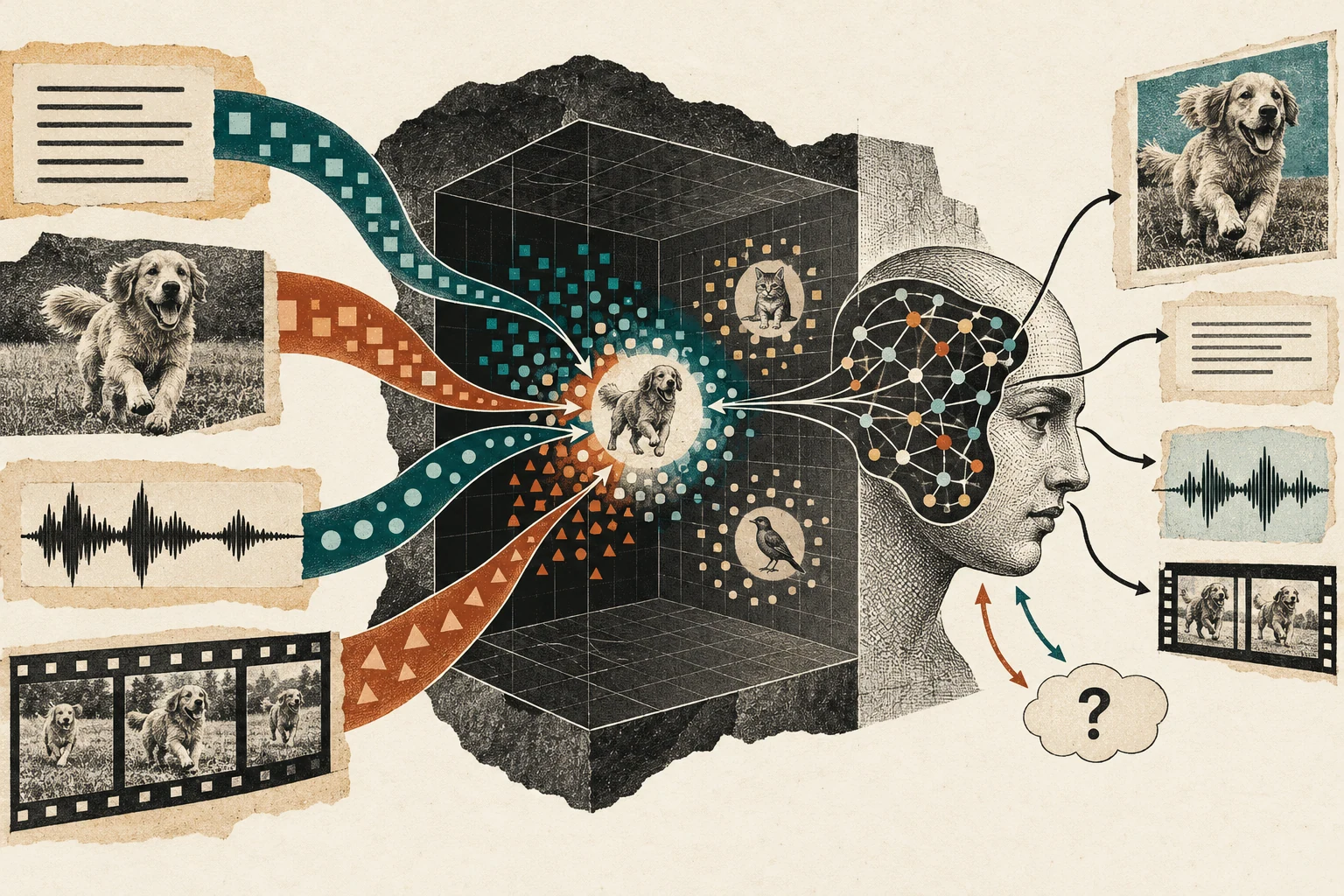
Information from image, sound, and text converges in a shared representation, drawing power from relationships across modalities.
AI-assisted illustration · conceptual metaphor View in visual quiz →Genesis and Global Lineage
The concept has two independent genealogies that converged in the 2010s. In 1990s communication studies, Gunther Kress and Theo van Leeuwen developed “multimodality” within social semiotics to show how page layout, color, gaze, and gesture co-construct meaning alongside verbal language. Independently, perceptual psychology had known since Harry McGurk and John MacDonald’s 1976 Nature paper (Hearing lips and seeing voices) that human vision and hearing fuse early in perception. The term entered deep learning through Jiquan Ngiam and colleagues’ ICML 2011 paper Multimodal Deep Learning at Stanford, which trained deep autoencoders on coupled audio speech and video lip movements in homage to the McGurk effect. In 2013, Google’s DeViSE model (Frome et al., including Tomáš Mikolov) projected visual recognition networks directly into a continuous word-embedding space learned from unannotated text. The modern inflection point arrived in early 2021 when OpenAI released CLIP (Learning Transferable Visual Models From Natural Language Supervision, Radford et al.) alongside DALL-E: training image and text encoders contrastively on 400 million web-scraped image–caption pairs proved that free-form natural language could replace fixed classification taxonomies like ImageNet’s 1,000 categories. Paired with the Vision Transformer (ViT, Dosovitskiy et al., 2020), which sliced images into 16 \times 16 patches treated like word tokens, CLIP made multimodality the default architecture of frontier AI.
Central European Lineage
One of the direct technical precursors cited by OpenAI’s CLIP paper has a documented Central European origin in Brno, Czechia. On October 2, 2012, Tomáš Mikolov defended his PhD dissertation, Statistical Language Models Based on Neural Networks, under Jan Černocký at the Faculty of Information Technology of the Brno University of Technology (Vysoké učení technické v Brně, VUT), culminating his Brno research on continuous neural language representations. Moving to Google in Mountain View, Mikolov led the creation of word2vec (2013) and co-authored the NIPS 2013 paper DeViSE: A Deep Visual-Semantic Embedding Model (with Frome, Corrado, Shlens, Bengio, Dean, and Ranzato). DeViSE replaced the fixed 1,000-class softmax layer of an image classifier with a linear projection into Mikolov’s dense word2vec semantic space, enabling zero-shot visual predictions across tens of thousands of unseen concepts using the geometry of language. When Radford and colleagues introduce the lineage of CLIP (2021), they explicitly credit DeViSE (Frome et al., 2013) as a foundational demonstration of shared visual-semantic embedding spaces—whose continuous language-embedding component grew directly out of Mikolov’s Brno doctoral trajectory.
Documented regional lineage · Link: 1. Compiled: October 2026.
-
documented influence 9 years
Central European Source: Tomáš Mikolov, “Doktorat „Statistical Language Models Based on Neural Networks” (FIT VUT, promotor Jan Černocký); współautorstwo „DeViSE: A Deep Visual-Semantic Embedding Model” (NIPS 2013)”; Brno, Czechoslovakia (now Czechia), 2012
Global Circulation: shared image–text embedding space (CLIP) — Alec Radford i in., OpenAI, 2021
documented influence
9 yearsTomáš Mikolov, “Doktorat „Statistical Language Models Based on Neural Networks” (FIT VUT, promotor Jan Černocký); współautorstwo „DeViSE: A Deep Visual-Semantic Embedding Model” (NIPS 2013)”
2012 · Brno, Czechoslovakia (now Czechia)
shared image–text embedding space (CLIP)
2021 · Alec Radford i in., OpenAI
- Claim & Connection
- Tomáš Mikolov received his academic formation in Brno, defending his PhD on neural language models on October 2, 2012, at the Faculty of Information Technology of the Brno University of Technology (VUT). Later that year he joined Google, where he led the development of word2vec and co-authored DeViSE (NIPS 2013), a model that projects visual images into a rich semantic word-embedding space learned from unannotated text. OpenAI's landmark CLIP paper (2021) explicitly cites DeViSE in its review of shared visual-semantic embedding spaces on which its own contrastive approach builds.
- Source Documentation
-
- biographical record Fakulta informačních technologií VUT v Brně, rekord rozprawy doktorskiej nr 283: Tomáš Mikolov, „Statistical Language Models Based on Neural Networks”; defense date October 2, 2012, advisor Prof. Dr. Ing. Jan Černocký. fit.vut.cz ↗
- primary source Andrea Frome, Greg S. Corrado, Jon Shlens, Samy Bengio, Jeff Dean, Marc'Aurelio Ranzato, Tomas Mikolov, „DeViSE: A Deep Visual-Semantic Embedding Model”, Advances in Neural Information Processing Systems 26 (2013), s. 2121–2129; author list and abstract. papers.nips.cc ↗
- reception / translation Alec Radford i in., „Learning Transferable Visual Models From Natural Language Supervision”, arXiv:2103.00020 (2021); related work section (passage on joint visual-semantic embedding spaces citing “Frome et al., 2013”); bibliography entry for DeViSE. arxiv.org ↗
- Historical Context
- The link concerns one of the key technical precursors cited by CLIP rather than the term “multimodality” itself. Mikolov was one of seven co-authors of DeViSE (2013), contributing the neural language-embedding component developed out of his Brno doctoral research and early Google work.
Why Now
Between 2021 and 2026, multimodality became the main battleground of the AI industry for three reasons. First, capability integration accelerated: DeepMind’s Flamingo (2022) demonstrated few-shot visual question answering; OpenAI’s GPT-4 (2023) and GPT-4o (2024) unified vision and real-time voice in one interface; and Google’s Gemini family (2023 onward) was pretrained as “natively multimodal” across text, image, audio, and video. Second, resource constraints drove the shift: as labs began exhausting high-quality public human text (the “data wall”), trillions of video frames, audio recordings, and PDFs became the next reservoir of training tokens. Third, multimodality created urgent regulatory vectors: in October 2021, Abeba Birhane, Vinay Uday Prabhu, and Emmanuel Kahembwe audited LAION-400M (the open-source reproduction of CLIP’s web scrape), revealing that uncurated image–alt-text pairs were rife with non-consensual pornography, misogyny, and racial slurs that flowed into generators like Stable Diffusion. By 2024–2026, real-time voice cloning and text-to-video models (Sora, Veo, Kling) made multimodal deepfakes a frontline issue in election integrity, banking fraud, and the EU AI Act.
Explanatory Power
The concept explains three structural shifts in how software interacts with the world. First, it explains why the boundary between “computer vision” and “language reasoning” dissolved: a vision-language model can read a photographed foreign menu, interpret a whiteboard diagram, or diagnose a bug from a screenshot without specialized OCR, because visual patches and linguistic concepts share one representational space. Second, it reveals why manual data labeling ceased to bottleneck visual AI: before CLIP, recognizing a new object required paying annotators to draw thousands of bounding boxes; after CLIP, noisy web captions written by humans serve as free, open-vocabulary supervision. Third, it exposes how a shared encoder becomes a systemic vulnerability: because the same text-image embedding space (like CLIP or SigLIP) conditions image generators, search engines, and moderation filters, any geometric stereotype or vulnerability inside it—such as a “typographic attack,” where taping the word “iPod” onto an apple tricks the vision encoder into classifying it as electronics—propagates across every downstream tool.
Axes of Debate
Does visual multimodality solve the “symbol grounding problem”?
In 2020, linguists Emily M. Bender and Alexander Koller argued via their “octopus thought experiment” that a text-only model can never acquire true meaning—echoing Stevan Harnad’s 1990 “symbol grounding problem.” Proponents of multimodal AI reply that coupling text tokens to millions of images, videos, and audio streams anchors linguistic symbols in perceptual reality. Strongest counterargument: Critics counter that static web photos paired with alt-text are still passive, disembodied representations rather than active causal engagement: a model correlating pixel matrices with character strings has no body, cannot intervene in the physical world to test counterfactuals, and routinely lets strong text priors override visual evidence (such as describing a five-legged dog in a doctored photo as having four legs because “dogs have four legs” dominates its text distribution). Nature of the dispute: substantive — bridging philosophy of mind and empirical tests of whether passive audio-visual correlation suffices for causal physical common sense.
“Natively multimodal” end-to-end training versus modular adapter stitching
Frontier labs (Google DeepMind with Gemini, OpenAI with GPT-4o) argue that true multimodal fluency requires training a single unified Transformer from scratch on interleaved text, image, audio, and video tokens. Open-source researchers and cost-conscious engineers (building LLaVA, InternVL, Qwen-VL) champion a modular approach: pair a frozen text LLM with a frozen vision encoder via a lightweight projection bridge trained at a tiny fraction of the compute cost. Strongest counterargument: On most document-understanding, OCR, and visual QA benchmarks, modular adapter models match native end-to-end models while letting enterprises swap encoders or upgrade the LLM independently—though native audio-to-audio models retain a clear edge in low-latency prosody and timing. Nature of the dispute: mixed — partly an architectural trade-off between cross-modal granularity and modularity, partly a commercial moat used by hyperscalers.
Uncurated web image–text pairs as democratizing resource versus toxic sewer
Creators of web-scale datasets (OpenAI’s WIT, LAION, DataComp) argue that scraping billions of raw image–caption pairs from the open web is the only way to achieve broad zero-shot generalization. Dataset auditors led by Abeba Birhane et al. (2021–2023) and the Stanford Internet Observatory (which in December 2023 found thousands of links to suspected child sexual abuse material inside LAION-5B, forcing its takedown) argue that treating raw web alt-text as supervision bakes misogyny, slurs, copyright infringement, and illegal imagery directly into model weights. Strongest counterargument: Automated pre-filtering with safety classifiers removes the worst extremes, yet those filters are themselves multimodal models trained on similar web distributions—creating a circular curation problem at billion-scale. Nature of the dispute: substantive — an unresolved governance crisis over legal and moral liability for multi-billion-item multimodal scrapes.
Underappreciated Angle
The most overlooked consequence of multimodality is that it quietly abolishes the administrative boundary between structured text and unstructured visual artifacts. Until around 2022, a crumpled receipt, handwritten medical chart, scanned parish register, whiteboard sketch, or video recording was computationally “dark” until a human clerk or brittle OCR pipeline transcribed it into database fields. Once a multimodal model reads a photo of a table, a spectrogram, and prose inside the same context window, every visual and acoustic trace becomes directly queryable as text. Yet this superpower carries a cultural asymmetry: the shared visual-semantic embedding spaces (like CLIP) were trained overwhelmingly on English alt-text and Anglo-American visual web culture. As cross-cultural audits show, when prompted with everyday nouns like “wedding,” “breakfast,” or “house,” multimodal encoders cluster high-probability embeddings around North American stock-photo norms while pushing traditional Central European, African, or Asian visual culture to the periphery—projecting English-internet defaults onto how machines see the physical world.
One-Sentence Takeaway
Multimodality does not mean that a machine sees the world with human eyes; it means that internet captions have replaced manual labels, pulling images, sound, and video into the same statistical token engine—and the same cultural biases—as text.
Related Concepts Network
How this concept reinforces, constrains, or complements other analytical frameworks in the corpus. View on graph →
-
Transformer reinforces
A single sequence-processing architecture that operates agnostically on tokens of any kind made it possible to process image patches, audio frames, and text subwords inside one unified network.
-
Foundation models complements
Multimodal models represent the next generation of foundation models: a single pretraining run accepting and emitting multiple sensory modalities.
-
Large language models (LLMs) complements
Because most contemporary multimodal systems graft vision and audio encoders onto a pretrained language model backbone, they inherit the reasoning strengths and hallucination weaknesses of LLMs.
-
Model hallucinations in tension
Proponents of multimodality hoped that linking words to visual images would ground language in physical reality, yet vision-language models routinely “hallucinate” objects that are not in the picture when language priors override visual tokens.
-
Diffusion models complements
Text-to-image diffusion generators rely directly on contrastively trained multimodal text embeddings (such as CLIP) to steer pixel denoising from natural-language prompts.
-
Synthetic media reinforces
A unified model that simultaneously interprets and generates image, voice, and text drastically lowers the barrier to producing synchronized deepfakes.
-
Scaling laws reinforces
Web-scale image, audio, and video archives became the primary new reservoir of training tokens once high-quality human text began approaching exhaustion.
Reading Canon & Translation Bridge
Foundational texts, introductions, and critical perspectives—with availability of English and Polish editions.
-
foundational text 2021 · English
Alec Radford i in., Learning Transferable Visual Models From Natural Language Supervision
The landmark CLIP paper from OpenAI: contrastive pretraining on 400 million web-scraped image–caption pairs unlocked zero-shot visual classification via arbitrary natural-language descriptions, proving that free-form text can replace fixed category labels.
In English: original text written in English
In Polish: no Polish edition
-
foundational text 2011 · English
Jiquan Ngiam, Aditya Khosla, Mingyu Kim, Juhan Nam, Honglak Lee, Andrew Y. Ng, Multimodal Deep Learning
The ICML 2011 paper from Stanford that brought the term into deep learning: trained shared representations across audio speech and video lip movements, explicitly invoking the psychological McGurk effect.
In English: original text written in English
In Polish: no Polish edition
-
introduction & synthesis 2017 · English
Tadas Baltrušaitis, Chaitanya Ahuja, Louis-Philippe Morency, Multimodal Machine Learning: A Survey and Taxonomy
The standard technical taxonomy organizing the field around five core challenges: representation, translation, alignment, fusion, and co-learning.
In English: original text written in English
In Polish: no Polish edition
-
cross-disciplinary 1976 · English
Harry McGurk, John MacDonald, Hearing lips and seeing voices
A classic three-page “Nature” paper demonstrating the perceptual illusion in which seeing a speaker's lips form [ga] while hearing [ba] makes the human brain perceive [da]—proving that human perception is cross-modal from the ground up.
In English: original text written in English
In Polish: no Polish edition
-
cross-disciplinary 2016 · English
Carey Jewitt, Jeff Bezemer, Kay O'Halloran, Introducing Multimodality
An accessible introduction to multimodality in social semiotics (the tradition of Gunther Kress and Theo van Leeuwen), where the term denotes how gesture, layout, image, and speech co-construct meaning in human communication.
In English: original text written in English
In Polish: Polish edition not verified
-
critical perspective 2020 · English
Emily M. Bender, Alexander Koller, Climbing towards NLU: On Meaning, Form, and Understanding in the Age of Data
The ACL 2020 “octopus thought experiment” arguing that communicative meaning cannot be learned from linguistic form alone—setting the philosophical bar that proponents of visual-linguistic multimodality claim to clear.
In English: original text written in English
In Polish: no Polish edition
-
critical perspective 2021 · English
Abeba Birhane, Vinay Uday Prabhu, Emmanuel Kahembwe, Multimodal datasets: misogyny, pornography, and malignant stereotypes
A forensic audit of the LAION-400M open image–text dataset scraped from Common Crawl, exposing what actually enters shared embedding spaces when uncurated web alt-text is treated as ground truth.
In English: original text written in English
In Polish: no Polish edition
-
critical perspective 1990 · English
Stevan Harnad, The symbol grounding problem
The classic cognitive-science formulation of how formal symbols can ever acquire intrinsic meaning without being grounded in sensorimotor perception; multimodal AI is engineering's contemporary attempt to answer Harnad.
In English: original text written in English
In Polish: Polish edition not verified