Memetics
original term: memetics (Eng.) · mem, meme, ewolucja kulturowa (ujęcie replikatorowe)
Central European lineage: 1 thread (counterpoint) · 1976–2000 · jump to documentation ↓
Working Definition
Memetics is a theoretical program that models cultural transmission on Darwinian evolutionary biology, treating units of culture—tunes, catchphrases, beliefs, styles, and visual templates—as replicators (“memes”) that compete for survival and reproduction in human minds and media environments. Its core move is to invert the commonsense perspective on ideas: instead of asking how humans choose ideas that are true or useful, memetics asks what formal properties of an idea make it good at getting itself copied by human hosts, even when the idea is false or harmful. In its strict 1990s evolutionary version, the field seeks to measure variation, copying fidelity, fecundity, and longevity of cultural replicators; in its contemporary media-studies version (Limor Shifman), an internet meme is a family of digital texts sharing a common form, content, and stance that users intentionally remix and circulate. Across both versions runs a single operational question: what in the structure of this artifact makes it reproduce faster than its rivals?
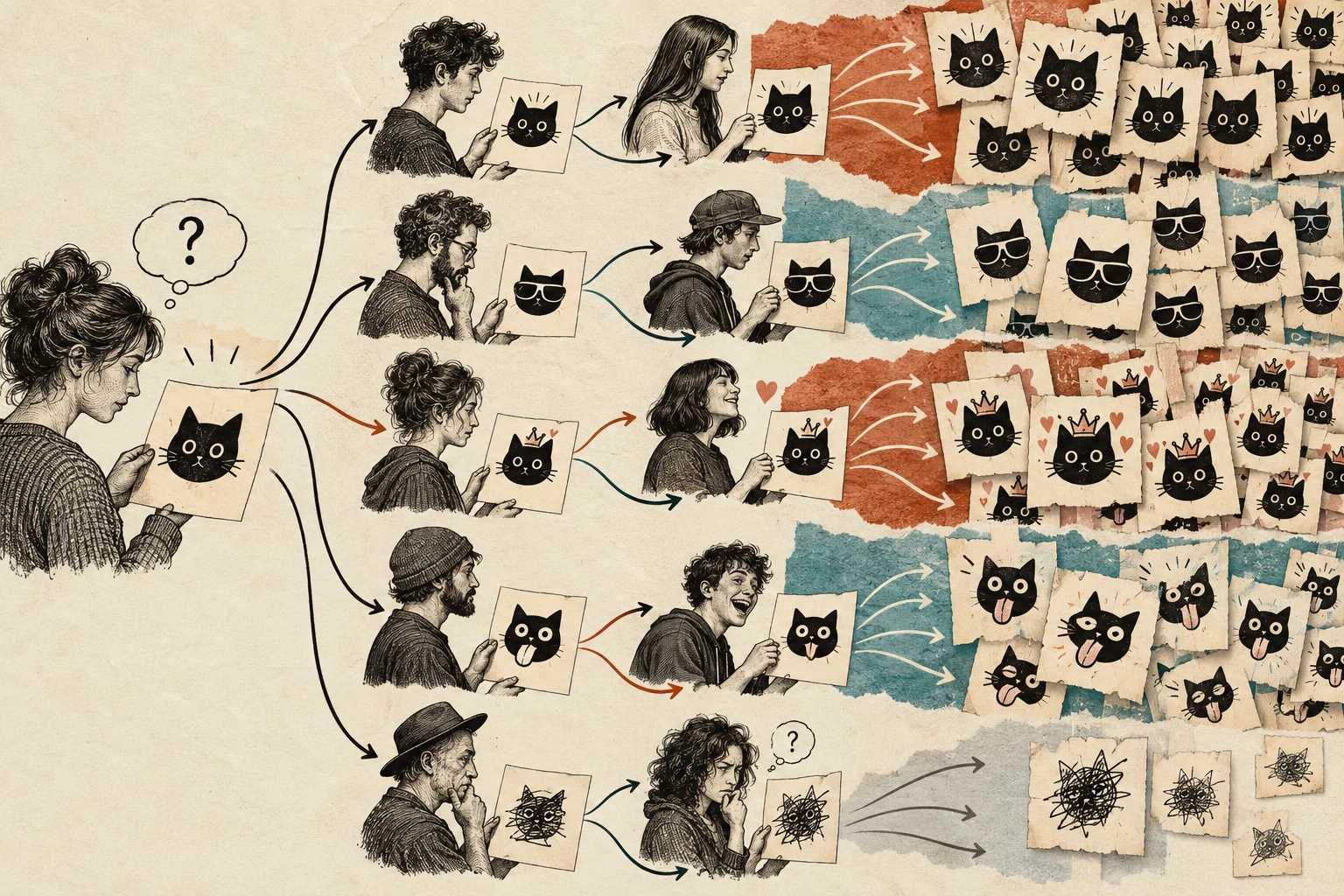
A motif is copied, altered, and passed along; differing popularity illustrates cultural selection as an analogy rather than a literal genetic mechanism.
AI-assisted illustration · conceptual metaphor View in visual quiz →Genesis and Global Lineage
The word meme was coined by evolutionary biologist Richard Dawkins in the final chapter of The Selfish Gene (1976). Seeking to show that natural selection operates on any self-copying replicator, not just DNA, Dawkins argued that human culture spawned a second soup of replicators—tunes, catchphrases, ways of making pots—which he shortened from the Greek mimēma (“that which is imitated”) to meme to rhyme with gene. In the 1990s, philosopher Daniel Dennett (Darwin's Dangerous Idea, 1995), Richard Brodie, and psychologist Susan Blackmore (The Meme Machine, 1999) tried to turn Dawkins's metaphor into an empirical science with its peer-reviewed Journal of Memetics (1997–2005). As a formal biological discipline, that wave collapsed by 2005: researchers could neither isolate a discrete “meme unit” in the brain nor establish high-fidelity copying comparable to DNA transcription, and anthropologists like Robert Boyd, Peter Richerson, and Joseph Henrich replaced memetics with quantitative “dual-inheritance” models of social learning. Yet the word outlived the failed science by migrating onto the early-2000s web (4chan, Reddit, Tumblr, YouTube) as the vernacular name for remixable image macros. In 2014, Limor Shifman rehabilitated the concept for media studies in Memes in Digital Culture, inverting Dawkins's premise: digital memes are participatory genres actively remixed by creative human agents.
Central European Lineage
While Dawkinsian memetics found an enthusiastic early reception in post-1989 Poland—producing Mariusz Biedrzycki's popular treatise Genetyka kultury (Genetics of Culture, 1998) and a dedicated academic periodical at the University of Silesia in Katowice, Teksty z Ulicy. Zeszyt memetyczny—the region's most enduring theoretical contribution to the global debate came as a foundational counterpoint from the Tartu school of semiotics in Estonia. In a landmark 2000 paper, Copy versus translate, meme versus sign: development of biological textuality, Tartu biosemiotician Kalevi Kull (working in the tradition of Juri Lotman at the University of Tartu) pinpointed why the gene-meme analogy breaks down as a theory of culture. Drawing on Charles Sanders Peirce's triadic sign theory and Lotman's cultural semiotics, Kull demonstrated that a Dawkinsian “meme” is a conceptually impoverished, degenerate sign: it reduces cultural transmission to mechanical one-to-one copying (replication), stripping out the active role of the interpretant. In real living systems and human cultures, Kull argued, transmission is never a xerox copy; it is an act of translation across asymmetric mental and cultural codes, in which transformation and reinterpretation are the rule rather than copying errors. That Tartu semiotic critique—paralleled in cognitive anthropology by Dan Sperber's “epidemiology of representations”—anticipated why 1990s replicator memetics stalled and why later digital scholarship (like Shifman's) had to replace mechanical copying with creative variation and remix.
Documented regional lineage · Link: 1. Compiled: October 2026.
-
counterpoint 24 years — regional source later than global formulation
Central European Source: Kalevi Kull, “Copy versus translate, meme versus sign: development of biological textuality”; Tartu, Estonia, 2000
Global Circulation: the meme as a cultural replicator (memetics) — Richard Dawkins, 1976
counterpoint
24 years — regional source later than global formulationKalevi Kull, “Copy versus translate, meme versus sign: development of biological textuality”
2000 · Tartu, Estonia
the meme as a cultural replicator (memetics)
1976 · Richard Dawkins
- Claim & Connection
- Kalevi Kull—a biosemiotician educated at the University of Tartu (diploma 1975; faculty member in its Department of Semiotics since 1997 and head of department 2006–2018)—formulated in his 2000 article a foundational semiotic critique of Dawkinsian memetics: a “meme” is a degenerate, impoverished concept of the sign that retains only the mechanical capacity for copying while stripping away interpretation and translation, whereas actual cultural transmission proceeds through active translation rather than replication. This link represents a theoretical counterpoint from the Tartu school that delimits the concept rather than its origin.
- Source Documentation
-
- scholarly study Hasło „Memetics”, Wikipedia (ang.), sekcja Criticism, przyp. 38: Kalevi Kull, „Copy versus translate, meme versus sign: development of biological textuality”, European Journal for Semiotic Studies 12 (1), 2000, s. 101–120; Criticism section, paragraph on the semiotic critique of memetics (Deacon, Kull). en.wikipedia.org ↗
- biographical record Hasło „Kalevi Kull”, Wikipedia (ang.); biographical section: born 1952 in Tartu, graduated from the University of Tartu in 1975, professor and head of the Department of Semiotics (2006–2018). en.wikipedia.org ↗
- Historical Context
- Note that Richard Semon (“Die Mneme,” 1904), sometimes cited as an early precursor of the word, was educated in Jena and Heidelberg and worked in Munich, and thus falls outside the Central European regional criterion.
Why Now
Between 2018 and 2026, memes became an operating language of electoral politics, financial markets, warfare, and AI. Political campaigns and influence operations institutionalized “memetic warfare,” using ironic templates to launder extremist narratives past moderation filters. In January 2021, retail traders on Reddit's r/WallStreetBets drove the GameStop short squeeze, giving birth to “meme stocks” and “meme coins” (from Dogecoin to Solana tokens)—assets whose valuations explicitly track the reproductive velocity of a shared joke rather than cash flows. Following Russia's invasion of Ukraine in February 2022, decentralized networks such as NAFO (“North Atlantic Fella Organization”) deployed Shiba Inu dog memes to counter Russian disinformation and crowd-source military funding. Simultaneously, TikTok's architecture (built around one-click audio and visual template reuse) turned memetic imitation into the default grammar of youth culture, while post-2022 generative AI reduced the cost of mutating and flooding variants to near zero.
Explanatory Power
Even where biological memetics fails as a laboratory science, the memetic lens forces us to ask “what structural traits make this narrative out-reproduce its competitors in a given media environment?” First, it explains the asymmetry between misinformation and fact-checking: a vivid three-word slogan (“plandemic,” “eat the bugs”) is a compact, high-fecundity replicator, whereas a 2,000-word investigative debunking full of statistical caveats has poor copying fidelity in conversation—meaning the correction loses the evolutionary race. Second, Limor Shifman's triad of content (topic), form (sensory template), and stance (tone, irony, or ideological positioning) explains how a visual template travels across hostile political tribes: the form stays fixed while the stance flips from sincere to ironic to weaponized. Third, it illuminates organizational life: corporate buzzwords and academic boilerplate survive endless reorganizations not because they improve performance, but because easily imitated phrases serve as cheap badges of conformity.
Axes of Debate
A genuine evolutionary science of replicators versus an empty biological metaphor
Evolutionary biologists and philosophers of science (Stephen Jay Gould, Massimo Pigliucci, Maria Kronfeldner), alongside dual-inheritance anthropologists (Boyd, Richerson, Henrich), argue that because culture has no discrete units analogous to genes, no genotype-phenotype distinction, and no Mendelian inheritance, “memetics” explains nothing beyond what standard models of psychological bias and social learning capture mathematically. Strongest counterargument: Daniel Dennett and Susan Blackmore reply that Mendelian genetics operated fruitfully for decades before Watson and Crick identified DNA; substrate-neutral Darwinism requires only variation, heredity, and differential fitness, and the digital environment—where files, hashtags, and audio templates are copied bit-for-bit and tracked with share counts—provides the empirical laboratory analog culture lacked. Nature of the dispute: substantive — it turns on whether positing “selfish cultural replicators” generates novel, falsifiable predictions that standard cognitive and sociological models cannot.
High-fidelity copying (Dawkins) versus cognitive reconstruction and translation (Sperber, Kull)
Cognitive anthropologist Dan Sperber (Explaining Culture, 1996) and Tartu biosemiotician Kalevi Kull (2000) argue that human minds almost never copy ideas like a photocopier; instead, when you hear a story or joke, you infer a rough meaning and reconstruct a version using prior cognitive schemas. Cultural stability comes from shared psychology pulling noisy reconstructions toward cognitive “attractors.” Strongest counterargument: On modern social platforms, transmission is a hybrid of both mechanisms: the underlying template (the TikTok audio track, image-macro background, or screenshot) is literally copied by software with 100% fidelity, while the user adds creative translation on top—making the tension between copying and translation the engine of internet culture. Nature of the dispute: mixed — substantively resolved in cognitive science in favor of reconstruction, but kept alive because scholars of oral culture and digital file-sharing analyze different substrates.
Autonomous viral ideas versus human agency and platform power
Critical media scholars (Shifman, Ryan Milner, Whitney Phillips) reject portraying humans as passive “meme machines” infected by mind-viruses: people actively choose and remix memes to perform identity, and what goes “viral” is steered by recommendation algorithms and paid amplification rather than natural selection in a neutral soup. Strongest counterargument: While individual creators act with conscious agency, no single creator or engineer controls which variant survives across millions of shares; at the population scale, the attention market acts as a Darwinian sieve rewarding formal traits (shock, brevity, tribal flattery) independently of the author's intentions. Nature of the dispute: substantive — a conflict between methodological individualism and population-level structural selection.
Underappreciated Angle
The most revealing case study in the history of memetics is the fate of the word “meme” itself. As an academic program attempting to found a quantitative evolutionary science of culture, memetics died around 2005 when its flagship journal folded and anthropology moved to dual-inheritance modeling. Yet as a cultural replicator, Dawkins's 1976 neologism achieved a spectacular triumph: because meme was short, punchy, symmetrical with gene, and flattered users with a veneer of scientific sophistication, it replicated across billions of minds—while mutating its meaning from “a unit of cultural imitation” to “a funny picture with Impact font.” In doing so, the word meme proved both Dawkins and his Tartu semiotic critics right at once: it survived because its phonetic packaging made it copyable (Dawkins), yet succeeded only by being reinterpreted and translated by internet users into something its inventor never intended (Kull and Shifman). The more contagious a concept's name is, the faster it tears free from its author's technical definition to serve its hosts.
One-Sentence Takeaway
If you want to understand why an idea, a rumor, or a joke dominates the public sphere, stop asking only whether it is true or who paid for it, and start asking what in its design makes it effortless to repeat without thinking.
Related Concepts Network
How this concept reinforces, constrains, or complements other analytical frameworks in the corpus. View on graph →
-
Epistemic bubbles vs. echo chambers complements
Echo chambers act as evolutionary selection environments for memes: they amplify variants that flatter ingroup identity and weed out variants that require cross-group nuance.
-
Disinformation complements
Memetics shifts the analytical question from “who invented this lie and why?” to “what formal features make this falsehood easier to copy and remember than its refutation?”
-
Attention economy reinforces
Human attention is the scarce ecological resource for which memes compete; severe attention scarcity selects for brevity, high emotional arousal, and instantly recognizable templates.
-
Platformization reinforces
Platform affordances and recommendation algorithms (duets, audio reuse, quote-posts, trending hashtags) serve today as the primary machinery of memetic mutation and differential selection.
-
Cultural hegemony in tension
Antonio Gramsci's theory locates cultural power in class interests and institutional apparatuses, whereas Dawkinsian memetics attributes agency to self-replicating ideas themselves—risking blindness to who owns the media infrastructure.
-
Information theory constrains
Because culture lacks a discrete four-letter alphabet analogous to DNA base pairs and a universal metric of copying fidelity, memetics' claim to be an exact evolutionary information science remains a heuristic metaphor rather than a formal model.
Reading Canon & Translation Bridge
Foundational texts, introductions, and critical perspectives—with availability of English and Polish editions.
-
foundational text 1976 · English
Richard Dawkins, The Selfish Gene
Chapter 11 (“Memes: the new replicators”) coins the word “meme” as a cultural analog to the gene to show that Darwinian selection can operate on any replicator, not just DNA; a brief, provocative sketch rather than a finished theory.
In English: original text written in English
In Polish: “Samolubny gen”, Prószyński i S-ka 1996, trans. Marek Skoneczny
-
introduction & synthesis 1999 · English
Susan Blackmore, The Meme Machine
The most ambitious attempt to build a comprehensive science of memetics (with a foreword by Dawkins): defines imitation as the human capacity that unleashed a second replicator, using meme-gene coevolution to explain the size of the human brain, language, and the illusion of a conscious self.
In English: original text written in English
In Polish: Polish edition not verified
-
foundational text 2014 · English
Limor Shifman, Memes in Digital Culture
The foundational text of contemporary internet meme studies (MIT Press Essential Knowledge series): redefines an internet meme not as a single viral unit, but as a group of digital items sharing common characteristics of content, form, and stance, created with awareness of each other.
In English: original text written in English
In Polish: Polish edition not verified
-
critical perspective 1996 · English
Dan Sperber, Explaining Culture: A Naturalistic Approach
Articulates the “epidemiology of representations” as a cognitive alternative to memetics: cultural items are almost never literally copied from brain to brain, but are actively reconstructed each time by human minds guided by psychological “attractors.”
In English: original text written in English
In Polish: Polish edition not verified
-
critical perspective 2000 · English
Kalevi Kull, Copy versus translate, meme versus sign: development of biological textuality
The Tartu biosemiotic critique: reduces the Dawkinsian meme to a degenerate sign stripped of its Peircean interpretant, arguing that living culture advances through creative translation rather than mechanical copying.
In English: original text written in English
In Polish: no Polish edition
-
cross-disciplinary 2005 · English
Peter J. Richerson, Robert Boyd, Not by Genes Alone: How Culture Transformed Human Evolution
The flagship synthesis of “dual-inheritance theory” (gene-culture coevolution) from evolutionary anthropology: builds rigorous mathematical models of social learning biases (prestige bias, conformist bias) that accomplish what 1990s memetics promised without needing discrete “memes.”
In English: original text written in English
In Polish: Polish edition not verified
-
introduction & synthesis 1998 · Polish
Mariusz Biedrzycki, Genetyka kultury
One of the earliest book-length Polish expositions of Dawkinsian and Dennettian memetics (Genetics of Culture), capturing the late-1990s Central European reception that also spawned the Katowice academic journal “Teksty z Ulicy. Zeszyt memetyczny.”
In English: no English edition
In Polish: original text written in Polish