Culture & Power #153
Culture wars
original term: culture wars (Eng.) · wojny kulturowe, wojna kulturowa, culture war
Global-circulation concept — no documented lineage in Central Europe. jump to documentation ↓
Working Definition
Culture wars are sustained political conflicts whose primary stake is not the distribution of material resources, but whose understanding of moral authority, family, religion, national history, and personal identity will be codified by law, schools, and public institutions. In the technical sociological sense introduced by James Davison Hunter (1991), a culture war is a structural cleavage between two competing impulses of moral authority: an “orthodox” impulse that locates moral truth in an external, transcendent, and unchanging source, and a “progressive” impulse that treats moral norms as historically evolving and revisable in light of human experience. In everyday media usage, the phrase refers loosely to any noisy public controversy over symbols, gender, monuments, or speech. Keeping the two distinct matters: Hunter diagnoses a deep institutional realignment that cuts across historic denominations, political parties, and social classes, whereas journalistic usage treats “culture war” as a label for any political fight that is not explicitly about taxes or wages.
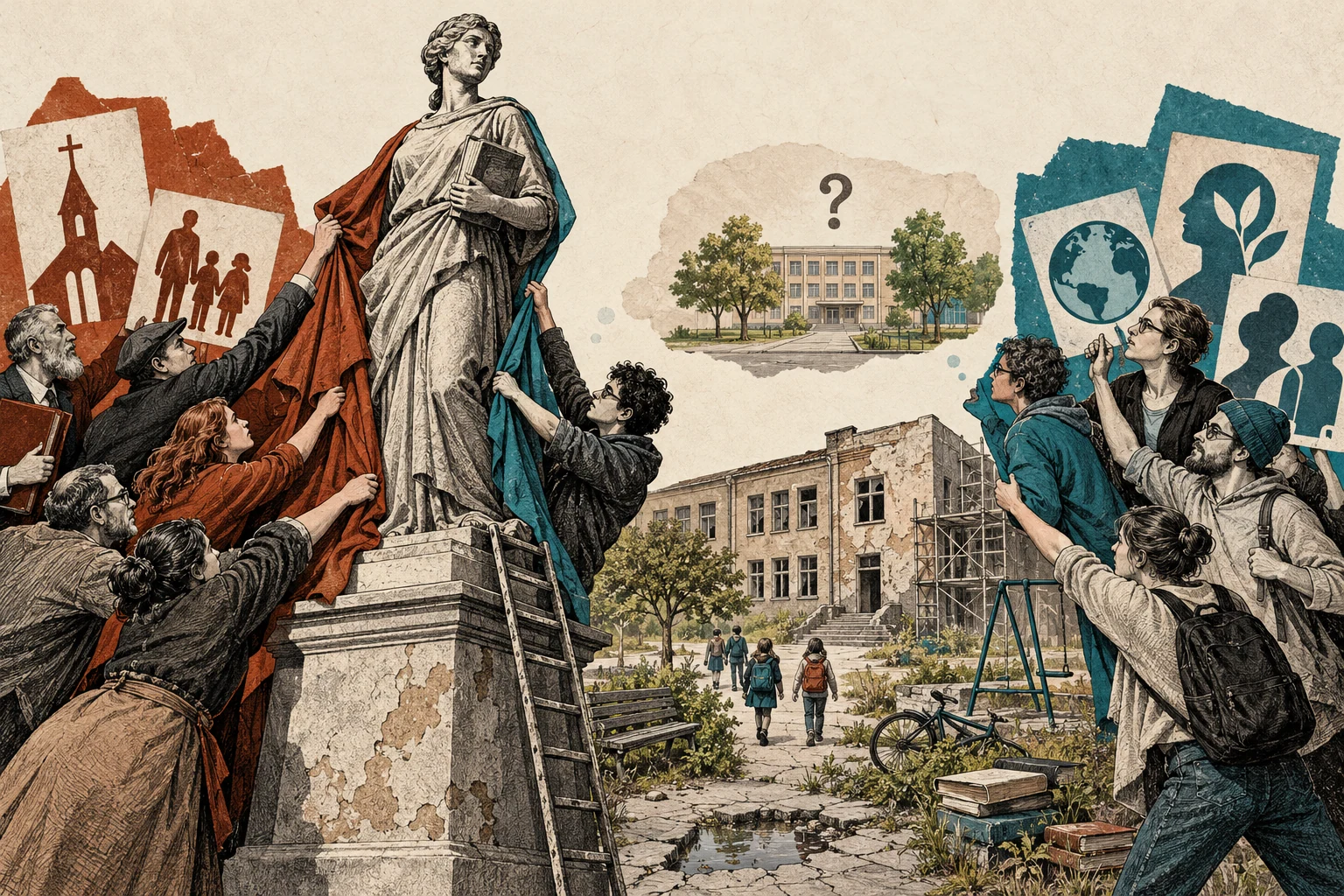
Conflict centers on the symbols and norms of shared space, as participants frame the stakes around defending core values and identity.
AI-assisted illustration · conceptual metaphor View in visual quiz →Genesis and Global Lineage
The English phrase culture war is a direct calque of the German Kulturkampf—the term coined in January 1873 by the liberal pathologist and politician Rudolf Virchow to describe Otto von Bismarck’s state campaign against the Catholic Church in Prussia over school inspection, civil marriage, and clerical appointments (a campaign that in Prussian-ruled Poland simultaneously functioned as forced Germanization). The concept was reinvented for contemporary sociology by James Davison Hunter in Culture Wars: The Struggle to Define America (1991), which showed that conservative Protestants, traditionalist Catholics, and Orthodox Jews—groups that had spent a century distrusting one another—had forged a common political bloc against the liberal-progressive wings of their own religious and civic traditions. One year later, Patrick Buchanan’s fiery address at the 1992 Republican National Convention in Houston proclaimed a “cultural war… for the soul of America” as fateful as the Cold War, launching the term’s double life as both an analytical category and a partisan battle cry. From American battles over school prayer, abortion, and the literary canon in the 1970s–1990s, the framework was exported globally after 2010 through transnational media, religious networks, and political consultancies to Europe, Latin America, and Australia.
Central European Lineage
We found no documented link between this concept and the intellectual history or historical experience of Central Europe.
We found no documented link between this concept and the intellectual history or historical experience of Central Europe (by our methodology, this means “none found,” not “none exists”; as of October 2026).
Why Now
Between 2018 and 2026 culture wars ceased to look like an American domestic peculiarity and became a primary operating mode of democratic and illiberal politics across Europe and the Americas. In Poland, local-government resolutions declaring “LGBT-free zones” in 2019–2020 and the Constitutional Tribunal’s ruling of October 22, 2020 imposing a near-total ban on abortion triggered the largest street protests since the fall of communism in 1989. In Hungary, a June 2021 law restricting the depiction of homosexuality and gender reassignment in materials accessible to minors sparked a formal infringement battle with the European Commission, while legal scholars such as Kim Lane Scheppele documented how culture-war mobilization was used to mask the institutional capture of courts and universities (placed under loyalist public-trust foundations in 2021). In the United States, the Supreme Court’s Dobbs decision (June 2022) overturning Roe v. Wade, state-level school-curriculum and library-book bans, and the 2025 federal executive campaign against DEI turned cultural conflict into direct state coercion. Meanwhile, in Ukraine after Russia’s full-scale invasion in 2022, the rapid de-Russification of street names, monuments, and school canons demonstrated that disputes over language and historical memory in Eastern Europe can be simultaneously cultural and existential.
Explanatory Power
The concept makes three political dynamics intelligible that classical class-based models of left versus right struggle to explain. First, it accounts for the great electoral realignment of the past three decades: why lower-income religious and non-degreed voters increasingly back right-wing parties that cut taxes on capital, while affluent, secular university graduates vote for center-left parties that propose taxing them more heavily. When the perceived stake of politics is the moral definition of a legitimate way of life, material trade-offs become secondary and symbolic compromise feels like betrayal. Second, it explains the escalatory grammar of local incidents: in a culture war, a dispute over a single school textbook, museum exhibition, or theater performance is read by both camps as a proxy battle for the entire normative order, drawing national media and party leaders into local school boards. Third, it explains why ostensibly neutral institutions—constitutional courts, universities, public broadcasters, museums—become the primary prize of politics: whoever controls the institutions that certify what counts as “normal” and “factual” does not need to win every election.
Axes of Debate
Deep societal divide (Hunter) versus elite and media fabrication (Fiorina, Wolfe)
Quantitative political scientists (Morris Fiorina and co-authors in Culture War? The Myth of a Polarized America, 2005) and sociologists such as Alan Wolfe argue from public-opinion surveys that the vast majority of citizens hold moderate, ambivalent views on abortion, gender, and religion, and that the “war” is an artifact of polarized party primaries, activist donors, and outrage-driven media. Strongest counterargument: Hunter replies that public culture is not the arithmetic mean of survey responses: it is produced by elite institutions, legal doctrines, and media vocabularies that frame the choices available to ordinary citizens; furthermore, subsequent research on affective polarization shows that emotional hostility between partisan camps has surged even on issues where policy preferences overlap. Nature of the dispute: substantive — it hinges on whether the proper unit of analysis for cultural conflict is individual survey attitudes or institutional and discursive power.
Genuine conflict over moral authority versus elite distraction from class inequality
Materialist critics on the left (from Thomas Frank’s What’s the Matter with Kansas?, 2004, to contemporary social-democratic strategists) argue that culture wars are deliberately stoked by billionaire donors and right-wing populists to divide working-class voters along identity lines so they do not unite around wages, healthcare, and taxation. Strongest counterargument: Treating moral and religious convictions as mere “false consciousness” assumes that the analyst knows better than voters what they ought to care about; moreover, some of the fiercest culture-war battles take place within the same socioeconomic class—for instance among university-educated professionals split over gender, free speech, and historical memory. Nature of the dispute: mixed — an empirical question about voter motivation is entangled with a normative disagreement over what should be the primary axis of politics.
American ideological import versus indigenous historical cleavage in Central Europe
Liberal commentators and researchers tracking transnational illiberal networks point out that the vocabulary, legal templates, and campaign slogans used in Poland, Hungary, and Slovakia since 2015 (“gender ideology,” anti-LGBT charters, attacks on “woke” universities) are directly imported—often word for word and with shared funding—from US conservative think tanks and religious-right organizations. Anthropologists and historians of the region (such as Wojciech Burszta in Poland) counter that these conflicts tap into deep local roots: nineteenth-century memories of imperial Kulturkampf, the post-1989 political role of the Catholic Church, and anxieties over rapid post-transformation modernization. Strongest counterargument: Demonstrating that a slogan or campaign playbook was imported from abroad does not explain why it resonated with millions of local voters; imported frames only catch fire when they latch onto genuine domestic cleavages between metropolitan beneficiaries of European integration and provincial communities. Nature of the dispute: mixed — the transnational flow of money and talking points is empirically verifiable, yet in domestic debate the charge of “foreign import” is wielded by both sides as a rhetorical weapon to paint opponents as unpatriotic agents.
Underappreciated Angle
The most corrosive effect of culture wars lies in what they do to the institutional machinery of democratic compromise. Modern representative democracies were engineered around divisible goods—budgets, tax rates, wage tariffs—where splitting the difference at 50% leaves both bargaining partners with half a loaf. Moral and ontological claims about when human life begins, what constitutes a family, or which historical figures are heroes versus criminals are structurally indivisible: splitting the difference looks to orthodox and progressive purists alike not like pragmatism, but like moral capitulation. A second overlooked dynamic is temporal asymmetry: a cultural camp that senses it is losing the long-term demographic and generational tide in everyday life has a powerful incentive to shift the struggle out of civil society and into counter-majoritarian state institutions with long time horizons—constitutional courts, electoral districting, and university boards—seeking to lock in by law what it can no longer sustain by cultural consent. That is why culture-war legislation often reaches its highest pitch precisely when the underlying social norm has already shifted in the opposite direction among the younger generation.
One-Sentence Takeaway
Culture wars are not arguments about art or manners; they are struggles over which institutions hold the authority to define what counts as “normal”—which is why they neither respect split-the-difference compromises nor end with a single election.
Related Concepts Network
How this concept reinforces, constrains, or complements other analytical frameworks in the corpus. View on graph →
-
Affective polarization complements
Culture wars describe the substantive content of the conflict (moral authority, family, national identity), whereas affective polarization measures its emotional temperature: hostility toward the opposing camp independent of policy views.
-
Cancel culture reinforces
High-profile episodes of online ostracism serve as ammunition for both sides of the culture war, offered as proof that the opposing camp already controls institutions.
-
Cultural hegemony complements
Gramsci’s framework explains why symbolic disputes over culture are fought with the intensity of struggles for state power: whoever defines common sense governs without needing constant coercion.
-
Overton window reinforces
Every campaign in a culture war is an attempt to shift or lock in the boundaries of what can be said in public without penalty.
-
Preference falsification in tension
If a large share of public declarations in moral disputes reflects conformism toward one’s own political tribe, the true ideological depth of the “war” among ordinary citizens is overstated.
-
Algorithmic amplification reinforces
Platform recommendation systems reward content that triggers moral outrage, and moral outrage is the primary fuel of culture-war mobilization.
-
DEI complements
Since 2020, institutional diversity programs have become one of the central battlegrounds over whose moral vocabulary public and corporate institutions should codify.
Reading Canon & Translation Bridge
Foundational texts, introductions, and critical perspectives—with availability of English and Polish editions.
-
foundational text 1991 · English
James Davison Hunter, Culture Wars: The Struggle to Define America
The foundational sociological text: diagnoses a new cleavage between an impulse of “orthodoxy” and an impulse of “progressivism” cutting across historic Protestant, Catholic, and Jewish denominational lines.
In English: original text written in English
In Polish: Polish edition not verified
-
introduction & synthesis 2006 · English
James Davison Hunter, Alan Wolfe, Is There a Culture War? A Dialogue on Values and American Public Life
A concise Brookings Institution debate between the author of the concept and one of his sharpest sociological critics; the best entry point into whether the divide runs through the general public or primarily through political and media elites.
In English: original text written in English
In Polish: Polish edition not verified
-
critical perspective 2005 · English
Morris P. Fiorina, Samuel J. Abrams, Jeremy C. Pope, Culture War? The Myth of a Polarized America
The classic survey-data counterargument: most ordinary voters remain moderate and ambivalent on social issues, while the “war” is fought by party activists, donors, and media entrepreneurs.
In English: original text written in English
In Polish: Polish edition not verified
-
introduction & synthesis 2015 · English
Andrew Hartman, A War for the Soul of America: A History of the Culture Wars
An intellectual history of the conflict from the 1960s to the late 1990s, showing how the culture wars grew out of the breakup of the postwar 1950s American normative consensus.
In English: original text written in English
In Polish: Polish edition not verified
-
cross-disciplinary 2003 · English
Christopher Clark, Wolfram Kaiser (red.), Culture Wars: Secular–Catholic Conflict in Nineteenth-Century Europe
Historians compare nineteenth-century Kulturkämpfe across ten European countries, reminding readers that struggles over schooling, civil marriage, and church authority have a deep European pedigree predating the American debate.
In English: original text written in English
In Polish: Polish edition not verified
-
critical perspective 2013 · Polish
Wojciech J. Burszta, Kotwice pewności. Wojny kulturowe z popnacjonalizmem w tle
A Polish cultural anthropologist reads post-2005 Polish political conflicts as a local variant of the culture wars in which national identity serves as an “anchor of certainty” amid liquid modernity.
In English: English edition not verified
In Polish: original text written in Polish
-
critical perspective 2017 · English
Mark Lilla, The Once and Future Liberal: After Identity Politics
A critique from within the liberal camp: argues that campus-style identity politics cedes the battlefield to the right by replacing shared civic solidarity with moralistic self-expression.
In English: original text written in English
In Polish: “Koniec liberalizmu, jaki znamy. Requiem dla polityki tożsamości”, Fundacja Kultura Liberalna 2018, trans. Łukasz Pawłowski