Epistemology #006
Brandolini’s law
original term: Brandolini's law (Eng.) · zasada asymetrii bzdury, bullshit asymmetry principle
Global-circulation concept — no documented lineage in Central Europe. jump to documentation ↓
Working Definition
Brandolini's law—also known as the bullshit asymmetry principle—states that the amount of energy needed to refute bullshit is an order of magnitude greater than the energy needed to produce it. In everyday life it captures the exhaustion of anyone who has ever tried to fact-check a viral claim in a family group chat; in analytical terms it is a proposition about the structural cost asymmetry between speech unconstrained by truth and speech that must answer to evidence. Crucially, the principle does not claim that corrections fail to persuade, only that they are expensive to produce and deliver: it measures the cost of entry, not the efficacy of the outcome. It thus reframes misinformation from a purely moral or logical failing into a problem of information economics.
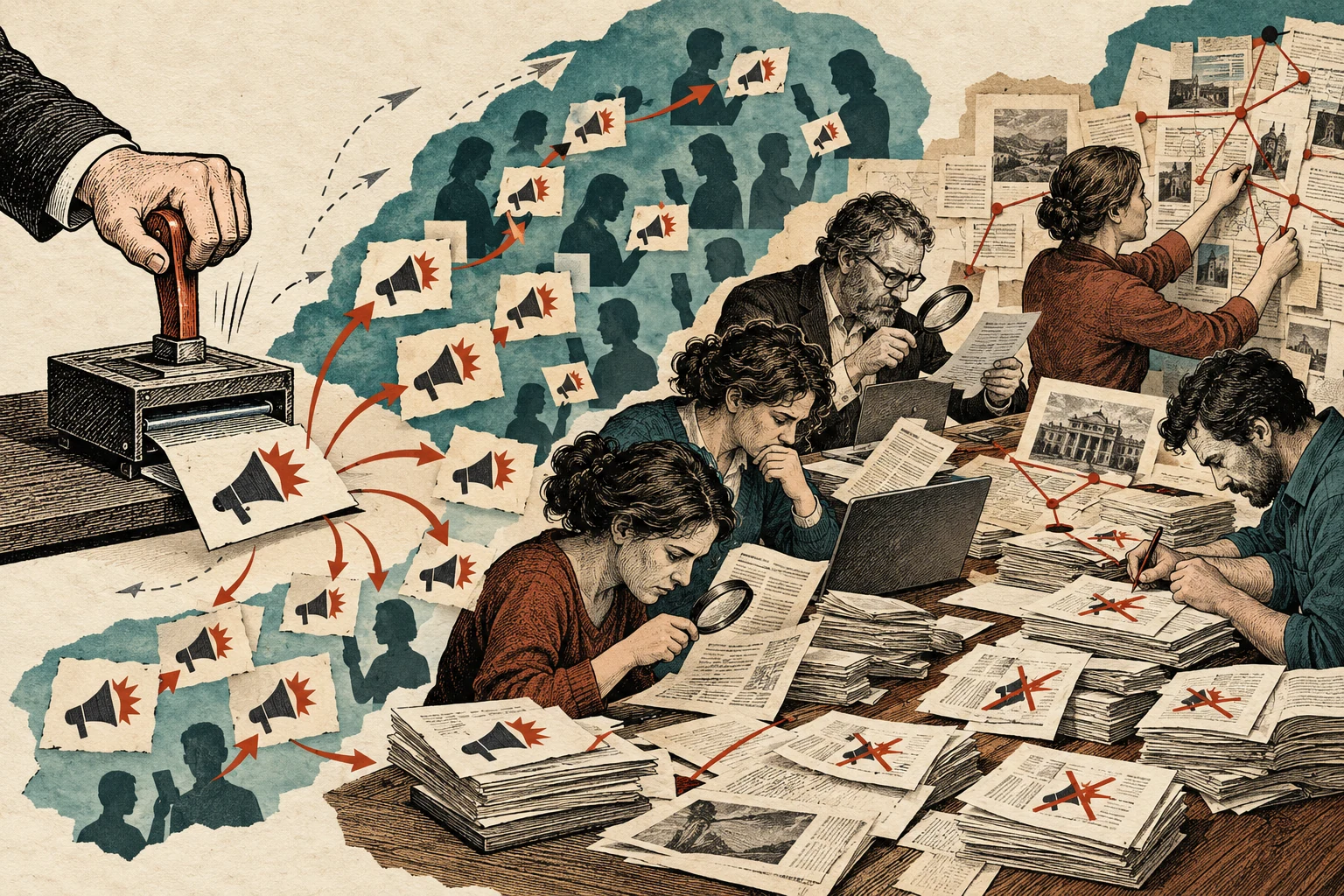
Launching a false claim is easy; tracing sources and correcting its copies takes vastly more work.
AI-assisted illustration · conceptual metaphor View in visual quiz →Genesis and Global Lineage
The formulation comes from Alberto Brandolini, an Italian software developer and consultant who posted his remark about “the bullshit asimmetry” on Twitter on 11 January 2013; according to his later accounts, it was prompted by reading Daniel Kahneman's Thinking, Fast and Slow just before watching a televised clash between former prime minister Silvio Berlusconi and journalist Marco Travaglio. The label “Brandolini's law” spread organically after a photograph of a slide from one of Brandolini's 2014 conference talks went viral. Yet the underlying observation has a three-century prehistory: Jonathan Swift wrote in The Examiner in November 1710 that “Falsehood flies, and Truth comes limping after it”; French economist Frédéric Bastiat complained in Economic Sophisms (1845) that an opponent can state a half-truth in a few words while exposing it requires a long, dry dissertation; and Italian blogger Uriel Fanelli formulated a blunt vernacular version (“La teoria della montagna di merda”) in 2010. The adage entered the scientific literature through environmental scientist Phil Williamson's December 2016 commentary in Nature, which urged researchers to correct public distortions of their findings despite the cost, and through Carl Bergstrom and Jevin West's Calling Bullshit (2020). Born as a programmer's aphorism, it subsequently acquired empirical foundations in cognitive psychology (the continued influence effect of misinformation) and computational social science (measuring false-news cascades), while also being misappropriated in two opposite directions: as an excuse for silence (“never bother replying”) and as a fatalistic dogma that truth is powerless.
Central European Lineage
We found no documented link between this concept and the intellectual history or historical experience of Central Europe.
We found no documented link between this concept and the intellectual history or historical experience of Central Europe (by our methodology, this means “none found,” not “none exists”; as of October 2026).
Why Now
Three shifts between 2018 and 2026 turned Brandolini's aphorism into a core diagnostic tool for the digital public sphere. In March 2018, Soroush Vosoughi, Deb Roy, and Sinan Aral published an analysis in Science of roughly 126,000 rumor cascades on Twitter from 2006 to 2017, showing that false news traveled farther, faster, deeper, and more broadly than the truth, with true stories taking roughly six times as long as false ones to reach 1,500 people—proving that production asymmetry is compounded by distribution asymmetry. In February 2020, the World Health Organization declared an “infodemic” alongside the COVID-19 pandemic, prompting twenty-two cognitive scientists to publish The Debunking Handbook 2020 as a field manual for low-cost, high-impact correction. Then, following the release of ChatGPT in November 2022, generative artificial intelligence drove the marginal cost of producing grammatically polished, citation-stuffed bullshit close to zero while leaving the cost of empirical verification stubbornly human—giving rise to the phenomenon of “AI slop.” Meanwhile, major platforms moved to offload verification costs: in January 2025 Meta ended its third-party fact-checking program in the United States in favor of crowd-sourced Community Notes, shifting the burden of refutation onto unpaid volunteers and independent civil-society fact-checkers worldwide (such as Poland's Demagog, founded in 2014, and TVN24's Konkret24 desk).
Explanatory Power
Brandolini's law reveals disinformation as an asymmetric economic game in which the attacker holds a structural cost advantage, explaining why well-intentioned defensive strategies routinely fail. First, it explains why the rhetorical tactic known as the “Gish gallop” works in live debate: a speaker can rattle off twenty fabricated or half-true claims in sixty seconds, whereas refuting even the first one with sources and context consumes the respondent's entire allotted time—meaning anyone who attempts point-by-point rebuttal loses the moment they accept the format. Second, it explains why professional fact-checking organizations are chronically underfunded and overwhelmed: their output is a classic non-rival public good, and the unit cost of verification rises steeply with the sophistication of the fabrication (for instance, when a real chart is paired with a subtly falsified axis or caption, as analyzed by Bergstrom and West). Third, it predicts why large language models will not automatically level the playing field: it is inherently cheaper to use a probabilistic text generator to invent plausible claims than to verify those claims against primary archival or experimental records. The practical takeaway is strategic: when point-by-point refutation is prohibitively expensive, defense must move upstream—to psychological inoculation (prebunking) and provenance standards—or to platform architecture, rather than funding an endless war of attrition.
Axes of Debate
Cost asymmetry versus the helplessness of truth
Cognitive psychologists (Stephan Lewandowsky, Ullrich Ecker) have documented since 2012 the “continued influence effect,” showing that once misinformation is encoded into a mental model, it continues to shape inferences even after a retracted detail is acknowledged. Media pundits often extrapolate this into the fatalistic claim that fact-checking is useless or even counterproductively entrenches false beliefs, citing Brandolini's law as proof. Strongest counterargument: Large-scale empirical tests by Thomas Wood and Ethan Porter (2019) across more than 10,000 participants and dozens of contested issues found virtually no evidence of a “backfire effect”: factual corrections reliably move average beliefs toward the truth. Brandolini's law describes the price of correction, not its efficacy; “expensive” does not mean “futile.” Nature of the dispute: substantive — it can be settled by measuring belief change and decay curves in controlled experiments rather than trading aphorisms.
Duty to rebut versus “oxygen of amplification”
Scientists such as Phil Williamson in Nature (2016) argue that researchers have a professional obligation to step into the public square and refute distortions of their work, lest silence be read as assent. Media scholars such as Whitney Phillips (The Oxygen of Amplification, 2018) counter that publicly rebutting fringe falsehoods rewards them with algorithmic visibility, prestige, and search-engine reach. Strongest counterargument: Strategic silence works only while a falsehood remains confined to a fringe niche; once a claim crosses a threshold of mainstream visibility, leaving it unanswered allows it to harden into common sense, even if no general formula can specify that tipping point in advance. Nature of the dispute: mixed — both sides appeal to real empirical mechanisms, but the debate also masks institutional conflicts over when experts and journalists should intervene.
Who pays the bill for verification
Major platform operators (X with Community Notes, Meta in 2025) argue that professional fact-checking desks are slow, unscalable, and perceived by partisan users as biased gatekeepers, making crowd-sourced bridging systems superior. Professional fact-checkers and platform-governance scholars reply that dismantling paid verification privatizes advertising profits from viral engagement while socializing the labor of truth-maintenance onto unpaid users. Strongest counterargument: Crowd-sourced notes that require agreement across ideologically diverse raters solve a real trust bottleneck that newsroom labels struggle with; the flaw of Community Notes is not its bridging mechanism, but its low throughput relative to the sheer volume of viral falsehoods. Nature of the dispute: mixed — a technical debate over scaling and trust metrics is entangled with a political struggle over platform liability and budgets.
Underappreciated Angle
Debates over Brandolini's law focus almost exclusively on the sender (how cheap it is to fabricate) and the fact-checker (how expensive it is to rebut), overlooking the third party where most of the energy is actually dissipated: the community in which the falsehood has taken up residence. As the Polish microbiologist and philosopher of science Ludwik Fleck observed in 1935, an established belief system actively defends its harmony: whatever contradicts the prevailing thought style is first unthinkable, then unseen, then kept quiet, and finally reinterpreted through elaborate auxiliary assumptions so that the system survives intact. That collective defensive tissue—not the word count of a fact-check—is what absorbs an order of magnitude more energy. A second neglected angle comes from public economics: a thorough refutation is a textbook public good (non-excludable and non-rival), whereas commercial bullshit is usually tied to a private return (clicks, political mobilization, product sales). Markets systematically underproduce public goods and overproduce unpriced negative externalities. Brandolini's law is therefore ultimately a theorem about the chronic underfunding of a public good, not a law of human gullibility.
One-Sentence Takeaway
Brandolini's law does not say that truth loses to falsehood, only that truth carries high fixed verification costs while bullshit carries none—so the decisive question is never simply whether to rebut, but how to fund and scale the infrastructure of verification.
Related Concepts Network
How this concept reinforces, constrains, or complements other analytical frameworks in the corpus. View on graph →
-
Prebunking complements
Because refuting falsehoods after the fact is costly, it is far cheaper to inoculate audiences against manipulation techniques before they encounter them.
-
Disinformation reinforces
Cost asymmetry is the economic foundation of disinformation campaigns: the sender wins by volume and speed rather than persuasive quality.
-
Motivated reasoning reinforces
On the receiver's side, bullshit that flatters existing priors raises the cognitive effort required to refute it even further.
-
AI slop reinforces
Generative AI drives the marginal cost of producing plausible-sounding nonsense toward zero, while the cost of verification remains stubbornly human.
-
Steelmanning in tension
Reconstructing an interlocutor's claim in its strongest form demands a cognitive investment that Brandolini's law warns us to ration carefully.
-
Hanlon’s razor complements
Bullshit does not require malice; the cost asymmetry between production and refutation holds regardless of the speaker's intentions.
-
Attention economy reinforces
Algorithmic platforms reward cheap novelty over laborious fact-checking, compounding the asymmetry at the stage of distribution.
Reading Canon & Translation Bridge
Foundational texts, introductions, and critical perspectives—with availability of English and Polish editions.
-
foundational text 2016 · English
Phil Williamson, Take the time and effort to correct misinformation
A commentary in Nature (vol. 540, p. 171, 6 December 2016) that brought Brandolini's principle into academic circulation and urged scientists to refute misrepresentations of their research despite the high cost.
In English: original text written in English
In Polish: Polish edition not verified
-
foundational text 1710 · English
Jonathan Swift, The Examiner, nr 15 (2–9 listopada 1710), znany jako „The Art of Political Lying”
The classic early formulation of the asymmetry between falsehood and truth, observing that if a lie be believed only for an hour, it has done its work; numbered 15 in Temple Scott's edition (14 in some others).
In English: original text written in English
In Polish: Polish edition not verified
-
introduction & synthesis 2020 · English
Carl T. Bergstrom, Jevin D. West, Calling Bullshit: The Art of Skepticism in a Data-Driven World
A handbook for spotting quantitative bullshit (misleading charts, big-data hype, selection bias) grown out of a University of Washington course, using Brandolini's law to frame the economics of refutation.
In English: original text written in English
In Polish: “Myśl krytycznie i nie daj sobie wcisnąć kitu”, Wydawnictwo JK (Feeria) 2021, trans. Jarosław Irzykowski
-
introduction & synthesis 2020 · English
Stephan Lewandowsky, John Cook, Ullrich Ecker i in., The Debunking Handbook 2020
A consensus guide by 22 researchers on how to debunk falsehoods efficiently and effectively (fact, warning, fallacy explanation, fact)—a practical response to cost asymmetry; DOI 10.17910/b7.1182.
In English: original text written in English
In Polish: “Podręcznik prostowania mitów 2020”, Skeptical Science (wydanie elektroniczne, partner polski: Nauka o klimacie) 2023, trans. Marcin Popkiewicz, Jacek Pniewski, Aleksandra Kardaś
-
cross-disciplinary 2012 · English
Stephan Lewandowsky, Ullrich K. H. Ecker, Colleen M. Seifert, Norbert Schwarz, John Cook, Misinformation and Its Correction: Continued Influence and Successful Debiasing
A landmark review in Psychological Science in the Public Interest (vol. 13, no. 3, pp. 106–131) analyzing the continued influence effect: the cognitive reason why uprooting a falsehood costs far more than planting it.
In English: original text written in English
In Polish: Polish edition not verified
-
critical perspective 2019 · English
Thomas Wood, Ethan Porter, The Elusive Backfire Effect: Mass Attitudes’ Steadfast Factual Adherence
A study in Political Behavior (vol. 41, pp. 135–163; online 2018) across more than 10,000 subjects showing that factual corrections generally work—proving that “costly” does not mean “futile.”
In English: original text written in English
In Polish: Polish edition not verified
-
cross-disciplinary 2005 · English
Harry G. Frankfurt, On Bullshit
The philosophical definition of bullshit as speech indifferent to truth (1986 essay in Raritan, 2005 book), explaining the root of the asymmetry: a liar must still track the truth to hide it, whereas the bullshitter pays no attention to truth at all.
In English: original text written in English
In Polish: “O wciskaniu kitu”, Czuły Barbarzyńca Press 2008, trans. Hanna Pustuła
-
cross-disciplinary 2018 · English
Soroush Vosoughi, Deb Roy, Sinan Aral, The spread of true and false news online
The Science paper (vol. 359, no. 6380, pp. 1146–1151) measuring Twitter cascades from 2006 to 2017 and showing that falsehoods travel farther, faster, and deeper than truth: distribution asymmetry alongside production asymmetry.
In English: original text written in English
In Polish: Polish edition not verified
Primary-Source Quotes
The bullshit asimmetry: the amount of energy needed to refute bullshit is an order of magnitude bigger than to produce it.
Falsehood flies, and Truth comes limping after it; so that when men come to be undeceived, it is too late.