Horizon & Ecology #176
Amara’s law
original term: Amara's law (Eng.) · prawo Amary, krótko przeceniane, długo niedoceniane
Global-circulation concept — no documented lineage in Central Europe. jump to documentation ↓
Working Definition
Amara’s law states that we tend to overestimate the effect of a technology in the short run and underestimate the effect in the long run. Operationally, forecasts for the first two to five years after a high-profile technological breakthrough are almost always inflated, whereas forecasts for a twenty-to-thirty-year horizon are far too conservative—with the true inflection point arriving only when the technology disappears from headlines and sinks into mundane infrastructure. In casual Silicon Valley usage, the adage often serves as a comforting excuse for disappointed investors (“just wait”); in its rigorous analytical version, it is a proposition about a systematic, non-random forecasting error driven by a concrete institutional mechanism: the decades required to reorganize workflows, legal rules, physical layouts, and human habits around a new general-purpose tool.
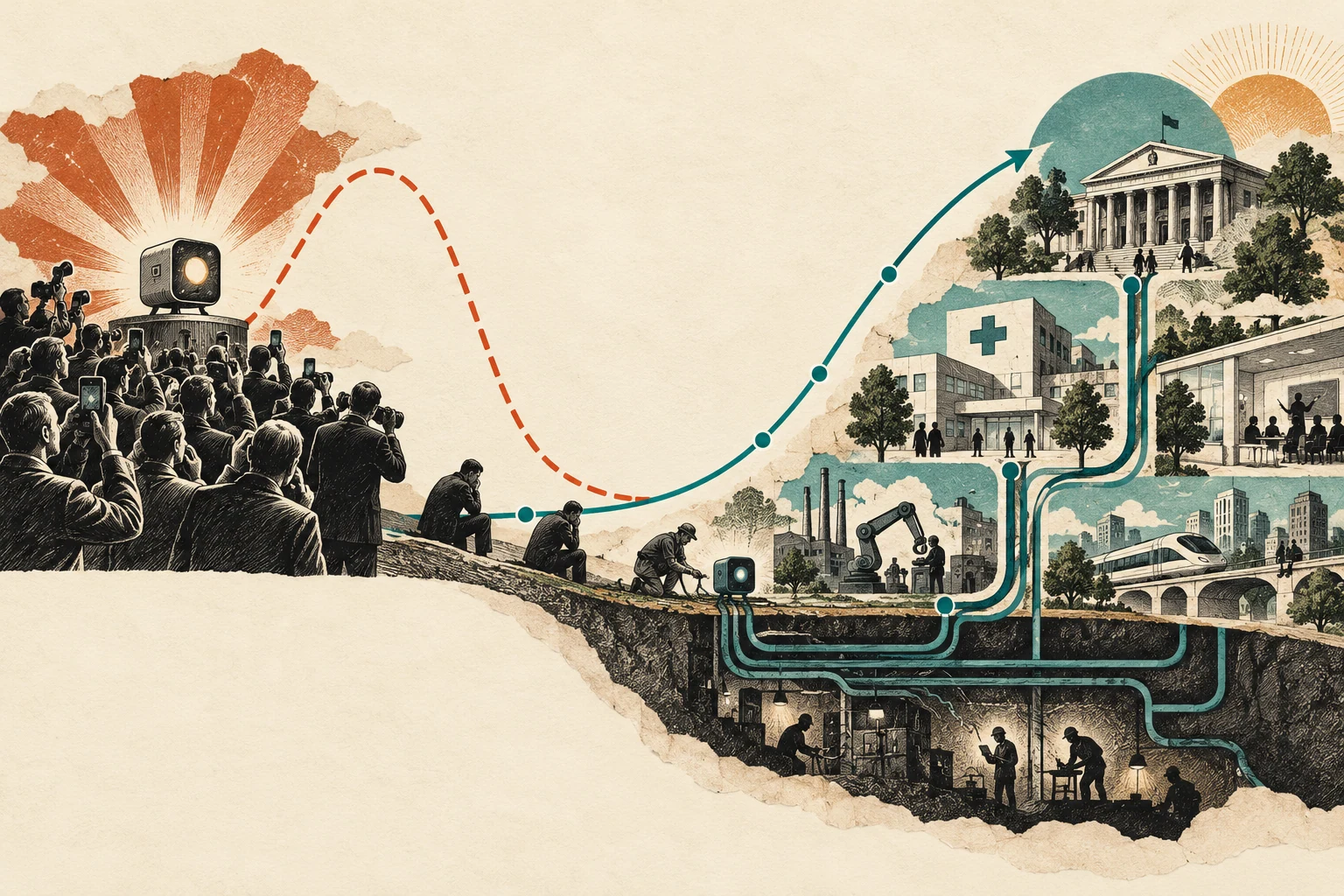
Early expectations outrun initial results while deeper transformation arrives later; this is a practical heuristic rather than an exact law with fixed dates.
AI-assisted illustration · conceptual metaphor View in visual quiz →Genesis and Global Lineage
The maxim is attributed to Roy Amara (1925–2007), an American systems scientist at the Stanford Research Institute who served from 1971 to 1990 as president of the Institute for the Future (IFTF) in Palo Alto, a pioneering long-range forecasting think tank. Although the sentence circulates across technology literature as an oral aphorism from the late 1960s or 1970s, Amara never published a canonical academic paper deriving it; it survived as an insider rule of thumb among futurists before being codified in quotation dictionaries and innovation textbooks. That oral origin matters for its intellectual status: Amara’s law is a practitioner heuristic rather than an econometrically estimated law, yet its core intuition converges with three weighty traditions of economic history—Paul A. David’s study of the forty-year lag between the invention of the electric dynamo and measurable factory productivity gains (1990), Carlota Perez’s neo-Schumpeterian theory of financial installation bubbles and deployment golden ages (2002), and Erik Brynjolfsson’s “Productivity J-Curve” (2018). In 1995, Gartner analyst Jackie Fenn translated a closely related intuition into the commercial Gartner Hype Cycle—plotting a “Peak of Inflated Expectations” followed by a “Trough of Disillusionment” and a “Plateau of Productivity”—capturing Amara’s verbal contrast in a graphical curve Amara himself never drew. In contemporary AI debates, roboticist Rodney Brooks brought Amara’s law to center stage in a 2017 MIT Technology Review essay, using the Global Positioning System (GPS) as his prime exhibit: launched as a military satellite project in 1978 and repeatedly threatened with cancellation in the 1980s, GPS quietly evolved decades later into the invisible backbone of precision agriculture, aviation, ride-hailing, and power-grid synchronization.
Central European Lineage
We found no documented link between this concept and the intellectual history or historical experience of Central Europe.
We found no documented link between this concept and the intellectual history or historical experience of Central Europe (by our methodology, this means “none found,” not “none exists”; as of October 2026).
Why Now
The years between 2018 and 2026 staged a live demonstration of both halves of Amara’s law operating at once. First came the “winter” of autonomous vehicles after 2018: breathless promises that driverless robotaxis would replace human drivers everywhere by 2020 collapsed, Uber and Lyft sold off their self-driving divisions, and yet between 2023 and 2025 Waymo quietly scaled commercial driverless ride-hailing to millions of paid trips across several US cities. Second, following the November 2022 release of ChatGPT, predictions that generative AI would transform white-collar macroeconomic productivity within twelve months collided between 2023 and 2025 with firm-level surveys showing modest, uneven gains bottlenecked by compliance, data plumbing, and organizational inertia—prompting economists to reach directly for Brynjolfsson, Daniel Rock, and Chad Syverson’s Productivity J-Curve, the formal macroeconomic cousin of Amara’s law. Meanwhile, tech markets rode violent boom-and-bust waves in blockchain, Web3, and the metaverse (2021–2022), while an August 2024 analysis by The Economist found that only around one-fifth of technologies tracked on Gartner’s hype curves ever complete the textbook journey from trough to plateau. The concept is indispensable today because analysts must distinguish a general-purpose technology going through its slow organizational digestion from a hyped product that simply does not work.
Explanatory Power
Amara’s law turns time from a passive calendar backdrop into an explanatory variable of technological change. First, it resolves Robert Solow’s famous 1987 productivity paradox (“you can see the computer age everywhere but in the productivity statistics”): as Paul David showed by comparing the computer to the late-nineteenth-century electric motor, early adopters simply bolted electric motors onto existing steam-age overhead drive shafts; productivity surged only a generation later, when factories were rebuilt from the ground up as single-story horizontal assembly lines with unit drive. Second, it explains why venture capital and media attention routinely abandon a field at the exact moment it begins to mature: the financial attention cycle lasts three to five years, whereas the institutional adoption cycle of a general-purpose technology lasts twenty to forty. Third, it clarifies why bitter disputes over artificial intelligence often talk past each other: the worker who says “AI hasn’t changed my daily job at all” and the researcher who says “AI will reorganize the entire division of labor” can both be right if one is looking at year three and the other at year twenty-five. As an analytical tool, the law instructs us to ask one concrete question whenever a shiny new tool stalls: which complementary investments—retraining, liability law, industry standards, organizational redesign—have not yet been paid for?
Axes of Debate
Empirical law versus unfalsifiable truism
Innovation scholars and forecasting methodologists (such as Ozgur Dedehayir and Martin Steinert in their 2016 review of hype-cycle models) point out that Amara’s law specifies neither the duration of the “short” and “long” runs nor an objective metric of “effect,” making it immune to refutation ex post: if a technology flops, we are told we are still in the short run; if it succeeds, we are told the long run has arrived. Strongest counterargument: Economic historians reply that for general-purpose technologies (steam, electricity, the internal combustion engine, computers), the lag between technical invention and aggregate total-factor-productivity impact is empirically measurable and remarkably consistent at three to four decades, with Brynjolfsson’s intangible-capital J-curve providing a falsifiable accounting mechanism. Nature of the dispute: substantive — it concerns whether a qualitative folk theorem can be specified with enough parameter discipline to generate testable ex-ante predictions.
Survivorship bias: remembering GPS, forgetting dirigibles
Critics of techno-optimism emphasize that textbook illustrations of Amara’s law are cherry-picked from technologies that eventually triumphed (the internet after the 2000 dot-com crash, GPS, solar photovoltaics); for hundreds of hyped inventions that entered the trough of disillusionment and never came out—consumer 3D printing in every kitchen, the Segway, Google Glass, supersonic civilian airliners—the second half of the law was simply false. Strongest counterargument: Defenders of the heuristic reply that Amara’s law is a conditional statement about transformative technologies rather than a guarantee that every startup pitch will succeed; indeed, Rodney Brooks invoked Amara in 2017 primarily to deflate near-term AI hype, not to pump it. Nature of the dispute: mixed — the charge of survivorship bias is devastating against venture-capital pitches that use Amara as an excuse for failure, but misses the mark when the concept is restricted to verified general-purpose technologies.
Analytical diagnostic versus commercial sales funnel
Critics of the management-consulting industry note that the Gartner Hype Cycle—the form in which most executives encounter Amara’s intuition—is a proprietary commercial product published without underlying empirical series, designed to keep corporate IT buyers on an endless treadmill of consulting engagements. Strongest counterargument: Whatever the flaws of Gartner’s trademarked curve, Roy Amara formulated his principle inside a non-commercial research institute to warn decision-makers against both errors: buying into premature mania at the outset and falling asleep at the wheel once the headlines fade. Nature of the dispute: rhetorical — a dispute over commercial appropriation rather than the validity of the underlying temporal lag.
Underappreciated Angle
The most important asymmetry in Amara’s law is not temporal, but institutional: the two errors are paid for by completely different groups of people. Overestimating a technology in the short run costs venture capitalists their equity and tech journalists their embarrassment—a private error that financial markets punish and clear within a few quarters. Underestimating a technology in the long run costs public institutions—schools, labor law, antitrust regulators, urban planners, national-security agencies—that went back to sleep as soon as the initial hype bubble popped and woke up fifteen years later to find an entrenched infrastructure too big to govern. That asymmetry yields a counterintuitive rule for public policy: the single best window to regulate a transformative technology is when it looks like a boring disappointment in the trough of disillusionment, because that is the only moment when its real-world architecture is already visible and its political lobby is not yet invincible. Equally overlooked is that Amara’s law is value-neutral: the long-run effects we underestimate are just as often corrosive as beneficial—in 2009, social media was widely dismissed as a trivial fad for teenagers sharing lunch photos, right before its second decade rewired democratic politics and adolescent mental health.
One-Sentence Takeaway
A new technology becomes structurally consequential at the exact moment it stops being exciting in the news—which is why the year everyone gets bored of talking about it is usually the last chance society has to shape it on its own terms.
Related Concepts Network
How this concept reinforces, constrains, or complements other analytical frameworks in the corpus. View on graph →
-
Jevons paradox complements
Both concepts describe long-run effects of technology that remain invisible in the first decade: Amara addresses aggregate scale, while Jevons addresses a counterintuitive reversal of direction.
-
Scaling laws in tension
Empirical scaling laws in language models promise smooth, predictable capability gains, whereas Amara's law warns that short-term societal impact forecasts systematically overshoot.
-
Technological solutionism constrains
Amara's law cools solutionist promises of rapid fixes to complex social problems, while simultaneously warning us to take their delayed, unscripted structural consequences seriously.
-
Artificial general intelligence (AGI) complements
The debate over AGI timelines is a textbook arena in which skeptics invoke the short-term half of Amara's law while proponents invoke the long-term half.
-
Lindy effect complements
The Lindy effect asks which technologies will survive; Amara's law asks how long it takes before a surviving technology actually reshapes the world.
-
Existential risk reinforces
If the long-term impacts of general-purpose technologies are systematically underestimated, then so are the tail risks that emerge only after full societal deployment.
Reading Canon & Translation Bridge
Foundational texts, introductions, and critical perspectives—with availability of English and Polish editions.
-
foundational text 2017 · English
Rodney Brooks, The Seven Deadly Sins of AI Predictions
The essay in “MIT Technology Review” (October 6, 2017) that popularized Amara's law inside contemporary AI debates and illustrated it with the history of GPS; in the absence of a primary paper by Amara himself, it serves as the standard secondary reference.
In English: original text written in English
In Polish: Polish edition not verified
-
foundational text 1990 · English
Paul A. David, The Dynamo and the Computer: An Historical Perspective on the Modern Productivity Paradox
An article in the “American Economic Review” (Papers and Proceedings, vol. 80, no. 2) explaining why factory electrification took forty years to show up in aggregate productivity statistics—the economic-history foundation for the long-run half of Amara's law.
In English: original text written in English
In Polish: Polish edition not verified
-
cross-disciplinary 2018 · English
Erik Brynjolfsson, Daniel Rock, Chad Syverson, The Productivity J-Curve: How Intangibles Complement General Purpose Technologies
NBER Working Paper 25148 (published in “American Economic Journal: Macroeconomics”, 2021) supplying an economic mechanism for Amara's law: heavy upfront investment in unmeasured intangible complements depresses measured productivity early on and magnifies it decades later.
In English: original text written in English
In Polish: no Polish edition
-
introduction & synthesis 2008 · English
Jackie Fenn, Mark Raskino, Mastering the Hype Cycle: How to Choose the Right Innovation at the Right Time
Written by the creator of the Gartner Hype Cycle (1995), showing how a management consultancy turned Amara's intuition into a commercial visual tool and what extra assumptions it added.
In English: original text written in English
In Polish: Polish edition not verified
-
critical perspective 2016 · English
Ozgur Dedehayir, Martin Steinert, The hype cycle model: A review and future directions
A critical review in “Technological Forecasting and Social Change” surveying empirical tests of the hype cycle and showing how rarely real technologies follow its neat five-stage curve.
In English: original text written in English
In Polish: no Polish edition
-
cross-disciplinary 2002 · English
Carlota Perez, Technological Revolutions and Financial Capital: The Dynamics of Bubbles and Golden Ages
A neo-Schumpeterian model of technological revolutions: an “installation period” driven by financial bubbles followed by a “deployment period” of broad institutional transformation—Amara's law scaled up to half-century waves.
In English: original text written in English
In Polish: Polish edition not verified
-
critical perspective 1987 · English
Robert M. Solow, We'd Better Watch Out
The “New York Times Book Review” piece (July 12, 1987, p. 36) containing the famous remark that “you can see the computer age everywhere but in the productivity statistics”—the sharpest statement of the puzzle Amara's law seeks to explain.
In English: original text written in English
In Polish: no Polish edition
Primary-Source Quotes
Today GPS is in what Amara would call the long term, and the ways it is used were unimagined at first.