Systems & Complexity #050
Metacrisis
original term: metacrisis (Eng.) · meta-kryzys, meta-crisis, kryzys sensu
Central European lineage: 1 thread (anticipation) · 1936–2021 · jump to documentation ↓
Working Definition
The metacrisis is the thesis that our ecological, economic, geopolitical, and epistemic crises are not separate sectoral problems, but symptoms of a single deeper condition: the flawed ways in which modern civilization makes sense of the world, assigns value, and coordinates action. In its game-theoretic version, developed by Daniel Schmachtenberger and the Consilience Project, this underlying layer is analyzed through the “generator functions” of existential risk: multipolar arms races, the externalization of costs onto the commons, and exponential technology coupled to rivalrous incentives. In the philosophical version articulated by Jonathan Rowson, it is a crisis in how we understand our own understanding: we fail to see how we see, and therefore cannot change what our institutions produce. Colloquially, the word is often conflated with “everything falling apart at once”—which is properly a polycrisis, not a metacrisis.
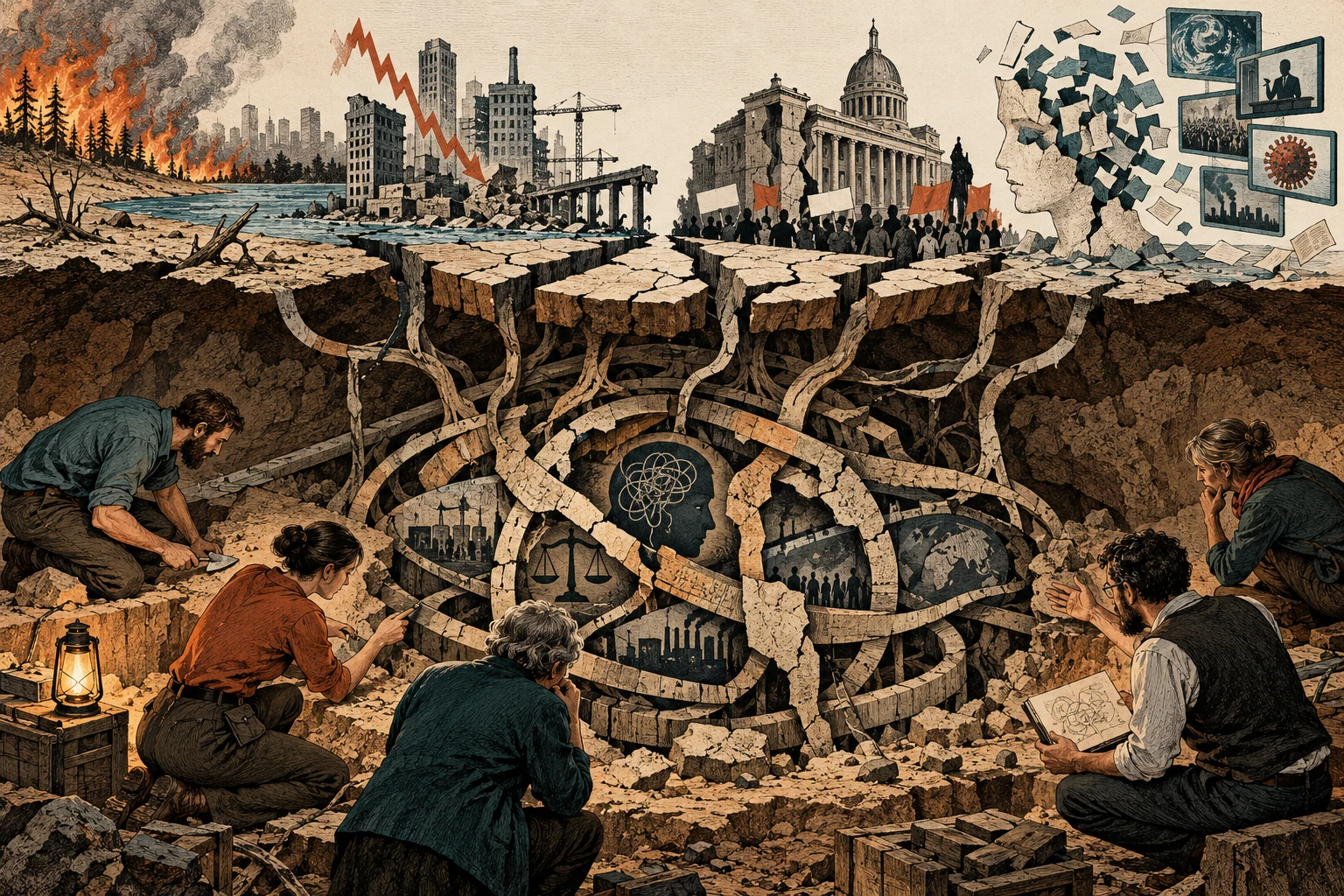
Beneath distinct crises, inquiry looks for shared mechanisms of generation and failed response—an interpretive frame rather than a single settled theory of everything.
AI-assisted illustration · conceptual metaphor View in visual quiz →Genesis and Global Lineage
Unlike most academic concepts, the metacrisis has no single founding monograph. It crystallized after 2015 across an anglophone ecosystem of podcasts, salons, and think tanks bridging complexity science, cognitive science, and contemplative philosophy: Daniel Schmachtenberger popularized it in long-form dialogues (such as “The Metacrisis: Making Sense in a Nonsensical World”), Zachary Stein in essays on education “in a time between worlds” (2019), and John Vervaeke through his cognitive-science lecture series Awakening from the Meaning Crisis (2019). The first systematic written stocktaking came in Jonathan Rowson’s essay Tasting the Pickle: Ten flavours of meta-crisis (published by the London-based Perspectiva institute in February 2021), which candidly acknowledged the term’s conceptual sprawl and organized it into ten distinct “flavours,” while noting an earlier precursor in the “meta-problems” of the Club of Rome’s 1970 prospectus. The concept thus emerged largely as a dissatisfied neighbour to the older term polycrisis (coined by Edgar Morin in 1993 and popularized by Jean-Claude Juncker and Adam Tooze). In popular online culture, it has been partially co-opted by metamodernist and “integral” subcultures, lending it at times a quasi-spiritual aura.
Central European Lineage
While there is no documented influence on the contemporary anglophone coiners, Central Europe produced a striking interwar anticipation of the core idea. Born in Moravian Prostějov (then Proßnitz in Habsburg Moravia, now Czechia) and philosophically formed at the University of Vienna under Franz Brentano (1884–1886), Edmund Husserl delivered two famous lecture series in Vienna and Prague in 1935—published in part in 1936 as Die Krisis der europäischen Wissenschaften und die transzendentale Phänomenologie (The Crisis of European Sciences). Husserl argued that the crisis of modern European science lay not in any failure of its technical or predictive power, but in the loss of its meaning for human existence: Galileo’s mathematical idealization of nature had been mistaken for reality itself, while the pre-scientific lifeworld (Lebenswelt) in which all human meaning and valuation are grounded was dismissed as merely subjective. Delivered in Vienna and Prague because Husserl, as a scholar of Jewish descent, had already been barred from teaching and publishing in Nazi Germany, his diagnosis anticipates what Rowson in 2021 called “our inability to see how we see”: a crisis located not in technical outputs, but in the epistemic frame that generates them. Rowson does not cite Husserl; the parallel stands as an undocumented anticipation.
Documented regional lineage · Link: 1. Compiled: October 2026.
-
anticipation 85 years
Central European Source: Edmund Husserl, “Die Krisis der europäischen Wissenschaften und die transzendentale Phänomenologie (Vienna and Prague lectures 1935; Parts I–II published 1936)”; Vienna, Austria; Prague, Czechoslovakia (now Czechia), 1936
Global Circulation: metacrisis as a crisis in how we understand our own understanding (meta-crisis) — Jonathan Rowson, 2021
anticipation
85 yearsEdmund Husserl, “Die Krisis der europäischen Wissenschaften und die transzendentale Phänomenologie (Vienna and Prague lectures 1935; Parts I–II published 1936)”
1936 · Vienna, Austria; Prague, Czechoslovakia (now Czechia)
metacrisis as a crisis in how we understand our own understanding (meta-crisis)
2021 · Jonathan Rowson
- Claim & Connection
- Husserl—born in Moravian Prostějov and philosophically formed in Vienna at Franz Brentano’s lectures (1884–1886)—argued in his 1935 lectures in Vienna and Prague that the crisis of European sciences is not a crisis of their technical results, but the loss of their meaning for human life: the Galilean mathematization of nature was mistaken for reality itself, while the lifeworld (Lebenswelt) was devalued. This is an earlier formulation of an insight close to the core of the metacrisis concept—a crisis in the very way a civilization understands and values—without documented influence on Rowson or Schmachtenberger.
- Source Documentation
-
- biographical record Christian Beyer, „Edmund Husserl”, Stanford Encyclopedia of Philosophy; Section 1 (Life and Work): Prostějov 1859, Vienna 1881–1883 and 1884–1886 (Brentano’s lectures 1884–1886); genesis of the “Krisis” from the 1935 Vienna and Prague lectures; thesis on the alienation of science from lived experience. plato.stanford.edu ↗
- reception / translation Jonathan Rowson, „Tasting the Pickle: Ten flavours of meta-crisis and the appetite for a new civilisation”, Perspectiva, 9 lutego 2021; introduction: “inability to see how we see”; section on the epistemic crisis. systems-souls-society.com ↗
- Historical Context
- Rowson does not cite Husserl in the inspected essay (verified 2026-10: name absent from the text); the structural parallel is our analytical comparison. SEP confirms: Prostějov 1859, Brentano’s lectures 1884–1886, Vienna and Prague lectures 1935, first printing of Parts I–II in the Belgrade journal “Philosophia” in 1936, full edition in Husserliana VI (1954). The year 1936 refers to initial publication, 1935 to the lectures.
Why Now
The concept gained traction when issue-by-issue policy fixes began visibly cannibalizing one another. After 2022 brought simultaneous war in Europe, an energy shock, inflation, and renewed nuclear brinkmanship—popularizing “polycrisis” in the Financial Times and at Davos in 2023—analysts at the Cascade Institute (Homer-Dixon, Lawrence, Janzwood, 2024) began formally mapping causal couplings between crises. The metacrisis framework stepped in to address the question that polycrisis leaves open: why do those couplings keep tightening in the same direction? The decisive catalyst since late 2022 has been the rapid scaling of large language models and generative AI. In essays and briefings such as Development in Progress (July 2024), Schmachtenberger and the Consilience Project argue that frontier AI acts as a universal accelerant of the existing generator functions—supercharging multipolar corporate and military races, polluting the epistemic commons, and outpacing institutional wisdom—rather than serving as a neutral tool that can simply be pointed at climate or governance problems.
Explanatory Power
The metacrisis frame explains why well-intentioned sectoral solutions routinely displace problems onto adjacent domains instead of resolving them. First, a green energy transition that replaces coal and oil with lithium, cobalt, and deep-sea mining without altering the underlying logic of rivalrous growth and cost externalization reproduces ecological overshoot on a different set of minerals. Second, social-media regulation focused narrowly on moderating individual posts leaves intact the attention-auction business model that rewards outrage, guaranteeing that new rules merely trigger new forms of engagement hacking. Third, the race among AI laboratories—in which executives openly admit to existential safety concerns yet accelerate deployment because slowing down unilateral means ceding the market to rivals—is a textbook multipolar trap: the framework explains why open letters calling for pauses are simultaneously rational and ineffective. In each case, the concept shifts the question from “how do we fix symptom X?” to “what generator rule keeps producing X, Y, and Z?”
Axes of Debate
Deep root versus measurable entanglement: metacrisis versus polycrisis
Adam Tooze and researchers at the Cascade Institute and the Potsdam Institute defend polycrisis as an empirically disciplined framework: multiple heterogeneous stresses with no single master cause, whose interactions can be traced and modeled. To them, “metacrisis” looks like a relapse into unfalsifiable monocausal grand theory. Strongest counterargument: Without a hypothesis about shared underlying drivers, polycrisis risks becoming a descriptive catalog of correlations rather than an explanatory theory; Schmachtenberger replies that generator functions (such as multipolar incentive structures and balance-sheet externalization) are empirically observable institutional mechanisms, not mystical essences. Nature of the dispute: substantive — a methodological disagreement over whether diagnosing a civilizational predicament requires a falsifiable causal model or a broader heuristic frame.
Crisis of meaning versus political economy
Materialist critics on the left (in the tradition of Mark Fisher’s Capitalist Realism, 2009) dismiss talk of a “meaning crisis,” “epistemic blindness,” and “spiritual bypass” as philosophical idealism: our inability to coordinate or imagine alternatives stems from concrete relations of capital accumulation, property, and class power, not from how “we” see the world. Strongest counterargument: Proponents of the metacrisis frame reply that twentieth-century state-socialist revolutions abolished private capital yet reproduced the exact same multipolar military races, bureaucratic Goodharting, and ecological devastation (from the Aral Sea to Chernobyl)—proving that the generator functions lie deeper than capitalist property relations alone. Nature of the dispute: mixed — a substantive disagreement over historical causation is entangled with mutual distaste for the other camp’s vocabulary.
Analytical diagnosis versus countercultural subculture
Sympathetic insiders, including Rowson and Stein themselves, warn that “going meta” easily degenerates into an intellectualized flight from concrete political action, turning the metacrisis milieu into a self-referential subculture of podcasts, retreats, and metamodernist jargon. Strongest counterargument: Every major diagnostic frame—from the Enlightenment and Marxism to political ecology—began inside a distinctive intellectual milieu with its own idiom; sociological critique of the messengers does not refute the structural argument about multipolar traps. Nature of the dispute: rhetorical — it concerns the sociology and credibility of the speakers rather than the validity of the diagnosis.
Underappreciated Angle
The least examined problem in the metacrisis literature is the epistemic status of the diagnosis itself. If the metacrisis consists in “our inability to see how we see,” then any theory of the metacrisis is itself a product of that very way of seeing—and owes an account of how it escapes the blindness it diagnoses. Husserl offered a rigorous methodological answer (the phenomenological epoché and transcendental reduction); the contemporary metacrisis milieu tends to answer instead with contemplative practices, “collective wisdom,” or systems diagrams, operating in a very different register. This points to an unfulfilled research program: instead of proliferating taxonomies of “ten flavours,” the framework needs empirical tests that distinguish a true generator function from a downstream symptom. Viewed this way, the most productive use of “metacrisis” is not as a rival to “polycrisis,” but as its hypothesis-generating layer—proposing testable claims about which cross-system couplings must keep intensifying if the thesis of a shared institutional root is correct.
One-Sentence Takeaway
The metacrisis is the wager that our proliferating crises share a common institutional and epistemic root—and the hardest question it raises is whether that root can be repaired using the very tools and incentives that produced it.
Related Concepts Network
How this concept reinforces, constrains, or complements other analytical frameworks in the corpus. View on graph →
-
Polycrisis complements
Polycrisis maps the entanglement of crises across multiple macro-systems; metacrisis asks about the shared root of that entanglement in our modes of sensemaking, valuation, and coordination.
-
Sensemaking reinforces
If the crisis lies in our capacity to understand, then repairing collective sensemaking becomes a precondition for addressing any sectoral crisis.
-
Moloch and coordination failure reinforces
Multipolar traps in which every rational actor worsens the collective outcome are treated by Schmachtenberger as one of the core “generator functions” of the metacrisis.
-
Existential risk in tension
Existential risk researchers calculate probabilities for discrete catastrophic scenarios; metacrisis shifts focus to the underlying cultural and institutional conditions that generate those risks, at some cost to measurability.
-
Planetary boundaries complements
In the metacrisis frame, breached planetary boundaries are symptoms rather than root causes: the material consequence of an extraction-and-growth logic that the framework seeks to name.
-
Complexity science constrains
Complexity models test cross-crisis couplings empirically and thereby mark the boundary where metacrisis stops being a testable hypothesis and becomes sweeping rhetoric.
-
Technological solutionism in tension
Metacrisis posits that the incentives and mindset producing the crisis cannot solve it through another technical fix, directly challenging solutionist faith in the next technology.
Reading Canon & Translation Bridge
Foundational texts, introductions, and critical perspectives—with availability of English and Polish editions.
-
foundational text 2021 · English
Jonathan Rowson, Tasting the Pickle: Ten flavours of meta-crisis and the appetite for a new civilisation
The fullest attempt to systematize the concept: ten distinct “flavours” of meta-crisis from political economy to spirituality, with a candid admission that the term is often used too loosely.
In English: original text written in English
In Polish: Polish edition not verified
-
foundational text 2021 · English
Jonathan Rowson, Layman Pascal (red.), Dispatches from a Time Between Worlds: Crisis and emergence in metamodernity
An anthology from the Perspectiva circle (Rowson, Stein, Vervaeke, Freinacht, Andersen) in which the metacrisis serves as a shared frame rather than a single doctrine, illustrating both the breadth and unevenness of the milieu.
In English: original text written in English
In Polish: Polish edition not verified
-
introduction & synthesis 2019 · English
Zachary Stein, Education in a Time Between Worlds: Essays on the Future of Schools, Technology, and Society
Essays on education as the arena where the metacrisis is most acutely felt and most actionable; the source of the widely used figure of “a time between worlds.”
In English: original text written in English
In Polish: Polish edition not verified
-
introduction & synthesis 2017 · English
John Vervaeke, Christopher Mastropietro, Filip Miscevic, Zombies in Western Culture: A Twenty-First Century Crisis
A cognitive-science account of the “meaning crisis” that the metacrisis milieu absorbed almost wholesale, reading the cultural figure of the zombie as a symptom of lost existential orientation.
In English: original text written in English
In Polish: Polish edition not verified
-
critical perspective 2022 · English
Adam Tooze, Chartbook #165: Polycrisis — thinking on the tightrope
An economic historian defends “polycrisis” as a pluralist framework without a single master root, showing what is lost when analysts insist on reducing disparate shocks to one underlying meta-cause.
In English: original text written in English
In Polish: Polish edition not verified
-
cross-disciplinary 2024 · English
Michael Lawrence, Thomas Homer-Dixon, Scott Janzwood, Johan Rockström, Ortwin Renn, Jonathan F. Donges, Global polycrisis: the causal mechanisms of crisis entanglement
The “Global Sustainability” article defining polycrisis through empirical causal mechanisms of entanglement—a measurable counterpoint to the philosophical frame of the metacrisis.
In English: original text written in English
In Polish: Polish edition not verified
-
cross-disciplinary 1936 · German
Edmund Husserl, Die Krisis der europäischen Wissenschaften und die transzendentale Phänomenologie
The classic phenomenological diagnosis of modern crisis as the alienation of mathematical science from the human lifeworld; a benchmark for testing how much of the contemporary concept is genuinely new.
In English: English edition not verified
In Polish: Polish edition not verified
-
critical perspective 2009 · English
Mark Fisher, Capitalist Realism: Is There No Alternative?
A diagnosis of our inability to imagine a systemic alternative that explains the same paralysis without invoking “meta-levels” or spirituality: through political economy.
In English: original text written in English
In Polish: Polish edition not verified
Primary-Source Quotes
the meta-crisis refers to our inability to see how we see, our apparent incapacity to understand how we understand